
State pays, corporation cashes in: Why BioNTech is now closing its German plants – 1,860 jobs lost, billions for shareholders
Xpert Pre-Release

Available in 27 languages 📢
Prefer Xpert.Digital on GoogleⓘPublished on: May 18, 2026 / Updated on: May 18, 2026 – Author: Konrad Wolfenstein
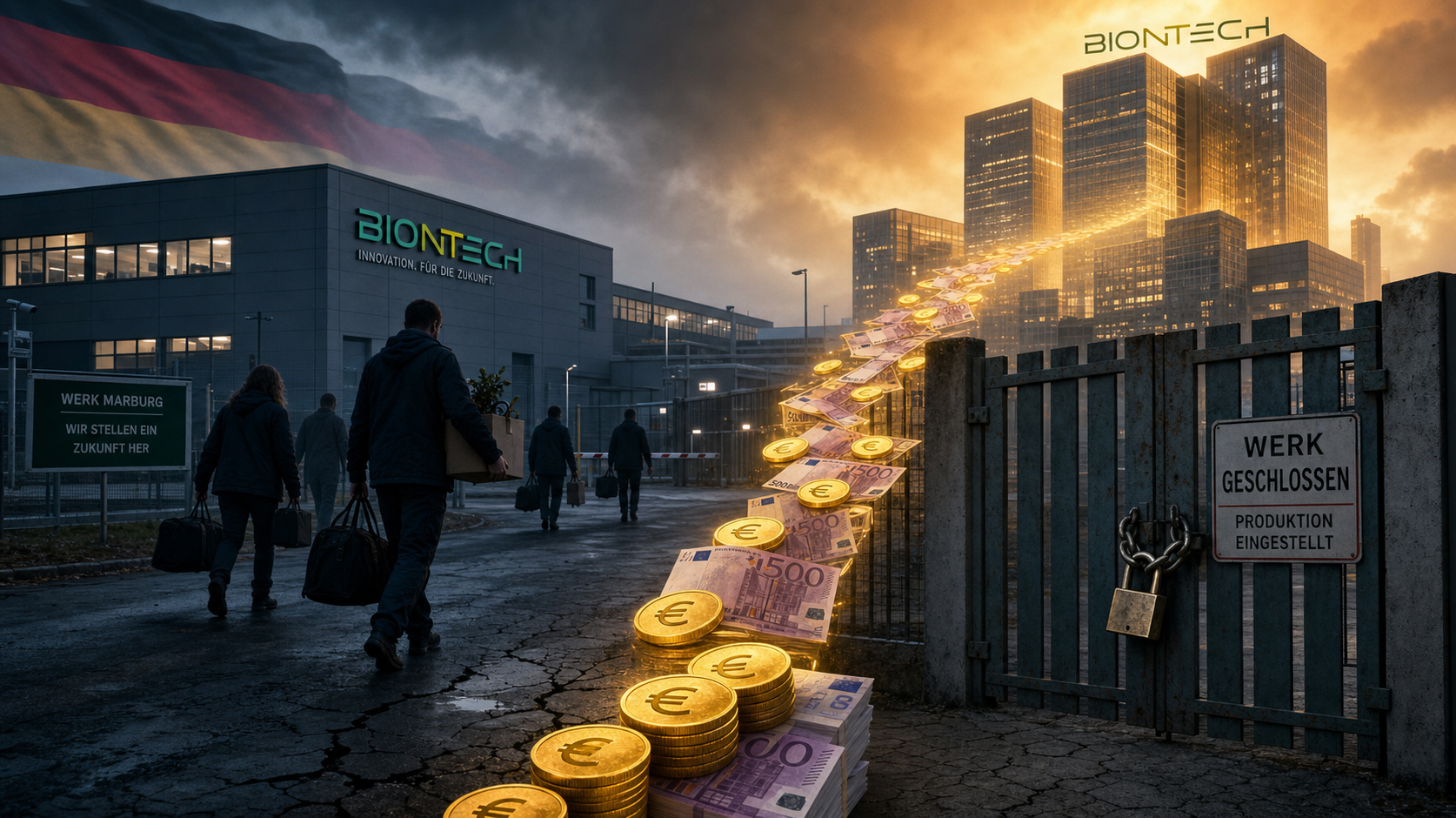
State pays, corporation cashes in: Why BioNTech is now closing its German plants – 1,860 jobs lost, billions for shareholders – Creative image: Xpert.Digital
Founders leave, factories close: The bitter downfall of the German vaccine hero – What remains of the German BioNTech fairytale
"Tricks" in the CureVac takeover? How BioNTech is liquidating the German biotech hopeful – The hard calculation behind the BioNTech restructuring
Taxpayer billions for nothing? What remains of the German BioNTech fairy tale?
The Mainz-based biotechnology company BioNTech was considered the shining example of German innovation during the coronavirus pandemic. Supported by hundreds of millions of euros in state funding from the federal budget, its mRNA vaccine saved millions of lives and brought the company and the local communities where it operated unprecedented profits in the billions. But just a few years after this celebratedsegen a bitter awakening has arrived: BioNTech has announced the closure of its German production sites, cut almost 1,900 jobs, and liquidated its former competitor CureVac. At the same time, billions are being poured into share buyback programs for its own shareholders. This article examines the rapid rise and drastic restructuring of the pharmaceutical giant. It shows why the BioNTech case could go down in history as a cautionary tale about the structural failures of German industrial policy – and what happens when the state bears entrepreneurial risks while profits are privatized.
How Germany invested billions in a success story – and ended up empty-handed
The model of state risk assumption – and who ultimately benefits
In the fall of 2020, the world was gripped by a global pandemic, and governments around the globe did what is typical in times of crisis: they dipped deep into public coffers. The German Federal Ministry of Education and Research (BMBF) pledged up to €375 million in funding to the Mainz-based biotechnology company BioNTech, as part of a larger program of up to €750 million for three German biotech firms. The money came from the specially established COVID-19 program and was intended to finance both the accelerated development of vaccines and the expansion of production capacities in Germany. Around €327 million of this was disbursed in 2020 alone. The rationale was compelling: Germany was investing in its future in the life sciences, securing jobs, strengthening its position as a business location, and in return receiving production capacities that would be readily available in the next crisis.
The story that has unfolded since then casts considerable doubt on this logic. For almost six years after receiving initial government funding, BioNTech has announced the complete closure of its German production sites. Anyone wishing to analyze the relationship between public investment and private benefit will find here a textbook example of modern industrial policy – with all its contradictions, promises, and disappointments.
The rise: Profits on an unprecedented scale
To understand the scope of current developments, one must consider the pandemic phase in figures. In 2021, BioNTech achieved sales of nearly €19 billion and a net profit of €10.3 billion – a figure that catapulted the company from a highly specialized research firm to one of Europe's most valuable pharmaceutical companies within just a few months. The spectacle repeated itself in 2022: revenues of €17.3 billion and a net profit of €9.4 billion. Before the pandemic began, in 2020, BioNTech had reported a profit of only €15.2 million.
These profits weren't generated in a vacuum. The government subsidies were part of a complex situation that also included advance payments from governments for vaccines that hadn't yet been approved, as well as the entire apparatus of state procurement systems. Marburg's mayor, Thomas Spies, succinctly summarized the core problem when he stated that the only profit the company had made so far had ultimately been financed by taxpayers' money. This statement may be politically charged, but it hits a structural nerve: The combination of government subsidies for development, government-guaranteed purchase volumes, and the company's complete withdrawal from the subsidized production facilities calls into question the fundamental principles of government industrial support.
The tax revenue that BioNTech generated for municipalities was also impressive. Mainz recorded almost €3.3 billion in trade tax revenue in 2021 and 2022. Marburg expected around €570 million in additional trade tax from advance payments for 2021 and 2022 alone. Thanks to BioNTech taxes, Idar-Oberstein posted an annual surplus of around €100 million. The federal government, the states, and the municipalities received substantial tax revenue back from this company – this is the counterpart that some critics prefer to ignore. Nevertheless, the question remains whether the ratio between the risks borne and the profits retained by the company is justifiable in a democratic society.
The crash: From a billion-dollar business to a loss-making balance sheet
The turnaround came faster than many observers had expected. After the acute phase of the pandemic ended, demand for Covid-19 vaccines plummeted. BioNTech expects revenues of between €2.0 and €2.3 billion for 2026 – a fraction of the peak pandemic figures. In the first quarter of 2026, sales fell to €118.1 million, down from €182.8 million in the same period of the previous year, and the net loss amounted to approximately €532 million. Research and development costs for the current year are estimated at €2.2 to €2.5 billion, significantly exceeding expected revenues. BioNTech is currently burning through capital while working on its cancer therapy pipeline – a classic transformation phase, not uncommon in the pharmaceutical industry.
From a business perspective, the logic behind BioNTech's current decisions is not irrational. Overcapacity in Covid vaccine production coupled with declining demand presents an economic problem that must be addressed. The company estimates the targeted annual savings from the shutdown measures at around €500 million starting in 2029. Production capacity will be transferred to its US partner Pfizer, which will handle Covid vaccine manufacturing at its European and American sites. For BioNTech itself, which holds a total of €16.8 billion in liquid assets and securities, this is a strategically sound move.
What complicates the equation from a public perspective, however, is the timing and geometry of these decisions. The pandemic preparedness contract, which obligated BioNTech to supply vaccines to Germany, expires in the first quarter of 2027. The German plants are scheduled to close precisely within this timeframe. German taxpayers have thus financed production capacities that will exist exactly as long as the minimum contractual obligations require – and not a day longer. Whether this aligned with the intentions of the original funding program is certainly open to question.
The locations: Marburg, Idar-Oberstein, Tübingen – a lament
The concrete effects of the company's decision will impact three German states simultaneously. In Marburg, where BioNTech built one of Europe's most important mRNA vaccine producers during the pandemic, around 540 full-time jobs will be lost. Operations are to cease this year, followed by downsizing. Significant job cuts are also expected in Idar-Oberstein in Rhineland-Palatinate. At the Tübingen site in Baden-Württemberg, CureVac's former headquarters, the end is nigh for around 820 former CureVac employees. A site in Singapore is also affected. In total, up to 1,860 jobs are to be lost – a figure that speaks for itself.
Marburg had received substantial business tax revenue from BioNTech's activities during the pandemic boom and even invested €350 million of it in a dedicated special fund. The city had prepared for the company's long-term presence. Mayor Thomas Spies criticized the announcement with unusual sharpness for a local politician: the company had made profits with taxpayer money, these profits had been privatized, and yet the jobs were still being lost. The IG BCE union, for its part, announced that it would not accept the complete closure of the site without resistance.
The disparity between the expected outcome and the actual results makes Marburg a prime example of the risks of municipal dependence on a single major taxpayer. As a counterargument, one could point out that Marburg built up substantial reserves from pandemic-related taxes – according to the city, the revenues were so substantial that the business tax rate could be temporarily reduced. The special fund that manages a portion of these funds provides the city with a certain buffer. Nevertheless, the structural loss of 540 industrial jobs and an entire production site remains a significant regional blow.
The CureVac affair: Takeover as a cover for closure?
Particularly significant in the context of BioNTech's decisions is the case of CureVac. The Tübingen-based biotechnology company, also an mRNA pioneer and once a hotly debated BioNTech rival, was targeted by BioNTech as a takeover target in the spring of 2025, before the transaction was completed in January 2026 for $1.25 billion. The public justification for the deal was that BioNTech wanted to leverage CureVac's mRNA expertise for the development of cancer therapies and settle ongoing patent disputes with its competitor. At the time, it was explicitly stated that the research and development site in Tübingen would be retained.
Just a few months after the acquisition was completed, BioNTech announced its intention to close the Tübingen site by the end of 2027. Around 820 former CureVac employees are affected, and they have been offered severance packages effective at the end of the year. CureVac founder Ingmar Hoerr reacted with open protest. He described BioNTech's actions as unfair and even called them a scam, arguing that everyone had acted in good faith, believing the acquisition was in CureVac's best interest and would create a strong, unified company. Hoerr suspected that BioNTech had primarily used the acquisition to resolve patent disputes and lull investors with promises. In his view, the acquisition should never have taken place.
Whether these allegations would hold up in court is another question. Crucial for the political and economic assessment, however, is the signal it sends: when a multi-billion-euro acquisition leads to the closure of the acquired sites just months after its completion, and when a founder publicly speaks of deception, the picture emerges of a strategic takeover primarily aimed at eliminating a competitor and acquiring patents – not at building a stronger German biotech sector. CureVac, too, had received substantial government funding throughout its history; the federal government had provided CureVac with resources under the same BMBF program. That money is now gone for good.
Our EU and German expertise in business development, sales and marketing

Our EU and German expertise in business development, sales and marketing - Image: Xpert.Digital
Industry focus areas: B2B, digitalization (from AI to XR), mechanical engineering, logistics, renewable energies and industry
More information here:
A thematic hub offering insights and expertise:
- Knowledge platform covering global and regional economies, innovation and industry-specific trends
- A collection of analyses, insights, and background information from our key areas of focus
- A place for expertise and information on current developments in business and technology
- A hub for companies seeking information on markets, digitalization, and industry innovations
From pandemic hero to profit-driven corporation: The political implications of BioNTech's withdrawal – When the state provides funding and companies pull out
The share buyback program: Gains for shareholders, losses for the location
While BioNTech announced plant closures and layoffs and reported quarterly losses of €532 million, management approved a share buyback program of up to US$1 billion in May 2026, to be implemented by May 2027. The program is to be financed from the company's existing liquid assets, which amounted to approximately €16.8 billion in cash and securities at the end of March 2026. Share buybacks are a legitimate instrument of capital allocation: they increase the value of the remaining shares, signal management's confidence in the company's future, and can return capital to shareholders in a tax-efficient manner.
Nevertheless, the simultaneity of these measures creates a significant contrast that is politically difficult to justify. A company built with public funds, which has paid billions in taxes on profits generated from government procurement contracts, lays off nearly 1,900 employees while simultaneously buying back its own shares for a billion dollars. The economic rationale of this decision is understandable for a capital market-oriented management: the money is on the balance sheet, the stock is trading far below its all-time highs, and the buyback makes financial sense. However, the socio-political impact of this combination is different: it reinforces the narrative that profits are privatized and risks are socialized.
This point warrants a more nuanced analysis. BioNTech made enormous tax payments during the pandemic years – the figures for Mainz alone amount to almost €3.3 billion in trade tax for 2021 and 2022. Added to this are corporate income tax, capital gains tax on dividends, as well as wage tax and social security contributions paid by employees over the company's entire lifespan. When these returns to public coffers are factored in, the image of BioNTech as a purely tax-receiving company becomes less compelling. Nevertheless, the original funding objective – sustainable production capacities in Germany – has not been achieved. This is a finding that remains valid regardless of the overall balance between tax receipts and expenditures.
Structural failure of German industrial policy
The BioNTech case is not an isolated incident, but rather symptomatic of a structural problem in German industrial subsidies: funding flows without sufficient safeguards being in place to prevent the premature demise of the subsidized capacities. This problem is not limited to BioNTech. Between 2016 and 2023 alone, some 40 DAX-listed companies received around €35 billion in subsidies. The Scientific Advisory Board to the Federal Ministry for Economic Affairs and Energy recently issued an explicit warning against excessive industrial subsidies and recommended that the use of industrial policy instruments be preceded by a proportionality analysis. For 2024 alone, the federal budget allocated approximately €67 billion for state aid and tax breaks for companies.
The German Federal Ministry of Education and Research's (BMBF) funding program for Covid vaccine manufacturers was designed on a milestone basis – payments were made in stages after achieving defined development goals. This is a sensible design in principle. What this design lacked, however, were site commitment clauses with sufficient temporal depth. If funding aims to expand production capacities in Germany, the use of these capacities – or a contractual repayment obligation in the event of premature abandonment – should be geared towards a period of at least ten to fifteen years. Instead, the operation of the funded sites was oriented towards the expiration of the pandemic preparedness agreement in the first quarter of 2027 – that is, towards a minimum administrative obligation, not a long-term economic perspective.
The market failed here, and the state failed to protect itself against this failure. This is a formulation that should be uncomfortable for both ordoliberals and state interventionists: for ordoliberals, because it points to a regulatory failure that could have been remedied with targeted contractual terms; for state interventionists, because it shows that even well-intentioned state investments fail if they are not secured by sufficient clawback clauses and usage restrictions. The British model of the Vaccine Manufacturing and Innovation Centre (VMIC), for example, which remained under state control, demonstrates that there are other ways to secure national production capacities in the long term.
The founders and the strategic restart
Another aspect that receives too little attention in the German public sphere is the announced withdrawal of BioNTech founders Uğur Şahin and Özlem Türeci from the company's board of directors, which is expected to be completed by the end of 2026. Şahin and Türeci, who originally founded the company in 2008 to develop mRNA-based cancer therapies, intend to build a new biotechnology company focused on the next generation of mRNA-based drugs. BioNTech will contribute rights and technologies to the new company and will receive a minority stake as well as license and milestone payments in return.
Özlem Türeci explained the move by stating that BioNTech was entering a new phase and preparing for an industrial pharmaceutical model – a necessary and sensible approach, but not something she was passionate about. This statement reveals a profound truth about the company's transformation: BioNTech is no longer the start-up that, fueled by academic pioneering spirit and government funding, developed a pandemic vaccine. It is on its way to becoming a traditional pharmaceutical company – with cost optimization, capital allocation based on return on investment, and a strategic focus on profitable segments. Given this context, the withdrawal from unprofitable German production facilities is an almost inevitable consequence.
This transformation does not mean that the company is completely abandoning the German research and development landscape. BioNTech itself emphasizes that essentially only administration and research will remain in Germany, and its hopes for the future rest on a pipeline of cancer drugs in late-stage clinical development. The company aims to submit several regulatory applications for oncology therapies by 2030. Should this be successful, new jobs in highly skilled fields could be created – though hardly on the scale of the lost production jobs.
The political economy of loss of trust
Beyond the concrete economic figures, the BioNTech case has a political dimension whose impact may be more serious than the immediate economic damage. Trust in government industrial policy and subsidy programs is built on the experience that promises are kept—both by the government and by the beneficiaries. When a company that was touted as a national asset during a crisis closes its German production sites a few years later while simultaneously buying back shares worth a billion dollars, it sends a devastating signal to all those who fundamentally believe that government support for industry is a good thing.
This signal doesn't just concern BioNTech. It also affects the public acceptance of the entire state subsidy system, which in Germany has now reached a size of more than 60 billion euros per year. When citizens and politicians experience that the risk lies with the taxpayer and the profit with the shareholder, political support for future funding programs—be it for semiconductor plants, battery factories, or pharmaceutical sites—becomes more fragile. The Intel investment in Magdeburg, for example, which involves up to 10 billion euros in state funding, will be considerably more difficult to justify in the political arena due to such precedents.
What follows from this? It doesn't mean abandoning state technology funding, which remains sensible and necessary in many strategic areas. What is needed, however, is a fundamentally different contractual framework: repayment clauses in the event of premature site closures, legally binding job guarantees as a condition of funding, public participation in extraordinary profits from state-subsidized developments, and comprehensive transparency obligations towards the funding provider. These instruments have long been in use in other countries – Germany failed to utilize them in the BioNTech deal.
A concluding perspective: What remains?
A sober economic assessment of the BioNTech experiment must consider both sides of the equation. On the positive side are: national vaccine production during the most severe pandemic in decades, billions in tax revenue, the development of mRNA expertise in Germany, and a biotech company that, despite its current transformation crisis, possesses over €16.8 billion in liquidity and a promising oncology pipeline. The government has recouped its investment many times over in the narrower tax sense.
On the downside are: the permanent loss of up to 1,860 jobs at German production facilities, the loss of nationally controlled mRNA production capacity, a CureVac takeover in which a founder publicly alleges fraud, a multi-billion-euro share buyback program as an accompanying signal, and lasting damage to confidence in the effectiveness of government industrial support. The structural finding—risk sharing at the expense of the public, profit-taking for the benefit of shareholders—remains valid even when factoring in the trade tax revenues from the peak of the pandemic.
This is not a failure of BioNTech as a company. It is a systemic failure in the design of government subsidy policies. Companies operate according to market logic – this is neither reprehensible nor surprising. The state's role should have been to frame this market logic through well-conceived contractual terms in such a way as to ensure the long-term protection of the public interest. This role was not adequately fulfilled. The lesson from the BioNTech case is therefore not that vaccines should no longer be subsidized – but rather that the conditions under which subsidies are granted must be fundamentally reconsidered.





