
The state as builder: Germany's housing crisis and the illusion of state solutions
Xpert Pre-Release

Available in 27 languages 📢
Prefer Xpert.Digital on GoogleⓘPublished on: April 2, 2026 / Updated on: April 2, 2026 – Author: Konrad Wolfenstein
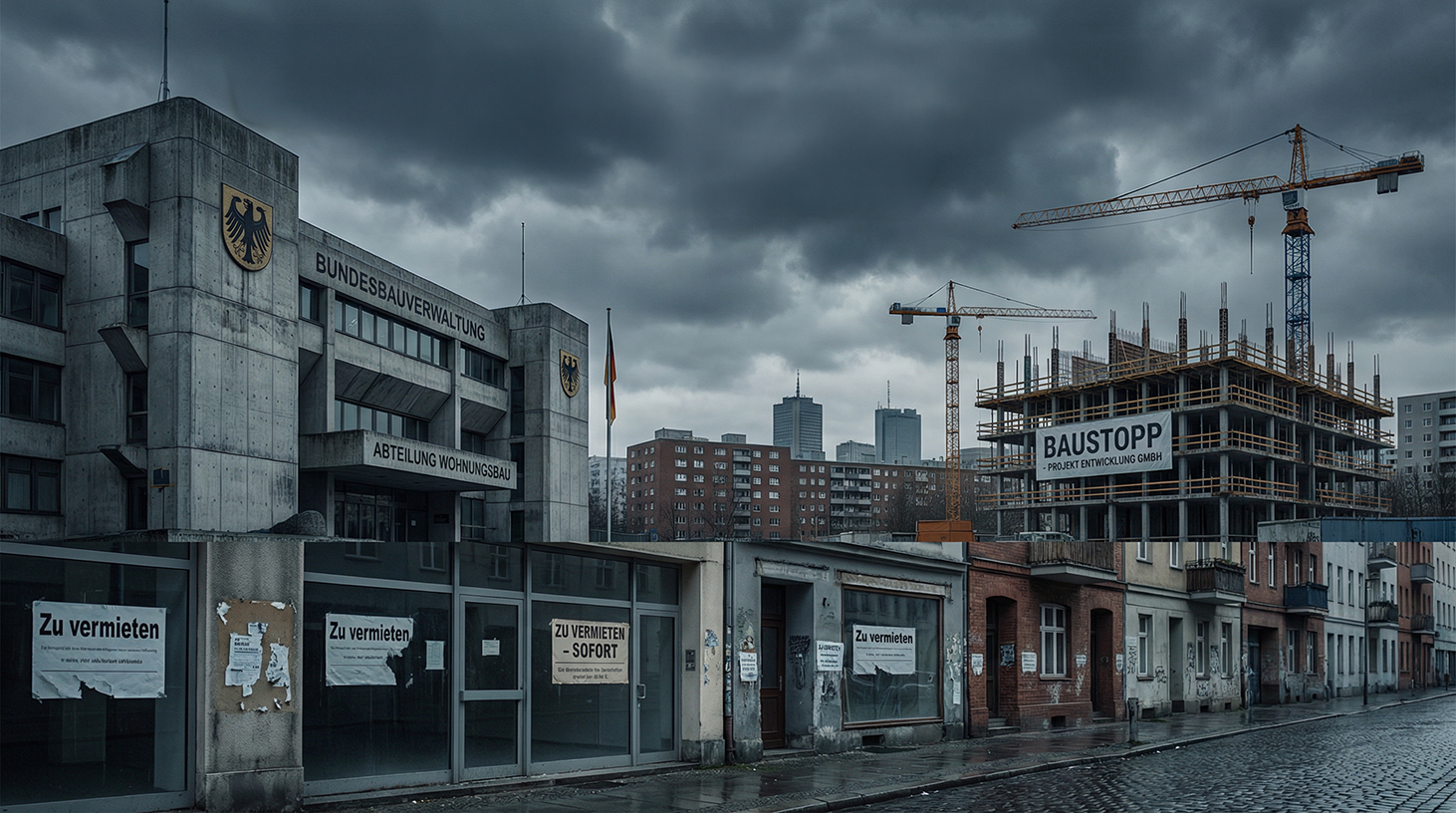
The state as developer: Germany's housing crisis and the illusion of state solutions – Image: Xpert.Digital
51 cents per euro to the state: The real reason why nobody is building anything in Germany anymore
Housing crisis escalates: Why a state-owned housing company is only making the problem worse
Construction bankruptcies at record highs and bureaucracy instead of new apartments: Why the state itself caused the construction crisis
Germany is hurtling unchecked toward its worst housing crisis in decades. With a record shortfall of 1.4 million apartments and a dramatic drop in building permits, the market is on the verge of collapse. In this emergency, politicians are presenting a supposed lifeline: the federal government is to step in as a state-owned developer. But what at first glance appears to be a liberating move turns out, upon closer inspection, to be a dangerous misstep. The real bottleneck is not a failing free market, but the state itself. With an impenetrable mountain of regulations, 16 different state building codes, and a tax and levy burden that devours more than a third of construction costs, politicians have simply rendered building uneconomical. Why a new federal housing corporation will not solve the profound structural problems and what drastic lessons the failure of existing state-owned real estate projects teaches can be read in our comprehensive analysis.
When the firefighter himself becomes an arsonist
A record deficit as a starting point: The collapsed housing market
Germany is facing its worst housing crisis in decades. The Social Housing Monitor 2026, compiled by the Pestel Institute on behalf of the Alliance for Social Housing, documents a record deficit of approximately 1.4 million missing apartments nationwide – almost exclusively in the affordable housing segment. Young people, older generations, and people with disabilities are particularly affected; in populous states like North Rhine-Westphalia alone, there is a shortage of around 376,000 apartments, and in Bavaria, around 233,000.
At the same time, new construction statistics show a dramatic decline. In 2024, only 215,900 apartments were approved for construction in Germany – a decrease of 16.8 percent compared to the previous year and the third consecutive decline. Compared to 2022, building permits plummeted by a total of 43 percent. The last time there were fewer building permits was in 2010. Politicians had set a target of 400,000 new apartments per year; however, only around 252,000 units were actually completed in 2024, and experts expect only about 235,000 for 2025 and around 215,000 for 2026. In absolute terms: The annual gap between demand and reality is more than 150,000 apartments.
In this situation, SPD leader and Federal Finance Minister Lars Klingbeil, in a speech at the Bertelsmann Foundation, demanded that the federal government build housing "on a large scale" in the future. Federal Construction Minister Verena Hubertz took up the idea and spoke of a potential "game changer" for the German housing market. However, Hubertz herself admitted that establishing such a federal housing corporation would require an amendment to the Basic Law (Germany's constitution). What at first glance appears to be a decisive reaction to a full-blown crisis proves, upon closer inspection, to be a symptomatic misdiagnosis.
Costs under the state seal: Why Germany is a high-cost country
Before the question of government solutions can be answered, the root cause of the housing crisis must be understood: Germany is a structurally high-cost country when it comes to new housing construction. According to an analysis by the global real estate services provider CBRE, the average construction costs for new housing in Germany were €5,150 per square meter – higher than in France and Finland (€5,000 each) and more than twice as high as in Poland (€2,130). In a more recent survey for Housing Construction Day 2025, the cost range for new multi-story apartment buildings in major German cities was between €3,300 and €8,300 per square meter, with a median of €4,470.
The key finding: Nearly a third of these costs, or around €1,500 per square meter, are directly caused by taxes and public levies. The German Property Federation (ZIA) estimates the total government-imposed share at 37 percent of the construction costs – comprised of real estate transfer tax, value-added tax, energy efficiency requirements, technical building regulations, and municipal requirements. The Pestel Institute put it even more bluntly in an earlier analysis: Of every euro invested in house construction, around 51 cents flow to the government in the form of taxes and social security contributions.
These figures have a striking consequence: The state is already one of the biggest cost drivers in German housing construction – through value-added tax, real estate transfer tax, energy efficiency regulations, technical building codes, and a multitude of municipal requirements. Anyone presenting a state-owned housing corporation as a solution in this context overlooks the fundamental paradox: The state is supposed to solve a problem that it itself has largely created.
The regulatory mountain: Bureaucracy as a structural brake on growth
The real bottleneck in German housing construction is not a lack of capital, but a regulatory mountain that is virtually impossible to navigate. The Konrad Adenauer Foundation, in its position paper for the 2025 Housing Congress, diagnoses that the multitude of building-related standards in Germany is driving up construction costs considerably. The federal fragmentation is particularly problematic: 16 different state building codes complicate planning and approval processes and increase construction costs due to a lack of standardization. What is considered a compliant building project in Bavaria can lead to months of additional demands for payment in Hamburg.
The approval times are symptomatic of systemic failure. In the simplified procedure, a building permit typically takes two to three months – provided all documents are complete. In the standard procedure, three to six months is the norm, but for complex projects, the actual processing by the authorities can take considerably longer. Furthermore, if external authorities such as historic preservation offices, environmental agencies, or the fire department need to be involved, their response times alone can take up to twelve weeks. The average time from building permit to completion is now 26 months, and for apartment buildings, it's even 34 months.
These regulatory obstacles affect private and public developers alike. The conclusion of economist Veronika Grimm from the German Council of Economic Experts is therefore clear: State-owned project developers struggle with the same problems as private ones – high construction costs, a shortage of skilled workers, and excessive regulation. A new state-owned company will not solve these structural problems; it will be exposed to them in the same way as any other market participant.
Wave of bankruptcies in the construction industry: Capital is withdrawing
While politicians debate new state-owned companies, the construction industry is undergoing a silent hemorrhage. The number of standard insolvency filings in the construction sector rose by 19.2 percent in July 2025 compared to the same month of the previous year – with 9.4 insolvencies per 10,000 companies, almost twice the national average. In the first half of 2025, Hesse alone reported 189 construction insolvencies – more than any other sector. In North Rhine-Westphalia, company bankruptcies increased by 17 percent in the first half of the year. The international credit insurer Atradius estimated that the overall increase in insolvencies for the entire year of 2024 was around 22 percent.
The economic logic behind this development is clear. With current investment costs of around €5,230 per square meter – including the land share – privately financed rentals hardly allow for monthly net rents below €17.50. Empirica researcher Andreas Braun puts it succinctly: There is hardly any demand on the market for these rents, therefore no construction is taking place – even when projects have been approved. The market is failing not due to a lack of self-interest on the part of investors, but because the framework conditions have made private-sector construction structurally unprofitable.
The reduction in capacity within the industry is creating a dangerous feedback loop: skilled workers who have left the sector rarely return. 80 to 85 percent of construction companies have fewer than 20 employees. Who will build the apartments that are so desperately needed today? A newly established state-owned company cannot create capacity out of thin air – it must rely on the same depleted labor market as all other construction companies.
Our EU and German expertise in business development, sales and marketing

Our EU and German expertise in business development, sales and marketing - Image: Xpert.Digital
Industry focus areas: B2B, digitalization (from AI to XR), mechanical engineering, logistics, renewable energies and industry
More information here:
A thematic hub offering insights and expertise:
- Knowledge platform covering global and regional economies, innovation and industry-specific trends
- A collection of analyses, insights, and background information from our key areas of focus
- A place for expertise and information on current developments in business and technology
- A hub for companies seeking information on markets, digitalization, and industry innovations
Why a federal housing company only makes the problem worse
The role model that isn't one: How the BImA failed
Anyone wanting to assess the idea of a federal housing corporation needs to look at the Federal Agency for Real Estate (BImA) – the federal government's existing state-owned real estate vehicle. The result is sobering. At the 2018 Housing Summit, the then-governing grand coalition announced that the federal government would create 6,000 to 8,000 new apartments through a housing initiative. The actual result: From 2020 to 2023, construction began on 2,753 apartments – but only 200 units were completed by the end of 2023. In 2023 alone, the BImA completed a mere 68 new buildings.
But it's not just the new construction figures that are alarming. One in six apartments in the BImA's (Federal Agency for Real Estate) portfolio is vacant – a total of over 6,000 federally owned apartments, some of which have remained unrented for years. The vacancy rate had almost doubled within a year and a half. An internal "cry for help" from BImA employees described the agency's internal chaos in stark terms: lack of a coherent plan, being overwhelmed, a shortage of qualified personnel, and no strategy for construction, operation, and management. The employees themselves considered it "impossible" for the BImA to take on housing construction on any significant scale. Furthermore, the Federal Court of Auditors found that the BImA did not act economically when purchasing occupancy rights and was basing its decisions on price guidelines that were more than ten years old.
Construction Minister Hubertz herself admitted that the Federal Agency for Real Estate (BImA) primarily serves federal employees and therefore does not represent a solution for society as a whole. The logical consequence, however, would not be a new, additional state-owned company – but rather a fundamental reform of the existing structures, which would have to accomplish precisely what is now being proposed.
State failure as a systemic characteristic: Historical and European lessons
Attempts to address housing shortages through direct government construction have a long history in Germany and Europe – with mixed results. The Viennese municipal housing model is internationally recognized as a prime example of successful public housing: 62 percent of Viennese residents live in subsidized housing, in approximately 220,000 municipal apartments or other subsidized units. Rents in Viennese municipal housing are significantly lower than on the open market, and the model has ensured social stability for decades.
But even the much-lauded Viennese model is not without its weaknesses. Critics point out that operating costs in municipal housing are above average and that city-run apartments are significantly more expensive to manage than private companies. Tenants can keep their municipal apartments indefinitely—even if their income has risen sharply since moving in—leading to a misallocation of subsidized housing. Moreover, Vienna is a special case: The city boasts centuries of institutional continuity in non-profit housing construction, municipal land, and a political system that treats the issue with high priority. These conditions do not exist at the federal level in Germany.
Veronika Grimm of the German Council of Economic Experts simply calls the SPD's proposal a "misguided idea" and points to structurally similar errors in other state infrastructure projects: Deutsche Bahn, Autobahn GmbH – major public projects in Germany are regularly characterized by significant cost overruns, massive delays, and inefficient decision-making structures. These patterns are not random failures, but rather inherent to the system: State organizations are subject to different incentive systems than private companies – they think politically rather than economically, operate with unlimited liability, and without genuine competitive pressure.
The real diagnosis: market failure or government failure?
The crucial economic question is not whether the housing market has failed. The question is: Why is it failing, and whose failure is it? Because a market that functions under normal conditions always exhibits dysfunction when the framework is structured in such a way that economic activity is no longer possible. This is precisely the case in Germany.
The data paints a clear picture: The state bears roughly 37 percent of new construction costs through taxes, levies, energy regulations, and municipal requirements. Sixteen different state building codes prevent standardization and cost reduction. Permitting processes tie up capital for months without creating added value. Energy efficiency standards exceed what is economically feasible, as demonstrated by the example of the Efficiency House 40, which, although permitted to consume less than one percent of the energy of a standard house, is considerably more expensive than the legally required Efficiency House 55. At the same time, Germany's housing costs as a share of income, at 24.5 percent, are significantly higher than the EU average of 19.2 percent – 12 percent of all German households are considered overburdened by housing costs (EU average: 8.2 percent).
What is completely lacking, however, is a state-owned new construction company: the funds are missing, the capacity is missing, and the personnel is missing. What does exist is not being used – as the vacancy scandals at the Federal Agency for Real Estate (BImA) demonstrate. The logical conclusion is therefore uncomfortable, but compelling: the housing problem was not caused by the free market, but by the state itself, through decades of overregulation, fiscal siphoning, and structural inefficiency. More of the same is not the solution.
What would actually help: The economically viable way out
A serious reform approach would have to address the root causes, not just the symptoms. The first and most important measure would be to unify the 16 state building codes into a single, nationwide set of regulations – a step that would significantly reduce construction costs through standardization, scaling, and simplified planning, as both the Konrad Adenauer Foundation and the chief economist of the HCOB (Hamburg Chamber of Commerce and Industry) unanimously emphasize. In addition, the real estate transfer tax, which has risen to 6.5 percent in many states, would have to be significantly reduced or temporarily suspended for new housing.
Secondly, Germany needs a realistic calibration of its energy efficiency standards. The blanket high standard of the Efficiency House 40 generates additional costs that are not offset by any energy savings and simply make private construction impossible. A differentiated regulation that distinguishes between new construction in the subsidized and private sectors would be more economically effective. Thirdly, permitting processes must be radically accelerated through digitalization and increased staffing in building authorities.
Government funding certainly has its place – but as an incentive mechanism for private actors, not as a replacement for them. Discounted land allocations, extended tax depreciation allowances, and targeted KfW funding for social housing can mobilize private investors without replicating the structural inefficiencies of public construction. Experience in Vienna shows that public housing can succeed under the right historical and institutional conditions – but these conditions would first have to be painstakingly established at the federal level in Germany, a process that would take decades.
Political symptom-oriented thinking instead of structural reform
The idea of a federal housing corporation is not a solution; it is a political signal. It conveys a sense of agency without addressing the structural causes of the crisis. SPD politician Hubertz herself admitted that her party had "for too long projected the image of obstructing reform"—a remarkably honest self-assessment that raises even more questions when the same party is now pushing for a solution that means more state intervention in a sector already suffering from over-regulation.
The fundamental problem of the German housing market is not market failure, but a politically created barrier to investment. As long as new construction projects cannot be operated profitably at market-rate rents, as long as building permits represent a bureaucratic obstacle, as long as 16 different state building codes prevent scaling, and as long as over a third of construction costs are caused by government levies, even a new state-owned company will not build more than the private sector. It will merely operate more expensively, more slowly, and with less accountability – using taxpayers' money that could be used far more efficiently for structural reforms.
Germany doesn't need the state as a developer. It needs a state that stops hindering developers.
Your global marketing and business development partner
☑️ Our business language is English or German
☑️ NEW: Correspondence in your native language!

Konrad Wolfenstein
I and my team are happy to be available to you as your personal advisor.
You can contact me by filling out the contact form here or simply call me at +49 7348 4088 965. My email address is : [email protected]
I'm looking forward to our joint project.
☑️ SME support in strategy, consulting, planning and implementation
☑️ Creation or realignment of the digital strategy and digitization
☑️ Expansion and optimization of international sales processes
☑️ Global & Digital B2B trading platforms
☑️ Pioneer Business Development / Marketing / PR / Trade Fairs
🎯🎯🎯 Data-driven B2B industry hub as a quasi-in-house solution

The quasi-in-house solution: How Xpert.Digital closes operational gaps in B2B marketing and sales – Smart Content-Driven Business - Image: Xpert.Digital
Xpert.Digital is a data-driven B2B industry hub led by Konrad Wolfenstein . The company acts as an external, quasi-in-house solution for industrial partners, closing operational gaps in marketing, content, and sales – without requiring additional resources on the client side.
More information here:










