
When humanoid machines fight kung fu: How China's $13,500 robots are now making the US competition look old
Xpert Pre-Release

Available in 27 languages 📢
Prefer Xpert.Digital on GoogleⓘPublished on: February 19, 2026 / Updated on: February 19, 2026 – Author: Konrad Wolfenstein
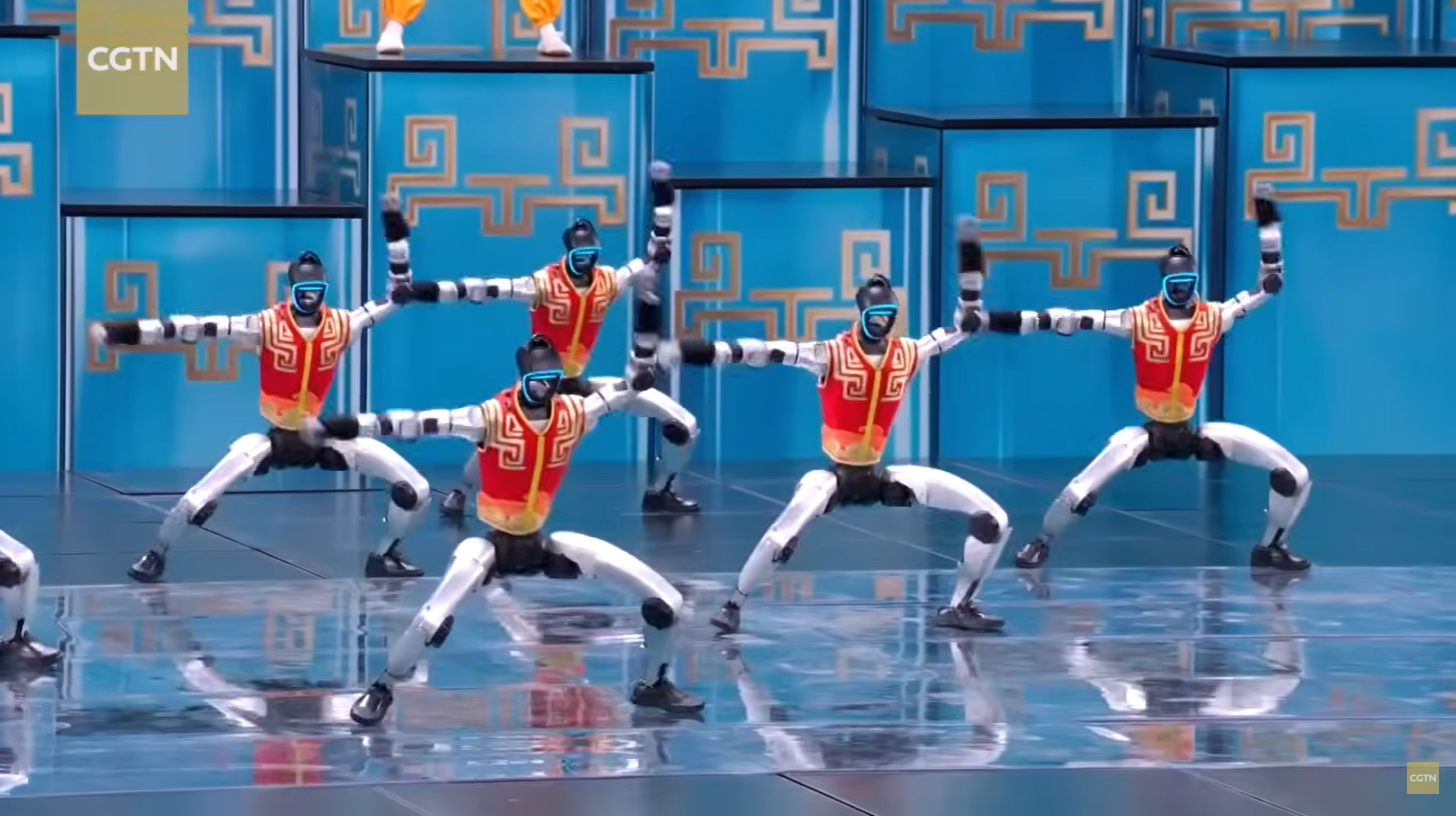
When humanoid machines fight Kung Fu: How China's $13,500 robots are now making the US competition look outdated – Image: CGTN/YouTube
What looks like entertainment is in reality the greatest technological show of force since Sputnik
Forget Boston Dynamics: Unitree G1 robots from China are currently demonstrating the future of humanoid robotics
On the evening of February 16, 2026, hundreds of millions of viewers worldwide witnessed a spectacle that definitively blurred the lines between cultural heritage and technological future. At the annual Spring Festival Gala of Chinese state television, the most-watched television event in the world, the focus was no longer on pop stars or acrobats, but on dozens of humanoid robots performing kung fu, sword fighting, and breakdancing with a perfection that left even seasoned technology experts speechless. What at first glance appeared to be a spectacular show was, in reality, a carefully choreographed message to the rest of the world: China is no longer just a player in humanoid robotics, but the driving force behind an entire industry with the potential to fundamentally transform the global economic order.
The performance marked a qualitative leap that even industry experts hadn't anticipated at this speed. Just the previous year, at the 2025 Spring Festival, 16 Unitree H1 humanoid robots had performed a traditional Yangge folk dance, twirling handkerchiefs and stepping in sync with human dancers. That performance was considered a milestone at the time. But only twelve months later, the movements of 2025 seemed almost rudimentary compared to what the 2026 Gala brought to the stage. Millions of users commented on what they had seen on the Chinese social media platform Weibo, and one widely shared post put it this way: This performance is likely to send shockwaves across the Pacific.
Related to this:
The architecture of a technological demonstration of power
The 2026 Spring Festival Gala, themed around the Year of the Fire Horse, reached a total of 23.063 billion media contacts in China alone, a 37.3 percent increase over the previous year. The live share of the national television market was 79.29 percent, the highest in thirteen years. An average of 325 million people watched simultaneously, peaking at over 400 million. Nearly 4,000 foreign media outlets broadcast the show, and it was shown live on 4,062 public large-screen televisions in 140 cities across 98 countries. For comparison, the American Super Bowl reaches approximately 120 million viewers; the gala surpassed that number many times over.
Into this unprecedented window of opportunity, the organizers, under the direction of Gala Director Yu Lei, placed no fewer than four of the country's leading robotics companies: Unitree Robotics, MagicLab, Galbot, and Noetix Robotics. Yu Lei explained that they had deliberately chosen a high concentration of robots to showcase the multidimensional development of the Chinese robotics industry to the audience. This wording was no accident; it came from the vocabulary of state industrial policy.
Related to this:

Table jumps, somersaults, and drunken boxing style: What the robots could actually do
The highlight of the evening was provided by Unitree Robotics, the official robotics partner of the China Media Group, which appeared at the gala for the third consecutive year. Dozens of G1 robots performed what the company described as the world's first fully autonomous, controlled martial arts cluster performance by humanoid robots with coordinated high-speed movement. The technical specifications read like something out of a science fiction novel: The robots performed table jumps, somersaults over three meters high, one-legged spins, wall-supported backflips, and extended rotation sequences. The coordinated movement of the robot cluster reached top speeds of four meters per second.
Particularly noteworthy was a sequence that imitated the traditional martial arts style of the Drunken Boxer (Zui Quan): The robots staggered, fell backward in a controlled manner, and rose again—a maneuver that demonstrated significant advances in control and coordination technology. The machines brandished swords, staffs, and nunchucks in close proximity to child actors, requiring an extreme degree of precision and safety.
Unitree's large H2 robot, standing 1.80 meters tall, concluded the performance on the main stage in Beijing as a so-called swordsman grandmaster, before performing a traditional salute with a young martial artist, symbolizing the continuity between human tradition and the machine future. At the secondary venue in Yiwu, the same robot appeared in the heavy armor of the Monkey King Sun Wukong, riding four-legged B2W robot dogs stylized as tumbling clouds. This fusion of iconic cultural motifs with cutting-edge technology was not a spontaneous directorial decision, but a meticulously planned narrative.
The technology behind the spectacle: AI fusion and swarm control
The technical infrastructure for the performance rested on an upgraded high-parallelism cluster control system designed to synchronize dozens of robots in real time with minimal latency. Unitree combined pre-trained motion control models with a proprietary AI fusion localization algorithm that integrated proprioceptive data and 3D LiDAR inputs to maintain positional accuracy during dynamic movements.
The G1 robots have 23 to 43 degrees of freedom, depending on the configuration, and utilize a Livox MID360 3D LiDAR sensor in combination with an Intel RealSense D435 depth camera. Their AI-powered whole-body motion control allows for a maximum joint torque of 360 Newton meters in the larger H1 model. Newly developed dexterous hands were also used for the gala, enabling the robots to handle props such as swords and nunchucks with astonishing dexterity. The SLAM (Simultaneous Localization and Mapping) positioning system with 360-degree panoramic depth perception allowed the machines to precisely interpret their environment and navigate accurately even within the complex stage layout.
Four companies, one message: The ecosystem behind the scenes
The fact that four robotics companies were allowed to perform on the gala stage was a deliberate industrial policy signal. Each company covered a different area of the technology spectrum, and together they represented the breadth of the Chinese robotics landscape.
Unitree Robotics, founded in Hangzhou, is the undisputed market leader in quadrupedal robots, holding approximately 70 percent of the global market share in this segment. In 2025, the company shipped over 5,500 humanoid robots and achieved annual sales of over one billion yuan, equivalent to approximately 140 million US dollars. Unitree has been profitable since 2020 and is preparing for an initial public offering (IPO) on Shanghai's STAR Market, planned for the second quarter of 2026, with a target valuation of up to 50 billion yuan, approximately seven billion US dollars. Investors include Alibaba, Tencent, China Mobile, Geely, and Ant Group.
MagicLab, founded only in January 2024, already employs over 300 people, more than 70 percent of whom work in research and development. The company has developed over 90 percent of its key components, such as joint modules, dexterous hands, and reduction gears, in-house and employs a dual architecture of cerebral and cerebellum that combines complex task planning with real-time motion control. At the gala, MagicLab robots performed a synchronized dance routine to the programmatically titled song "We Are Made in China.".
Noetix Robotics, founded in Beijing in September 2023 by graduates of Tsinghua University and the Chinese Academy of Sciences, specializes in robots that resemble real people. In a comedy sketch at the gala, an actress unveiled an android version of herself, a moment that elicited both laughter and amazement. Noetix closed a pre-B+ funding round of nearly 200 million yuan at the end of 2025.
Galbot, based in Beijing, demonstrated the everyday usability of humanoid robots by having its machines crack walnuts, skewer sausages, and fold clothes. The company had recently raised over $300 million in a new funding round. Galbot's key innovation lies in a training pipeline that combines synthetic simulation data with smaller amounts of real-world data.
The market in numbers: China's robotics dominance becomes measurable
The scale of China's advance in humanoid robotics can now be measured in hard sales figures. According to the market research company Omdia, Chinese companies shipped the vast majority of the approximately 13,000 humanoid robots sold worldwide in 2025. The International Data Corporation (IDC) even put global shipments at around 18,000 units, an increase of 508 percent compared to the previous year. Global revenue from humanoid robots reached approximately US$440 million in 2025. The China Mobile Robot Industry Alliance (CMRA) reported over 22,000 units shipped worldwide, of which Chinese companies accounted for 80.7 percent.
AgiBot from Shanghai led the delivery statistics with over 5,100 units and a global market share of 39 percent, followed by Unitree with 4,200 units and UBTECH from Shenzhen with 1,000 units. American competitors such as Figure AI, Agility Robotics, and Tesla each achieved sales figures between 150 and 500 units. Zhang Yunming, Vice Minister of the Chinese Ministry of Industry and Information Technology, announced that China will have launched more than 330 different humanoid robot products by 2025.
Market forecasts read like an exponential growth curve. According to the 2024 Humanoid Robot Industry Research Report, the Chinese market for humanoid robots will grow from the equivalent of US$380 million in 2024 to US$1.4 billion by 2026. By 2029, it is projected to reach US$10.3 billion, representing 32.7 percent of the global market. By 2035, analysts predict a Chinese market of 300 billion yuan, equivalent to US$41.3 billion. Goldman Sachs estimates the total global addressable market for humanoid robots at US$38 billion by 2035, with 1.4 million units shipped. The ecosystem already comprises over 350 companies, including more than 140 manufacturers, and attracted investments of over 40 billion yuan, approximately US$5.7 billion, last year.
Price breaker from Hangzhou: Why the price advantage is strategic
A key element of China's robotics strategy is its aggressive pricing. The Unitree G1, which demonstrated kung fu at the gala, is available in its basic version starting at $13,500. The research variant with full SDK access starts at $43,500, while the flagship H1 model costs between $99,900 and $128,900. The cheapest Unitree model, the R1, is priced at just $5,900. By comparison, the American Agility Digit, a humanoid logistics robot, costs over $250,000.
This pricing structure is no accident, but a direct consequence of China's deep supply chains. As the world's workshop, China possesses a unique ecosystem of suppliers for actuators, sensors, batteries, and structural components. Cost-effective production enables scaling that is simply impossible for Western competitors at present. Chinese manufacturers can afford to offer humanoid robots at prices below the production costs of their American rivals. This is not a market distortion; it is a structural advantage fueled by decades of industrial policy investment.
🎯🎯🎯 Benefit from Xpert.Digital's extensive, five-fold expertise in one comprehensive service package | BD, R&D, XR, PR & Digital Visibility Optimization

Benefit from Xpert.Digital's extensive, five-fold expertise in a comprehensive service package | R&D, XR, PR & Digital Visibility Optimization - Image: Xpert.Digital
Xpert.Digital possesses in-depth knowledge across various industries. This allows us to develop tailored strategies precisely aligned with the requirements and challenges of your specific market segment. By continuously analyzing market trends and monitoring industry developments, we can act proactively and offer innovative solutions. The combination of experience and expertise generates added value and provides our clients with a decisive competitive advantage.
More information here:
China's plan is working: How the country became a robot superpower while the West watched
Demographics as a driving force: Why China needs robots, not just wants them
Behind this technological offensive lies a demographic imperative that leaves the Chinese leadership no alternative. China is the fastest-aging country in the world. At the end of 2024, the population aged 65 and over numbered around 220 million, representing 15.6 percent of the total population. In just over two decades, the country has transitioned from an aging society to the cusp of a super-aging one. The working-age population shrank by 5.57 million in 2024, marking the third consecutive year of decline. Manufacturing labor costs in eastern China rose by six to eight percent annually.
The robot density in Chinese manufacturing has already reached 470 units per 10,000 employees, placing China third worldwide and surpassing both Germany (429) and Japan (419). China accounts for over half of all industrial robots installed globally. According to the World Economic Forum, over 90 percent of Chinese companies identify AI and robotics as key technologies for transforming their businesses.
The Chinese government has declared the use of robots to care for its aging population a strategic goal. The State Council has elevated the so-called silver industry to a national strategic priority and presented a roadmap for establishing a technology-driven nationwide elderly care system by 2035. Intelligent care robots are already being piloted in Beijing and Shanghai, monitoring seniors' health data in real time, preparing meals, and engaging in conversation. The proportion of people over 65 in China's population, currently at 23 percent, is projected by the UN to rise to over 50 percent by 2100.
Related to this:

Industrial policy with a system: The five-year plan as a robot accelerator
China's robotics offensive is not the result of a single political decision, but rather of an industrial strategy systematically built up over more than a decade. The 2012 Twelfth Five-Year Plan for the Development of Service Robot Technology first formulated the goal of developing humanoid robots. The 2016 Thirteenth Five-Year Plan focused on building an industrial robot system and achieving breakthroughs in core components. The 2021 Fourteenth Five-Year Plan for the Development of the Robotics Industry set the goal for China to be a major source of global robotics technology innovation and a manufacturing powerhouse by 2025.
In 2023, the government published three landmark documents: the Robot Plus Action Plan, which aimed to double robot density in manufacturing by 2025; a program for building humanoid bionic mechanisms with 28 degrees of freedom; and the Guidelines for the Innovative Development of Humanoid Robots, which outlined a long-term international perspective. In October 2025, President Xi Jinping and the Central Committee adopted the Fifteenth Five-Year Plan, which identified "embodied artificial intelligence"—that is, artificial intelligence in the form of robotics and autonomous vehicles—as a key area.
At the 2025 World Robotics Conference in Beijing, a government official announced a new subsidy package for the entire humanoid robot production value chain, aiming for an annual production of 10,000 units by 2027. The subsidies include tax breaks with up to 200 percent deductibility for research expenses, preferential financing for vertical integration, government procurement programs, and technology transfer restrictions to protect domestic intellectual property. The China Development Bank has allocated approximately US$50 billion to advanced manufacturing sectors between 2021 and 2024.
The transatlantic race: Where does the USA stand?
A comparison with American competitors reveals a paradoxical picture. In software development and the underlying AI models, the USA is still considered a leader, particularly through companies like Tesla, Boston Dynamics, Figure AI, and Nvidia. However, in physical implementation, hardware agility, and especially mass production, China has gained a significant advantage.
Tesla had announced plans to manufacture at least 10,000 Optimus humanoid robots by 2025, but had to postpone this target to 2026. Boston Dynamics is planning the industrial rollout of its Atlas robot in Hyundai factories only by 2028 and is working on a dedicated robot factory that is expected to reach an annual capacity of 30,000 units by 2030. Figure AI has set itself the goal of bringing a total of 100,000 humanoid robots into workplaces and homes by 2029. Industry observers attribute the gap to longer validation cycles, higher unit costs, and a stronger focus on software platforms rather than hardware scaling in the US.
Andreas Brauchle, a partner at the consulting firm Horváth, put it this way to CNBC: China is currently ahead of the United States in the early commercialization of robots, although both nations are likely to develop comparably large markets in the long term. Karel Eloot, a senior partner at McKinsey, identified three driving forces behind China's initiative: addressing demographic challenges, stimulating new economic growth, and strengthening its global competitive position.
The gala as a stock market prospectus: When state television engages in investor relations
The placement of robotics companies on the world's biggest television stage has an economic dimension that extends far beyond mere entertainment. Analysts at the Institute for Strategic Technology point out that the CCTV Gala has long served as a platform to showcase Beijing's technological ambitions. What distinguishes this format from similar events elsewhere is the direct link between industrial policy and prime-time entertainment: companies that appear on this stage often receive significant benefits in the form of government contracts, investor interest, and market opportunities.
The timing is significant. Unitree Robotics is preparing for its IPO, which would make it the largest Chinese robotics IPO. AgiBot, the world's largest manufacturer of humanoid robots by unit volume, is also planning an IPO. The gala further fueled the euphoria surrounding the sector. Last year, following his appearance at the Gala 2025, Unitree founder Wang Xingxing participated in a major technology symposium with President Xi Jinping, the first of its kind since 2018. Over the past year, Xi met with five founders of robotics startups, more than he met with entrepreneurs from the electric vehicle or semiconductor sectors during the same period.
ByteDance, the parent company of TikTok, also used the gala as a platform: The AI chatbot Doubao distributed virtual red envelopes of money to users of the app as a sponsor, and the AI video generation model Seedance 2.0 contributed to the visual production of several segments.
Beyond the show: Where humanoid robots are already working
While the gala performance captivated the world's attention, the real revolution is taking place in the country's factories, warehouses, and care facilities. By 2025, most humanoid robots delivered will be used in entertainment and commercial demonstrations, followed by research and education, data collection, exhibitions and reception, smart manufacturing, and warehousing and logistics.
UBTECH, a competitor from Shenzhen, has secured orders worth over 1.3 billion yuan and plans to deliver between 2,000 and 3,000 units of its Walker series in 2026, with a targeted annual production capacity of 10,000 units. UBTECH robots are already in use at Airbus. Chery, one of China's largest automotive exporters, uses humanoid robots in its dealerships in China, Hong Kong, and Malaysia. Texas Instruments and Foxconn are also among the customers of Chinese robotics companies. The Chinese government even uses humanoid robots at the Vietnamese border.
In the textile industry of the Yangtze Delta, the switch to robot-controlled production has already led to dramatic efficiency gains: factories with an annual output of 300 million yuan, which previously required around 100 workers, now operate with only four to five employees. These so-called dark factories, which require no light for human workers, are no longer just a vision of the future, but an industrial reality.
What the gala reveals about geopolitical tectonics
The robot performance at the 2026 Spring Festival Gala must be interpreted against the backdrop of escalating technological competition between China and the United States. The development of humanoid robots touches upon key areas of national security and economic sovereignty: advanced semiconductors, artificial intelligence, sensor technology, materials science, and automation. China's strategy of technological self-sufficiency, manifested in initiatives such as "Made in China 2025," explicitly aims to reduce its dependence on foreign, particularly American, technologies.
The robotics sector benefits from China's dominance in rare earth elements, which are essential for permanent magnets in electric motors and actuators. This vertical integration of the supply chain, from raw materials to components to the finished robot, gives Chinese manufacturers a structural advantage that is difficult to replicate. While the debate in the US focuses on trade tariffs and technological decoupling, China is quietly building a production ecosystem that is unparalleled in its depth and breadth.
The show of force on the gala stage also had a foreign policy dimension. The choice of the song "We Are Made in China" as background music for dancing robots was a thinly veiled message to the international community. China is no longer positioning itself merely as a cheap manufacturing hub, but as an innovation leader in one of the most promising technological fields of all.
Risks and downsides of the robot revolution
Despite the euphoria, the risks are undeniable. Estimates suggest that automation could affect around 70 percent of China's manufacturing industry. Chinese government officials have already announced plans to implement measures to mitigate the impact of rapid technological adoption on employment. Timing is crucial: while automation is a long-term necessity for a shrinking workforce, in the short term it could lead to job losses for people who currently lack clear alternative employment options.
Valuations in the robotics sector are also ambitious. Unitree's targeted IPO valuation of seven billion US dollars with revenues of around 140 million US dollars corresponds to a price-to-sales ratio of approximately 50. This presupposes enormous future growth and carries significant valuation risks should commercialization proceed more slowly than expected. The question of whether humanoid robots can actually be used economically on an industrial scale beyond entertainment and demonstrations remains the central challenge for the coming years.
Why the rest of the world should be watching closely
The kung fu robots of the 2026 Spring Festival Gala are more than a technological curiosity. They represent the visible pinnacle of an industrial transformation with the potential to fundamentally restructure global value chains. Within just a few years, China has built a lead in the commercialization and scaling of humanoid robotics that will be difficult for Western competitors to overcome. The combination of state guidance, cheap capital, deep supply chains, a vast domestic market, and the demographic pressures of an aging society creates a self-reinforcing dynamic: the more robots are deployed, the more real-world data is collected, which in turn enables better AI models.
For European industry, and especially for German mechanical engineering, this development poses an existential challenge. Germany's robot density in manufacturing, once a world leader, has already been overtaken by China. The question is no longer whether humanoid robots will transform factory floors and service sectors, but rather who will build the machines that drive this transformation. After the evening of February 16, 2026, there are strong indications that the answer to this question will come from China, disguised as the Monkey King and armed with a sword.
📈🔵 Ambidexterity or doom: The only management concept that still works in the triple crisis💡

When proven strategies fail: Organizational adaptability in the digital transformation of ambidexterity - Image: Xpert.Digital
We are currently experiencing a period of economic turmoil that differs fundamentally from previous recessions. A deceptive silence prevails in the boardrooms of European and international companies – broken only by the sound of failing strategies that were considered a guarantee of success just yesterday. This is not merely a cyclical downturn, but a profound structural break. The tools with which companies achieved growth for over two decades simply no longer work.
More information here:
Your global marketing and business development partner
☑️ Our business language is English or German
☑️ NEW: Correspondence in your native language!

Konrad Wolfenstein
I and my team are happy to be available to you as your personal advisor.
You can contact me by filling out the contact form here or simply call me at +49 7348 4088 965. My email address is: [email protected]
I'm looking forward to our joint project.









