

Published on: January 28, 2026 / Updated on: January 28, 2026 – Author: Konrad Wolfenstein
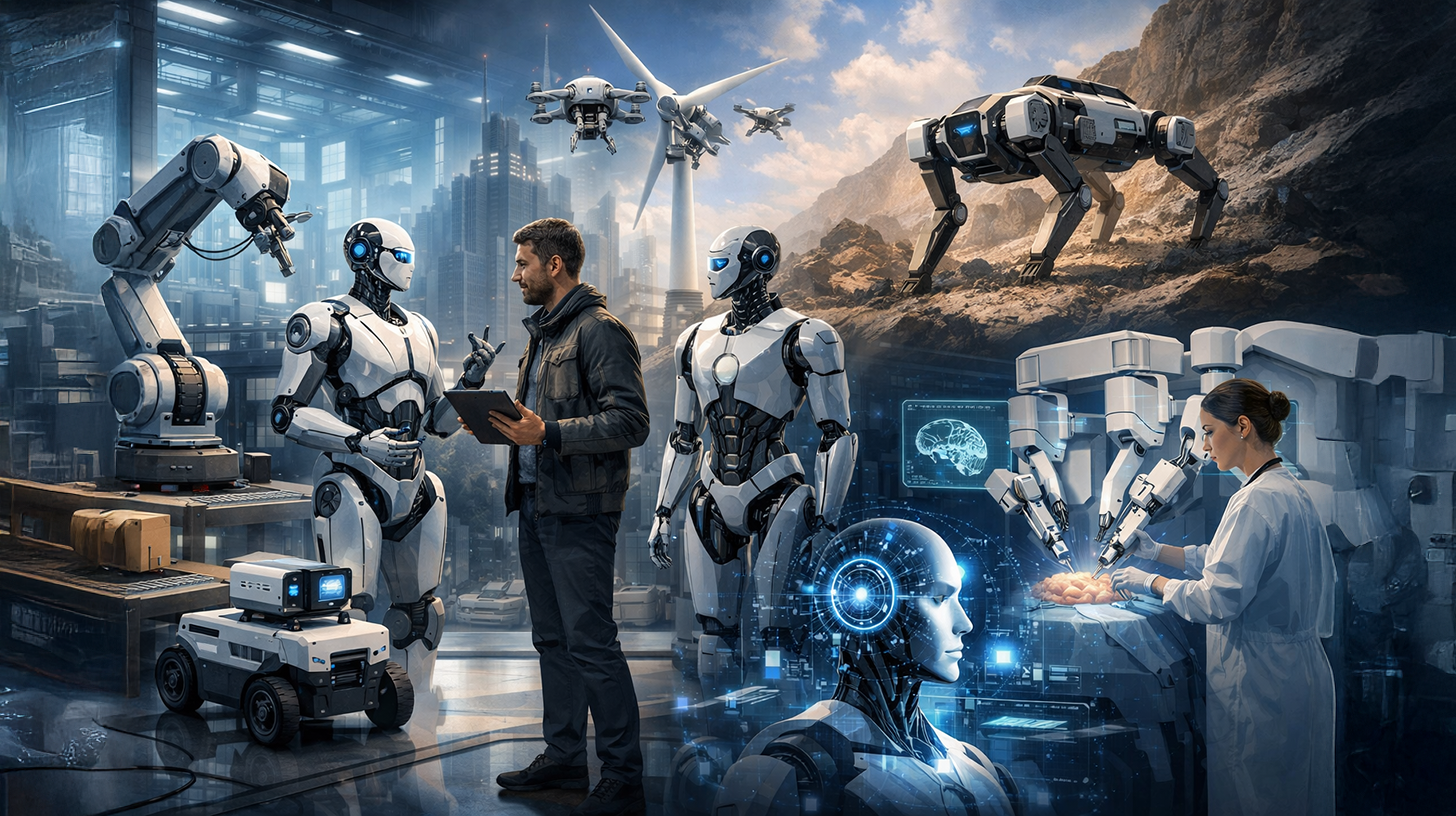
Robotics Report | 5 Mega-Trends in Robotics: How “Agentic AI” is transforming machines from tools into colleagues – Image: Xpert.Digital
From tool to colleague: The new era of “Agentic AI” in production
From helper to intelligent worker – how AI-driven automation is redefining industrial value creation
The global market value of installed industrial robots has reached a historic high of US$16.7 billion. This figure symbolizes a tectonic shift in industrial production: robots are no longer merely supplementary; they are becoming integral players in global value chains. This growth is fueled by technological breakthroughs, falling costs, new fields of application, and structural changes in labor markets. While in the past decade automation primarily sought efficiency gains in existing processes, by 2026 it will increasingly focus on high-quality, learning, and adaptive systems that redefine the role of humans in the production environment.
The International Federation of Robotics (IFR) highlights five key development pathways that together form the foundation of the global robotics market: artificial intelligence and autonomy, the integration of IT and OT, advances in humanoid robots, safety and governance, and the use of robotics to address the skills shortage. These trends should not be viewed in isolation but rather represent the nodes of a multifaceted, macroeconomic transformation.
Suitable for:

1. AI-driven autonomy: The beginning of the self-thinking machine economy
Perhaps the most profound transformation in global industry lies in the integration of artificial intelligence into robotics. New-generation robots are no longer merely mechanical tools – they are evolving into cognitive systems that make independent decisions based on data analysis and machine learning. Analytical AI enables them to interpret operational data in real time, predict maintenance needs, and autonomously optimize resource allocation. In the smart factory, production lines can thus automatically respond to changes in demand, and intralogistics systems can regulate their routes based on traffic density and capacity utilization.
Furthermore, generative AI is fundamentally transforming the structure of industrial automation. It is shifting the paradigm from pre-programmed processes to learning systems that develop new strategies through simulation and generate their own training data. This leads to the creation of robots that can not only perform tasks but also expand their capabilities. This development aligns with the concept of agentic AI – a hybrid form of AI that combines analytical stability with generative creativity. This results in systems that not only react but also act situationally, assess risks, and weigh different solutions against each other through simulation.
From an economic perspective, this autonomy generates a massive productivity effect: An intelligent robot no longer simply replaces human labor, but increasingly takes over planning, adaptation, and optimization tasks. This reduces transaction costs, increases plant availability, and accelerates innovation cycles. At the same time, the capital structure of many industrial companies is shifting – investments are flowing more strongly into software, cloud integration, and AI models, while the pure hardware component of total costs decreases.
2. IT/OT Convergence: The Backbone of the Networked Production Economy
The trend toward the convergence of information technology (IT) and operational technology (OT) has become a strategic necessity. The physical-mechanical domain of robotics is controlled by digital systems that aggregate real-time data from machines, sensors, and enterprise-wide platforms. This convergence breaks down decades-old silos – production data flows seamlessly into ERP, MES, or cloud systems, enabling holistic control of the industrial ecosystem.
From a business perspective, this results in enormous leverage: End-to-end transparency in supply chains, adaptive production planning, predictive maintenance, and resource management can be orchestrated with high precision. Companies that fully implement IT/OT convergence often achieve efficiency gains of over 20% in operating costs and significantly increased plant availability.
This transformation, however, also demands new skills in human resources management. The demand for specialists with expertise at the interface of IT, automation technology, and data analysis is growing rapidly. Industrial companies are thus faced with a paradoxical situation: the more they automate, the more they need human know-how to manage the digital infrastructure.
Overall, IT/OT convergence marks the transition to a data-centric industrial economy, in which competitiveness is increasingly determined by the degree of networking, data quality, and algorithmic coordination.
3. Humanoid Robotics: From Experiment to Productive Reality
Humanoid robots were long considered a futuristic vision – today they are evolving into a real industrial factor. By 2026, humanoid robotics will be on the verge of mass production and logistics integration. The reason lies in its universal design: it is ideally suited for environments originally conceived for human operation. Humanoid systems can thus use tools, vehicles, or machines without requiring any modifications to production facilities.
This development is largely driven by advances in mechanics, sensor technology, and AI. Manufacturers in the automotive and electronics industries are already experimenting with humanoid robots that take over assembly tasks, material handling, and workplace interactions. The biggest challenge remains balancing reliability, efficiency, and safety. Only if humanoid systems achieve comparable cycle times and similar fault tolerance to specialized industrial robots can they compete economically.
Economically, however, humanoid robotics holds enormous potential: it opens up markets beyond traditional manufacturing – for example, in healthcare, logistics, and construction. Furthermore, it could become a key tool in combating the skilled labor shortage by taking over tasks that are both physically demanding and difficult to fill. Billions of dollars are being invested in these research fields in Japan, South Korea, the USA, and Germany. Initial analysts predict that humanoid systems could reach a market volume in the hundreds of billions by 2030.
4. Security, liability and governance: The new regulatory tension
As robots become increasingly autonomous, the understanding of safety and liability is also shifting. While safety fences, limit switches, and emergency stop systems dominated traditional production lines, autonomous and AI-controlled systems require a dynamic, context-dependent safety framework. Human-robot interaction in shared workspaces introduces new risks that affect physical, digital, and ethical dimensions simultaneously.
Added to this is the increasing attack surface due to IT/OT networking. Cloud-controlled robots are potential targets for cyberattacks, where manipulation or sabotage could cause significant damage – be it through data loss, production downtime, or uncontrolled movements. Industry experts report a rising number of targeted attacks on industrial control systems and cloud platforms that process robotics data.
The complexity of the legal framework is increasing. Deep learning-based control systems are often considered "black boxes" whose decision-making processes are difficult to trace. Who is liable if an autonomous robot makes a mistake—the system manufacturer, the operator, or the developer of the AI models? These questions are increasingly occupying legislators and the insurance industry. The call for standardized certification processes, clear definitions of liability, and transparent decision-making structures is growing louder.
In the long term, a new economic ecosystem is emerging here, combining legal, technical, and ethical expertise. Security is becoming a core component of the business model – those who can offer trustworthy robotics gain a competitive edge in an increasingly regulated economic environment.
5. Robotics as an answer to the skills shortage: Economic imperative instead of option
The global skills shortage is not a temporary phenomenon, but a structural problem in developed economies. In many industrialized countries, the number of unfilled positions in technical and skilled trades significantly exceeds the available labor supply. Demographic aging and the declining working-age population are particularly exacerbating this pressure.
Robots fulfill a dual economic function here: they compensate for missing workers in physically demanding or dangerous tasks and simultaneously relieve the burden on the existing workforce. Studies show that companies that actively implement robotics strategies not only increase their productivity but also reduce employee turnover and enhance their attractiveness to young professionals.
A crucial success factor lies in the early involvement of employees. The acceptance of automated systems increases significantly when workforces are involved in shaping the transformation process. In this context, further training becomes a key lever for industrial resilience. Governments are promoting retraining programs to transition employees from manual tasks to those requiring monitoring and control.
Economically, this creates a new equilibrium: robots don't simply fill gaps, they transform work organization. Routine tasks disappear, while new professions emerge that require technical understanding, data literacy, and process-oriented thinking. This transformation becomes a prerequisite for long-term competitiveness. Companies that miss this development will not lose out to cheaper labor markets, but to more digital ones.
The new industrial intelligence
The sum of these trends shows that global industry will be in a stage of qualitative growth by 2026. The focus is shifting from quantity – i.e., unit sales and throughput – to intelligent, adaptive, and data-driven value creation. The robotics economy is increasingly becoming a data economy.
At the same time, geopolitical tensions are emerging: countries with high levels of automation are expanding their production independence, while states with low robotics penetration risk falling behind technologically. Europe finds itself caught between two poles: it possesses strong mechanical engineering expertise but is still grappling with regulatory and infrastructural fragmentation. Leadership in this era means mastering the integration of AI, robotics, and human resources – not only technologically, but also culturally.
The future of industry belongs to those economies that dare to make the leap from automation to intelligent cognition during this phase. Robots will then no longer replace workers, but embody production intelligence – the foundation of a new industrial renaissance.
Would you like me to supplement this analysis with a quantitative forecast – such as estimates of market volume, growth rates and regional distributions up to 2030?
Advice - planning - implementation

Konrad Wolfenstein
I would be happy to serve as your personal advisor.
contact me at wolfenstein ∂ xpert.digital
Just call me on +49 7348 4088 965 (Munich) .


