
The end of the click? The silent takeover: When AI agents hijack the customer journey – Why AI agents will soon control 80% of your customers
Xpert Pre-Release

Available in 27 languages 📢
Prefer Xpert.Digital on GoogleⓘPublished on: April 1, 2026 / Updated on: April 1, 2026 – Author: Konrad Wolfenstein
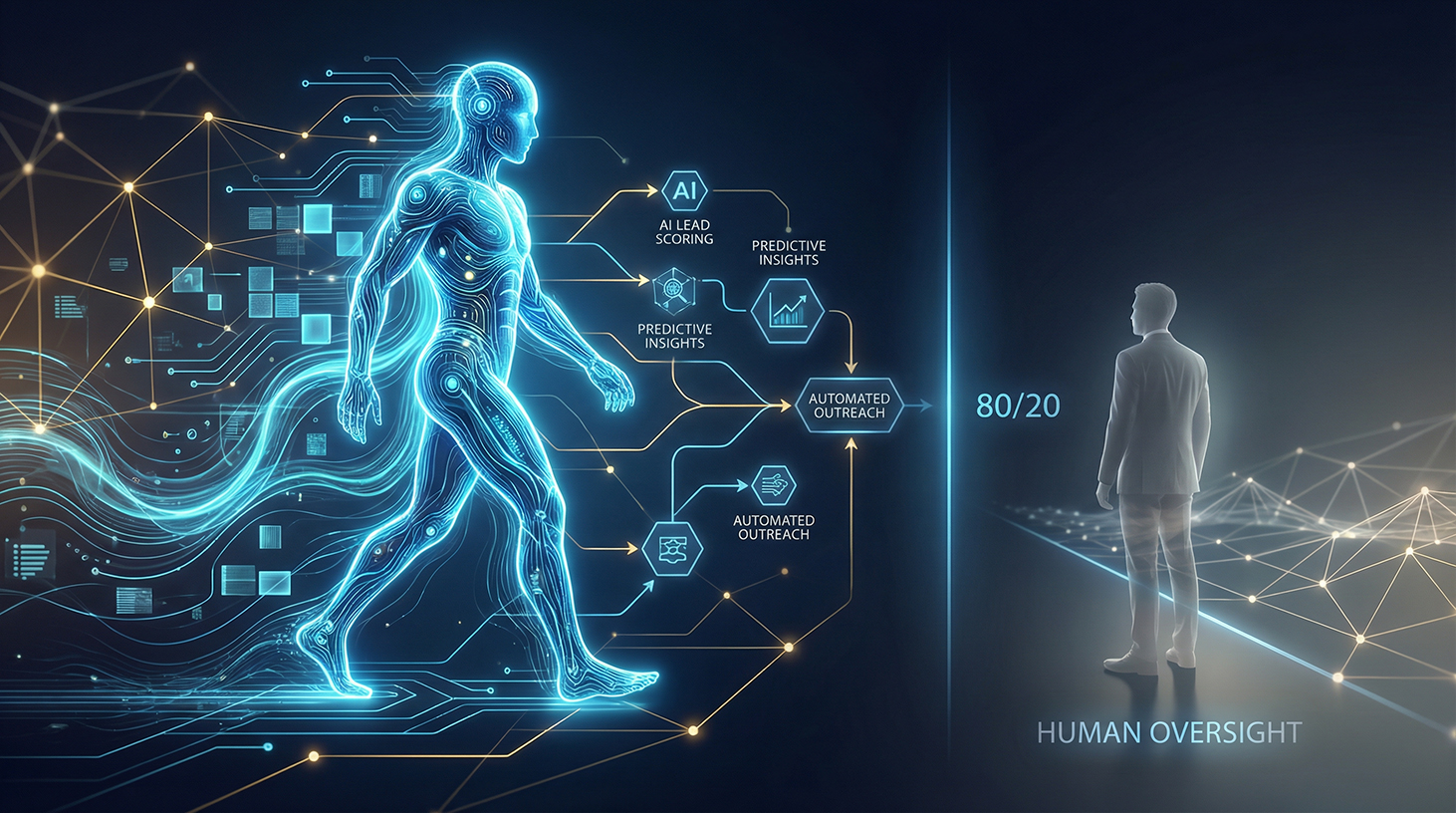
The end of the click? The silent takeover: When AI agents hijack the customer journey – Why AI agents will soon control 80% of your customers – Image: Xpert.Digital
When machines shop: How AI agents are radically changing B2B marketing
Despite the AI revolution: Why the human factor in marketing is now more valuable than ever
The marketing world is facing an unprecedented structural shift: By 2028, forecasts predict that vast portions of the customer journey will no longer be navigated by the customer themselves, but by autonomous AI agents. The provocative, yet data-driven 80/20 rule states that machines will handle 80 percent of the research, evaluation, and pre-selection processes, leaving humans with only the final 20 percent for emotional decisions and building genuine relationships. Those still relying solely on click-through rates, traditional website traffic, and conventional SEO are optimizing for a world that is disappearing before our very eyes. This article explores why Generative Engine Optimization (GEO) is the new standard, the logic behind AI agents' purchasing decisions, and why the human factor is by no means becoming obsolete in this new era—but rather undergoing a fundamental transformation. Discover why the transition to agent-first marketing is no longer a thing of the future, but is already determining the strategic survival of companies.
Related to this:

Who actually decides anymore – the human or their machine?
Most marketing teams are still optimizing for a world that's disappearing. They're adjusting click paths, refining landing pages, analyzing email open rates—and thus consistently measuring past performance. What they're overlooking: By 2028, according to Gartner forecasts, 90 percent of all B2B purchases will be brokered by AI agents, driving more than $15 trillion in corporate spending. McKinsey also anticipates a global revenue volume of $3 to $5 trillion orchestrated by agentic AI in the consumer sector alone by 2030. This is no longer a future scenario. It's an ongoing structural shift—and marketing organizations that ignore it risk their strategic relevance.
The core of the thesis: The 80/20 principle of the new customer journey
The provocative claim that 80 percent of the customer journey will no longer belong to the customer, but to their agent, sounds radical. It isn't. It's a sober description of a technological power shift that is already clearly reflected in the data. Gartner quantifies that organizations using multi-agent AI for 80 percent of their customer-facing business processes will systematically outperform their competitors by 2028. At the same time, the company predicts that AI agents will outnumber human salespeople by a ratio of ten to one by then.
What does this mean in concrete terms? An AI-powered purchasing agent, making procurement decisions on behalf of a company, doesn't read advertising messages. It doesn't click on banners. It isn't swayed by emotional campaigns. It analyzes product attributes, compares prices, checks reviews, verifies delivery documentation, and executes transactions autonomously – all without human involvement at the actual moment of decision. The 80/20 formula doesn't describe an arbitrary estimate, but rather the emergent endpoint of an automation trend: 80 percent of the research, evaluation, and pre-selection processes are handled by the machine; the remaining 20 percent – the final emotional decision, contract signing, and relationship management – still remain with humans.
The end of the human-centered funnel
To understand the scope of this shift, one must consider how the classic customer journey was conceived. From the ground up, it was a human process. The customer researches, compares, doubts, trusts, and decides. Marketing teams have spent decades learning how to address precisely these people: with emotions, with storytelling, with trust-building content at every touchpoint. The modern B2B customer journey, on average, comprises between 27 and 59 touchpoints before a purchase is completed. At the same time, studies show that 73 percent of B2B decision-makers have already made 70 percent of their purchasing decision before they even contact a supplier's sales department for the first time.
This picture is now fundamentally changing. The touchpoints aren't disappearing – they're being delegated. Humans send their agents ahead. These agents independently navigate the awareness, consideration, and sometimes even the decision phases. They condense information, eliminate alternatives, and ultimately present the human client with a pre-structured recommendation or execute transactions directly. The actual human only enters the journey once the machine has already made the decision.
The consequence for marketing teams is devastating when you think it through: campaigns that focus on human attention and emotion simply no longer reach anyone in the pre-decision phase – because no human attention takes place there.
Why classic marketing metrics no longer reflect the present
Click-through rate, open rate, website traffic, time on site – these metrics share a common underlying assumption: a human must actively create them. This very assumption is now crumbling. Around 65 percent of all search queries today end without a single click on a website. Gartner predicts that traditional search volume will decline by 25 percent by the end of 2026 because generative AI assistants and conversational platforms are increasingly replacing Google as the primary entry point. The traffic that marketing teams measure is therefore not only declining – it's also no longer measuring what it should be measuring.
The actual decision-making activity is shifting to invisible layers: into AI queries, API calls between agents, and machine-negotiated parameters that never open a browser or access a landing page. Anyone still solely focused on clicks, opens, and website traffic is measuring the past with outdated tools. Traffic from AI services to retail websites increased by 4,700 percent year-over-year in July 2025—but these are the instances where the agent still directs the human to a website. Far more often, it sends them nowhere at all, because it takes action itself.
The emerging new metric is "Share of Conversation" or "Answer Share": How often is a brand, product, or offer cited, recommended, or used as a preferred source by an AI system? This metric is still uncharted territory for most marketing teams today – but it will be the decisive competitive metric for the next three to five years.
The market volume of the upheaval: figures that underline the urgency
The economic dimensions of this transformation are both impressive and sobering for anyone still hesitant. The global market for enterprise agentic AI was estimated at $2.58 billion in 2024 and is projected to grow to $24.5 billion by 2030 – at a compound annual growth rate (CAGR) of 46.2 percent. Other research firms have arrived at similarly impressive figures: Grand View Research estimates the agentic AI market at $3.67 billion for 2025, Mordor Intelligence at $7.28 billion, and estimates for 2030 range from $24.5 billion to $48.2 billion. The total economic impact from productivity gains and new value creation patterns is forecast to generate between $2.6 trillion and $4.4 trillion in additional GDP growth by 2030.
These figures are not abstract. They describe concrete capital flows that are already shifting. According to a BCG survey, 43 percent of the CMOs surveyed are already investing between $10 and $15 million annually in scaling AI solutions. Over 80 percent of all CMOs report growing confidence and curiosity regarding the potential of AI – but only slightly less than a third have piloted beyond pure content creation. This gap between awareness and action is the real risk area for the next two years. Anyone who only starts transforming their marketing operating model to be agent-based in 2027 will have already lost out significantly.
BCG stands for Boston Consulting Group — a US-American strategy consulting firm founded in Boston in 1963 by Bruce D. Henderson. Along with McKinsey and Bain & Company, it belongs to the so-called “Big Three” of global management consulting and is considered one of the most influential think tanks for corporate strategy worldwide.
How AI agents actually make purchasing decisions
To effectively implement agent-first marketing, it's essential to understand the logic behind AI agents' selection processes. A study by Columbia University and Yale University, which analyzed the purchasing behavior of various AI models—including GPT-4, Claude Sonnet 3.5, and Gemini 1.5 Flash—in controlled e-commerce environments, provides illuminating insights. AI agents systematically analyze product attributes such as price, ratings, and reviews. They also react to platform characteristics like page position and recommendation tags. "Sponsored" labels tended to be viewed negatively, while recommendations like "Top Choice" or structured product data had a positive effect.
The implications are far-reaching: Classic advertising formats, designed to rely on human receptiveness to visual stimuli, narrative emotionalization, or brand relationships, completely miss their mark when the target audience is an algorithm. An AI agent is immune to glossy advertising. It responds to structured data, machine-readable product attributes, trustworthy rating structures, and clear API interfaces. This fundamentally shifts the marketing arsenal: away from creative branding and toward technical data preparation, semantic structuring, and algorithmic trustworthiness.
Added to this is the dimension of transparency and control: A representative Deloitte survey of 1,500 German consumers shows that around half of the respondents have already used AI-supported functions while shopping. At the same time, the majority still want human oversight when it comes to autonomous decisions, especially in sensitive areas – with transparency and traceability as key expectations. This creates a productive tension: Agents are becoming increasingly powerful, but the people who trust them reserve the right to escalate the situation. For brands, this means they must optimize for both levels – for the agent who pre-selects and for the person who ultimately places their trust in the system.
Generative Engine Optimization: The new SEO for the agent era
As AI agents increasingly act as intermediaries between brands and buyers, the strategic question arises: How do you get found and preferred by these agents? The answer lies in a new field of discipline emerging under the term Generative Engine Optimization (GEO). Where traditional SEO asked how to appear among the top results for specific keywords, GEO asks: How do you become a source that an AI system trusts enough to cite, recommend, or prefer for transactions?
The difference is fundamental. Traditional SEO ranking is optimized for human attention: A user clicks, scrolls, reads, rates, and converts. GEO is optimized for machine credibility: AI analyzes, prioritizes, trusts, and recommends—without a human eye ever seeing the website. Technical precision, unambiguous data structures, clear topical authority, consistent facts, and robust semantic markup are the building blocks of this new visibility. Those not positioned for GEO are simply invisible to the growing share of agent-mediated decision-making processes—regardless of how good their traditional SEO performance is.
Closely related to this is the concept of "machine-readable brand signals": Brands must communicate in formats that AI agents can process directly – via structured product data, open APIs, machine-readable price lists, and documented delivery terms. Retailers and suppliers who do not provide their data in this format will simply be incompatible with autonomous procurement agents and thus eliminated from the competition before the first human even considers manual research.
🎯🎯🎯 Data-driven B2B industry hub as a quasi-in-house solution

The quasi-in-house solution: How Xpert.Digital closes operational gaps in B2B marketing and sales – Smart Content-Driven Business - Image: Xpert.Digital
Xpert.Digital is a data-driven B2B industry hub led by Konrad Wolfenstein . The company acts as an external, quasi-in-house solution for industrial partners, closing operational gaps in marketing, content, and sales – without requiring additional resources on the client side.
More information here:
Data, trust, people: Three levers with which Xpert.Digital makes partners future-proof
The new dual strategy: Discoverability and Desirability
In a recent analysis, BCG describes the two strategic imperatives that determine success or failure in the age of agentic marketing: discoverability and desirability. Discoverability refers to the ability to be found by the agents who facilitate discovery processes—the GEO paradigm. Desirability describes the power to be desired by the consumers these agents serve—the classic brand and trust promise.
This dual strategy is crucial because it corrects the illusion that agentic marketing is purely technical. Those who optimize exclusively for machines lose the human connection that ultimately drives brand loyalty. Those who optimize exclusively for humans are overlooked by agents who handle 80 percent of the initial selection. Successful brands must master both levels: They must be algorithmically visible and humanly desirable – simultaneously.
BCG quantifies the ROI of this dual-oriented approach: Companies that deeply integrate Agentic AI into their marketing operations achieve a tripling of ROI, speed, and volume—translating into 5 to 10 percent incremental top-line growth and 15 to 20 percent cost savings. This is a self-financing transformation: Faster cycles generate higher margins, which can be reinvested in further AI investments.
Related to this:

B2B procurement as the vanguard of structural change
In the B2B sector, the transformation is even more dramatic than in the consumer segment because transaction volumes and the complexity of decision-making processes are far greater. Gartner projects that by 2028, more than $15 trillion in B2B spending will flow through AI agent exchanges—autonomous machine-to-machine procurement processes in which comparisons, negotiations, document reviews, and transaction execution take place without human intervention. Already, 94 percent of procurement teams use generative AI tools weekly—complete agentization is therefore not a question of if, but when.
The practical consequences for B2B sales organizations are profound. A company's B2B purchasing agent will soon be able to independently scan suppliers, compare prices, review compliance documents, monitor inventory levels, and automatically trigger orders when levels fall below a certain threshold—all without human intervention. Sales representatives who rely on human interaction and personal relationships will increasingly only be contacted when the agent escalates an exception or a decision is required above predefined thresholds. Adobe's "Experience Platform Agent Orchestrator," for example, already automates the entire process from buying group identification and journey orchestration to lead qualification. Salesforce Einstein Agents, HubSpot Breeze Intelligence, and similar platforms implement the same logic operationally.
According to Alvarez & Marsal, 81 percent of MarTech executives already report that their organizations are either testing or deploying autonomous AI agents in production. This is no longer a future scenario – it's the current state of affairs at leading companies.
How Xpert.Digital develops added value for its partners in this paradigm
The question of how a specialized B2B platform provider like Xpert.Digital creates added value for its partners in this context is not an abstract strategic question – it is a core operational question with a direct impact on competitiveness. The approach derived from these structural shifts follows a clear logic.
First: Data architecture as the foundation. In a world where AI agents make purchasing decisions based on product attributes, pricing structures, and rating data, the quality and machine readability of your own data becomes a core competency. Partners who provide their services, expertise, and terms in structured, API-accessible formats are compatible with agentic commerce processes. Those who don't are simply invisible to autonomous procurement agents. Xpert.Digital creates added value here by providing the digital infrastructure that makes partners visible in a machine-readable format—not only for human users but also for AI agents that research and procure on behalf of companies.
Secondly: Trust signals as a strategic resource. AI agents algorithmically weigh trust: through evaluations, consistency of information across data sources, and the strength of topical authority. Xpert.Digital's platform architecture enables partners to systematically build precisely these signals – through content strategies, structured expertise documentation, and verifiable performance records accessible to both human decision-makers and AI evaluation algorithms.
Thirdly: The human element as a differentiating factor. The 20 percent of the customer journey that remains with humans – emotional decisions, strategic partnerships, complex negotiations, high-risk contracts – is not a residual that can be ignored. It is the area where human competence, empathy, and strategic judgment are at their most valuable. For Xpert.Digital, this means the platform must not only be agent-capable but also human-centric in critical moments. This duality is the strategic core of the partner's value proposition.
The governance question: Who controls the agents who make the decisions?
As AI agents gain autonomy, so does the governance challenge – and it is far from trivial. When agents act on behalf of companies and consumers, questions of accountability, transparency, and human escalation mechanisms must be clearly defined. Around 73 percent of respondents in a recent German survey assume that AI agents are already being used in advertising – yet the majority still desire human oversight when autonomous decisions are made in sensitive areas. Transparency and accountability are considered key expectations for the use of AI.
This expectation creates structural requirements for companies: Agent decisions must be auditable. Escalation paths for human review must be defined. Governance frameworks must embed data protection, bias checks, and regulatory compliance into the agent architecture. Gartner explicitly warns that the AI agent ecosystem will fragment regionally, governance requirements will tighten, and companies that underestimate this structural complexity face significant regulatory and reputational risks.
At the same time, it's important to avoid overly prescriptive approaches. A recent Criteo study warns against viewing AI in shopping as the all-dominating interface – it will initially function as an additional touchpoint that gradually assumes more control. For marketers, this means that discovery, trust, and visibility must be strategically managed across an increasing number of environments – not as an either-or choice between human and agent-based marketing, but as a conscious management of both layers simultaneously.
Why the human factor doesn't disappear – but transforms
Amidst all these structural shifts toward agent-based automation, a false impression easily arises: that humans are being pushed out of the customer journey. This is a dangerous overinterpretation. The reality is more nuanced—and strategically more significant. While agents take over the efficiency-intensive, information-processing side of the journey, the importance of human competence grows precisely in those moments when trust, empathy, creative problem-solving, and ethical judgment are required.
BCG's findings show that two-thirds of leading marketing executives expect a significant AI-driven disruption of consumer behavior. They identify three areas where brands must build resilience: Discovery (where agents dominate), Service (where human-machine hybrids emerge), and Customer Relationships (where humans lead). The companies that strategically master this triad—that are algorithm-compatible without sacrificing human warmth—will be the winners of the next era.
Particularly revealing is the finding from neuropsychology: studies show that AI-generated advertising content activates weaker memory structures and is more frequently perceived as intrusive or boring. Brands like Polaroid, Heineken, and Porsche are already beginning to publicly position themselves with the "Made by Humans" signal – thereby appealing to precisely the 20 percent of the customer journey where the emotional quality of human communication makes all the difference. This isn't a romanticized regression, but rather a smart positioning strategy in a world where the human element gains value precisely because of its rarity.
Strategic areas of action for marketing organizations
Taking these economic and technological developments into account, concrete strategic fields of action emerge for marketing organizations that want to position themselves for the future.
The first area of focus is data strategy. Product data, service descriptions, pricing structures, and company profiles must be provided in machine-readable, structured formats that AI agents can process directly. This isn't an IT task—it's a core marketing competency. Those who don't invest here simply aren't compatible with the growing segment of agent-driven decision-making processes.
The second area of action is the metrics revolution. Traditional KPIs – clicks, opens, traffic – must be supplemented by agent-based metrics: Answer Share, AI Citation Rate, Agent Compatibility Score. Companies that rely solely on historical metrics will systematically make poor decisions because their data does not reflect the new decision-making reality.
The third area of action is skills development. According to Gartner, AI skills will be actively tested in 75 percent of all hiring processes by 2027. Marketing teams must start developing AI literacy not as an optional add-on, but as a core competency. Prompting skills, workflow design with AI agents, and critical judgment regarding AI spending are the new power skills of marketing.
The fourth area of action is governance architecture. Anyone using agents in marketing must define clear decision-making structures: What decisions can an agent make autonomously? At what point does the agent escalate to a human? How are agent decisions documented and made transparent? This framework is not only relevant from a regulatory perspective – it also signals trust to customers and partners.
Finally, the fifth area of action is the paradoxical strengthening of the human element. Precisely because agents handle 80 percent of the work, the remaining 20 percent of human interaction must be filled with even greater quality, empathy, and strategic depth. These are the moments when brand relationships truly emerge—and which no agent can ever replace.
The hour of decision
The 80/20 thesis is not a dystopia. It's a sober description of the reality currently unfolding. AI agents are taking over information processing, comparison, and pre-selection—simply because they can do it better, faster, and more cost-effectively than humans. This isn't a threat to marketing, but an invitation to reinvention. The question isn't whether this change is coming—it's already here. The question is which marketing organizations will shape it and which will be left behind.
Those who still build exclusively with a human-first approach are building for yesterday. Those who think with an agent-first approach – without forgetting the human element – are building for tomorrow. The strategic advantage lies not in an either-or choice, but in the masterful control of both levels: algorithm-compatible across the board, yet compellingly human in depth. This is the new benchmark for marketing excellence in the age of autonomous agents.
Your global marketing and business development partner
☑️ Our business language is English or German
☑️ NEW: Correspondence in your native language!

Konrad Wolfenstein
I and my team are happy to be available to you as your personal advisor.
You can contact me by filling out the contact form here or simply call me at +49 7348 4088 965. My email address is : [email protected]
I'm looking forward to our joint project.
☑️ SME support in strategy, consulting, planning and implementation
☑️ Creation or realignment of the digital strategy and digitization
☑️ Expansion and optimization of international sales processes
☑️ Global & Digital B2B trading platforms
☑️ Pioneer Business Development / Marketing / PR / Trade Fairs
📈🔵 Ambidexterity or doom: The only management concept that still works in the triple crisis💡

When proven strategies fail: Organizational adaptability in the digital transformation of ambidexterity - Image: Xpert.Digital
We are currently experiencing a period of economic turmoil that differs fundamentally from previous recessions. A deceptive silence prevails in the boardrooms of European and international companies – broken only by the sound of failing strategies that were considered a guarantee of success just yesterday. This is not merely a cyclical downturn, but a profound structural break. The tools with which companies achieved growth for over two decades simply no longer work.
More information here:
📈🔵 Market knowledge vs. marketing knowledge: Why SMEs block their own growth 💡

Market vs. Marketing Knowledge: Why SMEs Block Their Own Growth - Image: Xpert.Digital
A persistent, pragmatic misconception exists among small and medium-sized enterprises (SMEs): that those who know their customers and the market also know how marketing works. However, this very equation is increasingly becoming a strategic trap for many SMEs.
The following article analyzes the often overlooked tension between operational market knowledge (looking in the rearview mirror) and strategic marketing knowledge (the high beam for future market share). Learn why a sole focus on sales targets leads to interchangeability in the long run and how SMEs can mature from "short-distance runners" to distinctive brands by consciously separating and realigning these two disciplines. Because those who understand marketing merely as "colorful pictures for sales" surrender 95 percent of tomorrow's potential customers to the competition without a fight.
More information here:










