
10,000 humanoid robots per year: The gigantic secret plan of UBTECH and Siemens
Xpert Pre-Release

Available in 27 languages 📢
Prefer Xpert.Digital on GoogleⓘPublished on: March 21, 2026 / Updated on: March 21, 2026 – Author: Konrad Wolfenstein
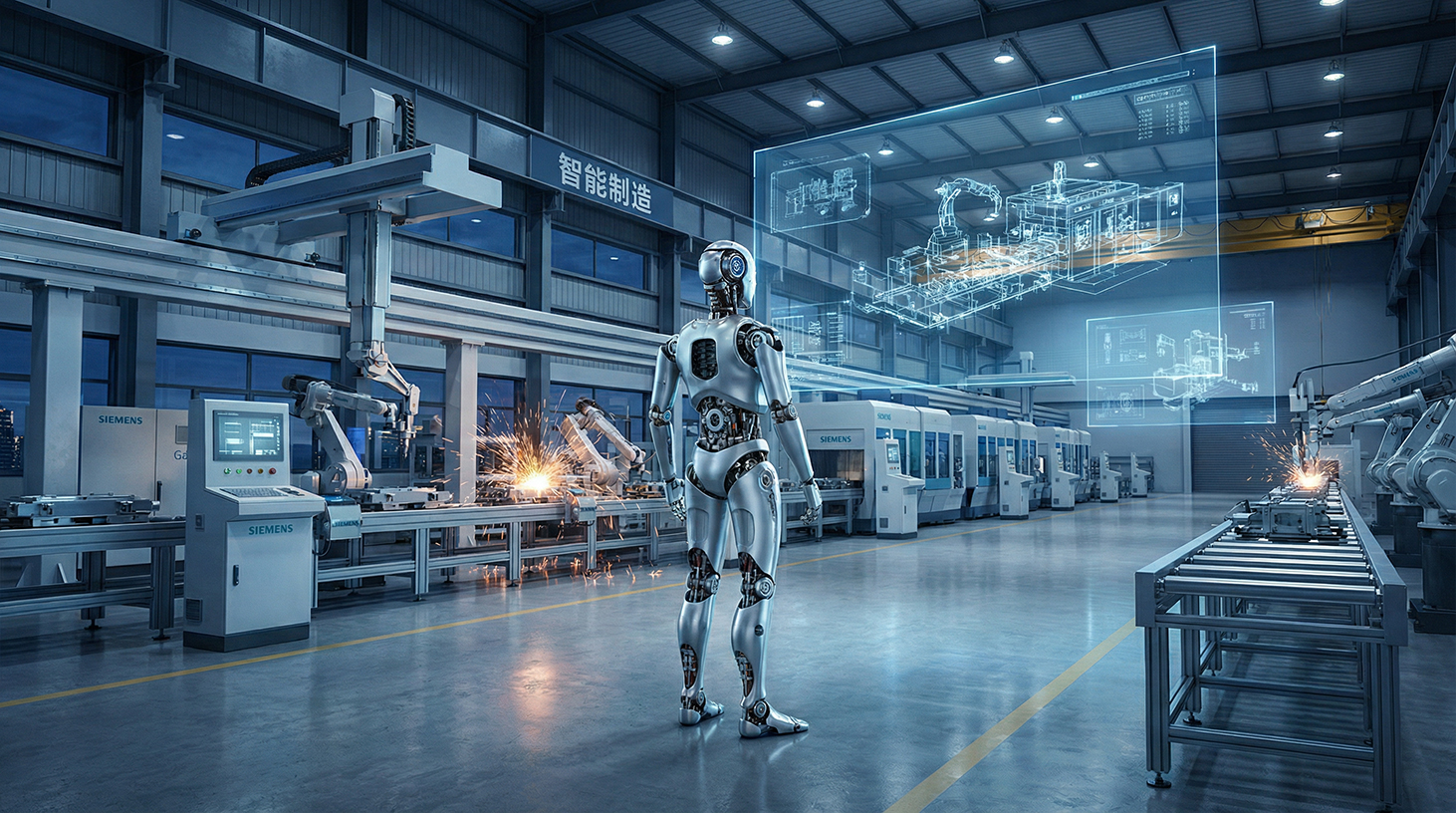
10,000 humanoid robots per year: The gigantic secret plan of UBTECH and Siemens – Image: Xpert.Digital
Airbus & BYD are already taking action: This Siemens deal brings humanoid robots into mass production
The robotics milestone: How Siemens is making the fully automated factory of the future a reality
Humanoid robots were long considered the stuff of science fiction or unfinished prototypes for research labs. But now, industry is accelerating its efforts toward global mass production: Chinese robotics pioneer UBTECH has partnered with German technology giant Siemens to achieve a scale previously unattainable in this sector. The ambitious goal: By the end of 2026, 10,000 industrial humanoid robots are to roll off the assembly line annually on a large scale. With the use of digital twins and Siemens' extensive software expertise, the historic leap from error-prone, small-scale manufacturing to high-volume industrial production becomes possible. This deal is not only a challenge to competitors like Tesla's "Optimus," but also marks a global turning point. Well-known customers such as Airbus and BYD are already using these steel helpers – demonstrating that the factory of the future is no longer a vision, but has long since become reality.
When software meets steel: Siemens paves the way to the humanoid factory
China's robotics frontrunner is acquiring European industrial expertise – thereby intensifying the global race for the factory of the future
A historic partnership with explosive potential
On March 16, 2026, UBTECH Robotics and Siemens Digital Industries Software signed a strategic cooperation framework agreement in Shenzhen that is causing a stir in the global robotics industry. The goal is clearly defined: UBTECH aims to achieve an annual production capacity of 10,000 industrial humanoid robots by the end of 2026 – not through slow scaling, but through technological acceleration made possible by Siemens' expertise in digitalization. This agreement is more than just another technology pact between an Asian hardware manufacturer and a European software provider. It marks a turning point in the history of humanoid robotics: the transition from prototype to industrial mass production.
UBTECH Robotics, founded in Shenzhen in 2012 and now listed on the Hong Kong Stock Exchange (09880.HK), has established itself over the past decade as one of the most technologically advanced developers of humanoid robots. The company employs a full-stack development approach – from motors and mechanical design to AI systems and control software, UBTECH develops all key components in-house. With the Walker S2, its current flagship model, the company launched its first series deliveries to industrial customers in November 2025, setting a milestone that few competitors have yet achieved.
Walker S2: From concept to commercial reality
The Walker S2 is 176 centimeters tall, weighs 70 kilograms, and boasts 52 degrees of freedom, giving it remarkable agility. Its payload capacity of approximately 15 kilograms makes it suitable for real-world production tasks, and a unique battery-swapping function enables continuous 24-hour operation without interruption—a crucial advantage in industrial shift work scenarios. At the heart of the system is UBTECH's proprietary Co-Agent System, an intelligent agent solution that provides the robot with capabilities for task planning, intent recognition, tool operation, and autonomous fault diagnosis.
Since the beginning of 2025, UBTECH has accumulated orders for its Walker series worth over 1.4 billion yuan – approximately US$195 million. Customers include prominent companies such as BYD, Dongfeng Liuzhou Motor, Geely Auto, FAW-Volkswagen Qingdao, Audi FAW, BAIC New Energy, Foxconn, and SF Express. In January 2026, an order from Airbus made headlines: The European aircraft manufacturer purchased Walker S2 robots for its manufacturing plant, making aerospace the fifth major industrial sector in which UBTECH's humanoid robots are commercially deployed.
The bottleneck problem: Why mass production is so difficult
Although demonstrations of powerful humanoid robots have garnered worldwide attention in recent years, a fundamental problem has persisted: scalable mass production. Humanoid robots integrate high-precision mechanics, AI systems, and motion control in a way that makes their manufacturing many times more complex than that of traditional industrial robots. Quality assurance, supply chain stability, and the reproducibility of highly complex assemblies in quantities exceeding a few hundred pose enormous challenges even for technologically advanced companies. This is precisely where the partnership with Siemens comes in.
UBTECH founder and CEO Zhou Jian succinctly summarized the problem: Demand for industrial humanoid robots has skyrocketed this year, and fulfilling these order volumes requires a qualitatively new manufacturing infrastructure. Mass production in the tens of thousands of units is no longer a matter of desire, but an operational necessity. The partnership with Siemens is designed as a strategic lever, combining technological excellence with industrial scalability.
Siemens as an architectural anchor: What the cooperation specifically entails
The collaboration will cover four core areas: strategic planning, technology integration, talent development, and ecosystem building. At its heart is the integration of Siemens' digital manufacturing software portfolio into UBTECH's entire development and production process – from component development to final assembly of the complete machine. Siemens will leverage its Xcelerator platform, which combines tools for product design, simulation, process planning, and manufacturing management.
At the heart of the technical collaboration is the implementation of digital twin technology. A digital twin allows every production process to be modeled, simulated, and optimized virtually before physical resources are deployed. In the context of robotic manufacturing, this means that design changes can be tested in real time, assembly processes can be validated virtually, and sources of error can be identified without causing costly interruptions in actual production. Siemens operates this expertise in more than 250 of its own plants worldwide and has thus built a database that is invaluable to external partners.
Beyond the software, Siemens has committed to providing technical training and tailored support services to prepare UBTECH's workforce for the demands of high-volume manufacturing. In an industry where skilled professionals with experience combining robotics, AI, and digital manufacturing management are still scarce, this knowledge transfer is a key part of the added value of the collaboration.
🎯🎯🎯 Benefit from Xpert.Digital's extensive, five-fold expertise in one comprehensive service package | BD, R&D, XR, PR & Digital Visibility Optimization

Benefit from Xpert.Digital's extensive, five-fold expertise in a comprehensive service package | R&D, XR, PR & Digital Visibility Optimization - Image: Xpert.Digital
Xpert.Digital possesses in-depth knowledge across various industries. This allows us to develop tailored strategies precisely aligned with the requirements and challenges of your specific market segment. By continuously analyzing market trends and monitoring industry developments, we can act proactively and offer innovative solutions. The combination of experience and expertise generates added value and provides our clients with a decisive competitive advantage.
More information here:
A German tech giant is supplying the brain for China's new robot army
Ambitious production targets and the new Shanghai base
The production targets are ambitious, but not unrealistic. UBTECH plans to initially manufacture 5,000 units in 2026 to fulfill large orders worth over 800 million yuan. By 2027, this capacity is expected to scale to 10,000 units annually. In addition, at the global investment promotion event in Shanghai on March 14, 2026, the company announced a new commercial production base for humanoid robots in the city, which is expected to play a key role in achieving these volume targets.
In parallel with its manufacturing expansion, UBTECH is securing its supply chain through vertical integration. The company has acquired a stake of nearly 30 percent in Zhejiang Fenglong Electric Co., Ltd. to gain direct control over critical components. CEO Zhou Jian has assumed operational control – a signal that management recognizes its reliance on external suppliers as a strategic risk and is actively minimizing it.
The global competitive landscape: From Tesla's Optimus to Chinese newcomers
UBTECH is not operating in a vacuum. The global robotics industry is engaged in an unprecedented race for industrial market leadership. Tesla has announced plans to begin production of its humanoid robot Optimus 3 in the summer of 2026, with high-volume manufacturing starting in 2027. At the same time, the Chinese company D-Robotics secured a $120 million funding round, bringing its total funding for Series A and B to $220 million.
The market for humanoid robots is growing with a dynamism that seemed unimaginable just a few years ago. MarketsandMarkets forecasts growth from $2.92 billion in 2025 to $15.26 billion in 2030 – an annual growth rate of 39.2 percent. Significantly more optimistic scenarios come from Goldman Sachs, which has revised its estimated market potential for 2035 upwards from $6 billion to $38 billion. Morgan Stanley even assumes that the total market, including supply chains and service networks, could exceed $5 trillion by 2050.
ABI Research sees a turning point between 2026 and 2027, when regulatory, safety, and return-on-investment issues should be largely resolved. The research firm expects global annual shipments of 195,000 humanoid robot units by 2030.
Strategic importance for Siemens: More than just a software licensing deal
For Siemens, the UBTECH collaboration is strategically significant, even if the immediate financial impact on the Munich-based company's balance sheet is likely to be moderate at first. The robotics industry is considered one of the most important growth markets for software solutions in the field of digital manufacturing. By entering into an early partnership with one of the leading commercially active humanoid robot manufacturers, Siemens is positioning itself as the preferred digitalization partner in a market that could encompass hundreds of companies and hundreds of thousands of production units within just a few years.
Siemens' Xcelerator platform benefits from a network effect: the more robot manufacturers use the platform, the richer the reference data, simulation models, and integration standards become – and the more attractive the platform becomes for new users. The UBTECH partnership is therefore not just an individual contract, but a reference project that Siemens aims to establish as the standard digitalization platform for humanoid robotics manufacturing.
Structural challenges on the road to mass production
As promising as the partnership is, significant structural challenges remain. Manufacturing humanoid robots in quantities of 10,000 units annually requires not only a functioning digitalization infrastructure but also a reliable supply chain for specialized components such as actuators, high-precision gearboxes, sensor systems, and AI processor units. Many of these components are still within supply chain processes optimized for significantly lower production volumes.
Added to this is the question of quality assurance on an industrial scale. A humanoid robot that fails during field use at an automotive manufacturer has a direct impact on the production line. The tolerance for errors is therefore significantly lower than in consumer-oriented applications. Siemens' experience with end-to-end digitalization in safety-critical manufacturing environments – from aerospace to automotive production – can make crucial contributions here by integrating quality control processes as early as the digital simulation phase.
The economic implications: An industrial sector on the rise
The collaboration between UBTECH and Siemens exemplifies a structural shift in the global industrial landscape. Humanoid robots are no longer science fiction. They are commercial products deployed on automotive production lines, in logistics centers, and data centers – with clearly defined order volumes, supply contracts, and return-on-investment calculations. IDTechEx predicts that the global market for humanoid robots will reach almost US$29.5 billion by 2036, driven primarily by applications in automotive manufacturing and logistics.
The true significance of the Siemens-UBTECH deal, however, lies not only in the specific production targets. It lies in the signaling effect: High-precision digital manufacturing infrastructures, such as those offered by Siemens with Xcelerator, are becoming a prerequisite for competitive humanoid robotics production. Whoever masters the digitalization of manufacturing will significantly influence the market economy – not only through production volume, but also through cost leadership, iteration speed, and consistent quality in an industry that is only just beginning to realize its full economic potential.
📈🔵 Ambidexterity or doom: The only management concept that still works in the triple crisis💡

When proven strategies fail: Organizational adaptability in the digital transformation of ambidexterity - Image: Xpert.Digital
We are currently experiencing a period of economic turmoil that differs fundamentally from previous recessions. A deceptive silence prevails in the boardrooms of European and international companies – broken only by the sound of failing strategies that were considered a guarantee of success just yesterday. This is not merely a cyclical downturn, but a profound structural break. The tools with which companies achieved growth for over two decades simply no longer work.
More information here:
Your global marketing and business development partner
☑️ Our business language is English or German
☑️ NEW: Correspondence in your native language!

Konrad Wolfenstein
I and my team are happy to be available to you as your personal advisor.
You can contact me by filling out the contact form here or simply call me at +49 7348 4088 965. My email address is: [email protected]
I'm looking forward to our joint project.









