
Federal Statistical Office | Order books fuller than ever: The German industry lobby's deceptive crisis game
Xpert Pre-Release

Available in 27 languages 📢
Prefer Xpert.Digital on GoogleⓘPublished on: May 22, 2026 / Updated on: May 22, 2026 – Author: Konrad Wolfenstein
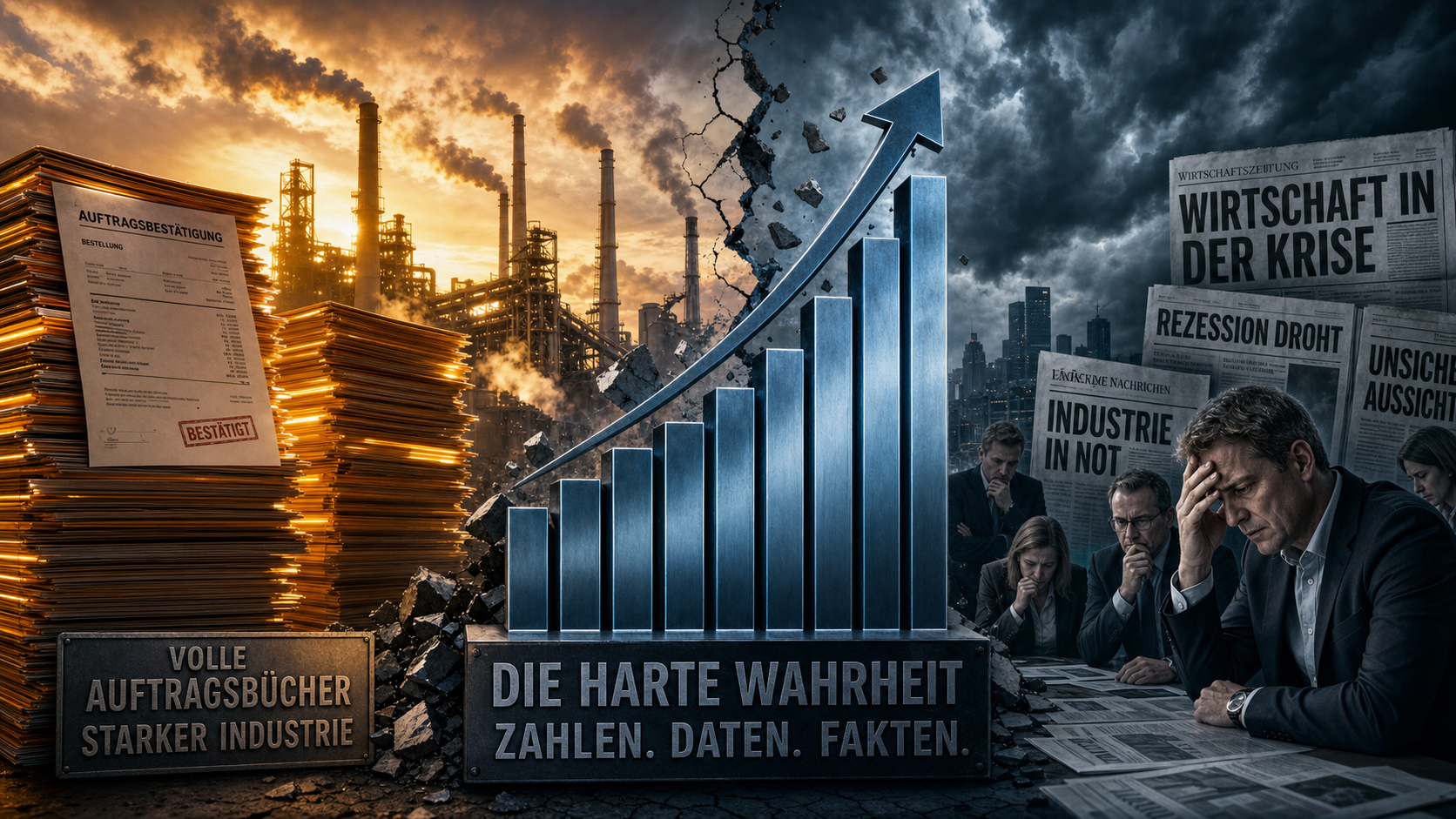
Federal Statistical Office | Order books fuller than ever: The German industry lobby's deceptive crisis strategy – Image: Xpert.Digital
Record orders and Cassandra-like warnings: The politically expedient strategy and economics of the German crisis discourse
The lie of deindustrialization? What the record economic figures really mean
Record orders vs. scaremongering: Why German industry is artificially portraying itself as poor
In the spring of 2026, the German economy experiences a paradoxical phenomenon: While the Federal Statistical Office reports record-breaking levels of industrial order backlogs, prominent business associations orchestrate an unprecedented crisis discourse. Order books across all sectors are as full as they have been since statistical records began, yet the official rhetoric of many lobbyists tirelessly conjures up the specter of deindustrialization. How can this be? The answer lies not in pure mathematics, but in the country's political economy. The systematic reinterpretation of economic successes as alleged harbingers of doom is not a communication error, but a highly rational strategy. It's about negotiating power, securing billions in state subsidies, and controlling the narrative surrounding Germany's economic standing. This article deconstructs the narrative of permanent crisis, separates legitimate industry concerns from targeted fear-mongering, and sheds light on the uncomfortable truths behind economic communication that strategically ignores positive facts as soon as they disrupt its own lobbying narrative.
Related to this:


When facts disrupt the narrative — record numbers, fear-mongering, and the negotiating power of associations
Billions in subsidies through fear: How business associations are gambling with ruin
German industry will make history in the spring of 2026—at least according to official statistics. The real, price-adjusted order backlog in the manufacturing sector rose by 1.6 percent in March 2026 compared to the previous month and by a substantial 8.4 percent compared to the same month of the previous year. What the Federal Statistical Office soberly publishes as a data point is, in reality, a watershed moment in economic history: Order books are fuller than ever before since these statistics began being compiled in 2015. The order backlog has climbed to 8.8 months, meaning that, assuming a constant production pace, industry could manage for almost nine months without a single new order. For manufacturers of capital goods, this figure is even higher, at 12.2 months.
At the same time, influential voices in organized business comment on these figures in a way reminiscent of a classic bilingual text: The same phenomenon that official statisticians report as a record is described by industry representatives as an expression of panic, a deceptive glimmer of hope, and a short-term peak in a long-standing structural crisis. This discrepancy is not mere communication noise. It is the result of a decades-long, systematically cultivated strategy of self-interest by the German industrial lobby—and it deserves critical economic analysis that goes beyond simply quoting press releases.
Related to this:

What the data really shows
The order backlog in March 2026, when considering the official Destatis figures in their entirety, is remarkably broadly diversified. This positive trend extended across all sectors of the economy. The largest increases came from other vehicle manufacturing – that is, the construction of aircraft, ships, trains, and military vehicles – with a rise of 1.5 percent, as well as from manufacturers of data processing equipment, electronic, and optical products, with an increase of 3.8 percent. The order backlog for intermediate goods also rose by 2.0 percent, and even the long-neglected consumer goods manufacturers recorded an increase of 5.0 percent.
Domestic orders rose by 1.4 percent, while foreign orders increased by 1.7 percent. This indicates that not only the domestic market but also international customers are signaling increased demand for German industrial products. It should also be noted that order intake—that is, new business, not the cumulative backlog—also rose sharply in March 2026: by 5.0 percent compared to the previous month and by 6.3 percent compared to the same month of the previous year. Even more telling is the fact that order intake excluding large orders increased by 5.1 percent, reaching its highest level since February 2023. Large orders, which often skew statistics, therefore did not play a significant role here—this represents a broad, organic recovery in demand.
These figures are not an isolated monthly fluctuation. They reflect a trend that has been evident since at least the second half of 2025. As early as December 2025, the order backlog had reached its highest level since October 2022. The order backlog had risen to 8.6 months in February 2026, before increasing again to 8.8 months in March. Capital goods manufacturers, which in Germany typically include mechanical engineering, aerospace, and special vehicles, are sitting on order reserves that, theoretically, guarantee them over a year of production.
The sector counterpoint: Chemistry on a special path
Before dismissing the crisis rhetoric of industry associations as purely strategic posturing, it is analytically necessary to identify the structural problems of individual sectors that exist beyond economic cycles. The chemical industry is the clearest example of this. The German Chemical Industry Association (VCI) reported a further decline in production, prices, and sales for the fourth quarter of 2025—with a capacity utilization rate averaging 72.5 percent for the entire year of 2025, well below the break-even point. In the basic chemicals sector, orders have fallen by around 30 percent since 2021. These figures are real; they represent real job losses and real plant closures.
Managing Director Wolfgang Große Entrup is therefore not entirely without reason when he interprets the industry's full order books as a reaction to the Iran war and the associated stockpiling by international customers, rather than as proof of a sustainable recovery. The Iran war and the blockade of the Strait of Hormuz have indeed created new dimensions of risk for the chemical industry: shortages of ammonia, phosphate, helium, and sulfur are real threats that extend beyond the immediate effects on oil and gas prices. For the chemical industry, the current increase in orders is indeed largely supply-driven—customers are securing quantities because they fear supply bottlenecks, not because demand has grown structurally.
This finding demonstrates the importance of properly decontextualizing the aggregated figures from the Federal Statistical Office: The manufacturing sector is not a monolithic entity. While aerospace, rail vehicle construction, electronics, and data processing equipment are experiencing a genuine recovery in demand, the basic chemicals sector is grappling with structural distortions that economic stimulus alone cannot resolve. Nevertheless, even if the chemicals sector is completely excluded from the overall analysis, the broad increase in orders across all other sectors remains in need of explanation—and fundamentally contradicts the sweeping crisis narrative.
When record numbers are reinterpreted as a crisis
It's a peculiar communicative phenomenon: the same institutions that demand immediate political action when faced with bad figures downplay good ones using a set of rhetorical techniques known in communication research as strategic ambiguity. Alexander Krüger, chief economist at the private bank Hauck Aufhäuser Lampe, commented on the record figures not as confirmation of a recovery, but as statistically interesting yet economically irrelevant. Orders are being processed slowly, and capacities are hardly being expanded. Despite the healthy order situation, the gradual decline in employment will likely continue.
Now, Krüger is a reputable economist, and his warning to exercise caution is not inherently wrong. There is indeed a link between order backlog and actual production ramp-up, a link that can be disrupted by bottlenecks, a shortage of skilled workers, and location-related cost issues. However, the timing of these attempts to downplay the situation follows a pattern worth noting: as soon as the data is favorable, structural constraints are touted as the main issue. As soon as the data is unfavorable, those very figures are presented as the ultimate proof of a profound crisis. The crisis narrative outlives every data point—both positive and negative.
The Ministry of Economic Affairs added that current indicators pointed to a significant slowdown in the second quarter. Rising prices, supply chain problems, and uncertainty were weighing on businesses and households. Further developments depended on the course of the conflict in the Middle East. This assessment is a valid geopolitical risk warning—however, it is likely to overshadow the structurally positive order data and divert public attention away from the record figures.
Lobbying through lamentation: How crisis myths generate political gains
To understand why the systematic exaggeration of crisis symptoms is rational for industry associations, one must understand the functional logic of the German corporatist system. Germany has a historically deep institutional entanglement between organized economic interests and state economic policy. Associations such as the BDI, the BDA, the VCI, or the VDA are not mere interest groups in the Anglo-American sense—they are part of a system in which they act as quasi-state actors and actively participate in shaping political decisions. This privileged position is contingent upon an implicit condition: The associations must present problems in such a way that political action appears imperative.
Those who signal crisis receive subsidies—this is not a cynical quip, but an empirically verifiable logic of German economic development. The Scientific Advisory Board of the Federal Ministry for Economic Affairs and Energy explicitly warned in an expert opinion that a multitude of support measures could transform the economy into a chaotic jumble of subsidies without a clear direction, because companies increasingly align their investments with political developments rather than market opportunities. In other words, the subsidy system itself creates an incentive not to appear too successful—or to frame success in such a way that it is not a given, rendering political intervention unnecessary.
Added to this is the classic mechanism of negotiating pressure. When companies and associations complain about location disadvantages, the primary goal is not the objective documentation of competitive barriers, but rather to create leverage in negotiations with federal policymakers. Demands for tax cuts, lower energy prices, fewer environmental regulations, or reduced social standards are much easier to push through politically when articulated within the context of a dramatized crisis than when presented against the backdrop of rosy record figures. An association announcing record numbers has a significantly weaker hand in the next lobbying session on electricity price compensation than one that simultaneously conjures up images of crisis, job losses, and deindustrialization.
The spectre of deindustrialization
Few terms have shaped the economic policy debate of recent years as much as deindustrialization. It is striking, however, how rarely this term is supported by concrete figures on the share of value added. Looking at the real, price-adjusted share of the manufacturing sector in gross value added reveals a picture that directly contradicts the popular narrative of industrial decline: this share has remained largely stable in Germany since 2010. A profound deindustrialization cannot be diagnosed based on this indicator. Previous studies based on OECD data have already shown that not only Germany, but also the USA and the Eurozone average have exhibited a remarkable consistency in the real share of industry.
What is actually taking place is a sectoral structural change within industry: sectors like basic chemicals are losing importance, while areas such as aerospace, rail vehicle manufacturing, medical technology, and electronics—precisely those segments that are driving the current record orders—are gaining in significance. This change is not deindustrialization, but rather industrial structural change—a process that has been part of the normal economic biography of developed economies since the emergence of the modern industrial economy. Authors such as Colin Clark and Jean Fourastié have theoretically anticipated this three-sector shift. Equating it with the term deindustrialization distorts the economic policy picture and creates a political alarm that does not reflect the nuanced reality.
Furthermore, the development of industry-related services deserves attention, as it is not visible in traditional industrial statistics: logistics, IT services, engineering firms, technical planning and maintenance—all these activities are functionally integral to the industrial value creation process, but are statistically counted as services. The true industrial core of Germany is therefore significantly larger than pure production figures would suggest.
🎯🎯🎯 Data-driven B2B industry hub as a quasi-in-house solution

The quasi-in-house solution: How Xpert.Digital closes operational gaps in B2B marketing and sales – Smart Content-Driven Business - Image: Xpert.Digital
Xpert.Digital is a data-driven B2B industry hub led by Konrad Wolfenstein . The company acts as an external, quasi-in-house solution for industrial partners, closing operational gaps in marketing, content, and sales – without requiring additional resources on the client side.
More information here:
Iran war, energy prices, skilled worker shortage: What risks are the record figures masking?
Iran War as a Wildcard: Real Uncertainty and its Strategic Use
It would be one-sided to ignore the geopolitical component of the current economic climate. The war with Iran and the associated blockade of the Strait of Hormuz represent a real, not symbolic, threat to parts of the German economy. The German Association of Energy and Water Industries (BDEW) noted that while the blockade has little direct impact on Germany's physical gas supply—because Germany obtains its gas primarily from Norway and via LNG imports from other sources—it does have noticeable indirect effects through wholesale prices. The International Energy Agency described the consequences as the largest supply disruption in the history of the global oil market.
For the chemical industry, the consequences are more immediate: Six to eight weeks of transport time from the Middle East or China means that raw material shortages will only become apparent after some delay. Companies like Lanxess have already initiated concrete measures—550 jobs are being cut, primarily in administration. Wolfgang Große Entrup explicitly warned of price increases and shortages of essential chemicals, especially for medium-sized companies that would have no chance of restructuring their raw material base in the short term.
These real problems justify economic policy attention. What they do not justify, however, is equating sectoral-specific geopolitical problems with an overall industrial decline. If the order backlog of the entire industry reaches record levels—driven by electronics, aerospace, and rail vehicle manufacturing—then the VCI's statement that its own record figures are an expression of "sheer panic" may be partially true for the chemical industry. As a description of German industry as a whole, it is simply wrong.
Employment: The inconvenient truth behind the numbers
The prediction of a gradual decline in employment despite full order books is not a contradiction in terms—but it requires a more thorough explanation than is usually provided. According to an IW survey, around 35 percent of companies planned to reduce their workforce in 2025. 22 out of 46 business associations surveyed anticipated job losses in their sectors by 2026. These figures are real and deserve attention.
However, job cuts coupled with a rising order backlog are not the hallmark of a declining industrial location, but rather often a sign of increased productivity, automation, and corporate restructuring. Companies are reducing staff not because of a lack of demand, but because they can or want to produce more with fewer employees—due to rising labor costs, the introduction of AI and automation technologies, or the relocation of value creation to countries with lower labor costs. In none of these cases is this an industrial decline in the sense of a lack of demand for German products. The data shows: demand exists. The question is who benefits from it—shareholders through higher margins or employees through job security.
This question of distribution is chronically neglected in German economic discourse. While the deregulation demands of industry associations—less bureaucracy, lower energy prices, more flexible labor markets—are partly formulated in the interest of employees, their concrete effect is to shift the balance of power between capital and labor in favor of capital. Research has empirically shown that lowering job security in several European countries has not led to more regular employment, but in some cases even to higher unemployment. The supposed job creation benefits of deregulation are empirically far less robust than their political proponents suggest.
Energy prices and location disadvantages: Valid concerns, strategically exploited
That high energy prices pose a real competitive problem for energy-intensive industries is undisputed. The most energy-intensive sectors—basic chemicals, aluminum, steel, and glass—do indeed suffer from a cost disadvantage compared to competitors from countries with lower energy prices. The structural reasons for this are complex: the cessation of cheap Russian natural gas after the war in Ukraine, the still incomplete energy transition, regulatory levies, and additional grid charges.
But it is analytically important to distinguish between the real energy price problem and the rhetorical use of this problem in political discourse. If the chemical industry association simultaneously reports record order backlogs and conjures up images of a structural crisis, one has to ask: What order backlog would actually be needed for the association to acknowledge a recovery? The answer is: none—because the crisis narrative is not tied to data points, but to political objectives. It's about permanently reducing energy price pressure through government compensation, tax breaks, and deregulation. These objectives are not illegitimate per se, but they don't become any more honest when they are clothed in the language of facts that the actual figures don't reflect.
This is also evident in the discrepancy between industry rhetoric and actual business reality. When order books are full, when capital goods manufacturers maintain a 12-month supply chain, when order intake, excluding large orders, reaches its highest level in three years—then German industry is clearly functioning. It does so not despite the disadvantages of its location, but alongside them. Industry is more adaptable than the complaints suggest.
Structural change or strategic pessimism: Two interpretive frameworks
There are two fundamentally different ways to interpret the current situation of German industry, and both have empirical foundations — they just weigh the evidence very differently.
The first interpretation is that of organized industry: Germany is structurally losing competitiveness. Energy prices are too high, bureaucracy too extensive, taxes too high, and the labor shortage too severe. The record order backlog is an illusion—either distorted by geopolitical stockpiling or devalued by structural obstacles to processing. Without fundamental reforms, long-term industrial decline is imminent.
The second interpretation arises from a sober reading of the data: Broad industrial demand exists and is historically high. Certain sectors—particularly basic chemicals—are struggling with structural problems that deserve real political attention. Other sectors—electronics, aerospace, and rail vehicles—are thriving. Geopolitical risks are real, but currently in their acute phase. The much-cited deindustrialization is not occurring according to the most relevant value-added metrics. What is happening is sectoral structural change—normal, historically embedded, and malleable. Job losses coupled with a full order book signal restructuring and productivity gains, not industrial decline.
Which interpretation is closer to the truth? Based on the available data, the second interpretation is more robust. This does not preclude the possibility that some of the reform demands contained in the first interpretation are justified. Reducing bureaucracy, creating more investment-friendly conditions, and ensuring cost transparency in the energy transition—these are legitimate political concerns. However, they become neither more analytically honest nor more politically credible when built on the foundation of a distorted crisis narrative.
The defense and infrastructure element: The new demand logic
One of the most striking explanations for the current record figures, which has received too little attention in public discourse so far, is the massive shift in government demand towards defense and infrastructure. Other vehicle manufacturing—a sector encompassing aircraft, ships, trains, and military vehicles—is among the strongest drivers of growth in the current order backlog. In Germany, the realignment of defense policy and the European defense package triggered a wave of government procurement contracts, which is now reflected in the industrial statistics.
This is economically significant. Defense and infrastructure contracts differ in their demand quality from private consumer orders or export-driven industrial orders: they are often longer-term, contractually bound, and less sensitive to economic cycles. The fact that capital goods manufacturers' orders extend to 12 months is also a reflection of the defense boom. This means two things: the record figures are genuinely record figures, but their composition contains structural elements that limit conclusions about civilian export demand. At the same time, the broad upward trend across all goods categories—intermediate, capital, and consumer goods—shows that the upswing cannot be reduced to government defense orders alone.
What responsible business communication should achieve
Public economic discourse fulfills a democratic function: it enables informed citizens to assess economic policy decisions. When this discourse is systematically distorted—when industry associations frame record figures as a crisis to maximize political gains—the quality of democratic economic policy erodes. Citizens pay subsidies to industries that simultaneously have record order books. Employees are urged to hold back wages, citing a crisis that is not reflected in official statistics.
Responsible business communication would differentiate: It would identify sectors genuinely facing structural difficulties—basic chemicals, for example, grappling with import competition from China and the structural end of the cheap energy era. It would name real geopolitical risks—the Iran war, the Hormuz blockade, supply chain disruptions. But it would also acknowledge that most German industry will be operating with full order books in the spring of 2026, meeting demand on a historic scale.
There is no structural or normative necessity to downplay good news. The challenge for German economic policy lies not in signaling further crisis, but in addressing the real structural transformation requirements—fairly distributing the costs of the energy transition, addressing the shortage of skilled workers, promoting digitalization, and making international supply chains more resilient—without resorting to the dramaturgy of false disaster scenarios.
The structural paradox: Full order books as an economic policy risk
It may sound paradoxical, but record order backlogs can also be problematic for an economy—not because of the orders themselves, but because of what they reveal about capacity and productivity reserves. A backlog of 8.8 months means that industry simply cannot meet the existing demand quickly enough with the available capacity. This raises questions: Is there a shortage of skilled workers? Are supply chains too fragile? Is the machinery too old or underdeveloped? Have too many years of hesitant investment policies—facilitated by years of cheap debt financing—squandered competitive potential?
If industry fails to expand capacity despite full order books, that's a valid warning signal—but one that calls for a different kind of political debate than crisis rhetoric. It's an argument for promoting investment in production infrastructure, for faster permitting processes for factory expansions, and for proactive skilled labor policies. That's a constructive agenda. It sounds different from complaints about deindustrialization and demands for subsidies—but it's more honest and politically more effective.
Between legitimate concerns and strategic exaggeration
In May 2026, German industry finds itself in a complex and challenging environment. Its order books are fuller than ever before since official records began—a statistical fact beyond interpretation. Individual sectors, particularly basic chemicals, are mired in a structural crisis that cannot be resolved with a single month's notice and requires real political solutions. The war with Iran and the Hormuz blockade create genuine geopolitical risks for parts of the economy. The energy price issue remains a persistent structural problem with significant implications for investment policy.
All of this is true. And yet: The systematic reinterpretation of historical record figures as proof of crisis is not an honest contribution to the economic policy debate. It is a tool of special interest politics, intended to push through deregulation, subsidies, and wage suppression policies under the guise of objective facts. Those who understand this mechanism can read economic reporting more critically—and better assess economic policy demands. Not everything formulated in the name of crisis serves those affected by it. Sometimes it only serves those who are telling the story of the crisis.
Your global marketing and business development partner
☑️ Our business language is English or German
☑️ NEW: Correspondence in your native language!

Konrad Wolfenstein
I and my team are happy to be available to you as your personal advisor.
You can contact me by filling out the contact form here simply call me at +49 7348 4088 965. My email address is [email protected]:or
I'm looking forward to our joint project.
☑️ SME support in strategy, consulting, planning and implementation
☑️ Creation or realignment of the digital strategy and digitization
☑️ Expansion and optimization of international sales processes
☑️ Global & Digital B2B trading platforms
☑️ Pioneer Business Development / Marketing / PR / Trade Fairs
🎯🎯🎯 Data-driven B2B industry hub as a quasi-in-house solution
The quasi-in-house solution: How Xpert.Digital closes operational gaps in B2B marketing and sales – Smart Content-Driven Business - Image: Xpert.Digital
Xpert.Digital is a data-driven B2B industry hub led by Konrad Wolfenstein . The company acts as an external, quasi-in-house solution for industrial partners, closing operational gaps in marketing, content, and sales – without requiring additional resources on the client side.
More information here:










