
Who owns the business lobby? The betrayed backbone: Why the middle class is losing mercilessly in politics
Xpert Pre-Release

Available in 27 languages 📢
Prefer Xpert.Digital on GoogleⓘPublished on: May 19, 2026 / Updated on: May 19, 2026 – Author: Konrad Wolfenstein
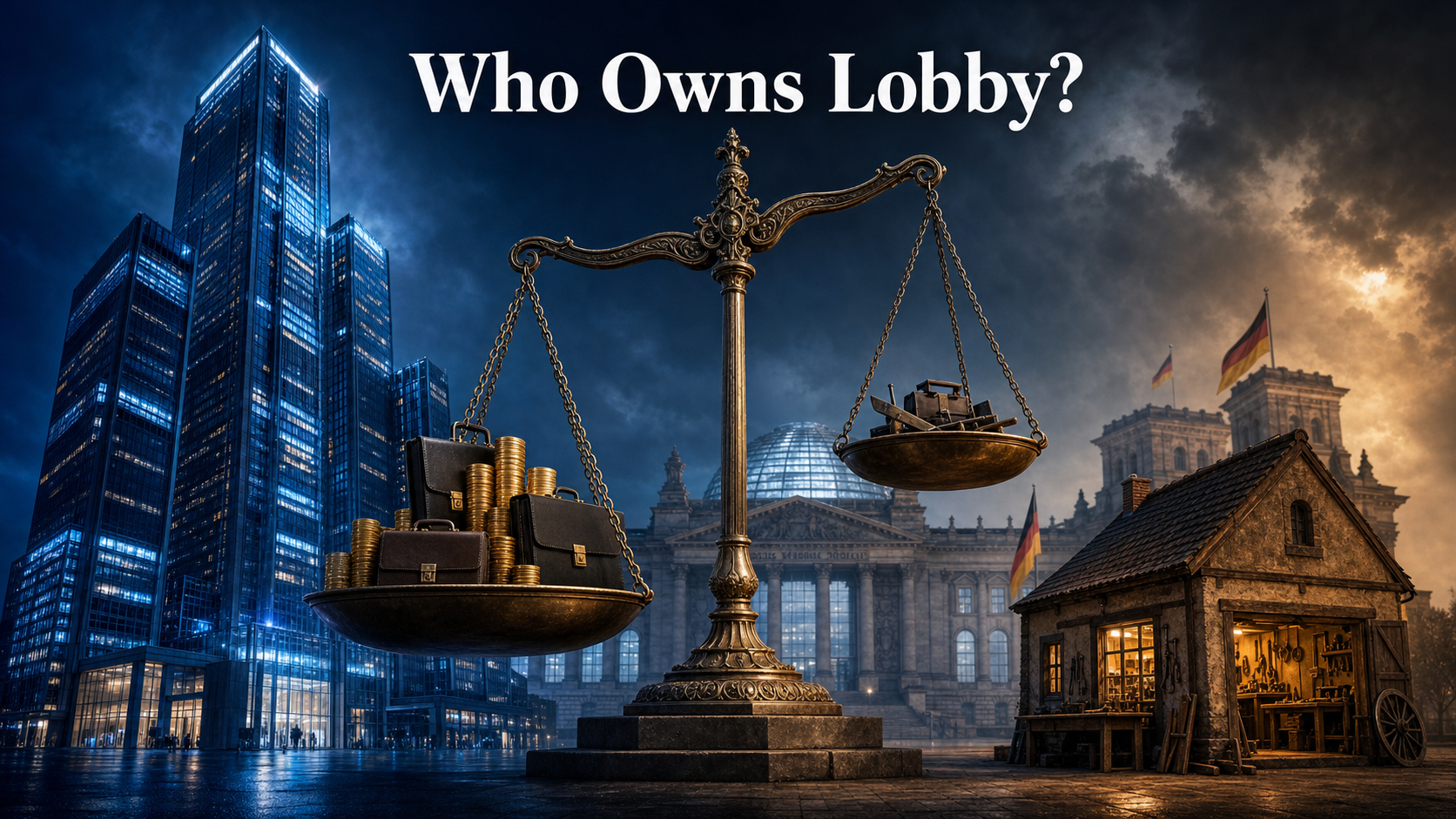
Who owns the business lobby? The betrayed backbone: Why small and medium-sized businesses are losing mercilessly in politics – Image: Xpert.Digital
Subsidies for the big players, bureaucracy for the small ones: Who really owns the business lobby?
Former minister as chief lobbyist: How the system excludes our small businesses
David versus Goliath: Why the middle class is a politically toothless tiger
Germany's small and medium-sized enterprises (SMEs) are generally considered the proud backbone of the economy: they provide the vast majority of jobs and apprenticeships, drive innovation, and are the engine of exports. However, a very different, bitter reality unfolds on the political stage in Berlin and Brussels. While large corporations and financially powerful associations with billion-euro budgets, legions of lobbyists, and direct lines to government ministries dominate legislation, SMEs are fighting with blunt weapons. Whether it's rampant bureaucracy, the unfair distribution of billions in state subsidies, or the lucrative move of top politicians into the private sector – the rules of the game are made by and for the big players. This in-depth analysis illuminates the structural powerlessness of SMEs, exposes the weaknesses of established umbrella organizations, and reveals the strategies that can finally transform the backbone of the German economy from a toothless tiger into a powerful force.
Related to this:

The Lobby Illusion: How Business Associations Are Letting German SMEs Down
The middle class as the economic foundation – and political lightweight
There is hardly an economic policy speech that doesn't praise Germany's small and medium-sized enterprises (SMEs) as the "backbone of the economy." This praise is well-deserved: More than 99 percent of all companies in Germany belong to the SME sector, and these 3.4 million SMEs employ over 71 percent of the workforce. They provide more than 70 percent of all apprenticeships, generate half of the total net value added, and, with a share of almost 98 percent, are the decisive drivers of German exports. No other group of companies contributes to the country's social and economic stability to a similar extent.
However, a vast gap exists between economic relevance and political influence. While corporations and large associations open doors in Berlin that often remain closed to small and medium-sized enterprises (SMEs), the backbone of the economy fights for its interests with blunt weapons. SMEs are economically indispensable – but astonishingly defenseless politically. This imbalance is no accident, but rather the result of structural inequalities, historically ingrained power asymmetries, and a lobbying landscape that systematically favors capital, connections, and corporate size.
Related to this:

One billion euros a year – and who benefits from it
The sheer scale of the political influence machinery in Germany is chillingly illustrated by the figures from the German Bundestag's lobby register. In 2024, the nearly 6,000 registered lobbying organizations spent a combined total of almost €900 million on their political lobbying efforts. 164 of these organizations each spent more than €1 million. The total amount is estimated to be even higher than €1 billion, as key players such as employers' associations and trade unions are exempt from registration.
The economy is by far the most frequently cited area of interest – almost every second lobbying organization states that it represents economic concerns. The organization LobbyControl has succinctly summarized this structural imbalance: the ratio between business lobbies and all other societal interest groups is 81 to 7 – business dominates. Employers' associations, which due to their special status are not even required to be registered in the lobby register, are likely to further reinforce this picture in favor of the financially powerful business sector.
But money alone doesn't determine influence. The organization most frequently cited in leading German media outlets in the first half of 2024 was the Federation of German Industries (BDI) – in nearly 1,000 articles, representing an increase of around 30 percent compared to the same period the previous year. The BDI is considered the leading organization of German industry and industry-related service providers, is registered in the Bundestag's lobby register, and has a budget of approximately 8.8 million euros for lobbying at the federal level alone. In comparison, even the well-funded associations of medium-sized businesses appear like minor players.
The balance of power between associations – between rhetoric and reality
A look at the 20 largest business associations by lobbying expenditures reveals a revealing ranking. At the top is the German Insurance Association (GDV) with more than €15 million, followed by the German Chemical Industry Association (VCI) with over €9.2 million. In third place is the German Association for Small and Medium-Sized Businesses (BVMW) with expenditures of over €9.1 million, just ahead of the Federation of German Industries (BDI) with €8.8 million.
At first glance, the BVMW (German Association for Small and Medium-Sized Businesses) appears to be a major player in the industry. However, closer examination reveals fundamental weaknesses in this advocacy group. While the BVMW claims to represent over 900,000 small and medium-sized enterprises (SMEs) through its SME alliance, research by the Handelsblatt newspaper in 2015 significantly reduced the actual membership of its core association to around 55,000 – a discrepancy that considerably undermines the association's self-image. Lobbying depends on credibility, and those who exaggerate their membership lose political capital.
To make matters worse, lobbying expenditures appear ridiculously low in relation to the economic base they represent. While DAX-listed companies deploy their own political departments, external lobbying agencies, specialized law firms, and their industry associations, most medium-sized businesses lack both the know-how and the personnel resources for independent political communication. The academic findings are clear: In the political competition for attention and influence, SMEs are often powerless against large corporations, and their voting power in federal and European policy-making is comparatively weak.
Related to this:

When umbrella organizations betray their own members
A particularly insidious problem lies in the internal power distribution within the business associations themselves. While SMEs are nominally represented in the large umbrella organizations – such as the BDI (Federation of German Industries) or the DIHK (Association of German Chambers of Industry and Commerce) – they are structurally marginalized. Voting rights within these associations are often allocated according to the amount of membership fees paid or company size, meaning that larger companies call the shots and representation of interests can only take place on the basis of the lowest common denominator.
This leads to a classic conflict of interest: what benefits a large corporation often harms small and medium-sized enterprises (SMEs). A multinational car manufacturer has different tax interests than a regional supplier, different preferences regarding skilled worker immigration, different needs concerning bureaucratic burdens, and different ideas about minimum wages and social security contributions. In case of doubt, the upper-class perspective prevails – the financially powerful companies with their resources and networks dominate the association positions. For SMEs, membership in umbrella organizations thus often remains a zero-sum game: they finance an advocacy group that does not articulate their actual interests, or only does so incompletely.
Experts like lobbying specialist Hubert Koch describe three structural deficiencies in the representation of interests in medium-sized businesses: firstly, a lack of self-confidence among entrepreneurs who believe their voice doesn't count in Berlin; secondly, insufficient know-how about political processes and decision-making structures; and thirdly, excessive trust in industry associations, whose internally divergent interests weaken the clarity of their positions and thus their political clout. Those who rely solely on others lose their own influence.
The subsidy problem: When large corporations empty the coffers
The imbalance of political influence is particularly striking in German subsidy policy. An analysis by the Flossbach von Storch Research Institute revealed that in 2023 alone, at least €10.7 billion in state subsidies flowed to the 40 DAX companies – almost twice as much as the previous year's €6 billion. From 2016 to 2023, Germany's largest listed corporations received a total of around €35 billion in public funds.
E.ON received the most subsidies, over €9.3 billion, followed by Volkswagen with €6.4 billion and BMW with €2.3 billion. Indirect subsidies—such as the environmental bonus for purchasing electric cars, which is de facto a government sales incentive for the automotive industry—are not even included in these figures. In contrast, critical academics argue that such subsidies promote resource waste, distortion of competition, and a dependence of businesses on government funds—effects that particularly affect small and medium-sized enterprises (SMEs), as they compete in the same market as the subsidized corporations but receive hardly any funding themselves.
A structural problem further exacerbates the situation: Large corporations have learned to strengthen their negotiating position through implicit or explicit threats against the state. If they do not receive subsidies, they threaten to relocate production abroad – a mechanism that is not unjustly described as "industrial blackmail." Small and medium-sized enterprises (SMEs), on the other hand, regionally rooted and often thinking in terms of generations, cannot and will not create this threatening atmosphere. They are therefore at a structural disadvantage in political negotiations.
Related to this:


The revolving door effect: Networks that exclude medium-sized businesses
Anyone wanting to understand the mechanisms of political influence in Germany cannot ignore the so-called revolving door effect. This refers to the movement of political decision-makers into lucrative business positions – and vice versa – a phenomenon that LobbyControl has documented in over 72 cases in Germany alone. The pattern is always the same: A minister or high-ranking state secretary leaves office and immediately afterwards takes up a position as chief lobbyist or supervisory board member at a major corporation.
The most prominent cases speak for themselves: Gerhard Schröder, after his chancellorship, moved to the top of the Nord Stream consortium, whose pipeline he had actively promoted as head of government. Eckart von Klaeden (CDU), Minister of State in the Federal Chancellery until September 2013, was working as chief lobbyist for Daimler just a few weeks later. Daniel Bahr, former Minister of Health, became a board member at Allianz Health Insurance – the very sector for which he had been responsible as minister.
The economic core of this problem is obvious: When corporations secure the services of former top politicians, they are not only buying their expertise, but above all their fresh contacts and privileged access to decision-making structures. This creates an exclusive network of political and economic elites that remains systematically inaccessible to medium-sized businesses. Those who don't have former state secretaries on their supervisory boards and can't invite members of parliament to their events are operating on a different level.
The Bundestag's lobby register, in operation since 2022, attempts to bring more transparency to these connections. A reform in March 2024 expanded the register's requirements: since then, contacts with heads of departments in ministries and staff of members' offices have also been recorded, and a five-year review of previous political offices is mandatory. Nevertheless, Transparency International Germany criticizes the fact that 13 of the 16 federal states meet less than half of the transparency criteria – Germany is still far from truly controlled, transparent lobbying.
Related to this:

Trade unions as a blueprint: What the middle class could learn
On the opposite end of the economic policy spectrum are the German trade unions – thus unintentionally providing a blueprint for what the middle class lacks. The German Trade Union Confederation (DGB), as the strongest umbrella organization, embodies a model of interest representation that rests on three pillars: institutional integration into political decision-making processes, legally enshrined instruments such as the right to strike, and clear, uncompromising public communication of its own positions.
The right to strike is more than just a tool for industrial action – it is the ultimate leverage unions have in political negotiations. Union statements put it succinctly: without the possibility of striking, collective bargaining is nothing more than collective begging. This rhetorical force, coupled with the actual capacity for collective action, gives unions a political weight that far exceeds their membership numbers. The middle-class lobby has nothing comparable.
Furthermore, trade unions are institutionally anchored in numerous self-governing bodies – in social security, the Federal Employment Agency, and the labor court system. They are not merely lobbyists knocking on doors, but active participants in shaping institutional structures. Small and medium-sized enterprises (SMEs), on the other hand, are represented in most of these bodies only through chambers of commerce, which in turn must mediate between the interests of different company sizes. SMEs almost entirely lack this institutional anchoring, and this is not a natural state of affairs, but rather the result of decades of political neglect.
From a critical perspective, the power of trade unions certainly has its limits: Since the reforms of the red-green coalition government (1998–2005), trade unions and employers' associations have lost corporatist influence, and their integration into social policy self-governance structures has been weakened. Trade union membership numbers have been declining in the long term. Nevertheless, measured against the instruments that small and medium-sized enterprises (SMEs) make available to their political representatives, trade unions are far superior – not necessarily in the breadth of their influence, but in the depth and intensity of their leverage.
Our EU and German expertise in business development, sales and marketing

Our EU and German expertise in business development, sales and marketing - Image: Xpert.Digital
Industry focus areas: B2B, digitalization (from AI to XR), mechanical engineering, logistics, renewable energies and industry
More information here:
A thematic hub offering insights and expertise:
- Knowledge platform covering global and regional economies, innovation and industry-specific trends
- A collection of analyses, insights, and background information from our key areas of focus
- A place for expertise and information on current developments in business and technology
- A hub for companies seeking information on markets, digitalization, and industry innovations
Why the middle class is politically disadvantaged – and how it can change the rules of the game
Why medium-sized associations fail – a structural diagnosis
The weakness of the SME lobby is not primarily a question of will, but of ability – and of structural design. Advocacy costs money, time, expertise, and political capital. Small and medium-sized enterprises lack all of these to varying degrees. Their owners are tied up in day-to-day operations, cannot dedicate staff solely to political networking, and lack the resources to hire professional lobbying agencies or specialized law firms.
Another structural problem is the heterogeneity of the Mittelstand itself. The medium-sized craft business in Bavaria has different interests than the technology service provider in Hamburg, the machine manufacturer in Baden-Württemberg different priorities than the retailer in Saxony. This diversity, which constitutes the economic strength of the Mittelstand, is simultaneously its political handicap: the greater the range of interests, the more difficult it is to consolidate them into a clear, effective position. Associations that try to represent everyone end up representing no one at all.
Academic analysis confirms this dilemma: An increased membership simultaneously brings heterogeneity of people and interests, thus making interest aggregation more difficult. This collective action problem—known in political science as the "Olson Problem"—hits small and medium-sized enterprises (SMEs) harder than any other economic actor. Corporations can speak with a single, coherent voice; SMEs must always seek compromise.
Added to this is the structural imbalance in access to information. Large corporations maintain offices in Brussels and Berlin that continuously monitor legislative processes and can exert influence early on. Small and medium-sized enterprises (SMEs) often only learn about new regulations when they come into effect. In the political arena, the rule is: those who are late to the game are penalized by legislation.
Related to this:

Small and medium-sized enterprises caught in the political press grip – the example of bureaucracy
Nowhere is the political powerlessness of small and medium-sized enterprises (SMEs) more evident than in the issue of bureaucracy. Reducing bureaucracy has been at the top of the wish lists of SME associations for years – and for just as long, too little has been done structurally. The contrast to the situation of large corporations is striking: While DAX-listed companies can employ specialized compliance departments to meet regulatory requirements and absorb additional costs through economies of scale, cumbersome documentation obligations, reporting requirements, and bureaucratic regulations hit SMEs disproportionately hard.
The same applies to tax regulations: International tax planning, which allows large corporations to achieve effective tax rates far below the nominal corporate tax rates, is simply inaccessible to medium-sized businesses. They pay the nominal tax rate, while corporations benefit through transfer pricing, holding structures, and tax optimization models. At the same time, the BVMW (German Association for Small and Medium-Sized Businesses) has been calling for the abolition of inheritance tax for years – a position that would protect business continuity but finds little political resonance because there is no powerful political pressure behind it.
Small and medium-sized enterprises (SMEs) rightly complain about the excessive focus of politics on large corporations. However, as long as this observation doesn't translate into concrete political mobilization, it remains just an observation. Criticism is not a lever; organized pressure is.
Ways out of powerlessness: Real options for small and medium-sized businesses
Despite all the structural disadvantages, the political powerlessness of small and medium-sized enterprises (SMEs) is not inevitable. There are concrete strategies that SMEs can use to actually expand their political influence – without necessarily needing the resources of large corporations.
The first and most important step is recognizing that local and regional influence is often more effective than attempting to operate at the federal level. Regional representatives are far more receptive to the concerns of a small or medium-sized business owner from their constituency than top officials in Berlin. Those who build and maintain personal relationships with local politicians, state parliamentarians, and government representatives create a base of influence that corporations with their often anonymous Berlin lobbying departments simply don't have. Small and medium-sized businesses have faces, stories, and local responsibilities – that's politically invaluable.
Secondly, the specific expertise of small and medium-sized enterprises (SMEs) offers a genuine lobbying advantage that should be utilized more systematically. Politicians and government officials rely on practical expertise when dealing with complex technical, economic, or regulatory issues. SMEs that contribute their concrete knowledge about the impact of proposed legislation and feed it into the regulatory development processes at an early stage create real added value for policymakers – and are heard in return. This is not a question of budget, but of preparation and self-confidence.
Thirdly, the model of coalition lobbying deserves more attention. Individual SMEs are weak; thematic alliances can be powerful. When medium-sized businesses from a region or industry join forces in ad-hoc coalitions to fight against or shape a specific regulatory project, they create a power that associations alone cannot generate. This requires entrepreneurs to take the step out of their day-to-day business and invest in the political sphere – not as supplicants, but as experts and voters.
Fourth, digitalization opens up new avenues for political communication. Lean lobbying—that is, streamlined, digitally supported political work—enables even actors with limited resources to follow political debates, effectively present their own positions to the public, and establish direct contact with decision-makers via digital channels. LinkedIn, Twitter/X, and professional policy platforms have significantly lowered the barrier to entry into the political arena. Small and medium-sized enterprises (SMEs) that showcase their expertise and comment publicly build reputation—and reputation is currency in the political arena.
The opportunism trap of SME associations
An honest analysis cannot ignore what many medium-sized business owners openly admit in conversation but rarely articulate publicly: The existing associations of medium-sized businesses have largely become self-perpetuating, more interested in their own institutionalization than in effective advocacy. What was conceived as a political fighting organization has, in many places, degenerated into a networking club with a conference calendar.
The phenomenon can be explained structurally: Large associations with permanent staff develop their own institutional logic. Leadership has incentives to avoid conflicts with politicians in order to maintain access to decision-makers. They prefer consultation to confrontation, position papers to public pressure, and events to campaigns. This is understandable from a human perspective but politically disastrous. What small and medium-sized enterprises (SMEs) need are not documents that disappear into drawers in Berlin, but rather advocates who, if necessary, are willing to engage in conflict and mobilize public opinion.
The comparison with the trade unions is devastating in this respect. IG Metall doesn't just negotiate, it strikes – and the mere threat of a strike shifts the balance of power in negotiations. Employers' associations, which are nominally the counterparts to the trade unions, have a similar means of exerting pressure in the form of a lockout. Small and medium-sized enterprises (SMEs), on the other hand, lack a comparable escalation option. They can neither paralyze the political process nor threaten collective economic measures that would have a noticeable impact on policymakers. This lack of power is the real problem.
Transparency as leverage: What the lobby register offers – and what it doesn't
With the introduction of the lobby register in 2022 and its reform in March 2024, Germany has taken an important step towards transparency. As of January 1, 2025, around 27,000 individuals were named in the register, and lobby organizations are obligated to disclose their expenditures, areas of focus, and – since the reform – also contacts with department heads and staff in members' offices.
Transparency International Germany welcomes this progress but urges caution. The fact that 13 of the 16 federal states meet less than half of the transparency criteria demonstrates how selective the willingness to reform remains. Even more seriously, the register contains no legislative footprint, meaning no proof of which lobbyist left their mark on which specific parts of a law. Those who only know that someone exerted influence, but not how and where, can hardly draw any political conclusions.
For small and medium-sized enterprises (SMEs), the lobby register represents an opportunity that has so far been largely untapped. The data transparently reveals which associations are active in which legislative processes – SME representatives could systematically use this information to identify their own points of intervention and take targeted countermeasures. Those who understand the political processes and get involved early enough can exert influence even with limited resources – as demonstrated by the example of the digital association Bitkom, which, according to its own statements, influenced 141 regulatory projects with less than five million euros in lobbying expenditures.
Related to this:

The structural problem remains: systemic inequality as a permanent condition
The final assessment is sobering. German small and medium-sized enterprises (SMEs) create jobs, provide training, innovate, export, and pay taxes – all within a political system that structurally disadvantages their interests. The business lobby belongs to those with the resources to invest in it: large corporations, financial institutions, the insurance industry, and the chemical and automotive industries. They are not influential because they contribute more to the common good than SMEs – quite the contrary. But they operate more professionally, in a more coordinated manner, and more ruthlessly in the political arena.
The asymmetry of weapons, which the director of the NGO Transport and Environment lamented at the European level, is just as real in the German context. Groups with strong resources simply have more opportunities to influence the agenda in political competition than those with weak resources – this is not a market failure that corrects itself, but a structural deficit that requires political will to rectify it.
As long as billions in subsidies flow to highly profitable corporations while small and medium-sized enterprises (SMEs) are burdened with bureaucracy; as long as former ministers, acting as chief lobbyists, open doors for corporations that remain closed to SMEs; as long as transparency regulations remain inadequate and lobby groups exaggerate their actual reach – the system will remain calibrated in favor of large corporations. This is not a conspiracy theory. These are facts unanimously confirmed by the Bundestag's lobby register, Transparency International reports, and academic research.
The sobering conclusion is this: Who owns the business lobby is not a philosophical question. It's an empirical one – and the answer is: the big players. Small and medium-sized enterprises (SMEs) have the choice of accepting this or taking the political arena seriously – with more self-confidence, more strategic thinking, and the courage to publicly advocate for uncomfortable positions. The backbone of German business must not remain a toothless tiger in politics.





