
When the student overtakes the master: South Korea's rise to arms power and Germany's industrial decline
Xpert Pre-Release

Available in 27 languages 📢
Prefer Xpert.Digital on GoogleⓘPublished on: May 17, 2026 / Updated on: May 17, 2026 – Author: Konrad Wolfenstein
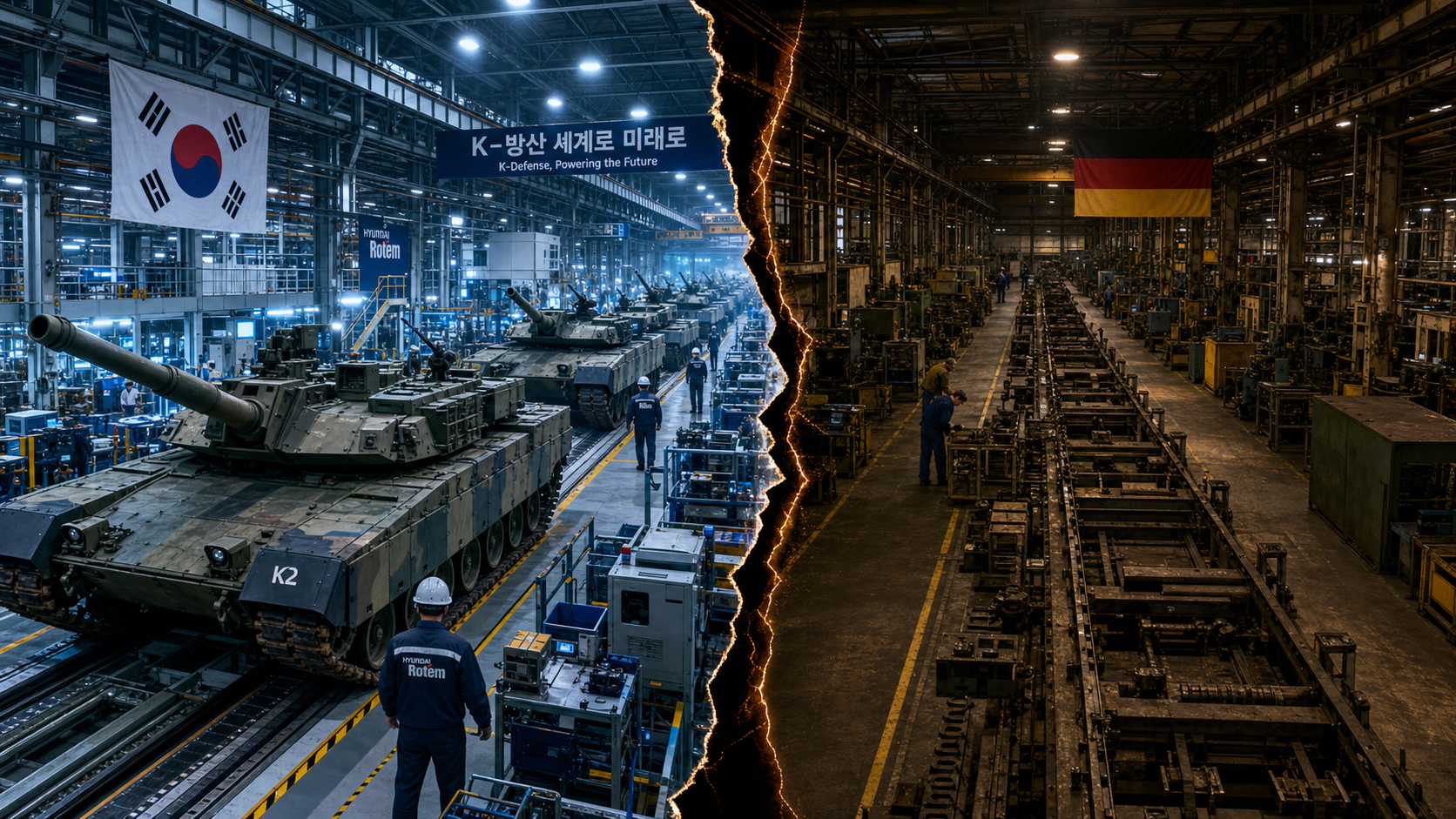
When the student overtakes the master: South Korea's rise to arms superpower status and Germany's industrial decline – Creative image: Xpert.Digital
Fourth place among arms exporters: What South Korea does so much better than Germany
Warning shot for the economy: Why German mechanical engineering is at a disadvantage
In a world increasingly shaped by geopolitical tensions and new security realities, a massive economic power shift is taking place in the background. While Germany grapples with homegrown crises—from record energy prices and rampant bureaucracy to creeping deindustrialization—South Korea is catapulting itself to the forefront of the global arms industry at an unprecedented pace. Recent data shows that Seoul has overtaken Berlin as the world's fourth-largest arms exporter. But this drastic change in the international rankings is far more than just a statistical footnote. It is both the symptom and the logical consequence of two fundamentally different industrial philosophies. On the one hand, there is South Korea's unconditional, state-sponsored drive for technological dominance and rapid expansion. On the other, the structural erosion of Germany's economic base is becoming apparent, a base that all too often gets bogged down in endless debates, slow approval processes, and ideological gridlock. How could a country that once shared Germany's clear focus on precision manufacturing, engineering, and export strength have fallen so far behind us? And what price is associated with this new global distribution of power?
While Seoul builds factories, Berlin debates — and that comes at a price
Few recent economic policy developments illustrate the gap between strategic industrial policy and ideologically blocked administration as sharply as South Korea's rise to global arms power at Germany's expense. According to data from the Stockholm International Peace Research Institute (SIPRI), South Korea reached fourth place among the world's largest arms exporters for the first time in 2025—with a global market share of six percent, an increase of 83 percent in a single year. Germany, which was still in fourth place in the five-year period from 2021 to 2025, has thus fallen back to seventh. What is happening here is not a short-term market shift. It is the result of fundamentally different industrial philosophies of two economies that once shared the same DNA: mechanical engineering, precision manufacturing, export strength, and technological excellence.
From a catching-up nation to a global arms power: South Korea's industrial transformation
To understand how South Korea rose from a net importer of military technology to the world's fourth-largest arms exporter in less than a generation, one must start with the basics. South Korea never had the luxury of taking industry for granted. The constant threat from North Korea, its geopolitical dependence on the United States, and the trauma of Japanese occupation forged a national mentality in which economic strength is seen as an existential necessity—not a choice. This strategic mindset remains the invisible engine behind South Korea's arms buildup.
The figures speak for themselves: South Korea's arms exports amounted to a modest US$250 million annually in 2006. By 2022, this figure had exploded to US$17.3 billion—a 70-fold increase in just under two decades. Although 2023 and 2024 saw a period of consolidation with US$13.5 billion and US$9.5 billion respectively, exports recovered to US$15.4 billion in 2025—and the US$20 billion mark is expected for the first time in 2026. The stated national goal is an export volume of US$20 billion annually by 2030, representing a global market share of six percent.
South Korea is now the second-largest arms supplier among European NATO states, after the United States. The record-breaking $13.7 billion contract signed with Poland—the largest arms deal in South Korean history—includes hundreds of K2 tanks, K9 self-propelled guns, Chunmoo rocket launchers, and FA-50 fighter jets. Poland alone currently accounts for approximately 58 percent of South Korean arms exports. The political calculation behind this is as cold as it is brilliant: Poland serves South Korea as a bridgehead into the European market—a platform from which Seoul intends to supply the Czech Republic, Romania, Slovakia, the Baltic states, and other European customers in the medium term.
The success model: How South Korea treats its defense industry as a strategic asset
South Korea's defense success is not the result of luck, but rather of a consistent, state-led industrial policy that is remarkable in its clarity and determination. Starting in 2020, South Korea began building regional defense industry innovation clusters—first in Changwon and South Gyeongsang Province, then in Daejeon (2022), and finally in Gumi (2023), where some 200 small and medium-sized defense companies, along with universities and research institutions, collaborate within a specifically supported ecosystem. These clusters are not mere theoretical projects. For the Gumi cluster alone, 49.9 billion won of state and local funds have been committed through 2027.
In parallel, major companies are investing heavily in production capacity. Korea Aerospace Industries (KAI) announced investments of the equivalent of $490 million for the construction of new manufacturing facilities and the expansion of production lines for the FA-50 fighter jet and the new KF-21 combat aircraft. Hanwha Aerospace, the heavyweight in the Korean defense sector, has significantly expanded its aircraft engine manufacturing capacity in Changwon and has now risen to become the fifth-largest conglomerate in South Korea—fueled by the booming defense industry. The message is clear: When orders come in, investments are made in capacity immediately, without waiting for rejections.
At ADEX 2025—South Korea's largest defense trade show, featuring 600 companies from 35 countries—President Yoon Suk-yeol announced a 2026 defense budget of 66.3 trillion won (approximately US$47.4 billion), an 8.2 percent increase over the previous year. The defense budget is projected to reach 3.5 percent of GDP by 2035. In addition, the government appointed a special envoy for the defense industry in Europe, tasked with securing contracts worth over US$56 billion.
The technological focus of this strategy is particularly revealing. South Korea is relying on artificial intelligence, drones, and robotics as key areas for future weapons systems—not least for a very pragmatic reason: The country has one of the lowest birth rates in the world, which means its troop strength will shrink in the long term. Unmanned systems are therefore both a military necessity and a technological differentiator in global competition. South Korea's defense startup scene is growing rapidly and has access to an industrial ecosystem now worth $30 billion.
Trial by fire in practice: How the Iran war is sealing South Korea's reputation
A key factor in South Korea's recent surge in exports is its combat effectiveness. When Iran attacked the United Arab Emirates (UAE) with ballistic missiles and suicide drones in early 2026, South Korea's Cheongung-II air defense system—dubbed the "Korean Patriot" by its supporters—proved its worth with a reported 96 percent interception rate. South Korea now maintains special forces on Emirati soil and has conducted emergency resupply operations under fire. This demonstrates Seoul's capabilities in an active conflict—a major endorsement for any arms exporter.
The immediate market reaction was predictable: Shares of LIG Nex1, the manufacturer of the Cheongung-II missile system, soared, and further orders from the Gulf region followed. Cheongung-II systems have already been sold to the UAE (10 batteries), Saudi Arabia (10 batteries), and Iraq (8 batteries). At the same time, the conflict has generated new demand from the Middle East for K9 howitzers, K2 tanks, the KF-21 fighter jet, and unmanned surface vehicles. Should South Korea also win the multi-billion-dollar contract to supply twelve new submarines to Canada, its position as the world's fourth-largest arms exporter could potentially be permanently solidified as early as 2026.
The other side: What Germany does right — and what systematically fails
It would be unfair and analytically dishonest to portray Germany solely as a loser in this development. German arms exports reached a historic high in 2024, with approved exports totaling €13.33 billion. The lion's share of this – €8.15 billion – went to Ukraine for its defense against Russia's war of aggression. This made Germany Ukraine's second-largest arms supplier. In the SIPRI five-year period from 2021 to 2025, Germany still ranked fourth among the world's largest arms exporters, with a global market share of 5.7 percent. Companies like Rheinmetall are profiting considerably from European rearmament.
But these figures mask structural deficiencies that will have long-term consequences. First, German export peaks are heavily distorted by the war in Ukraine and thus highly dependent on a single geopolitical emergency. Second, German arms exports had already fallen significantly again by 2025 to around €8.4 billion—a decline of approximately 37 percent compared to the record year. Third, Germany is not developing its own arms export strategy comparable to South Korea's systematic market development.
A particularly embarrassing example of Germany's competitive disadvantage comes from the infantry fighting vehicle competition in Australia: The South Korean company Hanwha Defence, with its AS21 Redback, beat its German competitor, Rheinmetall's KF-41 Lynx, in a direct performance comparison. Australia opted for 129 AS21 Redbacks in a contract worth five to seven billion Australian dollars. Even more bitter is the irony that South Korea's most important ground exports—K2 tanks and K9 howitzers—are heavily dependent on German MTU engines and transmissions, which is why Seoul required German government approval for every export contract for years. South Korea has therefore launched a national effort to localize these key components in order to finally overcome this dependency.
The energy price syndrome: How Germany is structurally hollowing out its industry
What fundamentally distinguishes South Korea from Germany, however, goes far beyond the arms industry. It is a systemic problem of German competitiveness that has built up over years and whose full impact is only now becoming apparent. The energy price shock resulting from the war in Ukraine left wounds that have not yet healed. The Leibniz Centre for European Economic Research (ZEW) concluded in a recent report that Germany has not yet fully overcome the problem of high energy prices stemming from the 2022 gas supply crisis—with lasting damage to the competitiveness of energy-intensive industries.
The figures from the international energy price comparison are sobering. In 2023, the average wholesale price for electricity in Germany was around €80 per megawatt-hour—down from a peak of €235 per megawatt-hour in 2022. Industrial electricity tariffs in the EU were 158 percent higher than in the US in 2023. At €39.50 per 100 kWh, Germany has one of the highest household electricity prices in the entire EU. For industrial natural gas, Germany ranks in the top third in Europe, and the price gap with the US is considered "particularly striking" by experts. In spring 2025, production in energy-intensive industries in Germany was almost 20 percent lower than in 2022.
This energy cost crisis is not affecting all sectors equally. While German defense companies are weathering the crisis relatively well, the chemical industry, the steel sector, mechanical engineering, and the automotive industry are suffering from a structural competitive disadvantage that they can hardly compensate for on their own. The KfW research institute offered a stark diagnosis: Germany is suffering from a prolonged period of weak growth, particularly pronounced in the manufacturing sector. Current challenges such as the energy price shock, the changing relationship with China, and the transformation of the automotive industry are compounded by unresolved structural problems such as excessive bureaucracy, high taxes, a severe shortage of skilled workers, and gaping digitalization gaps.
Our EU and German expertise in business development, sales and marketing

Our EU and German expertise in business development, sales and marketing - Image: Xpert.Digital
Industry focus areas: B2B, digitalization (from AI to XR), mechanical engineering, logistics, renewable energies and industry
More information here:
A thematic hub offering insights and expertise:
- Knowledge platform covering global and regional economies, innovation and industry-specific trends
- A collection of analyses, insights, and background information from our key areas of focus
- A place for expertise and information on current developments in business and technology
- A hub for companies seeking information on markets, digitalization, and industry innovations
Geopolitics as an economic engine: Why crises strengthen South Korea and weaken Germany
Deindustrialization in numbers: The gradual dismantling of Germany's industrial base
The once abstract warning about deindustrialization has long since become a concrete reality. In 2025, German industry lost over 124,000 jobs—almost twice as many as in 2024, as an EY analysis based on data from the Federal Statistical Office demonstrates. At the end of 2025, around 5.38 million people were still employed in industry—2.3 percent fewer than in the previous year. Since the pre-pandemic year of 2019, employment in the manufacturing sector has fallen by around 266,000 jobs, a decrease of almost five percent.
The automotive industry was hit hardest. Around 50,000 jobs were lost there alone in 2025. By the end of the third quarter of 2025, only 721,400 people were employed in the automotive sector—the lowest number since the second quarter of 2011. Volkswagen plans to cut up to 50,000 jobs in Germany alone by 2030, including the potential closure of up to four plants. ThyssenKrupp is cutting 11,000 jobs, Bosch 13,000, and ZF Friedrichshafen 14,000. At the same time, industrial sales are declining: the fourth quarter of 2025 marked the tenth consecutive quarter of falling sales. Since 2023, industrial sales have shrunk by almost five percent.
With all these figures, caution is advised against drawing hasty conclusions. Not every job cut means an immediate loss of employment—many programs run for years and utilize natural attrition. And Germany still has one of the world's most productive industrial bases. With around 934,200 employees, mechanical engineering continues to employ more people than the automotive industry. The electrical and metal industries even saw slight growth recently. But the direction of the trend is unmistakable—and it's a steep downward one.
Structural comparison: What makes South Korea different
A direct comparison of the two industrial philosophies shows where the crucial decisions have been made in recent years.
| dimension | South Korea | Germany |
|---|---|---|
| Industrial policy | Strategic asset, active government support | Regulated economic area, market principle dominates |
| Approval process | Accelerated, export-oriented | Slow, with multiple safeguards |
| Energy costs | Competitive (state-subsidized) | They are among the highest worldwide |
| arms export policy | Pragmatic, proactive market development | Restrictive, politically highly complex |
| Investments in capacity | Massive, directly after order receipt | Behavior, rather wait-and-see |
| Technology focus | AI, drones, unmanned systems | Proven, incremental improvements |
| Geopolitical strategy | Clearly, independent ability to act | Embedded in NATO/EU, consensus-based |
| Defense budget 2026 | 47.4 billion US dollars (+8.2%) | Part of NATO's special fund, moderate growth |
However, it would be a mistake to derive a simple good-versus-evil narrative from this comparison. South Korea's arms export model carries enormous risks. The more Korean weapons systems are deployed in active conflict zones—from Ukraine to the Emirates—the deeper Seoul will be drawn into geopolitical conflicts it originally sought to avoid at all costs. Critics within South Korea itself warn of a "blind spot" in the export model: the operational and political consequences if the exported weapons systems are actually used in lethal combat. The question of arms exports to conflict zones and the potential entanglement in human rights violations is now just as pressing for Seoul as it is for Berlin.
Bureaucracy as a brake on innovation: A systemic German problem
In a completely different sector than the arms industry, the same fundamental problem is evident. Germany is suffering from a massive backlog of permits and regulations, which is also exceptionally well documented in economic policy. Business associations have been sounding the alarm for years: High energy prices, taxes, and bureaucracy are seriously jeopardizing competitiveness, industrial production has been declining continuously since 2022, and investments are shifting abroad at an alarming rate. The German Association of Chambers of Industry and Commerce (DIHK) expects another decline in gross domestic product of 0.5 percent for 2025—it would be the third consecutive year of decline.
Germany is taking countermeasures, albeit with the agonizing delay typical of German bureaucracy. On February 1, 2026, a package of measures to accelerate and simplify export control procedures for military equipment and dual-use goods came into effect. This introduces new general licenses that exporters can use without a complex individual application to the Federal Office for Economic Affairs and Export Control (BAFA). This is undoubtedly a step in the right direction—but compared to South Korea's systematic export strategy, which has been in place for years, it remains a purely reactive measure.
Of particular interest in this context is a technical dependency that exemplifies how closely intertwined the two countries were until recently: South Korea's most successful export products—the K2 tank and the K9 howitzer—long used German MTU engines and transmissions. For every single export contract, Seoul was therefore required to obtain Berlin's approval. Over time, Germany repeatedly delayed these approvals or made them more difficult through political reservations—a short-sighted practice that ultimately only further motivated South Korea to radically end its dependence on parts and develop its own high-performance propulsion systems. The result: Seoul is well on its way to becoming completely independent, while Germany is relinquishing one of its last remaining economic and political levers.
Geopolitics as a growth engine: Why external crises benefit South Korea
One of the most important explanations for South Korea's rapid arms buildup is its ability to capitalize on global crises far more quickly than its established competitors. The Russian attack on Ukraine in 2022 created an overnight, massive demand for rapidly deliverable, NATO-compatible equipment. Western manufacturers—including, in particular, German companies—could not even begin to meet this demand quickly enough because they had sacrificed their production capacities for decades to a naive peace dividend mentality. South Korea, on the other hand, never had this supposed luxury: The constant, real threat from North Korea forced the country to maintain a permanently high level of military readiness and never to dismantle its enormous manufacturing capabilities.
This also explains why South Korea can deliver high-quality and highly complex weapons far faster and more reliably than almost any other supplier—and at extremely competitive prices. The Middle East conflict, which escalated in February 2026 with widespread airstrikes, has now triggered a second massive boom: The successful combat trials of the Cheongung II system in the Emirates and the drastically increased demand from across the Middle East give South Korea an invaluable reputational advantage that no marketing budget in the world could ever buy. At the same time, Korea Aerospace Industries and other Asian companies are profiting immensely from the rapidly growing demand from Southeast Asia, while the economic ministries of many European countries are still debating the relevant bodies and approval procedures.
The strategic question: What Germany can learn — and what it should not copy
The rigorous economic analysis inevitably leads to an uncomfortable strategic question: Should and can Germany adopt the uncompromising Korean industrial philosophy? The honest answer is: partially yes, categorically no.
What Germany urgently needs to learn from South Korea is the unwavering commitment to treating core industrial capabilities as an indispensable strategic resource. In a world where geopolitical tensions are not diminishing but rather increasing, the ability to rapidly and sovereignly produce defense equipment is not merely an option—it is an absolute necessity for national security. Germany has undoubtedly taken an important initial step with the €100 billion special fund for the Bundeswehr (German Armed Forces), but the translation of these financial resources into real, tangible industrial capacity is still progressing far too slowly. While companies like Rheinmetall, Hensoldt, KNDS Deutschland, and others are visibly expanding, the rigid structural framework of complex permitting regulations, exorbitant energy prices, and an acute shortage of skilled workers continues to act like heavy sandbags on the feet of a sprinter.
What Germany should absolutely not copy uncritically, however, is South Korea's virtually limitless pragmatism regarding arms exports. German arms export restrictions are based on deeply rooted historical experience and are by no means a purely bureaucratic exercise. They reflect the profound conviction that unregulated arms exports to highly unstable regions or to state actors with questionable human rights records can and will ultimately undermine national security. With its extreme expansionist course, South Korea is currently approaching precisely this painful boundary—and as the rapidly growing internal debate in Seoul demonstrates, the ethical and political risks are anything but trivial. The steep path to becoming an undisputed export power comes at a high price, one that is not always honestly factored into the daily celebratory reports of record sales.
Germany thus faces the enormous challenge of finding a new, coherent path out of the constant dilemma between compelling strategic necessity and ethical self-restraint. South Korea has consistently pursued this path toward maximum export agility. Germany urgently needs to redefine its own course—but without a swift, profound, and structural reform of energy costs, paralyzing permitting processes, and entrepreneurial investment, it will inevitably fall behind for years to come.
The competition between two industrial philosophies
What South Korea's meteoric rise to become the world's fourth-largest arms exporter and Germany's simultaneous, painful deindustrialization together frighteningly illustrate is a fundamentally different answer to one and the same question: How does a state treat its industrial base in the 21st century?
South Korea treats its industry as its most valuable strategic asset—an absolutely indispensable core to its geopolitical capabilities, security, and economic resilience. Germany, on the other hand, increasingly treats its industry like a highly complex, troublesome regulatory burden—something that must be meticulously managed, rigorously controlled, and constantly confined by endless political compromises. The devastating result of this policy is now clearly visible in the SIPRI rankings, the bleak labor market figures, the alarming energy price reports, and, above all, in the massive relocation and investment decisions of international companies.
In 2025, South Korea reached fourth place among the world's largest arms exporters for the first time, relegating former leader Germany to seventh place. This is no insignificant footnote in recent economic history. It is an unmistakable signal affecting the entire spectrum of international industrial competition—from pure manufacturing expertise and technological innovation to ultimate geopolitical influence. Those who no longer proactively participate in this fierce global competition will soon lose far more than just economic market share. They will lose political influence, national sovereignty, and ultimately the fundamental ability to confidently represent their own interests in an increasingly unstable world.










