
America's fiscal abyss – When megalomania is financed on credit: How the USA is jeopardizing its prosperity
Xpert Pre-Release

Available in 27 languages 📢
Prefer Xpert.Digital on GoogleⓘPublished on: April 9, 2026 / Updated on: April 9, 2026 – Author: Konrad Wolfenstein
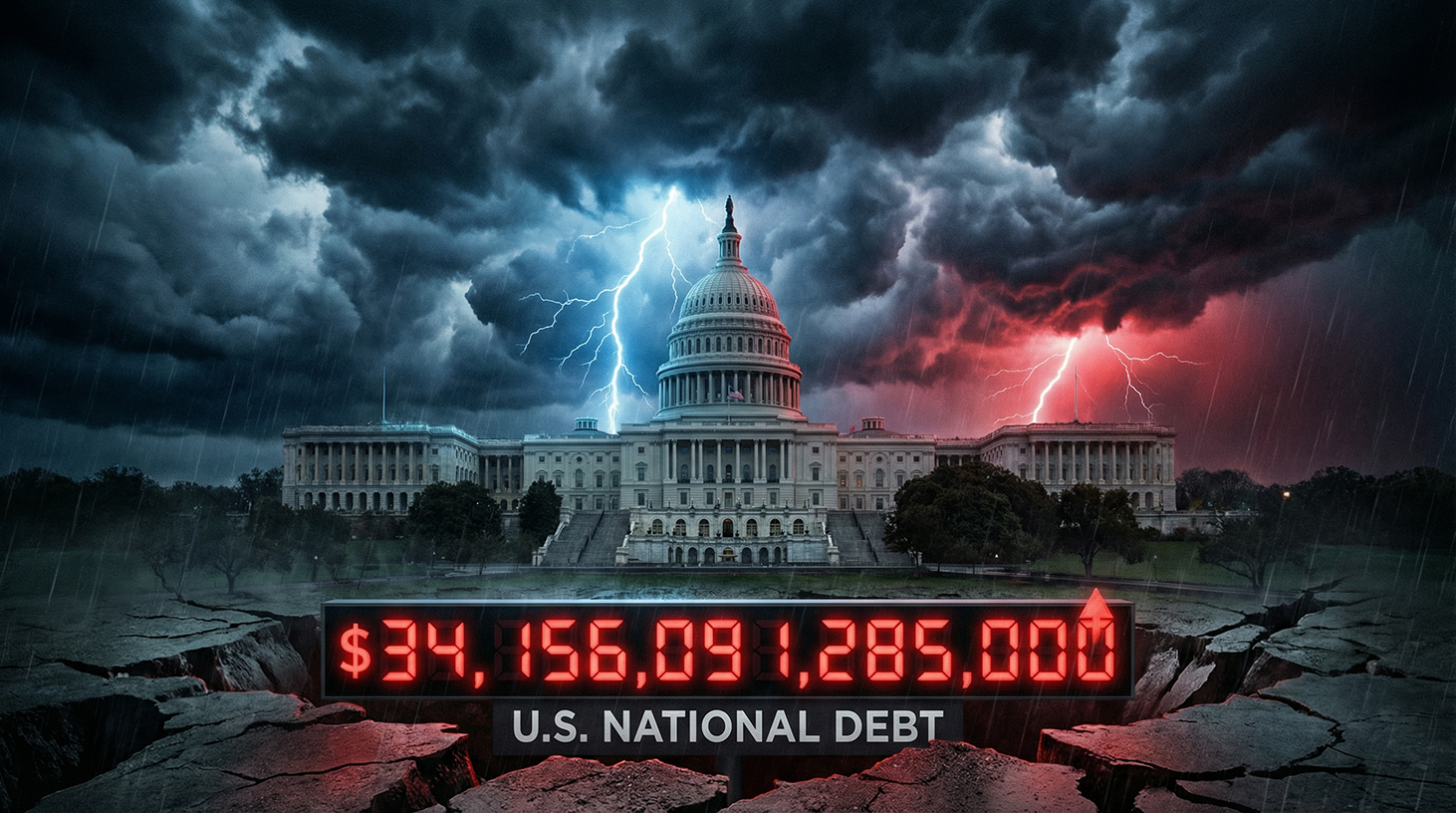
America's fiscal abyss – When megalomania is financed on credit: How the USA is jeopardizing its prosperity – Image: Xpert.Digital
Interest rate trap and punitive tariffs: How the USA is jeopardizing its own prosperity
The ticking debt bomb: What Trump's risky fiscal policy now means for Germany
The end of the dollar's power? America's historic mountain of debt is shaking the financial system
American national debt is exceeding all historical norms and has reached unprecedented levels under the presidency of Donald Trump. With a gigantic mountain of debt exceeding 38 trillion US dollars and a dangerously spiraling interest rates, the USA is heading towards an unprecedented fiscal abyss. Tax cuts in the trillions without any real corresponding funding, the sobering failure of Elon Musk's "DOGE" fiscal reform agency, and aggressive tariffs are exacerbating the budget situation. But this financial megalomania fueled by borrowing is not without consequences: The historically untouchable special status of the US dollar is crumbling, rating agencies are stripping the country of its top rating, and the shockwaves of this risky policy threaten to hit the European and German economies hard, far across the Atlantic. This is an in-depth analysis of how America's fiscal policy is destabilizing the global financial order.
Worse than during World War II: Why US national debt is now completely out of control
With unprecedented fiscal energy, the United States is hurtling toward a mountain of debt whose dimensions will surpass even the worst years of World War II. Under President Donald Trump, American fiscal policy has reached a new level of structural recklessness: tax cuts without corresponding funding, spending programs financed by borrowing, and a defensive stance toward any reform proposal that would entail genuine consolidation. What at first glance appears to be typical Washington fiscal policy, on closer inspection proves to be one of the most serious fiscal shifts in modern American history—with global repercussions that extend far beyond the Atlantic.
From 23 to 38 trillion: The breathtaking rise of debt arithmetic
The stark figures speak for themselves. At the end of the 2025 US fiscal year, on September 30, 2025, the American national debt stood at approximately $37.6 trillion. By January 2026, this figure had increased by another $1 trillion, bringing the total debt to over $38 trillion. For comparison, at the beginning of 2020, before the COVID-19 pandemic, the US national debt was around $23 trillion. Within just five years, the debt has thus increased by more than 50 percent – a remarkable rise in its speed, even when taking into account the extraordinary crisis spending of the pandemic years.
The ratio of national debt to economic output, that is, the debt-to-GDP ratio, exceeded 100 percent in 2025 and is estimated to be around 120 to 124 percent of GDP. This is a historic turning point: This ratio surpasses the previous post-war peak from 1946, which was caused by the enormous war debts of World War II. As recently as 2000, the same ratio was a comparatively moderate 60 percent. The US has thus doubled its debt-to-GDP ratio within a quarter of a century – without a lost world war, without an existential national emergency, but primarily through political decisions that systematically favored spending and minimized revenue.
The Congressional Budget Office (CBO), the nonpartisan budget office of Congress, paints a bleak picture in its long-term projections: Federal deficits are expected to rise from 6.2 percent of GDP in fiscal year 2025 to 7.3 percent in 2055 – significantly above the 30-year average of 3.9 percent recorded during the period from 1995 to 2024. According to these projections, the debt-to-GDP ratio is expected to climb to 156 percent by 2055. The CBO estimates that by 2030, the US debt-to-GDP ratio will definitively surpass the post-war record of 106 percent set in 1946 and reach dizzying heights.
The great tax promise and its fiscal consequences
The central lever with which Trump further worsened the fiscal situation bears the optimistic name "One Big Beautiful Bill Act" (OBBBA). This legislative package, passed by the US Congress on July 4, 2025, and signed by Trump, bundles tax policy, border security, military spending, and social spending cuts into a single, ideologically charged package. The core of the law is the permanent extension of the tax cuts from Trump's first term in office in 2017, which would have expired at the end of 2025 without this extension.
The fiscal costs of this measure are substantial. The Congressional Budget Office estimates that the law will increase national debt by at least $3.4 trillion over the next ten years. Extending the 2017 Tax Cuts and Jobs Act alone could increase the deficit by $3.5 to $4 trillion over that period. Even more pessimistic scenarios project an additional burden of up to $5 trillion if temporary measures are considered permanent and unfavorable interest rate developments are factored in. The Committee on Responsible Federal Budgeting (CRFB) puts the net increase in debt from legislation and executive action in 2025 at $1.5 trillion—the largest increase since 2022.
The proposed offsetting measures prove insufficient upon closer analysis. Planned cuts to Medicaid—the health insurance program for low-income earners and the elderly—are intended to save approximately $800 billion. These are supplemented by cuts to food assistance and subsidized social programs. However, these austerity measures are politically controversial, economically questionable, and socially burdensome: The CBO estimates that these cuts could leave nearly 12 million people without health insurance coverage within ten years. Economists point out that the expectation that tax cuts will finance themselves through higher economic growth is neither empirically supported nor economically consistent. Experience shows that sovereign debt crises build up slowly over years before erupting abruptly and with full force.
Trump himself is selling the law as an economic masterpiece that will renew the American Dream. However, the fiscal assessment of impartial analysts paints a different picture: The law adds structural problems to a debt edifice that is already beginning to crumble under its own weight.
The interest rate trap: When debt accelerates itself
Perhaps the most threatening dimension of the American fiscal crisis is not the sheer mountain of debt, but the associated and ever-increasing burden of interest payments. In 2025, for the first time in its history, the US will have spent more than one trillion US dollars on interest payments alone on its national debt. More precisely, FERI expects a record high of around 1.3 trillion dollars in interest payments for 2025—a sum that exceeds the entire United States military budget. Interest payments have nearly doubled in just four years—a dynamic resulting from the combination of rapidly rising debt and a significantly increased interest rate of around 4 percent in the post-pandemic era.
According to the Congressional Budget Office, interest payments now consume more than 13 percent of all federal spending. By 2035, this figure is projected to rise to 16.7 percent—meaning that one-sixth of every federal tax dollar would be spent solely on interest payments on existing debt. The Congressional Budget Office also forecasts that by 2055, government interest payments will exceed all discretionary government spending—including education, infrastructure, research funding, and all other freely available budget funds.
This interest rate spiral unfolds its own dangerous logic: the more debt is incurred, the higher the interest burden; the higher the interest burden, the larger the structural deficit; the larger the structural deficit, the more new debt is needed. Economists refer to this as a self-reinforcing debt dynamic that is virtually unstoppable without decisive political countermeasures. The interest burden thus forces the US government into a fundamental choice: either investment spending on infrastructure, education, and social programs is permanently cut, or the deficit continues to grow—a choice in which the latter option has consistently been favored.
Trump is responding to this interest rate trap with a strategy that seems simple at first glance but carries considerable risks: He has long been calling for greater political influence on the Federal Reserve to lower interest rates. The Fed chairmanship is up for election in May 2026 – an opportunity Trump has announced he will use to install a favorable candidate. However, a politically dependent central bank would severely undermine global capital markets' confidence in the US and, in the long term, fuel inflation – which would hardly reduce the net interest burden but would significantly jeopardize macroeconomic stability.
The three-agency verdict: When all the major rating agencies distance themselves
A particularly symbolic event occurred in May 2025: The rating agency Moody's downgraded the US credit rating from the top grade of "Aaa" to "Aa1". With this, Moody's became the last of the three major rating agencies to withdraw the coveted triple-A rating from the United States. Standard & Poor's had already done so in 2011, and Fitch followed in 2023. The US is therefore no longer among the mere ten countries that are rated with the highest rating by all major agencies – including Germany, Australia, the Netherlands, and the Nordic countries.
Moody's reasoning is precise and insightful: It is the continuous rise in national debt and interest costs over more than a decade that is weighing on the country's credit rating, and this increase is significantly higher than that of other countries with comparable economies. The rating agency's explicit statement that no single administration is responsible for this development, but rather that "successive administrations and congresses" have failed to reverse the trend of high deficits and rising interest costs, is noteworthy. Nevertheless, the Trump administration is facing particular criticism: Moody's does not expect the 2026 budget being debated in Congress to result in substantial multi-year cuts in mandatory spending and deficits.
The White House reacted to the downgrade with a characteristic mix of outrage and dismissal. Communications Director Steven Cheung personally attacked Moody's economist Mark Zandi, declaring that no one took his analyses seriously—even though Zandi belongs to Moody's independent research division and not to the rating department that made the decision. The fiscal consequences of the downgrade are real: A lower credit rating structurally increases the interest rates at which the government can borrow money on the market. This, in turn, reinforces the aforementioned interest rate spiral.
The DOGE experiment: Megalomania meets bureaucracy
As a counterpoint to the spending expansion of the "One Big Beautiful Bill," Trump presented the DOGE initiative, the Department of Government Efficiency under Elon Musk. Dramatic cuts in government spending of up to two trillion dollars were promised—almost a third of the entire US federal budget. What followed was one of the most ambitious and loudly marketed efficiency experiments in the history of the US government—and simultaneously one of the most sobering examples of how rhetoric and reality can diverge in fiscal policy.
After four months of work and Musk's departure at the end of May 2025, DOGE estimated its savings at around $160 to $170 billion—a sum less than a tenth of its target. Musk himself admitted in a podcast that the department had only been "fairly successful" in saving taxpayer money. He stated that he wouldn't take the DOGE job again if he could turn back time. The initiative's methods—mass layoffs in the public sector, blanket contract terminations, and widespread spending freezes—resulted in significant hidden costs through productivity losses, increased employee turnover, and lost tax revenue, which eroded some of the nominal savings.
What remains is the sobering realization: DOGE addressed the wrong side of the deficit problem. The real structural drivers of the US budget deficit are the growing mandatory spending on Social Security, Medicare, and Medicaid, as well as the exploding interest burden—all areas that DOGE either couldn't or wasn't allowed to tackle. At the same time, the "One Big Beautiful Bill" created a net debt burden of $3.4 trillion over ten years—more than 20 times what DOGE ever hoped to save. The conclusion is mathematically clear: The spending expansion on the one hand renders the austerity rhetoric on the other a farce.
Fiscal year 2025: A marginal deficit, but that's deceptive
In October 2025, the US Treasury Department released the final results for fiscal year 2025 (October 1, 2024 to September 30, 2025): The federal deficit was $1.78 trillion – about $41 billion, or 2.2 percent, less than the previous year. At first glance, this appears to be positive news. However, a closer look reveals what made this marginal decrease possible: tariff revenues, which surged to $202 billion due to Trump's aggressive trade policies – an increase of 142 percent compared to the previous year. In September 2025 alone, tariff revenues reached $30 billion, a 295 percent increase compared to September 2024.
Without these temporary tariff revenues, the deficit would have been significantly higher. The tariffs do not finance permanent expenditures, but rather buy fiscal leeway in exchange for economic friction: higher import prices for US consumers and businesses, retaliatory trade barriers from partner countries, and structural uncertainties for investment. Interest payments on the national debt reached a record high of over $1.2 trillion in 2025—roughly $100 billion more than the previous year—and for the first time exceeded defense spending. The deficit-to-GDP ratio stood at 5.9 percent, falling below 6 percent for the first time since 2022, while the historical norm in stable times is around 3 percent.
The CBO forecasts a slight increase in the deficit to $1.853 trillion for fiscal year 2026. Public debt is projected to grow to $56 trillion, or 120 percent of GDP, by 2036, compared to $30 trillion, or 99 percent, in fiscal year 2025. The implications of this forecast are considerable: In just ten years, the absolute US national debt would almost double.
Our US expertise in business development, sales and marketing

Our US expertise in business development, sales and marketing - Image: Xpert.Digital
Industry focus areas: B2B, digitalization (from AI to XR), mechanical engineering, logistics, renewable energies and industry
More information here:
A thematic hub offering insights and expertise:
- Knowledge platform covering global and regional economies, innovation and industry-specific trends
- A collection of analyses, insights, and background information from our key areas of focus
- A place for expertise and information on current developments in business and technology
- A hub for companies seeking information on markets, digitalization, and industry innovations
BlackRock warns: The debt dynamics that could threaten the dollar
Dollar hegemony under scrutiny: When creditor status falters
The dollar is not just any currency. As the world's leading global currency and primary reserve currency, the US enjoys a unique "exorbitant privilege"—it can borrow in its own currency, for which there is a structural global demand. This special status has allowed the US for decades to finance deficits that would have long since triggered a crisis in other countries. But the recent debt dynamics, coupled with Trump's economic policies, are beginning to undermine precisely this privilege.
BlackRock, the world's largest asset manager, has repeatedly warned that rising US national debt could reduce the appeal of long-term US Treasury bonds and the dollar to foreign investors. Executives at BlackRock's fixed income division put it succinctly in a quarterly note: Uncontrolled US national debt is the single largest risk to the US's "special status" in financial markets. Looking at a longer historical timescale, troubling shifts in the global financial architecture are becoming apparent: In September 2025, gold surpassed US Treasury bonds as the largest asset held in global foreign exchange reserves for the first time in nearly two decades. China has reduced its holdings of US Treasury bonds by almost 40 percent since 2013. In July 2025, China held only $730 billion in US Treasury bonds—the lowest level since 2008.
The picture, however, is more nuanced than some apocalyptic predictions suggest. Other countries, such as Great Britain and Japan, increased their holdings of US Treasury bonds during the same period. In July 2025, total foreign holdings of US Treasury bonds reached a new record high of $9.16 trillion. Foreign funds and governments now hold over 30 percent of all outstanding US Treasury bonds. A complete de-dollarization of the global economy is not to be expected in the medium to short term—there are no viable alternatives. Neither the euro nor the Chinese renminbi possesses the market depth, institutional infrastructure, and political trust necessary for a reserve currency.
Nevertheless, closer inspection reveals the first cracks. The US Dollar Index (DXY) lost around 10.5 percent against a broad basket of currencies between the beginning of 2025 and the end of April 2025. The dollar, which was still trading at 1.02 per euro at the beginning of February 2025, fell to 1.14 by the end of April. Trump himself apparently accepts a weakening dollar as the price for a more competitive American industry. From a European perspective, this is increasingly seen as a historic opportunity to strengthen the euro as a reserve currency – an opportunity that only arises because America is creating it through its own decisions.
Tariffs as a double-edged sword: revenue today, wealth losses tomorrow
Trump's trade policy is inextricably linked to fiscal policy. The blanket tariffs imposed in April 2025 on imports from some 60 countries—including China with up to 145 percent and the EU with 20 percent (temporarily reduced to 10 percent)—have created a tariff level averaging around 27 percent, the highest in over a century. Tariffs of this magnitude have complex effects: They generate government revenue that reduces the deficit in the short term, but simultaneously increase costs for American importers and ultimately for consumers.
Financial markets have already demonstrated the limitations of this strategy. When Trump announced his "Liberation Day" tariff package on April 2, 2025, the markets experienced a dramatic shock: stock prices worldwide plummeted, with the DAX losing more than ten percent within a few days. The dollar depreciated, and US Treasury bonds also fell. Faced with rising borrowing costs, Trump was ultimately forced to temporarily suspend the most extensive tariffs—a remarkable demonstration that financial markets function as an effective check on economic policy, even if political actors are reluctant to acknowledge this limitation.
The tariffs have also triggered global secondary effects that are significant for Germany and Europe. Chinese exporters, cut off from American markets, are increasingly pushing into European markets – resulting in significantly intensified competition for European and German companies in their domestic markets. At the same time, Chinese export restrictions on rare earths affect not only the US but also European industry. Tariff policy is thus proving to be an instrument that redirects global trade flows but hardly addresses the structural deficits and debt problems of the US economy.
Structural failure on both sides of the corridor
It would be historically dishonest and analytically incomplete to blame the American debt crisis solely on Trump and the Republicans. Moody's put it succinctly: Successive administrations and Congresses have failed for more than a decade to agree on measures to reverse the trend of high deficits and rising interest costs. Since 1970, the US federal budget has only been truly balanced in four years, namely from 1998 to 2001 under President Clinton. The financial crisis of 2007/2008 led to a sharp increase in the deficit through bank and industrial bailouts, and the COVID-19 pandemic to a further explosion of debt through massive direct transfer payments to the population.
What distinguishes the Trump era from previous administrations is the extent of its fiscal recklessness at a time when debt has already reached a structurally threatening level and interest rates are no longer near zero. The Obama and Biden administrations also produced large deficits—driven partly by crises, partly by political decisions. But the Trump administration chose to enact further permanent tax cuts without offsetting them, at a time of high interest rates and already extreme debt ratios. This represents a structurally different quality of risk.
Democrats, in turn, consistently refuse to implement serious reforms to mandatory social spending, which appear inevitable in the medium term. The CBO points out that the aging population will drive social security expenditures from 5.2 percent of GDP in 2025 to 6.1 percent in 2055—an increase that, without reforms, will automatically widen the deficit. Fiscal consolidation requires political courage on both sides and a bipartisan commitment to long-term sustainability, which is currently lacking in Washington.
The international coordinate system: USA in comparison
To put the American situation into perspective, an international comparison is worthwhile. Japan has held the dubious world record for debt-to-GDP ratio for years: at the end of 2024, Japanese national debt amounted to around 216 percent of GDP – a figure that significantly exceeds the American ratio. Nevertheless, despite this exorbitant debt, Japan has not experienced a full-blown debt crisis – primarily because Japanese government bonds are predominantly held by domestic investors, because Japan possesses substantial foreign assets, and because the Bank of Japan intervened directly in the bond market for a long time.
The American model, however, differs fundamentally: The US is dependent on foreign capital inflows, lacks substantial foreign assets as a buffer, and its debt-based economic advantage is directly tied to the dollar's special status as the world's reserve currency. This special status is not divinely ordained but is based on confidence in the US's institutional reliability, economic dynamism, and political stability. All three factors have been weakened in recent years by domestic polarization, fiscal dysfunction, and the tendency to instrumentalize the dollar as a geopolitical tool. Germany, on the other hand—used for comparison—adheres to the principle of the debt brake and has a debt-to-GDP ratio of around 63 percent, which is structurally sustainable.
Looking ahead: Scenarios between consolidation and crisis
What realistic future scenarios arise from the current situation? The optimistic scenario assumes that strong economic growth—driven by technological innovation, artificial intelligence, and US energy dominance—will stabilize the deficit-to-GDP ratio without requiring painful fiscal consolidation. Historically, the American economic model has already experienced such moments of innovation-driven self-healing. This scenario remains possible, but unlikely given the structural dynamics of social spending and interest payments, unless productivity growth exceeds all previous historical experience.
The middle scenario—currently the most likely—is a slow slide into a period of chronically high interest rates, weaker growth, and increasingly limited fiscal leeway. In this scenario, the US will remain capable of taking action, but with significantly less flexibility for economic and social policy measures. Infrastructure deficits will accumulate, public investment will stagnate, and the growing debt burden will increasingly crowd out spending that should be geared toward securing the future.
The pessimistic scenario—still considered a tail risk in financial markets, but no longer dismissed as unthinkable by serious economists—is a serious crisis of confidence in the US bond market. If foreign investors and central banks begin systematically avoiding or dumping US Treasury bonds, yields would rise sharply, government financing costs would skyrocket, and a downward spiral would ensue. The credit default swap market has already priced in temporarily increased default probabilities: The implied default probability on US debt nearly tenfold during a period in 2025. The only way out of this predicament would be a flight to monetary financing—that is, the Fed printing money—but this would come at the cost of serious inflation.
Global consequences for Europe and Germany
The US fiscal trajectory has direct consequences for Europe and Germany that go beyond mere interest rate arithmetic. First, rising US bond yields act as a global amplifier of financing costs. If the US has to pay higher interest rates, the pressure on international investors to channel more capital into the US market increases – which draws capital away from other markets and can also push European yields upwards.
Secondly, a loss of confidence in the dollar threatens to trigger a turbulent phase of global currency adjustment, for which neither Europe nor emerging economies possess sufficiently stable institutional structures. The fragmentation of the global financial system into regional currency blocs would be a painful process that would significantly increase the cost of trade and investment.
Third, as the world's largest economy, the US is also the primary anchor of global growth. A fiscally induced recession, or even just a prolonged slowdown in growth in the US, would directly impact the export-oriented German and European economies via global trade channels. Germany's export sector already felt the effects of US tariff policy in 2025; a US slowdown in growth due to fiscal overstretch would represent a second, systemic wave of stress.
At the same time – and this is the constructive interpretation of the situation – America's self-created weaknesses offer Europe the opportunity to develop strategic independence: through the development of a deeper European capital market, a credible and stable fiscal policy that strengthens the confidence of international investors, and a stronger role for the euro as a reserve currency in certain regions of the global economy. However, this opportunity must be actively shaped – it will not arise automatically.
Between system trust and structural drift
The American debt crisis is not an acute crisis phenomenon, but rather the result of decades of structural perverse incentives, which were not invented by the Trump administration, but significantly exacerbated. The combination of permanent tax cuts without corresponding funding, an exploding interest burden, a failed austerity experiment, and a trade policy that trades short-term revenues for long-term growth potential paints a picture of fiscal irresponsibility on a historic scale.
The central risk lies not in an immediate default—the US will service its debts, if necessary through monetary expansion—but in the gradual erosion of America's special status. Once trust is lost, it can only be regained with considerable economic pain and political will. The financial markets have shown glimpses of their willingness to test this limit. The question is no longer whether, but when global capital markets will demand a credible response to the US debt situation—and whether Washington will be prepared to provide it by then.
Your global marketing and business development partner
☑️ Our business language is English or German
☑️ NEW: Correspondence in your native language!

Konrad Wolfenstein
I and my team are happy to be available to you as your personal advisor.
You can contact me by filling out the contact form here or simply call me at +49 7348 4088 965. My email address is : [email protected]
I'm looking forward to our joint project.
☑️ SME support in strategy, consulting, planning and implementation
☑️ Creation or realignment of the digital strategy and digitization
☑️ Expansion and optimization of international sales processes
☑️ Global & Digital B2B trading platforms
☑️ Pioneer Business Development / Marketing / PR / Trade Fairs
🎯🎯🎯 Data-driven B2B industry hub as a quasi-in-house solution

The quasi-in-house solution: How Xpert.Digital closes operational gaps in B2B marketing and sales – Smart Content-Driven Business - Image: Xpert.Digital
Xpert.Digital is a data-driven B2B industry hub led by Konrad Wolfenstein . The company acts as an external, quasi-in-house solution for industrial partners, closing operational gaps in marketing, content, and sales – without requiring additional resources on the client side.
More information here:










