
The direct hit on the US economy – Trump's risky game: Why the escalation in Iran is backfiring on the US economy
Xpert Pre-Release

Available in 27 languages 📢
Prefer Xpert.Digital on GoogleⓘPublished on: March 30, 2026 / Updated on: March 30, 2026 – Author: Konrad Wolfenstein
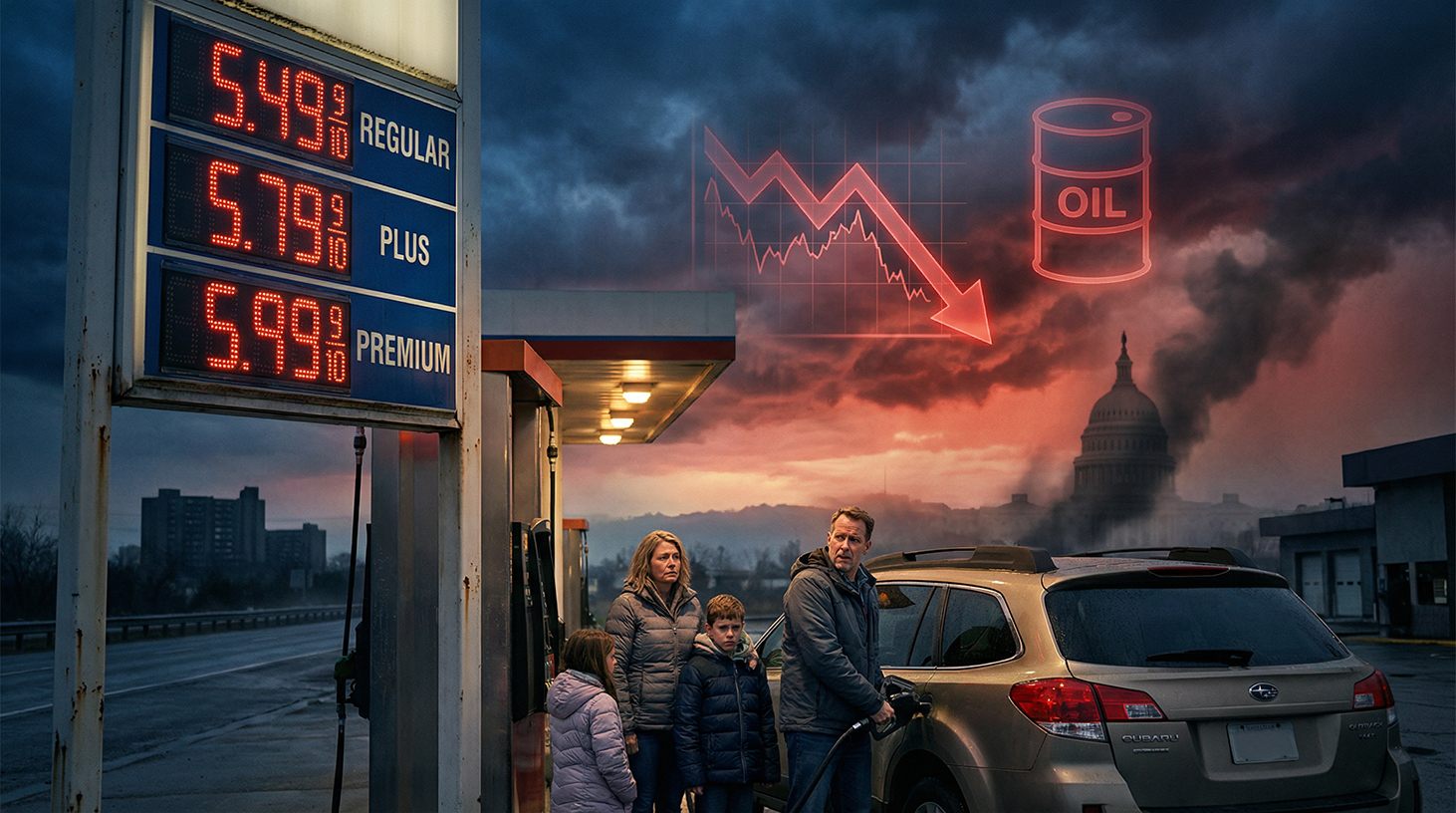
The direct hit on the US economy – Trump's risky game: Why the escalation in Iran is backfiring on the US economy – Image: Xpert.Digital
Longest losing streak in four years: Is this the beginning of the big stock market crash?
Warning of the biggest economic shock in 50 years: What the Iran war means for the USA
55 kilometers that will change everything: Why a bottleneck in the Middle East is crashing the global economy
At the end of February 2026, the geopolitical situation escalated dramatically: Coordinated attacks by the US and Israel on Iranian military installations plunged the Middle East into a war whose shockwaves reverberated far beyond the region. At the heart of the crisis lies the Strait of Hormuz – the most critical bottleneck for global energy supplies. The de facto blockade of this narrow waterway, only a few kilometers wide, has caused oil prices to skyrocket and is fueling worldwide fears of a new stagflation. From soaring gasoline prices and plummeting stock markets to the central banks' seemingly intractable monetary policy dilemma, the global economy is teetering. Renowned macroeconomists are already warning of the biggest economic upheaval since the oil crises of the 1970s. This comprehensive analysis illuminates the devastating domino effects of the conflict on the US and global economy, the high-risk political tightrope walk of the Trump administration, and the profound geopolitical shifts in which China in particular plays a crucial strategic role.
Some analysts interpret the US attack on Iran not primarily as a nuclear preventive measure, but as a strategically motivated operation ultimately aimed at bringing China's energy supply under American control in the long term.
US experts warn of economic earthquake: "The biggest shock in five decades"
The Strait of Hormuz is one of the most unassuming yet powerful geographical narrow passages on Earth. Only about 33 kilometers wide at its narrowest point, it connects the Persian Gulf with the Gulf of Oman, forming the only maritime route for the energy exports of the Gulf States. Approximately 20 million barrels of crude oil and refined petroleum products flow through this corridor daily – a fifth of the world's traded oil. In addition, it carries about a quarter of the global liquefied natural gas (LNG) trade, primarily from Qatar, and about a third of the international trade in urea, the world's most widely used fertilizer. More than 3,000 ships pass through the strait every month. What is considered a natural part of the world order under normal circumstances is, in the event of war, a potential time bomb beneath the foundations of the global economy.
Since the coordinated US-Israeli attacks on Iranian nuclear and military facilities on February 28, 2026, shipping traffic through the Strait of Hormuz has decreased dramatically. Iran responded by shelling tankers, announcing a formal closure, and launching targeted drone attacks on merchant vessels. Shipping companies withdrew their tankers, and insurance companies refused coverage for voyages through the war zone. Dozens of ships became stuck in the strait, and at times 150 vessels were unable to pass through. The result was a de facto, though not complete, blockade of the world's most vital energy corridor—with immediate, far-reaching, and as yet unforeseeable consequences for the US and global economies.
From price shock to system disruption – oil, gas and the escalation spiral
The price of oil, the most sensitive barometer of geopolitical risks, reacted promptly and sharply. On the weekend of the first US-Israeli attacks, Brent crude rose by more than 10 percent to around $80 per barrel. Within a few days, the price shot up to over $85, and a week after the start of the war, it briefly reached almost $120. At the beginning of March, Brent was above $83, an increase of around 25 percent compared to pre-war levels. At the time of this analysis, Brent is trading between $100 and $112 per barrel – more than 40 percent above the pre-war price of around $70.
This price increase is not a technical market phenomenon, but rather an expression of a fundamental supply problem. Iran produces around 3.5 million barrels of crude oil daily, making it the fourth-largest producer within OPEC. The hostilities not only disrupted Iranian production capacity, but also damaged LNG production facilities in Qatar with debris from missile defense systems. Qatar Energy, one of the world's largest LNG exporters, subsequently had to declare force majeure on all exports. As a result, European gas prices surged by over 40 percent. Simultaneously, drone attacks on Iranian facilities and installations in Saudi Arabia were recorded, confronting markets with the unsettling prospect that the entire Gulf region could become a battleground for an energy infrastructure war.
The US military stated that it had deliberately targeted Iranian naval forces from the air. Iran, for its part, insisted on maintaining control of the strait and demanded explicit coordination from non-belligerent states regarding its right of passage. The Islamic Revolutionary Guard Corps (IRGC) threatened to set fire to any ship that passed through without authorization. In this situation, shipping companies faced a residual risk that was difficult to calculate – the de facto closure through market mechanisms, without a formal declaration of blockade, was thus complete.
The direct impact on the US economy – gasoline prices, inflation and consumer power
The most immediate impact of the energy price shock on everyday American life is felt at the gas pump. On the night of March 2-3, 2026, the national average price of unleaded gasoline rose by 11 cents per gallon to $3.11 – the largest daily increase since March 1, 2023. By March 6, the national average price of regular gasoline had already reached $3.32, an 11 percent weekly increase and the highest level since September 2024. Diesel prices climbed even more sharply: to $4.33 per gallon, 15 percent above the previous week's level and the highest since November 2023.
By mid-March, the average gasoline price had risen to $3.72 per gallon, an increase of nearly 80 cents over the previous month. Analysts like Tom Kloza of Gulf Oil predicted that prices between $3.25 and $3.50 were possible in the coming weeks, with a tendency toward higher prices in western regions. Oxford Economics warned that rising gasoline prices would completely erode the expected tax refund effects on consumption and forecast the slowest growth in annual private consumption since 2013 in 2026—aside from the pandemic-related slump.
US consumers use roughly 370 million gallons of gasoline daily, which is why price increases are felt immediately and across the board. Higher fuel costs not only impact mobility but also act as a silent multiplier throughout the entire economy: transportation costs rise, food prices follow suit, and fertilizer prices increase, as a third of the world's urea trade is transported across the Strait of Hormuz. Gasoline price increases were particularly pronounced in Republican-leaning states in the Midwest and South—for example, the average price in Georgia rose by 40.1 cents per gallon in a single week. These are no longer abstract economic figures but politically charged everyday experiences for millions of Trump voters.
Financial markets under constant fire – the longest losing streak in four years
The war has left its mark on the stock markets. The S&P 500 – the most important barometer of US economic expectations – fell 1.7 percent in the week of March 24-27, 2026, marking its worst week since the start of the war and the fifth consecutive week of losses – the longest such streak in almost four years. The Dow Jones Industrial Average lost 793 points this week, falling more than 10 percent from its record high last month. The Nasdaq Composite declined 2.1 percent, slipping into correction territory. Since the start of the war, all three major US indices have lost more than 5 percent.
Particularly noteworthy is that the S&P 500 has now formed a so-called "death cross"—a technical chart pattern in which the 50-day moving average falls below the 200-day moving average, traditionally considered a warning sign of continued weakness. The index fell to 6,368 points, its lowest level since August of last year. This represents a decline of almost 9 percent compared to its January high.
The service sector, the backbone of American employment, also sent out warning signals. The S&P Global Services PMI—a monthly indicator of business sentiment—fell to 51.1 in March, a multi-month low, down from 51.7 in February. Companies reported increased costs, declining orders, and falling job expectations. In the labor market, the US economy lost a net 92,000 jobs in February—far short of the expected increase of more than 50,000. A moderate rebound to around 60,000 new jobs is expected for March, with the unemployment rate rising. This development confirms that the war is further burdening an already slowing economy.
The Federal Reserve's Dilemma – Between Inflation and Recession Fears
No institution faces a more difficult dilemma than the US Federal Reserve. The Fed is caught in a classic stagflation dilemma: Energy prices are driving up inflation while economic activity is simultaneously slowing. Raising interest rates to combat inflation would further stifle growth, while lowering them to stimulate the economy could anchor inflation expectations. Both options carry significant risks.
At its meeting on March 18, 2026, the Fed decided to leave interest rates unchanged at 3.50 to 3.75 percent—a decision supported by a divided committee and reflecting the uncertainty surrounding monetary policy. Fed Chair Jerome Powell stated that it was too early to assess the full economic impact of the conflict, but emphasized that rising oil and gas prices would push inflation higher in the short term. The Fed raised its year-end inflation forecast to 2.7 percent, compared to a December forecast of 2.4 percent. Fed member Stephen Miran voted dissentingly for an immediate 25-basis-point interest rate cut.
Matthew Luzzetti, chief economist at Deutsche Bank Securities USA, posed a question in a commentary that seemed unthinkable just a few weeks ago: whether the Fed could actually raise interest rates in 2026. This idea, completely off the table before the war, is now a serious topic of discussion among economists. According to revised market expectations, investors now anticipate only one possible interest rate cut in all of 2026 – possibly in September – instead of the previously expected two to three cuts. The yield on the 10-year US Treasury bond has risen noticeably since the start of the war, indicating increased inflation expectations and heightened risk awareness at the long end of the yield curve.
Recession risk and GDP erosion – What Goldman Sachs and the OECD fear
Wall Street has reacted. Goldman Sachs, one of the most influential institutions for macroeconomic forecasts, successively raised its recession probability for the next twelve months: first to 25 percent after the weak February jobs report and high oil prices, then to 30 percent after further escalation. At the same time, the bank lowered its growth forecast for US GDP in the final quarter of 2026 by 0.3 percentage points to 2.2 percent. In the worst-case scenario of a one-month complete closure of the Strait of Hormuz, Goldman economists see Brent crude briefly reaching $110 and headline inflation approaching 4.5 percent in the spring. The unemployment rate is expected to rise to 4.6 percent by the fourth quarter – above the 4.4 percent median of the Fed's forecasts.
In its spring forecast, the OECD maintained its global growth estimate for 2026 at 2.9 percent, but stressed that global growth had previously been on track to be significantly stronger – an upside scenario of around 0.3 percentage points, which was completely wiped out by the Iran war. G20 inflation is now expected to be 1.2 percentage points higher than anticipated, reaching 4.0 percent in 2026, as a result of the energy price shock. The OECD forecasts GDP growth of around 2.0 percent for the US in 2026, declining to 1.2 percent in 2027. The ICIS analysis arrives at similar conclusions: it lowered its US growth forecast from 2.4 to 2.2 percent, pointing to the US economy's ability to tolerate oil prices between $80 and $100 – however, prices between $100 and $150 are expected to cause a significant slowdown in growth, with Europe and Asia being even more severely affected.
The US Department of Commerce has already revised its preliminary GDP growth forecast for the fourth quarter of 2025 to an annualized rate of 0.7 percent – half the original figure. This means the war is hitting an economy that was already losing momentum before it even began. Economists who had anticipated a recovery in the first half of 2026 now have to fundamentally rethink their models.
Our US expertise in business development, sales and marketing

Our US expertise in business development, sales and marketing - Image: Xpert.Digital
Industry focus areas: B2B, digitalization (from AI to XR), mechanical engineering, logistics, renewable energies and industry
More information here:
A thematic hub offering insights and expertise:
- Knowledge platform covering global and regional economies, innovation and industry-specific trends
- A collection of analyses, insights, and background information from our key areas of focus
- A place for expertise and information on current developments in business and technology
- A hub for companies seeking information on markets, digitalization, and industry innovations
Three scenarios for the global economy — from recovery to recession due to Hormus blockade
Kenneth Rogoff's warning: The biggest shock since the 1970s
Harvard professor Kenneth Rogoff, former chief economist of the International Monetary Fund and one of the world's most renowned macroeconomists, has unequivocally identified the historical context for this shock. In interviews and analyses, he placed the Iran war alongside the major economic upheavals of postwar history: The war, which follows the trade war and the ongoing war in Ukraine, is emerging as the greatest shock to growth and prices to hit the global economy in five decades. These five decades lead directly back to the oil crises of the 1970s—1973 due to the Arab oil embargo, 1979 due to the Islamic Revolution in Iran—both times with devastating consequences: inflation, recession, stagflation, a decade of lost prosperity.
In an interview with the Nikkei, Rogoff emphasized that the magnitude of the current shock exceeded his own predictions: In his book "Our Dollar, Your Problem," he had spoken of a possible financial earthquake within 5 to 10 years – the time horizon has now shortened to 4 to 5 years, partly due to increased national debt under the Trump administration and the weakened independence of the Fed. He thus linked his assessment to a fundamental structural caveat: The current shock may not merely be a temporary supply shock, but rather the beginning of a longer-term erosion of the dollar-based financial system.
Rogoff's historical analogy is particularly striking: He compared the current situation to the days following the assassination of Archduke Franz Ferdinand in 1914 – an event whose immediate macroeconomic consequences were considered manageable, but which marked the beginning of a world war that altered the international system for decades. The fact that astute, well-informed actors at the time did not know what was coming is not a historical curiosity, but a warning to all those who are now prematurely sounding the all-clear. What follows the Iran war – whether regional escalation, destabilization of other Gulf states, the spread of the conflict to Houthi operations in the Red Sea, or intervention by other powers – is unpredictable. And it is precisely this unpredictability that constitutes the real economic damage: Uncertainty paralyzes investment, scares away capital, and poisons the climate of trust.
Trump's political calculations between hardline pose and economic reality
In the weeks following the outbreak of war, US President Donald Trump found himself caught in a political balancing act that threatened to divide his own electorate. On the one hand, he had presented the attack on Iran as a strategic success – the destruction of Iranian nuclear facilities as the fulfillment of a long-standing Republican security principle. On the other hand, the political consequences for his core constituency were anything but triumphant: rising gasoline prices, fears of recession, and a falling stock market.
Political scientist Michael A. Bailey of Georgetown University in Washington offered a sober analysis of the findings: Trump's decisions in Iran had produced many clearly identifiable losers, while the winners were either few or benefited from advantages that were difficult to predict. A loss of support among parts of his own electorate was to be expected if the prices of gasoline, fertilizer, and other essential goods continued to rise—a scenario that became more concrete with each passing day of the war. Trump's response to a question about rising gasoline prices, "if they rise, they rise," reflected a politically risky stance.
His negotiating strategy with Iran followed a pattern typical of Trump: First, he issued an ultimatum – opening the Strait of Hormuz by March 22 or bombing Iranian power plants. When the deadline passed without an agreement, the ultimatum was extended to five days, then postponed to April 6, 2026 – Easter Monday. Each postponement was accompanied by claims of “very good and productive talks,” which were sometimes explicitly denied by Iran. The Wall Street Journal reported that Iran had not requested a postponement. This pattern – maximum threat, successive retreat, accompanied by face-saving rhetoric – is characteristic of a negotiating style that is difficult for markets and allies to predict.
Trump himself seemed unconcerned. He pointed to the fact that the US is the world's largest oil producer and "makes a lot of money" when oil prices are high. While this is technically correct – US oil companies profit from high prices – it ignores the net losses for the overall US economy due to higher production costs, inflation, and weak demand.
The geopolitical depth dimension – China's energy security as a strategic goal
Behind the immediate economic consequences of the Iran war lies a deeper strategic dimension, often overlooked in Western media, but seen as a central interpretive framework by Chinese policymakers and a growing number of geopolitical analysts. Some analysts interpret the US attack on Iran not primarily as a nuclear preemptive measure, but as a strategically motivated operation ultimately aimed at bringing China's energy supply under American control in the long term. Whether this thesis is accurate or exaggerated is difficult to definitively assess – however, the structural consequence that a US-controlled or US-friendly Iran would fundamentally threaten Chinese energy security is undeniable.
The figures speak for themselves: China is the world's largest importer of crude oil, sourcing roughly 80 to 90 percent of its total Iranian oil exports. According to Kpler data, China purchased an average of 1.38 million barrels of Iranian oil per day in 2025 – approximately 13.4 percent of its total maritime imports of 10.27 million barrels per day. Furthermore, 45 to 50 percent of all Chinese crude oil imports transit the Strait of Hormuz, including shipments from Saudi Arabia, Kuwait, Iraq, and the United Arab Emirates. Overall, oil accounts for roughly one-fifth of China's total energy consumption – of which 70 percent is imported, with almost half coming from the Persian Gulf.
China is therefore monitoring the situation with a level of strategic attention that goes far beyond what can be explained economically. The Bruegel Institute in Brussels noted that Beijing had anticipated the signs of escalation: In the first two months of 2026, China increased its oil imports for strategic storage by 16 percent. Russia delivered around 300,000 barrels per day more to China in January and February than before. China's strategic petroleum reserves are considered among the largest in the world, but precise figures are a state secret. Ships loaded with oil near the coast—a total of 191 million barrels of Iranian and Russian crude oil on floating storage facilities near Chinese ports—also served as an additional buffer.
And yet: A US-friendly Iran would represent a seismic shift in the geopolitical landscape. The Chatham House analysis from March 2026 found that while China's Five-Year Plan includes strategic self-sufficiency as a goal, its current energy vulnerability is unlikely to be overcome quickly. Columbia University's SIPA analysis concluded that while China may be resilient in the short term, a prolonged conflict could increase China's domestic economic pressures and undermine its global objectives.
China's strategic framework – a response between pragmatism and a show of force
China's diplomatic response to the war was deliberately ambiguous. Foreign Ministry spokesman Lin Jian warned in Beijing that the conflict and the situation around Hormuz threatened global energy security and China's oil supply – the use of force would only lead to a vicious cycle. At the same time, China warned of an "uncontrollable situation" and called on all parties to cease military operations. Simultaneously, Beijing maintained discreet contacts with Iran and the Gulf states with the aim of preserving at least partial oil and gas flows through Hormuz.
Particularly revealing is the fact that some tankers—especially those with Chinese connections—continued to pass through the strait under special agreements, while passage was virtually impossible for other vessels. This demonstrates, on the one hand, China's leverage over Tehran and, on the other, Iran's willingness to pragmatically manage its economic relations with its only significant major customer. At the same time, it illustrates the fragile nature of the relationship: A US-dominated or neutralized Iran would end this unofficial special status overnight.
Analysts at Columbia University SIPA noted that China is well-positioned to absorb a short-term shock, but will come under pressure in the medium to long term. Russia and China have jointly expressed concerns about restrictions on the passage of the Strait of Hormuz and warned against escalation. This coordinated response signals that both powers view the Iran war as a precedent for the new geopolitical order—a test of how far the US is willing to reshape the global energy architecture to its advantage.
Stagflation as a risk scenario – The most dangerous of all economic situations
Economists and central bankers are using a word with particular reluctance these days: stagflation. It describes the simultaneous combination of economic stagnation and rising inflation—a situation in which the classic instruments of monetary policy become ineffective or counterproductive. An interest rate cut to support the economy fuels inflation. An interest rate hike to combat inflation exacerbates the recession. The central bank is caught in the middle.
Even before the war, the Fed was struggling with inflation above its 2 percent target, stubbornly hovering around 3 percent. While the energy price explosion has impacted core inflation less directly than headline inflation, it is having a second-round effect on transportation, food, and production costs. Dario Perkins, chief global macro economist at TS Lombard, summed up the situation: Just when it seemed the worst of the political turmoil was over, the Iran war hit. The Fed, having learned from the mistake of underestimating post-pandemic inflation, will proceed very cautiously—and this very caution means that interest rates could remain high longer than is good for the economy.
According to BCA Research analysis, the threshold at which Trump would be forced to reconsider his Iran strategy for political reasons is a correction decline in the S&P 500 of more than 10 percent. This threshold approaches as the war progresses. In a worst-case scenario with persistently high energy prices and heightened geopolitical uncertainty, the US economy could indeed slip into recession—driven not by a financial shock like in 2008, but by a classic supply shock like that of the 1970s, combined with the structural problems of high national debt and political unpredictability.
Geopolitics without winners – The world the day after the Iran war
What economic scenarios are conceivable in the medium and long term? The most optimistic scenario envisions a swift agreement, a gradual reopening of the Strait of Hormuz, and a stabilization of the energy markets within weeks. Goldman Sachs' baseline scenario assumes that Brent crude will fall back to around $71 by the end of the year. In this case, the damage would be substantial but limited: inflation would peak near 4 percent in the spring of 2026, growth would stagnate in the second quarter, and then a recovery would follow. A recession would be avoided.
The medium scenario – a continuing conflict without a complete deadlock, but also without an agreement – anticipates further elevated energy prices between $90 and $110 per barrel, a sluggish economy with growth of around 2 percent, rising unemployment, and political pressure on the Fed to cut interest rates in the second half of the year. The risk of further inflationary surges remains.
The negative scenario – a complete, prolonged blockade of the Strait of Hormuz, extensive attacks on the energy infrastructure in Saudi Arabia or Qatar, the involvement of other actors such as Houthi forces, or more direct involvement of Russia and China – would briefly drive Brent to levels close to $150, trigger a serious recession, push inflation into double digits, and have geopolitical consequences that extend far beyond the economic.
For the US, the longer-term economic legacy of the Iran war can be measured along three axes: inflation dynamics and the Fed's monetary policy response; labor market performance and consumer demand; and the global perception of the dollar and US economic leadership. Kenneth Rogoff suggested that events like this could accelerate the erosion of the dollar's primacy—the yuan, euro, and digital currencies would gain ground in the long run. Whether this is a direct consequence of the Iran war or a longer-term structural development, the direction is clear.
What remains is the historical context: A war that escalates simultaneously with a global trade dispute and the ongoing war in Ukraine accumulates shockwaves in a way that baffles even experienced economists and strategists. Rogoff's comparison to Archduke Ferdinand is not rhetorical flourish, but a precise warning: History teaches us that local sparks can ignite world-historical conflagrations – and that no one knows in advance when that moment will arrive.
Your global marketing and business development partner
☑️ Our business language is English or German
☑️ NEW: Correspondence in your native language!

Konrad Wolfenstein
I and my team are happy to be available to you as your personal advisor.
You can contact me by filling out the contact form here or simply call me at +49 7348 4088 965. My email address is: [email protected]
I'm looking forward to our joint project.
☑️ SME support in strategy, consulting, planning and implementation
☑️ Creation or realignment of the digital strategy and digitization
☑️ Expansion and optimization of international sales processes
☑️ Global & Digital B2B trading platforms
☑️ Pioneer Business Development / Marketing / PR / Trade Fairs
🎯🎯🎯 Data-driven B2B industry hub as a quasi-in-house solution

The quasi-in-house solution: How Xpert.Digital closes operational gaps in B2B marketing and sales – Smart Content-Driven Business - Image: Xpert.Digital
Xpert.Digital is a data-driven B2B industry hub led by Konrad Wolfenstein . The company acts as an external, quasi-in-house solution for industrial partners, closing operational gaps in marketing, content, and sales – without requiring additional resources on the client side.
More information here:










