
Polar Silk Road 7,000 kilometers shorter? How melting ice is opening up a new mega-trade route and Europe is boycotting the new Arctic hype
Xpert Pre-Release

Available in 27 languages 📢
Prefer Xpert.Digital on GoogleⓘPublished on: August 23, 2026 / Updated on: August 23, 2026 – Author: Konrad Wolfenstein
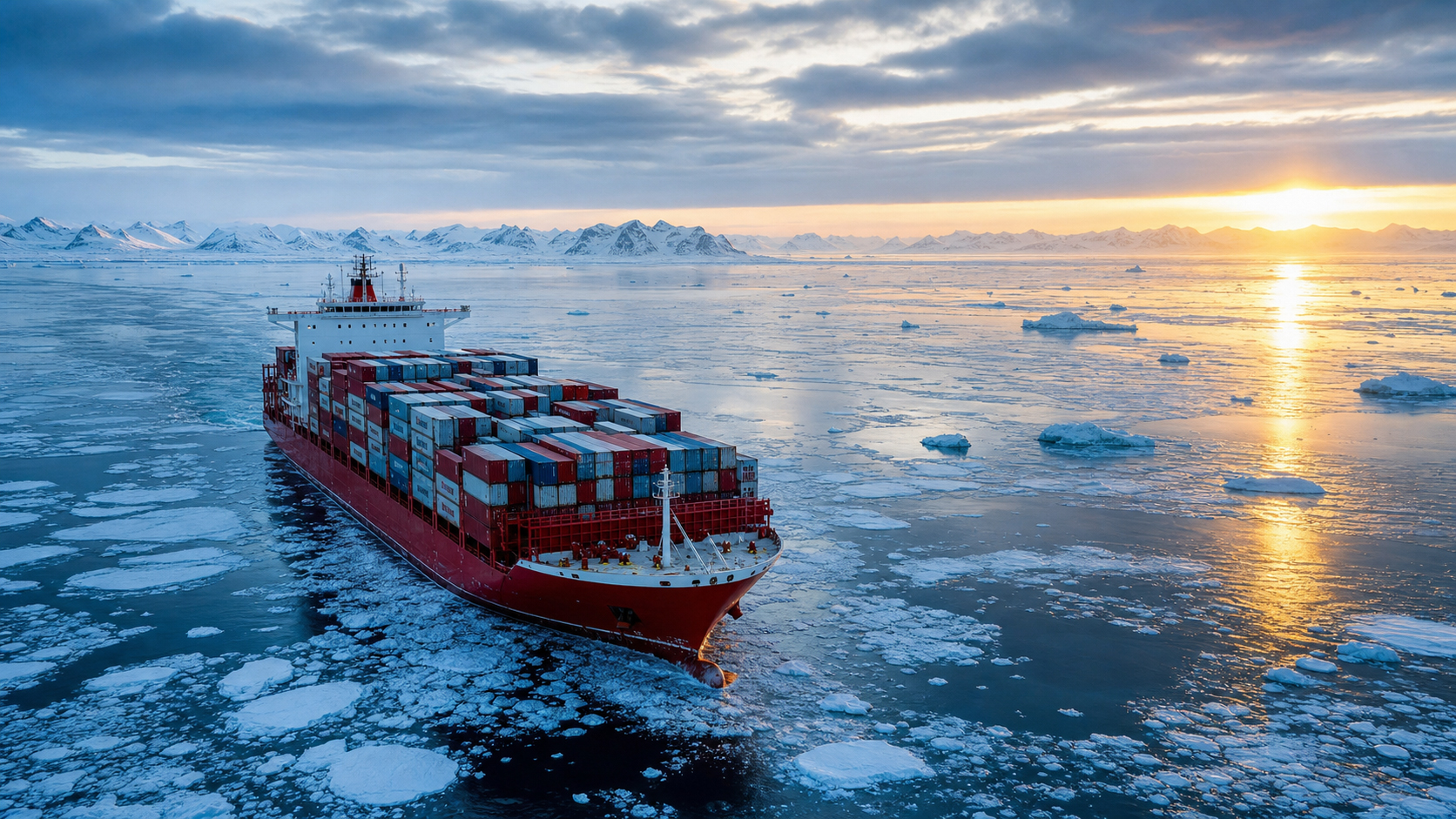
Polar Silk Road 7,000 kilometers shorter? How melting ice is opening up a new mega-trade route and Europe is boycotting the new Arctic hype – creative image on the topic, with AI: Xpert.Digital
Suez Canal bypassed: China and South Korea's gigantic race at the North Pole
Dangerous shortcut: Why Europe is boycotting the shipping companies' new Arctic hype
Polar Silk Road opens: The risky plan for the new route to Europe
The shrinking Arctic ice is paving the way for one of the most controversial and lucrative shortcuts in the global economy: the Northeast Passage. While European shipping companies are still hesitant, concerned about the fragile ecosystem and the catastrophic consequences for the climate, China and South Korea have long since taken action. With state-funded pilot projects and new, regular liner services across the Arctic ice, a geopolitical race is raging at the North Pole that could forever alter global supply chains. Far from the crises in the Middle East and far from Western control, a new maritime power struggle is emerging – and at a time when scientific monitoring of Arctic warming is being massively undermined. A deep dive into the opportunities, risks, and far-reaching consequences of this new trade war in the ice.
A continent of ice becomes the stage for a global power struggle
Anyone who believes that the race for the world's oceans has long been decided is sorely mistaken, because a new front of the global trade war is currently opening at the North Pole.
For centuries, the Arctic was a symbol of inaccessibility, a blank spot on the map that only explorers and researchers dared to cross. Today, this image is changing rapidly. On August 22, 2026, the South Korean container ship Panstar Acro set sail from the port of Busan on a historic test voyage through the Northeast Passage, the first voyage of a South Korean container ship on this route and the first South Korean Arctic voyage in ten years. Just a few days earlier, on August 15, the Chinese shipping company Sea Legend had already commenced regular weekly container service through the Arctic with the Dubai Tower. This marks the beginning of a new, commercial phase in a race that has so far been perceived as a rather exotic niche phenomenon. Climate change, paradoxical as it may sound, is itself becoming an economic factor, because the shrinking sea ice is opening up economic opportunities that seemed unimaginable just a few years ago.
The Northeast Passage as a geographical game changer
To understand the implications of current events, it's worth looking at the geographical background. The Northeast Passage, also known as the Northern Sea Route, runs along the Russian Arctic coast through the Barents Sea, the Kara Sea, the Laptev Sea, the East Siberian Sea, and the Chukchi Sea to the Bering Strait between Siberia and Alaska. It differs fundamentally from the Northwest Passage, which leads through the Canadian Arctic Archipelago and is practically unsuitable for container traffic due to its complex, branching island structure. For the current situation, only the Russian route is relevant, as it alone offers the necessary water depth, the comparatively predictable ice conditions, and, above all, the political infrastructure to enable regular freight traffic.
The economic appeal of this route stems from a simple calculation. The classic connection between East Asia and Europe runs via the Suez Canal and the Mediterranean Sea, measuring approximately 20,000 kilometers, while the route via the Northeast Passage shrinks to about 13,000 kilometers, a reduction of roughly 7,000 kilometers. Translated into time, this means a travel time reduction of up to ten days, sometimes significantly more, when comparing the route to the heavily trafficked and politically sensitive Red Sea. Fewer kilometers mean less fuel consumption, lower emissions, and reduced operating costs – a trifecta that immediately stands out in an industry with notoriously thin margins.
How Beijing set the standard with the Polar Silk Road
China has already taken the first crucial step, making it clear that this is not a one-off experiment. On August 15, 2026, the container ship Dubai Tower, operated by Sea Legend Shipping, departed from the port of Ningbo-Zhoushan, launching the so-called China-Europe Arctic Express, or CAX for short. Unlike previous isolated test voyages, such as the Istanbul Bridge's journey in 2025, the current service is designed as a scheduled service with eight fixed departures between August and October 2026, employing a total of seven to eight ice-strengthened vessels on a rotating basis. The cargo, including solar panels, batteries, and other temperature-sensitive energy storage systems, will initially be collected in Chinese ports such as Dalian, Qingdao, Shanghai, and Ningbo, and then transported across the Arctic to Felixstowe, Rotterdam, Hamburg, and Gdansk.
It is noteworthy that the Russian state nuclear energy corporation Rosatom, which operates the entire Northeast Passage, has already granted permits to seven Chinese transit vessels for the 2026 season. Rosatom CEO Alexei Likhachev explicitly emphasized that this is the first time a fully-fledged regular service has been established, rather than just experimental one-off voyages. This close cooperation between Chinese shipping companies and Russian authorities fits into a broader geopolitical picture, as Beijing, with its so-called Polar Silk Road, is pursuing the strategic goal of diversifying its trade routes to Europe and becoming less dependent on the increasingly unstable Middle East region. The transit time of approximately 20 days between Ningbo and Felixstove almost halves the travel time compared to the traditional Suez Canal route, thus giving China a significant logistical advantage, at least during the few ice-free summer months.
South Korea's belated but ambitious countermove
South Korea is not passively observing this development, but is now responding with its own state-coordinated pilot project. The Panstar Acro, a container ship specially converted for polar voyages by the PanStar shipping company with a capacity of approximately 2,758 TEU, departed Busan Newport on the evening of August 22, 2026, bound for the Bering Strait. On board are chemical products, used cars, auto parts, and metal products, totaling 837 TEU of cargo, 737 TEU of which are export goods from 85 shippers. The voyage is expected to take around 45 days and will include stops in Felixstowe, Rotterdam, and Gdansk, before the ship returns to Busan in early October. (Note: The place name "Gdansk" has been changed to "Danzig" in the German text for better consistency.).
Unlike the Chinese expedition, this initiative explicitly prioritizes scientific and economic evaluation. The South Korean Ministry of Maritime Affairs and Fisheries stated that the primary objective is to systematically record operating distance, travel time, fuel consumption, and costs to verify the route's economic viability and safety. Suho Lee, head of the Arctic Route Promotion Headquarters at the ministry, described the test voyage as a first step toward a comprehensive assessment of commercial, technical, and environmental feasibility. It is also noteworthy that the Panstar Acro intends to determine its route independently based on ice and weather conditions, without relying on separate support from Russian icebreakers. Seoul's ambitious goal is to establish Busan as a regular commercial hub for the Arctic route by 2030, thereby transforming the port into a global logistics center.
Reluctance of established shipping companies in Europe
While Asia is forging ahead with decisive action, Europe remains demonstrably skeptical. Major shipping companies like Germany's Hapag-Lloyd and Switzerland's MSC have clearly signaled their intention not to sail through the Arctic for the time being – a stance that has persisted for years and is based on both ecological and economic considerations. Hapag-Lloyd has previously justified this reluctance by arguing that soot particles from the combustion of fossil fuels could further exacerbate global warming and endanger the fragile Arctic ecosystems as long as there is no certainty about the environmental impacts. This position is part of a broader voluntary commitment by many international shipping companies to avoid the Arctic route in order to prevent accelerating ice melt through their own actions.
There are also practical reservations. Industry insiders point out that the volumes transported by Sea Legend are negligible – less than 0.5 percent of the weekly container volume between East and Southeast Asia and Northern Europe, which, considered over the entire season, doesn't even amount to 0.1 percent of the annual volume. Experts therefore continue to classify the Arctic route as a niche product, attractive for high-value, time-critical cargo such as batteries or solar panels, but not yet an alternative to established routes for the mass transport of the global economy.
Our EU and German expertise in business development, sales and marketing

Our EU and German expertise in business development, sales and marketing - Image: Xpert.Digital
Industry focus areas: B2B, digitalization (from AI to XR), mechanical engineering, logistics, renewable energies and industry
More information here:
A thematic hub offering insights and expertise:
- Knowledge platform covering global and regional economies, innovation and industry-specific trends
- A collection of analyses, insights, and background information from our key areas of focus
- A place for expertise and information on current developments in business and technology
- A hub for companies seeking information on markets, digitalization, and industry innovations
Northeast Passage instead of the Suez Canal: Economic opportunities and environmental risks of a new trade route
Ecological risks and scientific controversies
The environmental question remains perhaps the most sensitive aspect of the entire project, as environmentalists are issuing unequivocal warnings about the consequences of a race that puts additional pressure on the very region that is already warming the fastest. According to scientific findings, temperatures in the Arctic are rising around four times faster than the global average, and in some sub-regions even up to seven times faster. This so-called Arctic amplification is causing ice sheets, once considered an impenetrable barrier, to increasingly open up, thus enabling commercial shipping in the first place. This, in turn, could further fuel warming through soot emissions and potential oil spills. A kind of self-reinforcing feedback loop is thus created, in which economic exploitation and ecological destruction go hand in hand.
Against this backdrop, the recent decision by the US government under President Donald Trump is particularly noteworthy. The National Oceanic and Atmospheric Administration (NOAA) has discontinued its support for the Arctic Report Card, published annually since 2006, without providing an official explanation. For two decades, this report was considered one of the most important scientific reference sources on the state of the Arctic, documenting warming processes, ice melt, and ecological shifts in the region with the participation of hundreds of researchers worldwide. The last published report, from 2025, found that the polar region had experienced its hottest year on record, with far-reaching consequences—from melting glaciers and encroaching vegetation to disruptions in global weather patterns. Researchers are now trying to find alternative ways to publish the 21st edition of the report, scheduled for December 2026, such as through universities or independent organizations, without the support of the US government. This development is part of a whole series of measures by the Trump administration that have scaled back or restructured climate science programs, including the recording of the economic costs of extreme weather events.
Economic calculation between opportunity and risk
From a purely business perspective, shipping companies face a complex balancing act that cannot be reduced to simply shortening travel time. On the cost side, shorter distances, lower fuel consumption, and the avoidance of geopolitically sensitive bottlenecks such as the Red Sea or the Suez Canal are attractive. The Suez Canal's passage fees and vulnerability to blockades and attacks have repeatedly led to significant disruptions in global supply chains in recent years. On the risk side, however, are the short navigation season, limited to a few summer months between July and October, the need for special ice-strengthened hulls, regulatory approval requirements from the Russian state nuclear agency Rosatom, and a generally higher degree of uncertainty regarding weather and ice conditions. This uncertainty can lead to delays, as happened with the Istanbul Bridge, which suffered a two-day delay due to a storm in the Norwegian Sea.
In addition, there is a structural limitation that is often overlooked. The ships used on the Arctic route are significantly smaller compared to the large container ships that typically travel via the Suez Canal. While modern ultra-large container vessels can transport up to 24,000 TEU on conventional routes, the capacity of the ships used on the Northeast Passage usually ranges between 1,700 and just under 5,000 TEU. This considerably limits economies of scale and, for the time being, makes the Arctic route a premium segment for time-critical and high-margin goods, not an alternative for the cost-sensitive mass transport of consumer goods.
Geopolitical dimension of a seemingly technological race
The competition between China and South Korea for the Arctic trade route cannot be viewed in isolation as a mere logistical detail, but must be understood as part of a larger geo-economic struggle. For China, the Polar Silk Road represents another pillar in its strategy to establish alternative trade corridors that are less vulnerable to Western naval control and the instability of traditional chokepoints. Furthermore, its close ties to Russian institutions like Rosatom strengthen the economic interdependence between Beijing and Moscow at a time when both countries, for different reasons, have an interest in circumventing Western-dominated trade structures.
South Korea, however, is acting from a different set of motivations. As an export-oriented economy with an industrial structure heavily reliant on maritime logistics, it cannot afford to fall behind in a potentially disruptive new trade route, especially when its immediate neighbor and economic rival, China, is already establishing its own position. The state's control of the South Korean pilot project, with the direct involvement of the Ministry of Maritime Affairs, differs significantly from the more business-driven Chinese model and demonstrates that Seoul explicitly views the Arctic issue as a strategic location policy, not merely as a commercial decision made by an individual shipping company.
An uncertain but irreversible development
The coming years will show whether the Northeast Passage truly evolves from a seasonal curiosity into a reliably bookable trade route, as both Sea Legend and the South Korean government hope. Seoul's target of establishing the route commercially by 2030 appears ambitious given the current data, but not unrealistic, provided climate change continues at its current pace and the melting ice extends the navigation season year after year. At the same time, the fundamental tension remains unresolved: the very climate change that makes the route navigable in the first place could be further accelerated by the additional emissions from shipping, while at the same time, scientific monitoring of these processes is significantly weakened by political decisions such as the cancellation of the Arctic Report Card.
For the European shipping industry and German foreign trade, which traditionally relies heavily on the Suez Canal as its main connection to Asia, this creates a new strategic area of focus. Should the Arctic route prove economically viable, European shipping companies and ports such as Hamburg, Rotterdam, and Gdansk, which already serve as destinations for Chinese Arctic express services, could be forced in the medium term to reconsider their current reluctance – even if this contradicts their own climate protection commitments. The race across the ice is therefore far more than a logistical experiment; it is an early indicator of how global trade patterns could fundamentally shift in the age of climate change, with all the economic opportunities and environmental risks that this transformation entails.
🎯🎯🎯 Data-driven B2B industry hub as a quasi-in-house solution

The quasi-in-house solution: How Xpert.Digital closes operational gaps in B2B marketing and sales – Smart Content-Driven Business - Image: Xpert.Digital
Xpert.Digital is a data-driven B2B industry hub led by Konrad Wolfenstein . The company acts as an external, quasi-in-house solution for industrial partners, closing operational gaps in marketing, content, and sales – without requiring additional resources on the client side.
More information here:
Your global marketing and business development partner
☑️ Our business language is English or German
☑️ NEW: Correspondence in your native language!

Konrad Wolfenstein
I and my team are happy to be available to you as your personal advisor.
You can contact me by filling out the contact form here [email protected]:or simply call me at +49 7348 4088 965. My email address is
I'm looking forward to our joint project.










