
Kazakhstan's New Silk Road: How the Steppe is Becoming a Hub Between East and West
Xpert Pre-Release

Available in 27 languages 📢
Prefer Xpert.Digital on GoogleⓘPublished on: August 7, 2026 / Updated on: August 7, 2026 – Author: Konrad Wolfenstein
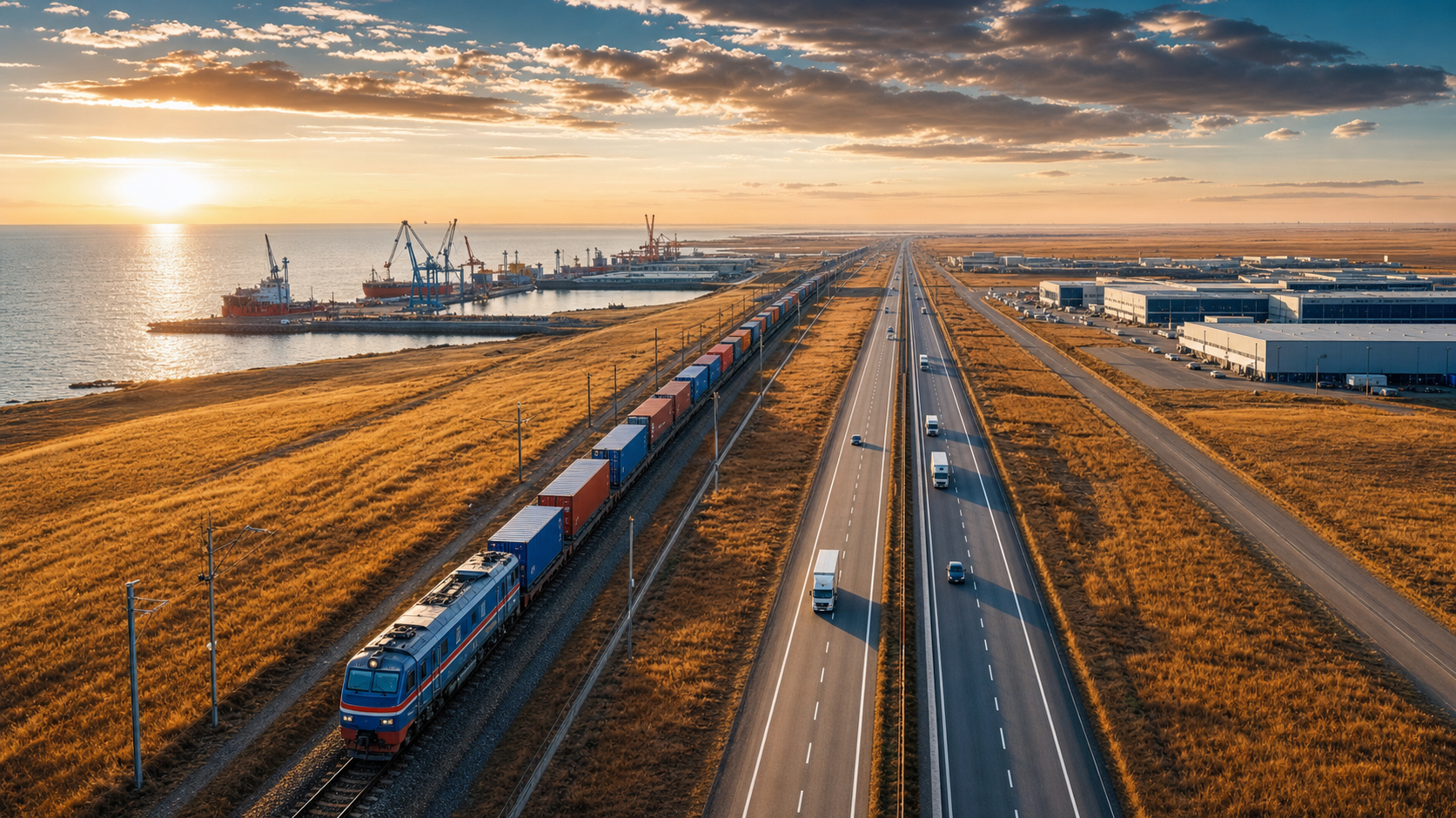
Kazakhstan's New Silk Road: How the steppe is becoming a hub between East and West – Creative image on the topic, with AI: Xpert.Digital
Alternative to the Suez Canal: Kazakhstan's new billion-dollar plan for global trade
1,000 kilometers shorter: The new transit route that will change trade with China forever
Lithium, logistics & billions: Why Kazakhstan is ideal and indispensable for Germany
Kazakhstan is reinventing itself: from a resource-rich landlocked country to an indispensable logistics hub between Asia and Europe. In light of global crises, uncertain sea lanes, and far-reaching geopolitical upheavals, the so-called "Central Corridor" is increasingly coming into focus for the global economy. With massive investments of billions in gigantic desert highways, modern rail networks, and Caspian ports, the world's ninth-largest country is creating a fast and secure land bridge that will significantly accelerate international freight transport and offer alternative routes bypassing Russia and the Suez Canal. But Kazakhstan is becoming increasingly strategically important not only for transit traffic, but also as a supplier of critical raw materials and a lucrative investment location – especially for Germany and the European Union. The following article examines how the steppe is being developed into the "golden bridge" of the 21st century, which stakeholders stand to benefit, and what structural challenges this ambitious mega-project might still present.
Related to this:

Kazakhstan is reinventing itself as a transport hub
Kazakhstan is pushing ahead with the expansion of its transport infrastructure with considerable financial and political force. President Kassym-Jomart Tokayev recently launched several major projects with which the world's ninth-largest country aims to solidify its role as a central logistics hub between Europe and Asia. The focus is no longer solely on the country's wealth of natural resources, but increasingly on its geographical location as a transit corridor between the world's two largest economic regions. This strategic repositioning is not a short-term project, but rather the result of a systematic expansion pursued for years, which has received additional impetus from the geopolitical upheavals of recent years.
Groundbreaking ceremony for a new desert highway
The latest announcements focus on the construction of an approximately 800-kilometer-long highway between Beineu and Saksaulsk, which President Tokayev himself has described as a golden bridge between China and Europe. This entirely new route will, for the first time, create a direct road connection through a previously undeveloped region, linking the border crossings to China directly with the Caspian ports of Aktau and Kuryk. According to the Kazakh government, this will shorten the freight route between China and Europe by almost 1,000 kilometers, while reducing delivery times by up to three days. In addition, the existing Kysylorda–Saksaulsk and Ulgaissyn–Saksaulsk routes, with a total length of 774 kilometers, will be upgraded and modernized in parallel. Domestic construction companies will handle the project, which is expected to create more than 10,000 new jobs. The idea for this route dates back to 2021, when Tokayev first proposed it at a meeting in Aktau. Since then, technical studies, feasibility analyses, and financing issues have been resolved before actual construction began. The entire road corridor now bears the programmatic name Aral-Caspian Highway, intended to underscore its national and transcontinental importance. The project is financed by an international consortium consisting of the European Bank for Reconstruction and Development, the World Bank, the Asian Development Bank, the Kazakh Development Bank, and the state budget, with the total investment amounting to the equivalent of several billion euros.
Related to this:

Rail, port and border crossing as a complete package
Road expansion is just one component of a much broader infrastructure program that also includes the rail network, modern border crossings, and new logistics and transshipment centers. A key project is the new, approximately 322-kilometer-long railway line between Mointy and Kyzyljar, which will eliminate a significant detour in the existing network, shorten the overall route by 149 kilometers, and enable the operation of double-decker container trains. The World Bank has provided an $846 million guarantee for this project, which will also mobilize an additional $1.41 billion in private capital, supported by a $564 million co-guarantee from the Asian Infrastructure Investment Bank. Simultaneously, Kazakhstan is dredging parts of the Caspian Sea around its main port of Aktau to allow access for larger ships and significantly increase transshipment capacity along the Trans-Caspian route. The second major Caspian port, Kuryk, is also being equipped with a new multifunctional container terminal, while new transshipment terminals have already gone into operation in the Chinese city of Xi'an and the Georgian port of Poti. According to Kazakhstan, the country has invested more than US$35 billion in transport and logistics infrastructure over the past fifteen years, highlighting the scale of its national effort.
From detour to main route: The central corridor is gaining momentum
The significance of this Kazakh infrastructure initiative can only be understood within the context of the so-called Middle Corridor, officially also known as the Trans-Caspian International Transport Route. This approximately 4,000-kilometer-long multimodal route connects Chinese factories via Central Asia, the Caspian Sea, the South Caucasus, and Turkey with European markets, thus representing the shortest land bridge between China and Europe. Around 85 percent of the corridor's total freight volume flows through Kazakhstan, giving the country a structurally dominant position within the route. The volume of freight transported has developed dramatically in recent years: According to the Kazakh Ministry of Transport, it increased more than sevenfold between 2021 and 2025 to almost 4.5 million tons, while over a longer period of six years it increased fivefold from 800,000 to 4.1 million tons annually. Transit times have decreased dramatically in parallel: shipments that previously took four to six weeks now reach their destination in eleven to eighteen days, while the Suez Canal sea route still takes 45 to 55 days. The Kazakh government aims to more than double the freight volume along the entire route to over ten million tons by 2028, while Prime Minister Bektenov has also announced the construction of 5,000 kilometers of new railway lines within the next four years and an increase in transit capacity to 100 million tons per year by 2035.
| Key figure | Value | Period |
|---|---|---|
| Freight volume Medium Corridor | from 0.8 to 4.1 million tons | 2019–2025 |
| Target freight volume | 10 million tons | until 2028 |
| Target transit capacity in the long term | 100 million tons annually | until 2035 |
| New railway lines (announcement) | 5,000 km | next four years |
| Investment Beineu-Saksaulsk Street | Approximately 780 billion tenge (total project) | until 2029 |
| EU Investment Package Central Corridor | 10 to 12 billion euros | ongoing since 2025 |
Our Asia expertise in business development, sales and marketing

Our Asia expertise in business development, sales and marketing - Image: Xpert.Digital
Industry focus areas: B2B, digitalization (from AI to XR), mechanical engineering, logistics, renewable energies and industry
More information here:
A thematic hub offering insights and expertise:
- Knowledge platform covering global and regional economies, innovation and industry-specific trends
- A collection of analyses, insights, and background information from our key areas of focus
- A place for expertise and information on current developments in business and technology
- A hub for companies seeking information on markets, digitalization, and industry innovations
The Middle Corridor as a new lifeline between China and Europe
Geopolitical upheavals as an involuntary catalyst
Russia's war of aggression against Ukraine and the subsequent Western sanctions have forced the European Union to seek alternative trade routes that bypass Russian territory. The Middle Corridor has emerged as the only viable land bridge between China and Europe, avoiding both Russia and Iran and thus appearing less politically vulnerable to sanctions risks. This dynamic has been further intensified by the ongoing tensions in the Red Sea and the Gulf, which have increasingly undermined traditional sea routes via the Suez Canal and made the multimodal, politically more stable connection via the Caspian Sea and Central Asia more attractive. This combination of military and maritime instability has triggered a structural surge in demand that extends beyond short-term shifts and now shapes the strategic investment decisions of international institutions. In response to this changed situation, the European Union has pledged investments of approximately ten to twelve billion euros for the development of the corridor as part of its Global Gateway Initiative, of which three billion euros alone are earmarked for direct investment in Kazakh infrastructure projects. During Tokayev's visit to Brussels in the summer of 2026, additional economic agreements worth around ten billion euros were signed, including agreements by the Kazakh sovereign wealth fund Samruk Kazyna alone worth 8.4 billion euros.
Related to this:

China's interest: trade route and geostrategic anchor
For the People's Republic of China, Kazakhstan has been more than just a transit country within the Belt and Road Initiative for years. The country also serves as an energy source, a market, and a stable neighbor to the volatile Chinese province of Xinjiang, significantly increasing its geostrategic importance for Beijing. Even before the official launch of the Belt and Road Initiative in 2013, China had invested billions of dollars in Kazakhstan's energy and transportation infrastructure, including the Khorgos dry port and the Aktau port. To date, a total of 51 Chinese investment projects with a combined volume of over US$27 billion have been agreed upon with Kazakhstan. Through clever participation models—for example, Kazakhstan holds a 51 percent stake in the Khorgos inland port compared to a 49 percent Chinese stake—Kazakhstan attempts to limit its economic dependencies. Kazakhstan already handles around 70 percent of all land freight traffic between China and the European Union via the Khorgos border crossing, highlighting the country's crucial role as a hinge in Eurasian trade. This close economic integration with China also represents a diplomatic balancing act for Kazakhstan, as the country maintains traditionally close security and economic ties with Russia and attempts to safeguard its sovereignty through a deliberate multi-vector foreign policy.
Germany and the EU as beneficiaries of new trade routes
For the German economy, the expansion of the Central Corridor opens up concrete prospects that go beyond mere symbolism. Industry, mechanical engineering, automotive manufacturers, chemical companies, logistics providers, and trade could benefit in the medium term from faster and more resilient transport routes between Europe and Asia, particularly given the ongoing fragility of established sea routes. Bilateral trade between Germany and Kazakhstan rose by 41 percent last year to US$3.9 billion, while German direct investment increased by 64 percent to a record level of US$770 million. At the Kazakhstan-Germany Economic Forum, agreements were also reached on a portfolio of 66 joint investment projects with a total value of US$55 billion, involving companies such as Siemens, the KfW banking group, CLAAS, and HORSCH. Of particular importance is the raw material dimension: Kazakhstan claims to possess 19 of the 34 raw materials classified as critical by the EU, including several rare earth elements essential for batteries, semiconductors, and the energy transition. To jointly develop these deposits, the German Mineral Resources Agency (DERA) and Kazakh partners are currently establishing a trading consortium for critical raw materials, while the German company HMS Bergbau is planning a lithium processing plant in eastern Kazakhstan with an investment volume of approximately US$500 million. Unlike China, which often exports raw materials unprocessed, the German cooperation strategy deliberately focuses on the principle of technology in exchange for raw materials, with processing ideally taking place in Kazakhstan itself to generate local added value. President Tokayev has also proposed formally linking the Middle Corridor to the Trans-European Transport Network and the European Global Gateway Initiative to provide an institutional foundation for the growing East-West trade.
Opportunities and structural risks in comparison
The economic logic behind Kazakhstan's infrastructure offensive is understandable, but it is not without structural risks. Capacity bottlenecks along the route are real: even after the planned expansion phases, the Central Corridor, with a current capacity of around ten million tons, will remain a niche corridor compared to global container flows via major sea routes, even though experts consider a share of ten to twenty percent of total Europe-China trade by 2035 to be realistic. Moreover, the route will continue to rely on a complex multimodal interplay of road, rail, and ferry traffic across the Caspian Sea, making it more susceptible to bottlenecks at individual junctions than continuous rail or sea connections. The political stability of Kazakhstan itself, which is considered an authoritarian state with historically close ties to Russia, is regularly questioned by Western observers, particularly with regard to raw material agreements, which in the past have also been deemed politically sensitive. At the same time, experience from recent years shows that Kazakhstan has so far successfully balanced its foreign policy between Russia, China and the West, mobilizing foreign capital and know-how in a targeted manner without becoming unilaterally dependent.
A long-term location strategy
With its recent infrastructure investments, Kazakhstan is pursuing the stated goal of systematically expanding its position as a reliable economic and transit partner between Europe and Asia, thereby transforming its geographically peripheral location into a genuine competitive advantage. For German and European companies, the country is likely to gain strategic importance in the future, not only as a supplier of raw materials but also increasingly as a logistics hub for trade with Central Asia and beyond. Crucial to the long-term success of this strategy will be whether Kazakhstan actually implements the announced capacity targets on time and whether its international financing partners, from the World Bank to the European Union, fulfill their commitments to the announced extent and pace.
Your container high-bay warehouse and container terminal experts

Container terminal systems for road, rail and sea transport in the dual-use logistics concept of heavy-lift logistics - Creative image: Xpert.Digital
In a world marked by geopolitical upheavals, fragile supply chains, and a new awareness of the vulnerability of critical infrastructure, the concept of national security is undergoing a fundamental reassessment. A state's ability to guarantee its economic prosperity, the provision of essential goods and services to its population, and its military capability increasingly depends on the resilience of its logistical networks. In this context, the concept of "dual-use" is evolving from a niche category of export control to a broader strategic doctrine. This shift is not merely a technical adjustment but a necessary response to the "paradigm shift" that demands a profound integration of civilian and military capabilities.
Related to this:
Consulting - Planning - Implementation

Konrad Wolfenstein
I would be happy to serve as your personal advisor.
You can contact me at wolfenstein∂xpert.digital or
Just call me on +49 7348 4088 965 .
🎯🎯🎯 Data-driven B2B industry hub as a quasi-in-house solution

The quasi-in-house solution: How Xpert.Digital closes operational gaps in B2B marketing and sales – Smart Content-Driven Business - Image: Xpert.Digital
Xpert.Digital is a data-driven B2B industry hub led by Konrad Wolfenstein . The company acts as an external, quasi-in-house solution for industrial partners, closing operational gaps in marketing, content, and sales – without requiring additional resources on the client side.
More information here:





