
Monopoly profits in the electricity grid: How grid operators rake in money while the energy transition waits
Xpert Pre-Release

Available in 27 languages 📢
Prefer Xpert.Digital on GoogleⓘPublished on: June 18, 2026 / Updated on: June 18, 2026 – Author: Konrad Wolfenstein
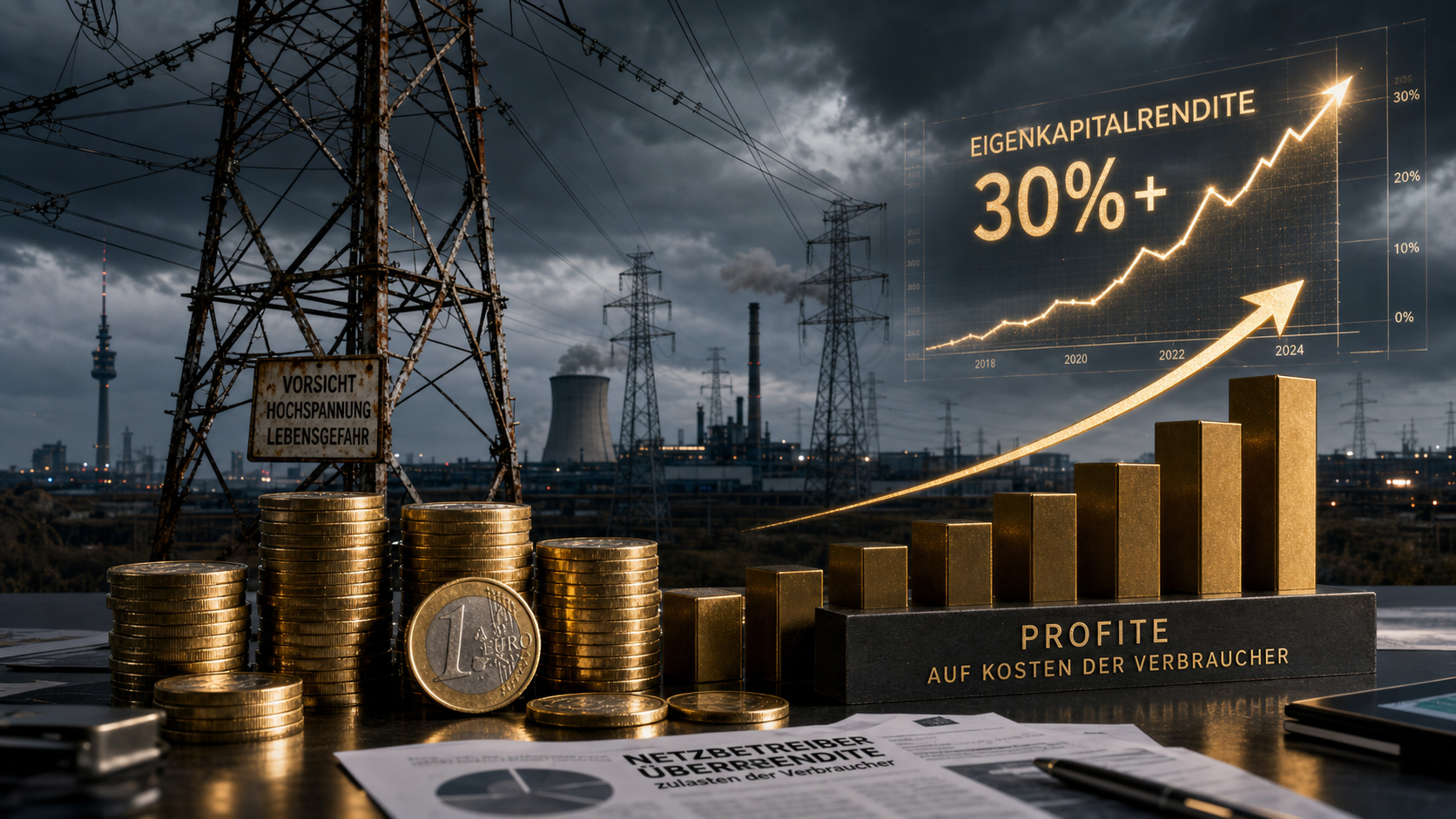
Monopoly profits in the electricity grid: How grid operators rake in money while the energy transition waits – Image: Xpert.Digital
Up to 50% return: How network operators rake in profits while the power grid collapses
Energy transition on hold: How the state is giving network operators dream returns
Billions in profits despite dilapidated networks: The absurd business model of electricity suppliers
Germany's electricity grids are the bottleneck of the energy transition – outdated, overloaded, and a massive cost driver for households and industry. Yet while tens of thousands of wind turbines, solar panels, and storage facilities are stuck in the queue for grid connection, the operators of these grids are making the deals of a lifetime. Thanks to a flawed regulatory system and a complete lack of competition, regional monopolists are achieving returns on equity of up to 50 percent. How can it be that one industry is raking in such profits while the country's critical infrastructure is stagnating? An investigation into the maze of electricity grid fees reveals that consumers ultimately foot the bill – and the system protects the profiteers.
When the net becomes a cash cow – and nobody repairs it
40,000 projects blocked: The obscene profits of Germany's electricity grid monopolists
Anyone reading the financial statements of Germany's largest electricity distribution network operators in spring 2026 will be astonished. Not by losses, but by the abundance of profits. According to an analysis by the German Association of New Energy Industries (BNE), which was made available to Zeitmagazin, the average return on equity of the 18 largest regional electricity network operators in 2024 was a remarkable 30.1 percent. This is not an outlier, but the culmination of an ongoing trend: As early as 2023, the average return on equity (according to commercial law) of the 15 largest distribution network operators examined was 20.2 percent, as determined by the BNE from an analysis of company balance sheets for the period 2019 to 2023. Individual companies exceeded these figures many times over. EWE Netz achieved a return of 50 percent in 2023, Pfalzwerke Netz 38 to 39 percent, and Westnetz 27 percent. In 2024, according to BNE, Westnetz's return even rose to 45 percent, Bayernwerk Netz achieved 38 percent and Mitteldeutsche Netzgesellschaft Strom 43 percent.
These figures are not only economically remarkable – they are politically explosive. At the same time, large parts of Germany's electricity grid are hopelessly overloaded, outdated, and hopelessly overwhelmed by the ramp-up of renewable energies. Around 40,000 projects across Germany are waiting for grid connection, including wind farms, solar plants, and battery storage facilities with a total capacity of 140 gigawatts. Experts estimate the need for expanding the distribution grid by 2045 at around €323 billion, and for the transmission grid at a further €328 billion – a total of around €651 billion. And yet: the companies to which society has entrusted the responsibility for this critical infrastructure are generating returns that would put even successful technology companies to shame.
The business model: Profit without competitive pressure
To understand how network operators can achieve such returns, one must grasp the nature of their business model. Electricity grids are so-called natural monopolies. It would be economically irrational and technically nonsensical to build competing transmission networks in a city or region. Consumers simply have no choice regarding their network operator – they pay the network charges of the one in whose service area they live. The network charge, which residential customers, businesses, and industry pay for the transmission of electricity, accounts for about one-third of the total electricity bill for private consumers. The network charges are divided into transmission network charges, levied by the four major transmission system operators and representing about 30 percent of the network costs, and distribution network charges, levied by the 866 regional distribution system operators, which account for approximately 70 percent.
Since competition doesn't work, the state regulates the profits that can be achieved. The Federal Network Agency sets so-called revenue caps for each regulatory period, from which the permissible network charges are derived. A central element of this system is the imputed return on equity: it dictates how much return a network operator is allowed to achieve on the equity capital invested and is included as a cost item in the calculation of the network charges. In the current fourth regulatory period, which applies to electricity networks from 2024 to 2028, this interest rate was set at 4.13 percent after taxes, with a higher rate of 5.07 percent for new investments. This sounds like a moderate and fair regulation. But the reality is different.
The gap between regulation and reality
How is it that companies with a regulatory-approved return on equity of around 4 to 5 percent actually achieve returns of 20, 30, or even 50 percent? The answer lies in a significant difference between what the regulations stipulate and what actually appears on the balance sheets. Regulatory regulations calculate the return on equity based on so-called imputed equity – a standardized value based on historical acquisition costs and a defined capital structure. However, the return on equity under commercial law relates the net income to the actual equity reported on a company's balance sheet – and this can be structurally much lower than the imputed fixed assets.
This accounting discrepancy explains part of the difference, but it is not the only explanation. The BNE (German Association of Network Operators) also accuses the network operators under investigation of specific practices that systematically exploit the regulatory system to generate higher profits. These include artificially inflating costs in the base year of the regulatory period, double-applying inflation adjustments, and – particularly explosive – factoring trade tax into network charges even though this tax is not actually paid, or not in full. According to estimates, distribution network operators burden their customers with approximately €400 million annually in calculated trade tax, a significant portion of which simply remains in the municipal tax system without ever being actually paid. BNE Managing Director Robert Busch summed it up: If network operators can achieve such high returns, then something is fundamentally wrong with the regulatory framework.
Consumers pay the bill
What sounds like technical jargon from regulatory authorities has direct financial consequences for millions of households and businesses in Germany. Network charges are not an abstract item on the energy bill – they make up a significant portion of the monthly electricity bill and have become a noticeable burden for many households and small and medium-sized enterprises in recent years. From 2023 to 2024 alone, network charges for residential customers with a typical annual consumption of 3,500 kilowatt-hours rose by around 10.6 percent – from an average of €341 to €377 net per year. In certain regions, such as Bavaria, the increases were as high as 17 percent.
Looking at the transmission grids, the picture is even more dramatic: The four major transmission system operators, 50Hertz, Amprion, TenneT, and TransnetBW, doubled their grid fees on January 1, 2024, from 3.12 cents per kilowatt-hour to 6.43 cents – a direct result of the elimination of government subsidies from the Climate and Transformation Fund. For residential customers, this meant an immediate increase in electricity costs, which was not offset by any efficiency improvements or competitive pressure. From 2025 onward, the Federal Network Agency did provide partial compensation for those regions where grid fees had risen particularly sharply due to the massive expansion of renewable energies – a new pass-through mechanism with a projected pass-through amount of €2.4 billion for 2025 now distributes the costs more broadly. However, the result is that the average household outside the benefiting regions will still face additional costs of around €21 per year, while grid profits continue unabated.
The paradoxical simultaneity: record returns, record delays
Perhaps the most explosive aspect of this story is not the magnitude of the returns themselves, but their simultaneous occurrence alongside a massive investment backlog. Companies generating such exceptionally high profits should, in theory, be investing heavily in their own infrastructure. However, reality paints a different picture. According to the legally mandated grid expansion plans for 2024, published in April 2024 by the 82 largest distribution network operators, approximately 24 percent of high-voltage projects and high- to medium-voltage substation projects were already delayed by December 31, 2023, measured by investment volume. The network operators cite internal factors (26 percent of the affected investment volume), permitting processes (17 percent), supply bottlenecks, and external factors as the main reasons for these delays.
This investment backlog is not an abstract problem. It has concrete, serious economic consequences. The consulting firm AFRY estimates the investment volume that cannot currently be realized in Germany due to a lack of grid capacity at 45 billion euros. Around 40,000 projects are in the connection queue – renewable energy and electricity storage facilities with a combined capacity of 270 gigawatts are waiting to be connected to the grid. An industrial park in Rommerskirchen in the Rhineland illustrates the problem perfectly: Located directly next to high-voltage power lines, the industrial park is nevertheless waiting for a sufficient electricity connection, as Westnetz reports that the capacity of the 110 kV distribution network is almost exhausted – a connection could be delayed until the 2030s. Companies seeking to grow and invest in Germany are thus encountering a structural limit to their growth.
The need for investment: A national effort is being hampered
The scale of the required investments is historically unprecedented. The electrification of transport, industry, and buildings, the massive expansion of wind power and photovoltaics, and the integration of millions of decentralized producers and consumers necessitate a fundamental transformation of the entire grid infrastructure. By 2033, the 82 largest distribution network operators expect an investment requirement of around €110 billion for grid expansion alone; by 2045, this requirement will rise to around €207 billion. Adding the investment requirements for transmission and distribution networks up to 2045 results in a total of €651 billion. This means that the annual investment volume must increase from around €15 billion in 2023 to approximately €34 billion per year – a rise of 127 percent.
The German Association of Energy and Water Industries (BDEW) specifies the investment path for the near future: In 2024, approximately €13.4 billion was invested in transmission networks and €8.6 billion in distribution networks, totaling around €22 billion. These figures are projected to increase to €16.4 billion annually for transmission networks and €15.4 billion for distribution networks by 2030 – a total of approximately €32 billion. Given the existing backlog and the need to integrate around 9.3 million additional network users by 2030, the question remains: Why aren't the network operators' extraordinary profits being reinvested to a significantly greater extent in the urgently needed expansion?
Approval hurdles and structural obstacles
The distribution network operators are not solely to blame. The picture would be incomplete without mentioning the structural obstacles that delay network expansion, regardless of the operators' willingness to invest. Germany suffers from a chronic permitting problem that affects all infrastructure sectors. For HVDC (high-voltage direct current) lines, the average permitting period is around six years from the date of application; together with the legally mandated planning time before the initial application, this adds up to at least 7.5 years. For conventional three-phase AC lines, a permitting process takes an average of five to six years.
For onshore wind turbines that need to be connected via the distribution grid, the permitting process doubled in the past ten years, from around 13 months to as much as 26 months in 2023, before legislative changes reduced it to an average of 17 months in 2025. This shows that political will can indeed reduce bureaucracy. However, this will is unevenly distributed and was not applied to grid expansion itself for too long. While wind power permits have been expedited, internal processes at grid operators remain among the most frequent causes of delays – the 26 percent of the delayed investment volume that the operators themselves cite as "internal reasons.".
The incentive regulation system: good concept, poor implementation
The fundamental principle of incentive regulation is well-founded: Instead of fully reimbursing a network operator's actual costs—which would eliminate any pressure for efficiency—the Federal Network Agency sets a revenue cap. If a network operator operates more efficiently than the regulatory assumptions allow it to keep the difference. This mechanism is intended to create incentives for cost reduction. In theory, it's an elegant instrument. In practice, however, it has produced an undesirable side effect: It doesn't necessarily reward investment and service quality, but rather cost optimization and—where possible—accounting ingenuity.
The Federal Network Agency's ongoing reform project, internally known as the NEST process (New Revenue Cap System and Increase), was intended to improve this system for the fifth regulatory period starting in 2029. However, the results presented by the agency in December 2025 disappointed both industry and consumer associations. The German Association of Energy and Water Industries (BDEW) criticized the planned changes, stating that they contained structural deteriorations compared to the status quo, weakening the investment and performance capacity of network operators. According to BDEW calculations, the industry expects revenue losses of €3.5 billion in the electricity sector and €1.5 billion in the gas sector over the entire regulatory period due to the new methodology. The Association of Municipal Enterprises (VKU) described the stipulations as "disappointing and completely inadequate for the current and future tasks of distribution network operators.".
One specific point of criticism concerns the methodology for calculating the cost of debt. The Federal Network Agency adheres to a fixed seven-year period for determining the cost of debt, instead of using a dynamic model. This threatens network operators with structural shortfalls in refinancing their investments during the upcoming regulatory period from 2029 to 2033. At the same time, cost increases are only recognized with a considerable time lag, which puts pressure on the actual profitability of network operators, particularly during periods of high inflation.
Our EU and German expertise in business development, sales and marketing

Our EU and German expertise in business development, sales and marketing - Image: Xpert.Digital
Industry focus areas: B2B, digitalization (from AI to XR), mechanical engineering, logistics, renewable energies and industry
More information here:
A thematic hub offering insights and expertise:
- Knowledge platform covering global and regional economies, innovation and industry-specific trends
- A collection of analyses, insights, and background information from our key areas of focus
- A place for expertise and information on current developments in business and technology
- A hub for companies seeking information on markets, digitalization, and industry innovations
Why the electricity grid is slowing down German energy reforms — and who benefits from it
Regulatory equity return in European comparison: A paradox
At this point, a seemingly irresolvable paradox arises. On the one hand, German network operators achieve exceptionally high returns under commercial law in practice. On the other hand, the equity return of 4.28 percent after taxes, as stipulated by the Federal Network Agency, is, according to the German Association of Energy and Water Industries (BDEW), at the lower end of the European range – the EU average is 6.65 percent. This seemingly contradictory situation is explained by the structural difference between regulatory and commercial returns, as already described. The regulatory return is a target set by the authorities, not a market price; the commercial return, however, reflects the actual business reality, which, due to cost optimization, accounting decisions, and systemic loopholes, can be significantly higher than this target value.
This presents a strategic problem for the upcoming grid expansion: Mobilizing the necessary private capital requires that institutional investors – pension funds, infrastructure funds, and insurance companies – can expect sufficiently attractive risk-adjusted returns. Economists estimate that the regulatory return on equity would have to rise to at least 8.7 percent before taxes to mobilize half of the required additional equity from institutional investors. This figure is far above the currently stipulated rate. At the same time, existing grid operators are already generating returns that far exceed this target value through inherent systemic mechanisms – just not via the regulatory calculation method, but rather through accounting and structural optimization.
Redispatch: The invisible cost engine of an overloaded network
Another often underestimated aspect of the grid problem is the so-called redispatch costs. When the grid reaches its capacity limits and electricity cannot be transported from producers to consumers, grid operators have to intervene in the market: electricity generation in overloaded regions is throttled, while in underserved regions it is increased. These measures cost money – and a lot of it. The total costs of grid congestion management amounted to around €2.776 billion in 2024. While this is 17 percent less than the previous year (2023: €3.335 billion), it still represents an annual economic burden in the billions, resulting directly from the structural deficit in grid expansion. Around 74 percent of all bottlenecks in 2024 were in the transmission grid – that is, the major electricity corridors that are supposed to transport wind power from the north and east to the consumption centers in the south and west.
The root of the problem lies in a political misjudgment that persisted for years: the decision to build transmission lines like SuedLink as expensive underground cables instead of more cost-effective overhead lines delayed completion by years and significantly increased the project's cost. This politically motivated concession to landscape protection shifted the costs onto all electricity consumers without solving the underlying capacity problem. At the distribution network level, according to an AFRY report, the backlog in grid expansion is blocking renewable energy projects with a total capacity of 140 gigawatts and battery storage projects with 130 gigawatts – a blockage of investments amounting to €45 billion.
Network charges as an industrial policy brake
The effects of excessive grid fees and an inadequately developed grid are not limited to household electricity bills. They have become a serious industrial policy problem. Energy-intensive industries that produce in Germany directly incorporate the high grid costs into their cost calculations. From January 2024, the major transmission system operators charged 6.43 cents per kilowatt-hour in grid fees – a doubling within months. While special regulations for large consumers with individual grid fees under Section 19 of the Electricity Grid Fee Ordinance were retained, and the federal government adopted various relief measures, including subsidies from the Climate and Transformation Fund totaling €26 billion to reduce transmission grid fees over the next four years, these measures only alleviate the symptoms without addressing the root cause.
For small and medium-sized enterprises (SMEs) and medium-sized industrial companies that do not fall under the exemption criteria, the cost burden remains high. The Institute for Macroeconomics and Business Cycle Research (IMK) of the Hans Böckler Foundation emphasizes that the annual investment volume for electricity grids must increase from around €15 billion in 2023 to approximately €34 billion to enable the energy transition – otherwise, the delayed expansion will increase the overall cost of achieving climate neutrality and jeopardize the competitiveness of Germany as a business location. Delays in grid expansion are not an abstract planning factor, but have concrete consequences for companies: higher production costs, uncertainty in investment decisions, and, in the worst-case scenario, relocation to regions with better-developed energy infrastructure.
The major reform: What AgNes and the new remuneration system are intended to bring
For 2029, the Federal Network Agency is planning the most significant reform of the electricity grid fee structure in twenty years. Under the acronym AgNes (General Grid Fee System for Electricity), a new structure is being developed that will redistribute approximately €37 billion in annual grid costs between households and businesses starting in 2029. The current Electricity Grid Fee Ordinance, which has defined the basic rules for distributing these costs since 2005, expires at the end of 2028. The reform aims to modernize cost allocation, strengthen incentives for flexible grid usage, and mitigate the growing regional imbalances that have persisted for years.
The already implemented cost-sharing mechanism for grid areas with above-average loads – particularly in the windy north and east of Germany – is a first step in this direction. From 2025 onwards, around 26 directly eligible grid operators will benefit from the Federal Network Agency's decision in August 2024; in the favored regions, grid fees will decrease by up to 39 percent, which translates to savings of up to €192 per year for an average household. Nevertheless, scientists from the Federal Environment Agency caution that this partial compensation is only an interim step – in the long term, uniform grid fees across Germany would ensure fair distribution better than a patchwork cost-sharing mechanism.
The structural dilemma: Between investment incentives and consumer protection
The political and regulatory debate ultimately revolves around a fundamental dilemma: Those who want private companies to invest hundreds of billions of euros in essential social infrastructure must offer them sufficiently attractive returns. However, those who allow excessively high returns place an undue burden on consumers and industry and effectively subsidize profits generated by monopoly, not by performance. The German regulatory system has not yet found a satisfactory solution to this balancing act.
The current data speaks for itself: Distribution network operators' returns far exceed regulatory requirements. At the same time, the network itself falls short of standards in many areas. The logical conclusion drawn by the BNE (German Association of Network Operators) is this: When excess returns and a backlog of investment occur simultaneously, something is wrong with the regulatory framework. Either mechanisms that consistently link profits to investment performance are lacking, or existing loopholes allow profits that have nothing to do with actual network investment.
One reform option demanded by the BNE (German Association of Energy and Water Industries) and discussed in the NEST process is so-called performance-based returns: The permissible return on equity rises or falls depending on whether a network operator actually achieves predefined expansion targets and quality standards. Such output-based regulatory models have been tested in other countries and could help correct the imbalance between return and performance. The BDEW (German Association of Energy and Water Industries) and VKU (Association of Municipal Enterprises) both criticize the fact that the Federal Network Agency has not yet implemented this approach sufficiently in the NEST process.
Market structure and ownership: Municipal utilities in the profiteer's shadow
Another aspect deserves attention: Who actually owns the most profitable network operators? EWE Netz is a subsidiary of the EWE Group, which is majority-owned by municipalities in Lower Saxony and Bremen. Westnetz belongs to the RWE Group, and Bayernwerk Netz to the Bavarian energy company E.ON. Mitteldeutsche Netzgesellschaft Strom is a subsidiary of enviaM, which in turn is majority-owned by E.ON. The extraordinary profits thus flow to a considerable extent into the coffers of energy companies and – in the case of municipally operated utilities – into municipal budgets. This makes the political debate surrounding regulatory reform delicate: Municipalities that profit from network revenues have a structural interest in ensuring that regulation is not too stringent. The separation between municipal infrastructure interests and private-sector profit interests has never been fully achieved in the German energy sector.
What needs to be done now
The analysis shows that the German electricity grid system is at a crossroads. On the one hand, there is a regulatory framework that, in its effect, enables excess returns without proportional investment. On the other hand, there is a gigantic investment need that cannot be met without reliable and fair regulation. Several measures are required to find a viable way out of this dilemma.
First, greater transparency is needed: The returns of network operators under commercial law must be systematically and publicly compared with the returns permitted under regulatory law. Until now, this analysis has only been possible through costly balance sheet studies by the German Federal Network Agency (BNE) – it should be a mandatory component of regulatory reporting. Second, returns need to be more consistently linked to performance: Network operators that fail to meet their expansion targets should not be entitled to the full regulatory return. Third, the approval process for network projects must be further accelerated – Germany has shown progress here by reducing the approval time for wind power, progress which must now be applied to network expansion projects. Fourth, capital structure optimization, which generates inflated returns on an accounting basis, should be limited through targeted regulatory adjustments.
The energy transition stands or falls with the electricity grid. It is the lifeblood of the future economy. It is no coincidence that the very companies entrusted with the operation and expansion of this lifeblood are currently reaping record-breaking profits, while 40,000 energy projects await grid connection and redispatch costs in the billions burden the public. It is the predictable result of a regulatory system designed by brilliant minds and subsequently exploited to their advantage by equally shrewd players. The question is not whether reforms are needed. The question is how long it will take politicians to implement them.





