
Redispatch 2.0 and large-scale battery storage: Curse or Segen for the power grid? The ambivalent role of giant battery storage systems
Xpert Pre-Release

Available in 27 languages 📢
Prefer Xpert.Digital on GoogleⓘPublished on: February 18, 2026 / Updated on: February 18, 2026 – Author: Konrad Wolfenstein
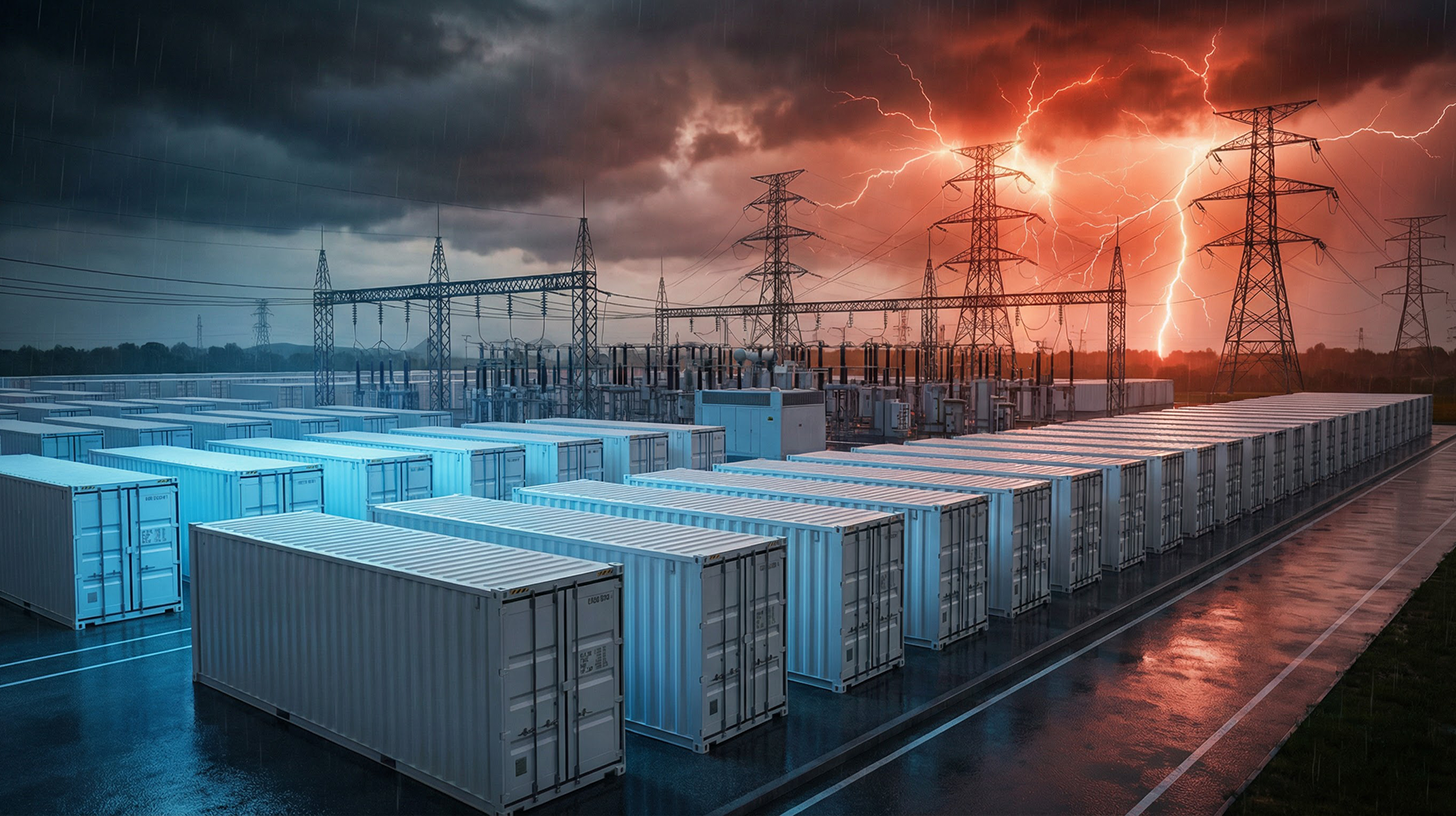
Redispatch 2.0 and large-scale battery storage: Curse or Segen for the power grid? The ambivalent role of giant battery storage systems – Image: Xpert.Digital
Blackout threat averted? How network operators manage the "power congestion" from north to south
Redispatch 2.0 explained in simple terms: What plant operators and storage investors need to know
Germany's electricity grid is facing a historic stress test: While wind turbines in the north are running at full capacity, there is often a lack of transmission lines to transport the energy to the industrial centers of the south. To prevent a collapse of the supply, grid operators are intervening in generation almost around the clock – a process known as redispatch, which costs consumers billions annually.
However, the energy transition has fundamentally changed this system. Where previously a few large power plants were centrally throttled, today tens of thousands of decentralized plants, solar parks, and increasingly, high-performance large-scale battery storage systems must be coordinated. Since the introduction of Redispatch 2.0 in October 2021, distribution network operators and smaller plant operators have also been obligated to ensure the physical stability of the grid.
The role of the booming large-scale battery storage systems is particularly interesting: they are seen as a beacon of hope for the energy transition, but – if used incorrectly – can actually exacerbate local bottlenecks. The problem often lies not with the technology itself, but with a lack of regional price signals. The following Q&A guide examines in detail how modern congestion management works, why costs are exploding, what role battery storage plays in this, and why the discussion about electricity price zones is crucial for the future security of our energy supply.
What is meant by redispatch and why is this term so central to the German electricity grid?
Redispatch refers to interventions in the generation output of power plants to protect transmission lines from overload. If a bottleneck threatens at a particular point in the grid, power plants on the near side of the bottleneck are instructed to reduce their feed-in, while plants on the far side of the bottleneck must increase their feed-in. This creates a load flow that counteracts the bottleneck. The term is frequently used in energy policy debates, but rarely explained in its full scope. Yet it is central to understanding modern grids, as it describes the mechanism by which grid operators ensure the physical stability of the electricity grid in real time. Without redispatch, grid bottlenecks would lead to uncontrolled overloads, which in the worst case could cause cascading outages. The principle is initially simple: If too much electricity is fed into the grid at one point, generation there must be reduced and compensated for at another point. However, the practical implementation of this principle has changed considerably over the years, particularly due to the massive expansion of renewable energies and the associated decentralization of electricity generation.
What are the legal foundations of redispatch and where do its historical roots lie?
The roots of redispatch reach back to the German Energy Industry Act (EnWG) of 2005. Section 13 of the EnWG, which came into force on July 13, 2005, obligates transmission system operators to ensure system security. Specifically, it states that transmission system operators are authorized and obligated to eliminate threats or disruptions to the electricity supply system through grid-related, market-related, and additional reserve measures. In what was then a highly centralized power plant system, this meant that in the event of impending grid overloads, individual large power plants could be instructed to adjust their feed-in. This primarily affected conventional plants in the 220 kV and 380 kV transmission grid. The number of affected plants was manageable, communication channels were short, and the coordination effort was comparatively low. The system functioned in an environment where a few large power plants handled the majority of electricity generation and load flows were highly predictable. This basic principle of centralized control formed the basis on which all subsequent expansions and reforms were built.
How has the expansion of renewable energies changed the electricity system?
With the expansion of renewable energies from 2010 onwards, the system structure changed fundamentally. Tens of thousands of decentralized generators gradually replaced a few centralized power plants. In the medium term, around 90 percent of generation facilities will be connected to the distribution grids, while large power plants will continue to decline in importance. This transformation led to new transmission routes, particularly from north to south, since a large proportion of wind energy is generated in northern Germany, while the main consumption areas are in the south and west. The transmission capacities were, and in many cases still are, insufficiently dimensioned to transport all the generated electricity to the consumption centers. At the same time, alongside traditional redispatch, feed-in management under the Renewable Energy Sources Act continued to exist for renewable energy plants. This parallel structure, in which conventional power plants were regulated via redispatch and renewable energy plants via feed-in management, led to increasing complexity and rising costs for congestion management measures. Wind and solar power plants generate energy depending on the weather and time of day, which significantly complicates the predictability of load flows and increases the need for control measures.
What was the problem with the old system of redispatch and feed-in management?
The old system was characterized by a structural division that became increasingly inefficient. On the one hand, there was the classic redispatch according to Section 13 of the German Energy Industry Act (EnWG), which was applied exclusively to the transmission grid and affected conventional generation plants with more than 10 megawatts of installed nominal capacity. The transmission system operators could regulate these plants to avoid grid congestion. On the other hand, there was feed-in management according to the Renewable Energy Sources Act (EEG) and the Combined Heat and Power Act (KWKG), which addressed the regulation of renewable energy plants and CHP plants separately for grid congestion management. With feed-in management, plants were curtailed based on actual values, i.e., in acute situations. Proactive, forecast-based planning was lacking. Curtailment occurred ad hoc, leading to higher costs and an inefficient use of available resources. The costs for overall grid congestion management increased significantly between 2019 and 2023, from €1.3 billion to €3.2 billion. In 2023, approximately 19 terawatt-hours of electricity were lost due to grid bottlenecks, which corresponds to about four percent of Germany's total electricity generation. Offshore and onshore wind farms were particularly affected.
What exactly was decided with the Grid Expansion Acceleration Act 2019?
The political response to the growing problems came in 2019 with the amendment to the Grid Expansion Acceleration Act, which entered into force on May 17, 2019. The aim was to merge redispatch and feed-in management into an integrated congestion management system. The previous feed-in management regulations under the Renewable Energy Sources Act (EEG) and the Combined Heat and Power Act (KWKG) were repealed and replaced by a unified redispatch regime, known as Redispatch 2.0, based on Sections 13, 13a, and 14 of the Energy Industry Act (EnWG). This was intended to establish a uniform, preventative congestion management system for electricity supply throughout Germany. Renewable energy and combined heat and power (CHP) plants were no longer treated separately but were regulated according to the same legal framework as conventional power plants. The implementation deadline was set for October 1, 2021, with initial data submission obligations beginning as early as July 2021.
Since when has Redispatch 2.0 been in effect and what is fundamentally new about it?
Since October 1, 2021, Redispatch 2.0 has been mandatory for all market participants. The new aspect was not the possibility of intervention itself, but its comprehensive system integration. All controllable plants with a capacity of 100 kilowatts or more, including conventional power plants, renewable energy plants, and energy storage facilities, have since been included in congestion management. This is a fundamental difference from the old system, where only large conventional power plants over 10 megawatts were directly affected by redispatch. In the new process, the grid operator determines the grid state for a planning horizon of approximately 36 hours in advance and optimizes it as needed. This requires load and feed-in forecasts. If congestion is identified, the grid operator must resolve it using cost-effective measures. Another key innovation is that these measures must be balanced in terms of both energy and energy consumption, ensuring that plant operators do not suffer any financial disadvantages as a result of control interventions. Furthermore, the handling is no longer solely the responsibility of the transmission system operators, but also of all distribution system operators, who have thus become a key pillar of congestion management.
How does the Redispatch 2.0 process work in detail?
The Redispatch 2.0 process is based on a planning-based approach that differs fundamentally from the previous reactive approach. Grid operators create congestion forecasts based on comprehensive data from all grid participants, particularly from power plants feeding into the grid and major consumers. Plant operators submit either planned or forecast data, depending on the chosen balancing model. In the forecast model, information on market-related adjustments and unavailability must be provided to the grid operator so that the operator can create generation forecasts. In the planned value model, the plant operator is responsible for submitting both forecast and planned data.
Based on this data and real-time information, the grid operator can identify potential grid bottlenecks early and take targeted, proactive action. Alternative schedules are calculated for foreseeable overloads, and deviations from the market schedule are balanced. Section 13a of the German Energy Industry Act (EnWG) regulates the balancing and financial compensation to the plant operator. The balancing group manager, in most cases the direct marketer, receives energy compensation from the grid operator for the missing quantity in their balancing group. In the new process, the amount of energy fed in and curtailed per quarter hour is allocated to a balancing group. This system requires industry-wide cooperation between transmission system operators, distribution system operators, plant operators, balancing group managers, and so-called deployment managers, to whom plant operators can delegate a large portion of their responsibilities.
What are the current costs of network congestion management and how have they developed?
The costs of grid congestion management have fluctuated considerably in recent years. In 2022, total costs reached a peak of approximately €4.2 billion, driven by the energy crisis and extremely high fuel and wholesale prices. In 2023, preliminary total costs fell to just under €3.1 billion, despite an increase in the volume of measures implemented to 34,297 gigawatt-hours. This decline was due to the easing of energy prices, as wholesale electricity prices dropped from just over €230 to around €92 per megawatt-hour. Preliminary deployment costs for redispatch measures using conventional power plants amounted to approximately €1.8 billion in 2023, while the costs of reducing renewable energy output tripled to around €600 million.
In 2024, the volume of measures decreased by approximately 12 percent to 30,304 gigawatt-hours, and the preliminary total costs fell further to around €2.78 billion. However, the fourth quarter of 2024 showed a worrying increase: 10,424 gigawatt-hours had to be used to stabilize the grid, a rise of 19 percent compared to the same quarter of the previous year. December 2024 was particularly noteworthy, with costs of €370 million incurred in that month alone, a new record high since the energy crisis. Around 47 percent of the curtailed renewable energy plants were connected to the distribution grid in 2024, with the cause lying in the transmission grid in 74 percent of the cases. At the same time, there is a growing shift of bottlenecks towards the distribution network: its share of redispatch volumes rose from 20 percent in 2023 to 26 percent in 2024. These costs are passed on to electricity prices via network charges and thus affect all consumers.
Why is Redispatch 2.0 particularly relevant for large-scale battery storage systems?
A large-scale battery storage system with a capacity of many megawatts is technically capable of shifting significant amounts of energy over time. However, its actual feed-in is subject to the grid architecture. It is capable of redispatching, requires forecasting, and is integrated into congestion management. Capacity alone does not guarantee feed-in: where system stability is required, marketing must take a back seat. Especially with large installed capacity, integration into grid planning, forecasting models, and congestion management is crucial. Large batteries can alleviate bottlenecks by selectively charging or discharging. The critical point, however, is that they themselves can also become part of the bottleneck scenario if several systems attempt to feed in power simultaneously.
The market for large-scale battery storage systems in Germany is growing rapidly. Installed capacity reached over 2 gigawatts of nominal power by 2025, and 1.46 gigawatts of new capacity were expected to come online in 2025 alone. A sevenfold increase in capacity compared to 2024 is projected by 2027, and various forecasts predict that total capacity could reach 15 gigawatts by 2030. Grid operators' requests for battery storage connections now exceed existing capacities by almost a hundredfold. With such growth rates, the question of integrating these systems into congestion management is becoming increasingly urgent.
Our EU and German expertise in business development, sales and marketing

Our EU and German expertise in business development, sales and marketing - Image: Xpert.Digital
Industry focus areas: B2B, digitalization (from AI to XR), mechanical engineering, logistics, renewable energies and industry
More information here:
A thematic hub offering insights and expertise:
- Knowledge platform covering global and regional economies, innovation and industry-specific trends
- A collection of analyses, insights, and background information from our key areas of focus
- A place for expertise and information on current developments in business and technology
- A hub for companies seeking information on markets, digitalization, and industry innovations
Redispatch 3.0: The silent transformation of our energy system has long since begun
Are large batteries generally good or bad for the power grid?
This question cannot be answered in general terms, as it depends on the location, operating mode, and the specific grid situation. A study by Neon Neue Energieökonomik, commissioned by the storage developer Eco Stor, examined the performance of two large batteries in Schleswig-Holstein and Bavaria for every quarter hour of the year. The results show that grid operators save redispatch costs of 3 to 6 euros per year for every kilowatt of battery capacity. Large batteries should therefore by no means be considered inherently burdensome for the grid, even if this is sometimes suggested in the energy policy debate.
However, this grid relief currently occurs purely by chance, as Germany only has one electricity price zone and therefore no regional prices. Batteries operate according to the uniform price signal on the wholesale and balancing energy markets. Grid bottlenecks are invisible to them. Detailed analysis shows that a large battery relieves and burdens the grid with roughly equal frequency, each in about 20 percent of the quarter-hours. In the remaining 60 percent of the time, either the battery is idle or the grid is free of congestion. Fraunhofer ISE also points out that large battery storage systems, which are primarily operated according to market mechanisms, can amplify local power peaks through unfavorable charging and discharging behavior, thereby exacerbating transformer and line loads.
What does grid-friendly operation mean for large battery storage systems?
Grid-supportive operation refers to the targeted use of a storage system to stabilize the grid, prevent bottlenecks, or compensate for voltage fluctuations. This differs from purely market-supportive operation, where electricity is primarily purchased at low prices and sold at higher prices – a classic case of price arbitrage. A large-scale battery storage system is considered grid-supportive if its placement within the grid and its operating mode reduce the grid load, which can, for example, lead to a reduction in the need for grid expansion.
In practice, both approaches can be combined: A storage system can participate economically in the market while simultaneously serving the grid. Studies show that grid-supportive storage systems selectively absorb electricity when high feed-in is imminent and feed it back in later. This reduces the need for interventions and increases security of supply. For battery storage systems to be grid-supportive, they should be installed wherever the grid is under particular strain. Intelligent control is also crucial, as it ensures that the storage system reacts at the right moment and provides energy efficiently. The larger and more flexible a storage system is designed, for example, with a minimum discharge time of four hours, the greater its contribution to grid relief.
Why are there currently no effective incentives for grid-friendly behavior from large batteries?
The problem lies in the German electricity market design. Germany currently has a single electricity price zone with uniform day-ahead prices. This means that the electricity price on the exchange is the same everywhere in Germany, regardless of whether there are grid congestion issues in a particular region. Battery storage systems and all other market participants rely on this uniform price signal in the wholesale and balancing energy markets. Grid congestion is simply invisible to them because there is no price signal that reflects regional bottlenecks.
In this system, there is no financial incentive to act in a grid-friendly manner. A storage facility in Schleswig-Holstein that charges during strong winds does so not because there is a grid bottleneck there, but because the nationwide electricity price is currently low. That this behavior is simultaneously grid-friendly is pure coincidence. The study by Neon New Energy Economics examined three regulatory approaches to strengthen grid-friendly behavior. A dynamic redispatch price signal, which reflects the grid situation every 15 minutes, performed best. Such a price signal creates both the greatest added value for the grid and the least loss of market value.
What role does the discussion about electricity price zones for large battery storage and redispatch play?
The debate surrounding the division of Germany's electricity price zone has gained considerable momentum in recent years and is directly linked to the issues of redispatch and large-scale battery storage. As part of its Bidding Zone Review, the EU Commission has called for a review of the European bidding zones, proposing a division of Germany into two to four zones. A study by Agora Energiewende and the Fraunhofer IEE concludes that a system of local pricing could significantly reduce redispatch costs and strengthen security of supply. As early as 2023, local price signals could have reduced electricity costs for businesses and households by an average of over €6 per megawatt-hour nationwide.
A short report by Neon Neue Energieökonomik, commissioned by the energy supplier Enercity, estimates the resulting bottleneck rents within Germany at around €2 billion per year if the electricity grid were divided into four to five price zones. However, a study by the Technical University of Munich shows that the price differences between a few large electricity price zones are small and result in only minor savings in redispatch costs. In contrast, node-specific nodal pricing leads to a significant reduction in redispatch and overall costs. Regional price signals would be of enormous importance for large-scale battery storage systems, as they would create, for the first time, an economic incentive for grid-friendly behavior. However, the new German government has agreed in its coalition agreement to maintain the unified electricity price zone for the time being.
How are plant operators financially compensated during a redispatch operation?
If the grid operator adjusts generation, Section 13a of the German Energy Industry Act (EnWG) governs the balancing and financial compensation to the plant operator. The balancing group manager of the affected feed-in or offtake point has a claim against the transmission system operator that issued the generation adjustment request for balancing compensation for the measure. Furthermore, the adjustment of active or reactive power generation must be adequately compensated financially. Adequate financial compensation includes the necessary expenses for the actual generation adjustments, the pro rata consumption of the plant's value, and the proven lost revenue.
In June 2024, the Federal Network Agency issued a ruling on determining the appropriate financial compensation for redispatch measures pursuant to Section 13a, Paragraph 2. The underlying principle is that the operator of a renewable or conventional power plant should not suffer any economic disadvantages as a result of control interventions. They are placed in the same position as if the intervention had not occurred. For example, if a wind farm in the north is shut down because the transmission line to the south is overloaded, the operator must still be compensated. At the same time, another power plant in the south must produce more electricity to meet the demand, which also incurs costs.
What role do distribution network operators play in the Redispatch 2.0 process?
Until September 30, 2021, redispatch was the sole responsibility of the four transmission system operators in Germany. With Redispatch 2.0, this has fundamentally changed. The distribution system operators have become a key pillar of congestion management in the German electricity grid. They must proactively identify grid bottlenecks and then determine, coordinate, and implement appropriate measures while ensuring grid and supply security. This requires them to model their networks with regard to expected loads and forecast grid states. To eliminate bottlenecks, the distribution system operators must include all renewable energy plants, combined heat and power (CHP) plants, and storage facilities with a capacity of 100 kilowatts or more.
This represents a significant expansion of their existing responsibilities and requires new market roles and processes to respond to potential bottlenecks in real time and based on forecasts. The increasing bottlenecks in the distribution network underscore the importance of this development. The distribution network's share of redispatch volumes for renewable energy plants rose from 20 percent in 2023 to 26 percent in 2024, a trend that is likely to continue with the further expansion of decentralized generation.
How exactly can large-scale battery storage systems contribute to reducing grid congestion?
Battery storage systems can intervene precisely when grid bottlenecks occur. When too much electricity is generated, they absorb energy and release it later when demand increases. Large-scale storage systems react in milliseconds, making them ideal for reliably compensating for voltage fluctuations, frequency instabilities, or local load peaks. They provide balancing power and can prevent blackouts. Every avoided redispatch measure saves costs and prevents electricity from renewable sources from going to waste.
In a practical scenario, a large-scale battery storage system in northern Germany can be charged selectively during strong winds, thereby mitigating the peak in feed-in that would otherwise lead to grid overload. Fraunhofer ISE analyzes whether large-scale battery storage systems can be operated in a grid-supportive manner for specific locations by examining generation and load time series from the relevant substation, modeling the resulting power flows, and simulating grid-supportive operating strategies. Furthermore, the analysis examines whether redispatch measures have been implemented at the specific location in the past. This also presents new opportunities for municipalities, grid operators, and project developers, as battery storage systems create local added value, reduce grid strain, and strengthen local security of supply.
Why can large battery storage systems themselves become a problem for grid stability?
The electricity system has transformed from a centralized power plant control system to a data-driven coordination of decentralized resources. In this new system, it's not just the power output that matters, but also the integration into the system architecture. A large-scale battery storage system with enormous capacity can become problematic if it operates solely based on market signals without considering the local grid situation. If several storage systems in a region want to feed power into the grid simultaneously because electricity prices are currently high, this can cause or exacerbate the very bottlenecks that are meant to be avoided.
Large-scale battery storage systems, primarily operated according to market mechanisms, can amplify local power peaks through unfavorable charging and discharging patterns, thereby increasing the load on transformers and transmission lines. The rapidly growing number of large-scale battery storage systems potentially exacerbates this problem. With grid connection requests now exceeding 200 gigawatts, it is clear that coordinating these systems represents one of the key challenges of the coming years. The crucial point is that capacity alone does not guarantee feed-in. Where system stability is essential, marketing must take a back seat. A storage system that wants to generate revenue in the market must accept that its feed-in options are limited by the physical boundaries of the grid and the decisions of the grid operators.
What does the future of bottleneck management look like, and what does Redispatch 3.0 mean?
While Redispatch 2.0 primarily integrates generation facilities into congestion management, a further development towards Redispatch 3.0 aims to integrate storage facilities, electrolyzers, and controllable loads even more closely. The goal is even finer coordination of generation and consumption via digital platforms and real-time data. The discussion surrounding electricity price zones and local price signals will play a crucial role in this. If regulatory incentives for grid-friendly behavior can be successfully created, large-scale battery storage systems could play a significantly larger role in congestion avoidance than they do today. The study by Neon New Energy Economics concludes that a dynamic redispatch price signal would create the greatest added value for the grid while simultaneously minimizing losses in market value.
Technological advancements support this trend: The cost of lithium-ion batteries has fallen by approximately 84 percent in the last ten years, and the trend is toward larger systems with longer storage durations. While the average battery project in 2022 was still a one-hour system, two-hour systems now dominate, and four- and six-hour systems are also increasingly being used. By 2030, the storage capacity of large-scale battery storage systems in Germany could increase to 57 gigawatt-hours with a total output of 15 gigawatts. In the long term, by 2050, a capacity of 60 gigawatts, or 271 gigawatt-hours, is even possible. With these capacities, large-scale battery storage could become a key instrument for congestion management, provided that the regulatory framework creates the right incentives.
What does all this mean for the energy transition as a whole?
The German electricity system is undergoing a fundamental transformation. The energy transition has transformed the formerly centrally controlled system into a highly complex network of decentralized producers, requiring new coordination mechanisms. Redispatch 2.0 is a key component of this new coordination, integrating all relevant stakeholders into a unified congestion management system. Large-scale battery storage systems are both part of the solution and a potential source of new challenges. They can alleviate congestion, provide balancing power, integrate renewable energies, and reduce the need for grid expansion. At the same time, they require careful integration into the system architecture to avoid becoming congestion drivers themselves.
The key levers for the future lie in the further development of electricity market design towards price signals that reveal grid bottlenecks, in accelerated grid expansion, in the digitalization of grid control, and in regulatory frameworks that reward grid-friendly behavior. The energy system of the future will no longer be controlled by a few large power plants, but by the data-driven coordination of hundreds of thousands of decentralized resources, from wind turbines and solar panels to battery storage, electrolyzers, and controllable loads. Redispatch 2.0 has laid the foundation for this coordination. The coming years will show whether the regulatory frameworks can keep pace with the dynamics of technological change.
Your global marketing and business development partner
☑️ Our business language is English or German
☑️ NEW: Correspondence in your native language!

Konrad Wolfenstein
I and my team are happy to be available to you as your personal advisor.
You can contact me by filling out the contact form here or simply call me at +49 7348 4088 965. My email address is: [email protected]
I'm looking forward to our joint project.










