
Industrial and logistics corridor at Noida International Airport in India: How a logistics park aims to transform North India's industry
Xpert Pre-Release

Available in 27 languages 📢
Prefer Xpert.Digital on GoogleⓘPublished on: November 11, 2026 / Updated on: November 11, 2026 – Author: Konrad Wolfenstein
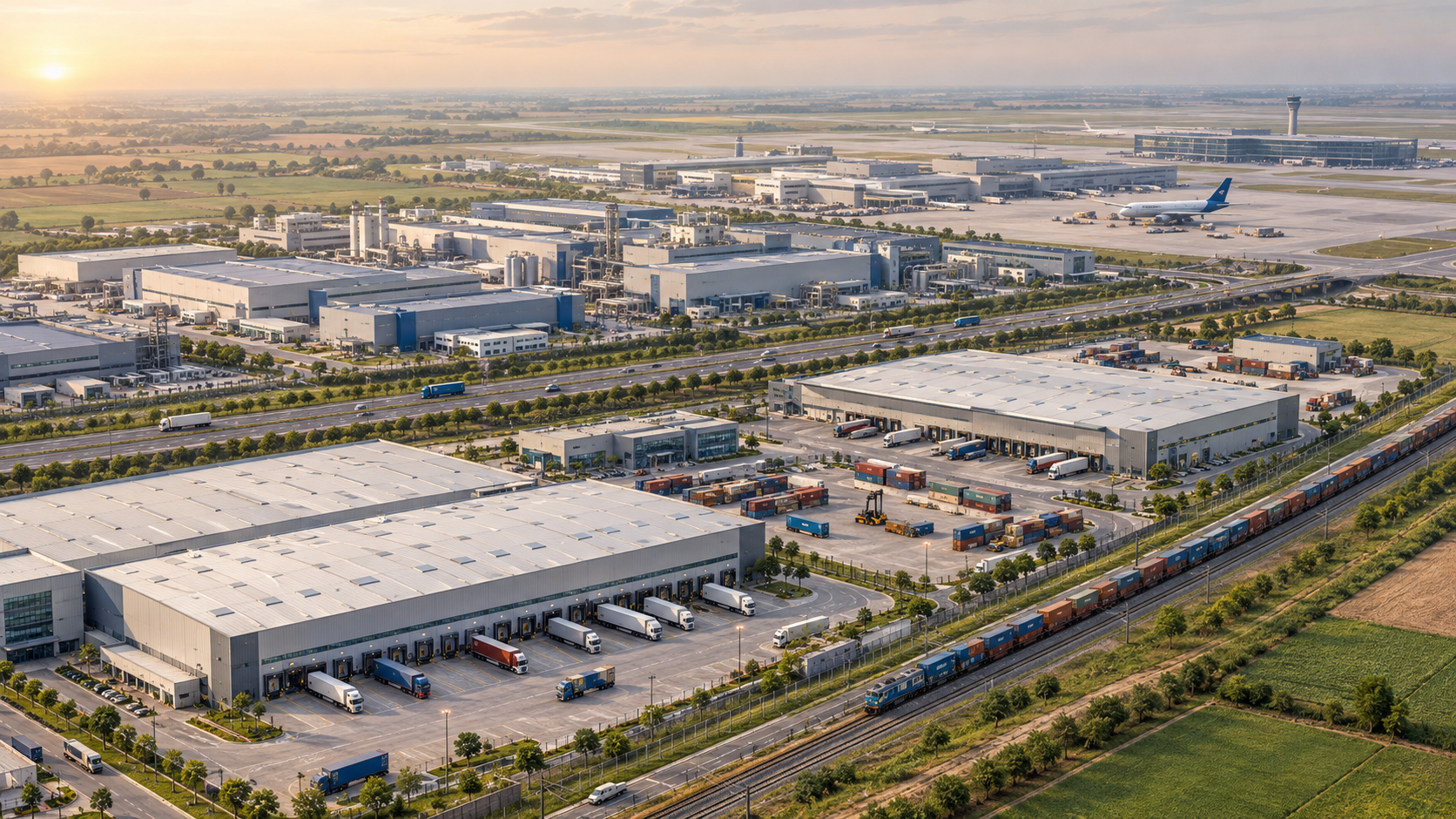
Industrial and logistics corridor at Noida International Airport in India: How a logistics park is set to transform North India's industry – creative image on the topic, created with AI: Xpert.Digital
Industry, logistics, air freight: This strategy is behind Noida's major project
More than an airport: Why Noida is focusing on a new industrial and logistics center
Can an airport transform an entire economic region?
The groundwork for a major industrial and logistics hub is being laid around Noida International Airport in Jewar, northern India. The Yamuna Expressway Industrial Development Authority (YEIDA) has granted preliminary approval for a multimodal logistics park in Tappal-Bajna and is simultaneously pushing ahead with plans for a significantly larger industrial zone south of the airport. Together, these projects could more closely integrate production, warehousing, cargo handling, and transportation services.
However, an important distinction must be made regarding the size specifications: The logistics park is planned to cover approximately 200 acres – about 81 hectares. The planned industrial hub, at roughly 8,000 hectares or 80 square kilometers, is almost a hundred times larger. The stages of development also differ: The logistics park has received preliminary approval, while the large industrial area is still in the planning phase. Therefore, the announced areas should not be equated with developed plots or an already functioning business location.
The economic idea behind the projects is clear: the airport should not function as an isolated transport facility, but rather become part of a larger production and distribution area. Whether this actually translates into a competitive advantage, however, depends not only on proximity to the runway or the size of the planned areas. Crucial factors include reliable transport connections, energy and water supply, a skilled workforce, functioning digital processes, and a phased development that is aligned with actual demand.
Noida's logistics offensive: How an airport could change northern India's industrial economic geography
Two large-scale projects with a shared economic logic
Around Noida International Airport in the Jewar region, the foundations are being laid for a new industrial and logistics hub of considerable regional economic importance. At its 93rd board meeting, the Yamuna Expressway Industrial Development Authority (YEIDA) approved a multimodal logistics park in Tappal-Bajna and advanced the planning of an approximately 8,000-hectare industrial center south of the airport. The underlying economic concept extends beyond additional warehouses: production, transport, cargo handling, and business-related services are to be spatially integrated to create a more efficient location for industrial value creation.
For the assessment, an important correction to the scale is necessary. The approved logistics park comprises approximately 200 acres, not 200 hectares. This corresponds to about 81 hectares or 0.81 square kilometers. The planned industrial hub, on the other hand, actually extends over approximately 8,000 hectares, or 80 square kilometers. Its planned area is thus almost one hundred times larger than that of the logistics park. At the same time, the stages of development differ: While the logistics park has received preliminary approval, the large industrial area is still in the planning phase. An approved development plan is not equivalent to developed land or a fully operational business location.
The strategic perspective is nevertheless clear. The airport is not intended to function as an isolated transport facility, but rather as an integral part of a larger production and distribution area. The logistics park will serve as a specialized connecting element. The industrial park will provide space for factories, warehousing, and complementary commercial uses. If both developments are sensibly coordinated, they can mutually reinforce each other. However, if implementation is uncoordinated, there is a risk of expensive land reserves, underutilized facilities, and additional traffic congestion.
The crucial economic question is therefore not the size of the announced projects. The decisive factor is whether their geographical proximity results in a measurable productivity advantage for companies.
Why the airport alone does not create an industrial site
An international airport generally improves a region's accessibility. However, not all forms of accessibility are equally valuable for industrial companies. Business travelers, service technicians, high-value spare parts, perishable goods, and standardized bulk goods place entirely different demands on infrastructure and transport costs.
Jewar's locational advantage therefore doesn't stem solely from its aircraft handling capabilities. The region becomes economically attractive when companies can reliably integrate their procurement, production, and distribution processes. This requires a coordinated system of industrial sites, electricity supply, water, labor, road connections, customs procedures, and transportation services.
An airport can accelerate this development, but it cannot replace it. A manufacturer doesn't need a particularly close runway if its factory regularly suffers from power outages or if crucial supplier parts get stuck in traffic. Conversely, a reliable airport connection can offer significant advantages when time-critical components, international customers, or technical specialists need to be available at short notice.
The planned integration of industry and logistics thus follows a logical location strategy. It aims to improve several prerequisites for economic activity simultaneously. This can create a location where companies do not have to organize every supporting infrastructure themselves.
However, a fundamental difference remains between an airport site and an industrial ecosystem. An airport is a self-contained facility. An ecosystem only emerges through the sustained collaboration of many independent actors: producers, suppliers, freight forwarders, warehouse operators, maintenance companies, educational institutions, government agencies, and financial service providers. These relationships can be prepared and facilitated, but not created simply by designating land.
Multimodality must prove itself in actual transport chains
The term multimodal describes the combination of several modes of transport. In the vicinity of Noida International Airport, this primarily refers to the interplay of road, air freight, and, in the future, high-performance rail connections. The logistics park in Tappal-Bajna is intended to support warehousing, cargo handling, and services along the supply chain.
The regional transport infrastructure offers a starting point. The Yamuna Expressway forms a central road axis. This is complemented by its integration into the wider network around the Delhi-Mumbai Expressway and the Eastern Peripheral Expressway, as well as its spatial relationship to interregional freight corridors. However, this does not automatically create a consistently efficient transport chain. Planned rail connections, additional access roads, and other transport projects must be considered separately according to their respective stages of implementation.
Economically effective multimodality means that companies can switch between modes of transport without incurring disproportionate additional costs or time losses. This requires suitable transshipment technology, coordinated operating hours, digital data interfaces, and a sufficient number of regular transport services.
A rail siding, for example, is only valuable if freight trains actually run on it as needed. An air freight terminal is of limited use to an exporter if the required target markets cannot be reached with sufficient frequency. Similarly, a high-capacity highway loses some of its benefit if the last few kilometers to the factory or warehouse become a bottleneck.
The location must therefore be planned from the perspective of complete transport chains. Not only the distance between the industrial site and the airport is relevant, but also the entire time from the shipping order to handover to the recipient. This includes waiting times, inspections, documentation, and potential interruptions during transfers between modes of transport.
This is precisely the difference between a property located near transport links and a productive logistics platform. The former benefits from its location. The latter organizes the movement of goods in such a way that the location actually creates an advantage in day-to-day operations.
Why time and reliability can become more important than low freight rates
The costs of a supply chain consist of more than just the price of transportation. They also include inventory, tied-up capital, damaged goods, spoilage, production interruptions, and the effort required to coordinate various service providers.
Inexpensive transport can therefore be economically costly if its transit time fluctuates significantly. Companies often react to uncertainty by maintaining higher safety stocks. These stocks require storage space and financing. For products with short innovation cycles, the risk also increases that stored goods will lose value, either technically or commercially.
An integrated logistics center can reduce these costs, provided it improves the reliability of operations. Shorter routes between the factory, intermediate storage, and freight handling facilitate tighter delivery windows. Better-coordinated processes can also reduce the likelihood of a shipment missing its scheduled onward transport.
A simplified calculation illustrates the relationship. If a company reduces the average capital tied up in its supply chain by four days and moves goods worth one million euros daily, it will theoretically require four million euros less working capital. Assuming annual financing costs of eight percent, this corresponds to a financing effect of approximately 320,000 euros per year. This is not a forecast for Noida, but rather an illustration of the economic mechanism.
However, such advantages only arise if the entire process chain becomes faster or more predictable. A modern warehouse alone is not enough. If customs clearance, an overloaded access road, or an unreliable data flow dictates the process, the benefits remain limited.
This results in a clear priority for site development: the focus should not be on the highest nominal handling capacity, but on the shortest and most reliable overall throughput time possible.
Air freight is a specialized tool and not a transport model for the entire industry
Proximity to the airport is particularly economically relevant for certain categories of goods. These include high-value, lightweight, or especially time-critical goods. Products with a limited shelf life can also benefit from fast international connections.
For electronic components, selected pharmaceutical products, urgent spare parts, or samples needed at short notice, a higher transport price may be justifiable. The decisive factor is the relationship between the value of the goods, the time required, and the potential damages of a delayed delivery.
For heavy, low-priced, or less time-sensitive products, air freight is often not an economically viable standard solution. Such companies primarily need efficient road and rail connections as well as reliable access to seaports.
The industrial development corridor around Jewar should therefore not be viewed solely as an air freight hub. Its greater benefit could lie in enabling different transport models at a single location. A company could handle regular freight flows via road, rail, and sea, while urgent parts or particularly high-value shipments would be transported via the airport.
This combination increases operational flexibility. It is particularly valuable when supply chains are not entirely predictable. A manufacturer can react to a delayed component without having to base its entire procurement strategy on expensive air freight.
For planning purposes, this also means that not every industrial site needs to be located in the immediate vicinity of the airport. Particularly expensive or traffic-sensitive areas should be reserved primarily for uses that actually derive an additional economic advantage from this proximity.
Two different logistics components must not be confused
In addition to the planned park in Tappal-Bajna, an independent air freight and logistics concept exists directly at the airport. AISATS, a joint venture between Air India and SATS, has been involved in this multimodal cargo hub. Plans include an integrated freight terminal as well as a warehousing and logistics zone with facilities for cargo handling and distribution.
The concept includes, among other things, general freight, express shipments, temperature-controlled goods, and the connection between road and air transport. This airport component therefore fulfills different functions than an external industrial and logistics park. The two projects should therefore not be considered equivalent in terms of either area or function.
Economically, this results in a sensible division of labor. Activities closely related to aircraft handling are concentrated directly at the airport. These include the immediate provision of air freight shipments, security processes, and the transition between land-based transport and air-side handling.
Further out, storage, consolidation, packaging, industrial services, and regional distribution can take place. Such activities often require larger areas, but not necessarily direct access to the apron.
A clear functional separation can relieve pressure on expensive airport space. At the same time, it prevents the same capacity from being built in multiple locations without sufficient demand. However, this requires operators to coordinate their roles and interfaces early on.
The airport system is projected to have an initial cargo capacity of more than 250,000 tons annually, with long-term expansion possibilities. This technical capacity should not be confused with actual demand. How quickly it is utilized depends on flight schedules, export structures, service quality, and the airport's competitive position compared to other locations.
The major industrial hub needs a demand-driven architecture, not a record-breaking floor space
With an area of approximately 80 square kilometers, the planned industrial zone is of a size that far exceeds that of a single business park. Such an area can provide long-term space for various production sectors, suppliers, and supporting services.
However, the size of the area is initially just a planning indicator. It says little about how much of it can actually be used for industrial purposes later on. Roads, drainage, energy supply, green spaces, safety distances, social infrastructure, and other public uses also require space.
Similarly, the total area does not directly correlate with investments, production values, or jobs. A highly automated factory can occupy a large area with relatively few employees. Conversely, a dense network of smaller manufacturing and service companies can create significantly more jobs on the same area.
The internal structure of the area will therefore be crucial. Planning that takes into account different company sizes and allows for both large, contiguous plots of land and smaller, flexibly usable units is advisable.
Such a demand architecture combines spatial planning with realistic assumptions about industries, company sizes, supply needs, and the speed of business development. It asks not only which industries are politically desirable, but also which businesses would actually use the location under real cost and market conditions.
A phased approach to development is particularly important. If large areas are fully prepared before sufficient demand exists, pre-financing costs increase. Developing in suitable phases can limit this risk and allows for adjustments if the industry structure develops differently than initially expected.
LTW Intralogistics Solutions – Intermodal Transport

LTW Intralogistics Solutions – Intermodal Transport – Image: LTW Intralogistics GmbH
LTW offers its customers not individual components, but integrated complete solutions. Consulting, planning, mechanical and electrotechnical components, control and automation technology, as well as software and service – everything is networked and precisely coordinated.
In-house production of key components is particularly advantageous. This allows for optimal control of quality, supply chains, and interfaces.
LTW stands for reliability, transparency, and collaborative partnership. Loyalty and honesty are firmly anchored in the company's philosophy – a handshake still means something here.
Related to this:
Multimodal logistics in focus: opportunities and risks
Electronics and semiconductors require more than just good transport links
The broader site strategy also includes specialized industrial projects, such as a semiconductor park and an electronics manufacturing cluster. Combining such uses with efficient logistics is fundamentally sound. Electronic components often have a high value relative to their weight. At the same time, production processes can be sensitive to missing parts.
However, the different stages of the electronics and semiconductor industries must be clearly separated. Assembly, testing, packaging, component manufacturing, and the actual production of semiconductor structures have very different requirements.
Demanding semiconductor production requires, among other things, a particularly reliable energy supply, suitable water treatment, specialized technical services, and highly qualified personnel. A location near an airport is helpful, but by no means sufficient.
From an economic perspective, it would be problematic if the business location strategy primarily pursued prestigious industry designations. A more promising approach is to analyze the value chain stages that can develop competitively under the specific site conditions.
An electronics cluster can gain depth, for example, through suppliers, testing companies, repair service providers, and packaging specialists. This creates advantages that extend beyond a single large company. Companies can find suitable partners more quickly and obtain certain services locally.
The decisive factor is therefore not whether a region lists a particular industry on its location map. What matters is whether robust economic relationships develop between the companies located there and whether this results in sustainably higher productivity.
Trade and industrial services can broaden value creation
The broader development plan also includes an international trading city, for which an area of approximately 20 hectares is designated in the underlying plan. Its economic function would be distinct from that of the logistics park and the industrial zone. The focus would not primarily be on manufacturing and physical transshipment, but rather on the organization of business relationships.
Such a facility could consolidate exhibition space, product presentations, sales offices, and business-related services. This can be relevant for small and medium-sized manufacturers if they have difficulty accessing international customers, technical standards, or export processes.
However, a commercial property alone does not generate additional exports. Its effectiveness depends on whether buyers, sellers, and specialized service providers actually come together. What's needed are robust business networks, not just prestigious buildings.
Particularly interesting would be the combination with services such as quality control, certification, export documentation, packaging development, and international payment processing. These services can help companies retain a higher proportion of added value at their location.
This also changes the role of logistics. It would no longer be just downstream transport, but part of a more comprehensive market access offering. A manufacturer could develop, test, present, and ship products without relying on distant service providers for each step.
Such consolidation can be productive. However, it should be aligned with the actual needs of businesses. Otherwise, there is a risk that additional commercial space will be created while the operational capabilities crucial for exports are lacking.
The competition will be decided by total costs
A new industrial and logistics site does not enter an empty market. Companies already have existing plants, warehouses, suppliers, and transport connections. Therefore, a relocation or expansion must be economically justified.
Noida doesn't have to be cheaper than other locations in every cost category. The overall calculation is what matters. Higher land or rental costs can be justifiable if transport processes become more reliable, inventory levels decrease, or international customers are more easily accessible.
Conversely, a cheap site can become expensive if workers face long commutes, energy supply is unreliable, or goods arrive regularly late. The land price is therefore only one part of the overall location costs.
Existing companies also face switching costs. Relocating production requires new permits, hiring new staff, adjusting suppliers, and often a transition phase with parallel structures. A new location must offset these hurdles with demonstrable advantages.
A more realistic scenario than a blanket wave of relocations is a more nuanced development. Some companies might establish additional production lines. Others might simply open a regional warehouse or relocate export-related functions. Still others will initially utilize the site through external logistics providers.
This distinction is important for economic evaluation. Not every additional warehouse represents new industrial production. Likewise, a smaller, specialized business can be more valuable to the regional business network than a large but isolated facility.
Employment is created in several stages and not automatically on site
The development of an industrial and logistics corridor can trigger different types of employment. Initially, activities will arise in planning, construction, and technical installation. These are temporary and should not be equated with long-term jobs.
Long-term employment depends on the specific role. Warehouse operations, transport management, maintenance, quality control, production, and digital services each require different qualifications.
Modern logistics is by no means solely a field of simple physical labor. Automated conveyor technology, warehouse management systems, refrigeration systems, and networked operational technology increase the demand for technical personnel. At the same time, certain manual tasks can be reduced through automation.
This presents both opportunities and barriers for the local population. Proximity to the project does not automatically guarantee the availability of the necessary qualifications. Without training, further education, and suitable placement structures, highly skilled positions may be predominantly filled by employees from outside the area.
Public transport also plays an economic role. If employees cannot reliably reach shift work sites, absenteeism and staff turnover increase. Companies may then have to organize their own transport solutions.
A sustainable employment strategy should therefore consider industrial development, vocational training, and accessibility together. Success is measured not only by the number of newly created jobs, but also by their sustainability, the income they generate, and how well the local population can benefit from them.
Land prices can rise faster than productivity
Major infrastructure projects change expectations for a location. Even the prospect of improved accessibility can increase property prices. This results in capital gains for existing owners.
However, this effect does not equate to an overall increase in economic productivity. If land is held primarily in anticipation of further price increases, its actual industrial use may even be hampered.
High land prices represent a real cost factor for companies. They increase capital requirements and can exclude smaller businesses from a location. It becomes particularly problematic when price trends far outpace the operational quality of the location.
In addition, there is the social dimension of land development. Agricultural use, existing settlements, and local income structures can change. Even if owners benefit financially, this does not guarantee that sustainable long-term employment opportunities will be created for all affected households.
A balanced economic development must therefore distinguish between asset effects and ongoing value creation. Rising land values can be a sign of successful location development, but they are not sufficient proof of its success.
The more meaningful measure is whether areas are actually used, whether companies invest, and whether goods, services, and income are generated from the location on a permanent basis.
Financing must cover the entire life cycle of the infrastructure
Parallel to the development decisions, a Corpus Fund Investment Regulation for 2026–27 was adopted. Such a regulatory framework is relevant for site development because infrastructure must not only be built but also operated and maintained for decades. However, the available information does not allow for a reliable assessment of the fund's financial resources or its specific long-term return impact.
The fundamental connection is clear. Roads, drainage systems, lighting, utility networks, and public facilities incur ongoing costs. If these obligations are underestimated during the initial development phase, the site's attractiveness can decline later.
One-off revenues from land development and ongoing expenditures follow different time patterns. High initial inflows can suggest financial strength, even though later maintenance costs are not yet adequately secured.
Robust financing therefore considers construction, operation, maintenance, and renewal together. It also requires reserves for delays, cost increases, and fluctuating revenues.
This question is directly relevant for companies. They invest in production facilities and supply relationships with a multi-year horizon. Good infrastructure development for initial move-in is not enough if the infrastructure loses reliability after a few years.
The long-term value of the site therefore also depends on unspectacular administrative services: transparent use of funds, reliable maintenance and a realistic assessment of future obligations.
Digital integration determines the quality of the flow of goods
Modern logistics requires not only transport routes but also a functioning information infrastructure. Goods can be physically available and yet cannot be moved further if documents are missing, status reports are unclear, or different parties are working with conflicting data.
For an integrated site, it is therefore crucial that manufacturers, warehouse operators, freight forwarders, and other stakeholders can reliably exchange information. This includes bookings, arrival times, shipment data, and information about available capacities.
Digital time slot management can, for example, help to better distribute truck arrivals. Comprehensive inventory data can reduce unnecessary searches. Suitable sensors facilitate the monitoring of temperature-controlled transports.
However, such applications are not automatically effective. Their usefulness depends on data quality, clear responsibilities, and actual usage by the participating companies. A complex platform with few active users may be less valuable than simple, reliably functioning interfaces.
Small and medium-sized enterprises must also be able to participate. If digital requirements are too expensive or too complex, large operators will primarily benefit, while smaller providers will be excluded.
Finally, networking increases the importance of cybersecurity. Disruptions in central systems can hinder the flow of goods. Therefore, access rights, data backup, and operational emergency procedures are fundamental aspects of a location's quality, not just optional technical equipment.
Energy, water, and the environment are becoming economic location factors
A large industrial and logistics area generates additional demand for electricity, water, and transport capacity. These requirements are not merely environmental policy considerations, but directly determine operating costs and the availability of the site.
This is particularly evident in cold chains, automated warehouses, and demanding electronics manufacturing. Power outages can damage goods, disrupt production processes, or necessitate costly restarts.
Drainage is also economically relevant. Large sealed surfaces alter how precipitation is managed. Inadequate planning can impair access roads, storage facilities, and technical installations.
On the transport side, it should be avoided that additional freight traffic flows uncontrolled through residential areas. Separate traffic routes and suitable operational areas can reduce conflicts and simultaneously increase efficiency.
The term multimodal should not be confused with an automatically favorable environmental impact. Additional air freight, extensive road traffic, and land-intensive development all cause negative impacts. Whether these can be partially offset by more efficient processes must be assessed based on actual traffic and operational data.
In the long term, resource-efficient site planning can create economic advantages. These include reduced energy losses, better use of existing infrastructure, and lower disruption risks. However, the decisive factor is the concrete implementation, not the label of a modern or sustainable park.
Implementation requires a realistic sequence
The biggest operational challenge lies in coordinating the individual development steps. Industry, logistics, and transport infrastructure should complement each other, but their development can diverge over time.
If storage facilities are built significantly ahead of demand, vacancies and economic pressure on operators are likely. If manufacturers arrive first, while access roads or supply networks are lacking, additional costs and reputational damage result.
A sensible approach therefore begins with reliable demand assumptions and securing basic infrastructure. Initial functional sections can then be built upon this foundation. Further areas should ideally only be developed when the use of existing sections and specific business decisions justify it.
This approach is not synonymous with a lack of ambition. It limits the risk of tying up large amounts of capital in infrastructure that will only be needed much later.
For the overall project, coordination between different facilities is also crucial. Airport operations, the logistics park, industrial development, and transport planning each have their own operational and financial requirements.
A common spatial strategy must take these differences into account. Otherwise, each individual component may appear plausible on its own, while the overall system fails at its transitions.
Success can be measured – but not by the volume of announcements
A reliable assessment of the development should combine several key indicators. The number of approved projects or the size of designated areas is not sufficient.
The first important factor is the actual land use. A distinction should be made between reserved plots, ongoing construction projects, and productively operating facilities. These categories have very different economic significance.
For logistics, throughput times, adherence to deadlines, capacity utilization, and susceptibility to disruptions are crucial. Additionally, one can consider how long trucks wait, how reliably transport connections are met, and how frequently goods need to be transshipped.
When considering industrial development, key factors include realized investments, long-term employment, and the development of regional supplier relationships. The proportion of local sourcing can also indicate how deeply a company is economically embedded in the region.
On the public side, long-term infrastructure costs and actual revenues are relevant. A location can exhibit high levels of private activity and still generate public financial problems if its operation and maintenance are insufficiently funded in the long term.
Since no reliable, complete investment figures, binding completion dates, or consistent employment forecasts exist for the two key development projects, precise promises regarding returns or job creation would currently be unreliable. A thorough analysis of the impact mechanisms is possible, but not a reliable prediction of their extent.
Three development paths reveal opportunities and limitations
In the best-case scenario, a gradually growing industrial and logistics network emerges. Companies establish themselves there because they recognize concrete advantages. The infrastructure develops with demand. Individual businesses evolve into supplier relationships, shared service markets, and reliable international transport chains.
In a moderate scenario, the region establishes itself primarily as a warehousing and distribution hub with selected industrial centers. This would not be a failure. Such a development can also be economically viable, but it would fall short of the vision of a comprehensive international production ecosystem.
In the worst-case scenario, land prices and expectations will rise first. Development will outpace actual demand, individual transport links will be delayed, and business establishments will fall short of projections. The result would be underutilized infrastructure and capital tied up for longer periods.
These development paths do not depend solely on regional planning. Export demand, financing costs, corporate strategies, and international trade conditions also influence the speed.
That's precisely why adaptability is important. A comprehensive master plan should provide a long-term direction without unnecessarily restricting later usage decisions. Economic development rarely follows the original industry mix exactly.
The justified perspective: A plausible project with high implementation requirements
The underlying economic idea behind the development around Noida International Airport is compelling: an airport can achieve more when it is combined with production facilities, regional distribution, and specialized services. The approximately 81-hectare logistics park and the planned 8,000-hectare industrial hub fulfill different, potentially complementary functions.
The greatest opportunity does not lie in a blanket reduction in the cost of all transport. It lies in better coordinated supply chains, a wider range of transport options, and the geographical proximity of economically related activities.
The crucial caveat concerns implementation. Neither an airport nor a large amount of available land guarantees industrial competitiveness. This only arises when companies can operate more reliably, flexibly, or productively under real-world operating conditions.
Therefore, the region should not be judged solely on its most spectacular size. More meaningful are factors such as utilized land, reliable infrastructure, viable business networks, and sustainably financed public services.
From this perspective, Noida's logistics initiative is neither a guaranteed growth success nor merely a real estate project. It is an economically sound development strategy with considerable opportunities and equally considerable demands on planning, coordination, and operation. Its true value will not be measured by the amount of construction, but by the amount of additional value creation the built infrastructure sustainably enables.
Consulting - Planning - Implementation

Konrad Wolfenstein
I would be happy to serve as your personal advisor.
You can contact me at wolfenstein∂xpert.digital or
Just call me on +49 7348 4088 965 .
Your intralogistics experts

Consulting, planning and implementation of complete solutions for high-bay warehouses and automated storage systems - Image: Xpert.Digital
More information here: