
Potential defense logistics: The South German dual-use logistics corridor Augsburg – Ingolstadt – Regensburg
Xpert pre-release

Available in 27 languages 📢
Prefer Xpert.Digital on GoogleⓘPublished on: July 14, 2025 / Updated on: July 14, 2025 – Author: Konrad Wolfenstein

Potential defense logistics: The South German dual-use logistics corridor Augsburg – Ingolstadt – Regensburg – Image: Xpert.Digital
Megaproject in southern Germany: How the logistics corridor creates thousands of new jobs and strengthens the economy!
Military & Economy Working Hand in Hand: Bavaria's New Corridor as a Blueprint for Dual-Use Infrastructure
By 2030, an east-west axis will be built between Augsburg, Ingolstadt and Regensburg, upgraded throughout to track class C (20 t axle load), which meets NATO's military "Military Mobility" requirements and at the same time serves as an economic growth engine for southern Germany.
The combination of rail and road expansion, new logistics and healthcare sites, and harmonized approval procedures across borders creates a networked dual-use corridor with high resilience and future viability.
Strategic importance
Germany already serves as a logistical hub for the alliance; almost all deployment routes to NATO's eastern flank lead through German territory. The Bavarian cross-connection Augsburg – Ingolstadt – Regensburg closes a gap in this network.
- From a military perspective, it enables the rapid deployment of heavy tracked vehicles up to Military Load Classification 70 by rail and, in parallel, via heavy-duty roads, without critical bridge or tunnel bottlenecks.
- Economically, it connects the dynamic industrial and research regions of Swabia, Danube-Iller and Upper Palatinate more closely to the north-south transversals Munich – Berlin and Rhine-Main – Vienna and increases the capacity for energy- and time-critical goods flows.
Technical specifications of the upgrade
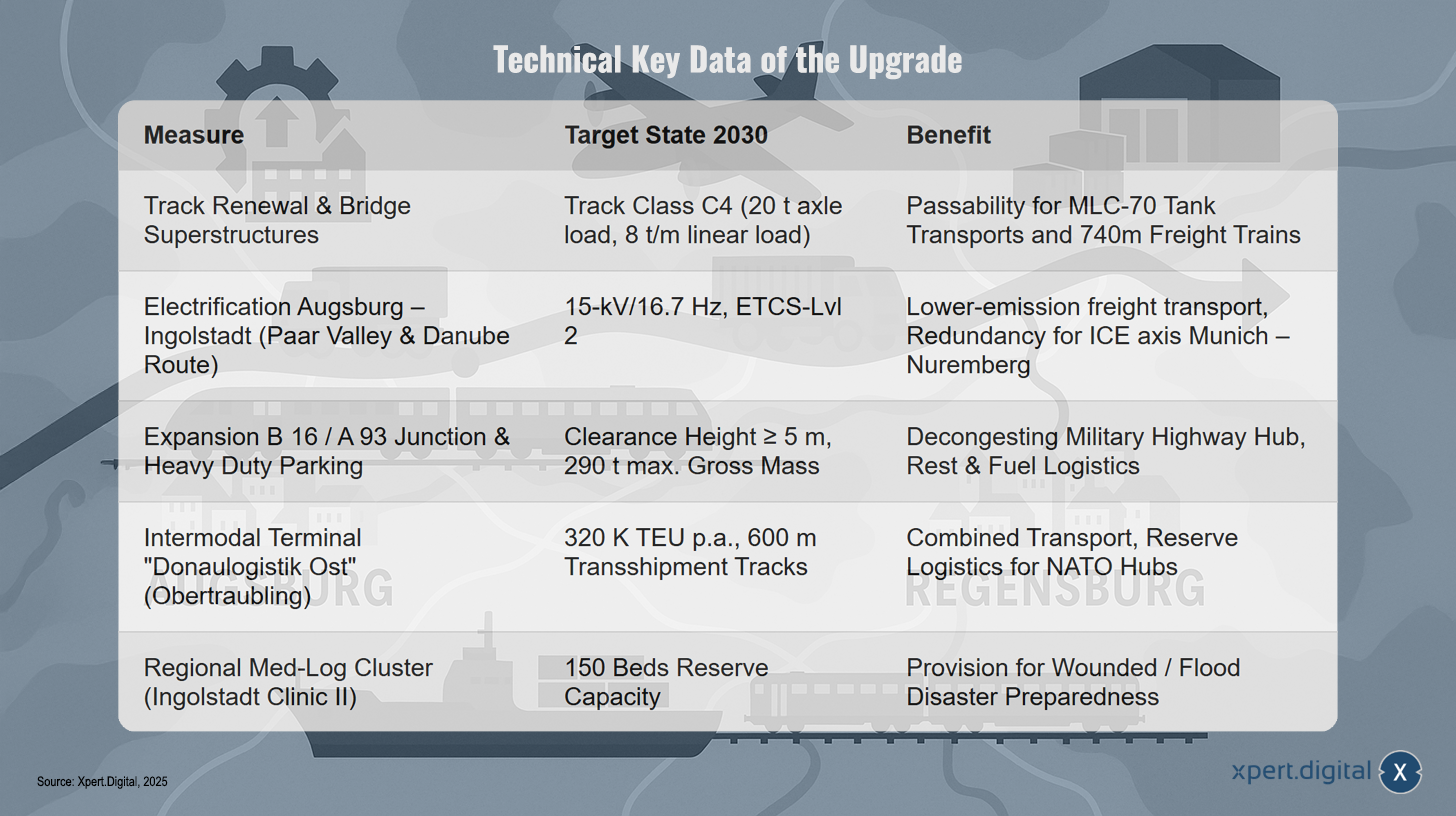
Technical specifications of the upgrade – Image: Xpert.Digital
The infrastructure upgrade includes several key measures to be completed by 2030. Track renewal and modernization of bridge structures will enable track classification C4, with a load capacity of 20 tons per axle load and 8 tons per meter. This will allow for the passage of MLC-70 tank transports and 740-meter-long freight trains.
The electrification of the Augsburg-Ingolstadt line along the Paar Valley and Danube routes will be carried out using 15 kV/16.7 Hz technology and ETCS Level 2. This measure will enable lower-emission freight transport and create redundancy for the Munich-Nuremberg ICE axis.
The expansion of the B 16 and the A 93 interchange, including parking spaces for heavy goods vehicles, will allow for a minimum clearance height of 5 meters and a maximum permissible weight of 290 tons. This will serve to separate traffic at the military motorway hub and improve rest area and refueling logistics.
The "Donaulogistik Ost" intermodal terminal in Obertraubling will offer a capacity of 320,000 TEU per year with 600 meters of transshipment tracks. It supports combined transport and serves as reserve logistics for NATO hubs.
The regional Med-Log cluster with the Ingolstadt Clinic II will provide 150 beds of reserve capacity for the care of the wounded and as flood disaster preparedness.
Dual-use concept: Civilian and military in harmony
1. Shared use
Routes, terminals and refueling points are technically designed so that civilian freight transport benefits in everyday operation, while military transport can be prioritized in the event of tension or defense.
2. Standardization & Procedures
The standardized approval processes in the EU-PESCO project “Military Mobility” reduce national exemption permits from sometimes 30 days to less than 5 days – a crucial time saving for the rapid deployment of forces.
3. Resilience through redundancy
Double tracks, modular bridges and fail-safe signal boxes minimize the risk of longer closures in civilian long-distance transport and ensure crisis and disaster mobility.
Economic impulses
- Freight transport forecast 2030: +23% in Baden-Württemberg/Bavaria, strong growth in combined transport.
- Regional value creation: According to the Swabian Chamber of Industry and Commerce (IHK-Schwaben), new logistics and commercial areas along the corridor generate "high economic benefits" beyond the core region.
- Jobs: Modernized intermodal terminals will create up to 2,000 direct and indirect jobs in the greater Regensburg and Ingolstadt area.
- Climate benefit: Shifting heavy transport from road to electrified rail reduces CO₂ emissions per tonne-km by up to 70%.
The Southern German Logistics Corridor is an exemplary project of modern dual-use infrastructure: It combines defense and economic policy, pools funding from the Federal Transport Infrastructure Plan, CEF military mobility and Bavarian state programs, and shows how targeted investments in heavy-load capability, digitalization and resilience strengthen Germany's role as a NATO hub while simultaneously promoting sustainable regional growth.
Your dual -use logistics expert

Dual -use logistics expert - Image: Xpert.digital
The global economy is currently experiencing a fundamental change, a broken epoch that shakes the cornerstones of global logistics. The era of hyper-globalization, which was characterized by the unshakable striving for maximum efficiency and the “just-in-time” principle, gives way to a new reality. This is characterized by profound structural breaks, geopolitical shifts and progressive economic political fragmentation. The planning of international markets and supply chains, which was once assumed as a matter of course, dissolves and is replaced by a phase of growing uncertainty.
Suitable for:
East-West Axis Southern Germany: Infrastructure Expansion Combines Defense with Economic Growth
Category C heavy goods route transforms southern German transport axis into a strategic corridor
The planned upgrade to a Category C heavy-load route by 2030 will create a highly resilient east-west axis in southern Germany, both militarily and economically. Through targeted individual measures – from track and road expansion to the development of medical and logistics/commercial infrastructure – a networked "dual-use corridor" will be created that meets NATO requirements while simultaneously stimulating regional growth.
Technical starting point
The technical situation shows clear differences between the C railway line and the federal highway 16. The railway line allows a permissible axle load of 20 tons with a maximum load per meter of 8 tons, while the federal highway allows a truck axle load of 11.5 tons according to the German Road Traffic Regulations (StVO), but has some bottlenecks at bridges.
The bottlenecks present various challenges: The railway line suffers from tight track curves and limited clearance profiles, while the federal highway is affected by town crossings and a lack of overtaking lanes.
From a military point of view, the railway line offers the possibility of transporting tracked and wheeled armored vehicles up to 70 tons, while the federal highway serves as an alternative route for convoys and heavy transports.
The civilian benefits also differ considerably: The railway line allows 25 percent more freight train mass per train compared to a class B line, while a 2+1 or 4-lane expansion of the federal highway would reduce traffic jam times by more than 30 percent.
Planned measures at a glance
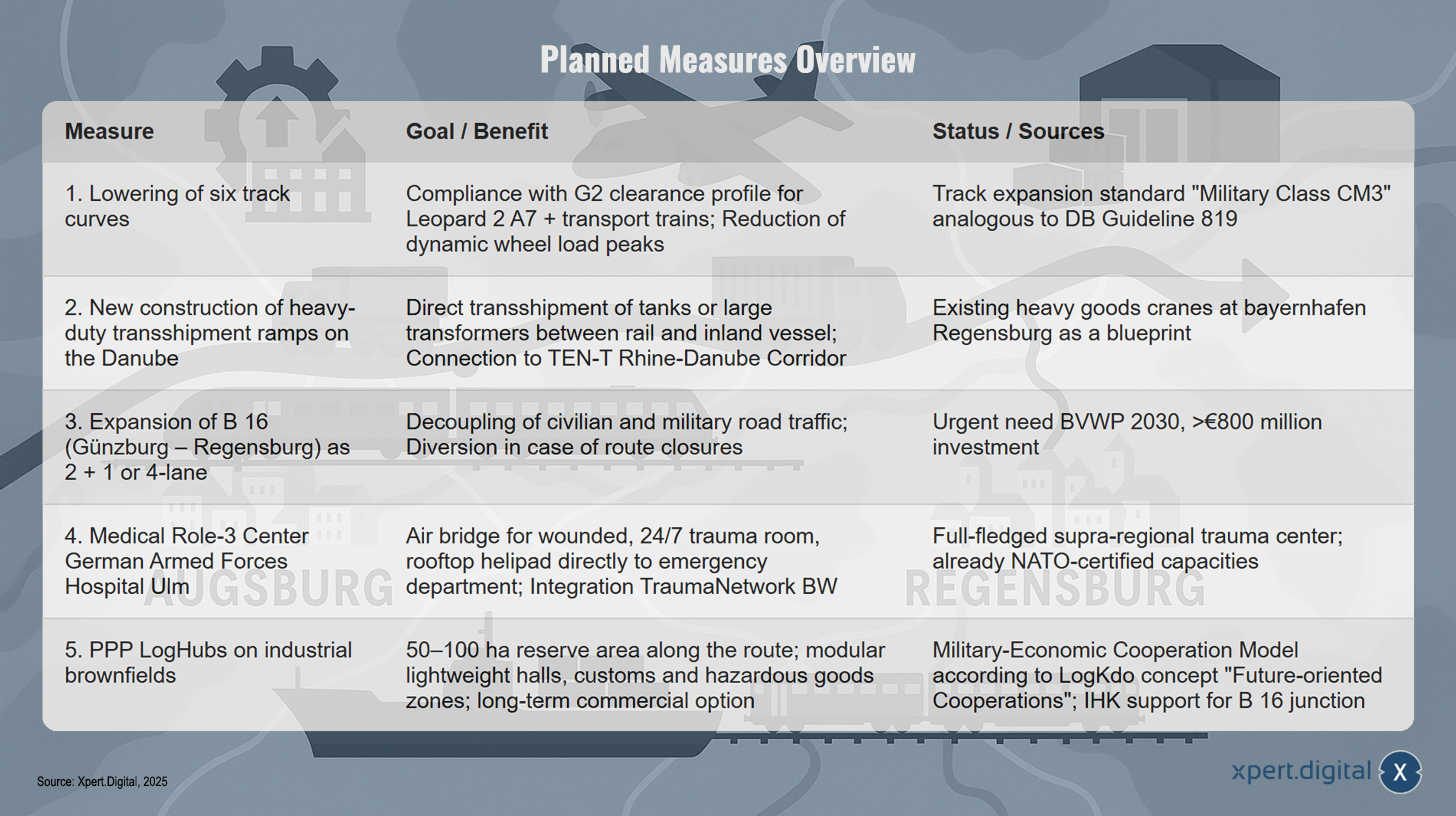
Planned measures at a glance – Image: Xpert.Digital
The planned measures include various infrastructure improvements to optimize military and civilian traffic. Initially, six track curves will be lowered to comply with the G2 clearance gauge for Leopard 2 A7 tanks and transport trains, as well as to reduce dynamic wheel load peaks. This will be carried out according to the "Military Class CM3" track construction standard, analogous to DB guideline 819.
Furthermore, the construction of new heavy-lift transshipment ramps on the Danube is intended to enable the direct transfer of tanks or large transformers between rail and inland waterway vessels and create a connection to the TEN-T Rhine-Danube corridor. The existing heavy-lift cranes of the bayernhafen Regensburg port serve as a blueprint for this project.
The expansion of the B 16 between Günzburg and Regensburg into a 2+1 or 4-lane road is intended to separate civilian and military traffic and allow for detours during road closures. This project is considered a priority in the 2030 Federal Transport Infrastructure Plan (BVWP 2030) with an investment of over 800 million euros.
Additionally, a Medical Role 3 Center is planned at the Bundeswehr Hospital in Ulm, which will offer an airlift for the wounded, a 24/7 shock room, and a rooftop helipad directly in the emergency room. Integration into the TraumaNetwork BW would create a fully-fledged supraregional trauma center with existing NATO-certified capabilities.
Finally, PPP LogHubs are planned for brownfield sites, offering 50 to 100 hectares of reserve space along the route, modular lightweight halls, and customs and hazardous goods zones. These are also intended to open up options for long-term commercial development and are based on a military-economic cooperation model according to the LogKdo concept "Future-Oriented Cooperations" with Chamber of Industry and Commerce (IHK) support for B 16 junctions.
Military added value
- Strategic deployment capability – Germany remains a “logistical hub” for up to 800,000 allied soldiers within 180 days.
- Load reserves – Category C allows 62-tonne freight wagons without gauge change; ramps on the Danube create trimodal redundancy.
- Casualty care – Role-3-Center Ulm ensures full surgical care within the NATO golden hour via CH-53K or A400M MedEvac.
Civilian effects
- Freight transport: The projected 42% increase in rail freight by 2030 can be partially shifted to the corridor.
- Jobs: According to IHK estimates, the expansion of the B 16 highway and the transshipment ramps will generate >2,500 construction jobs and 1,200 permanent jobs in logistics and port operations.
- Environment: Shifting heavy goods to inland waterway vessels saves around 60% CO₂ per 1,000 t-km compared to road transport.
- Crisis resilience: Dual-use facilities strengthen regional disaster relief (pandemic intensive transport, flood logistics).
challenges
The project faces several challenges that require appropriate solutions. Regarding permits for lowering the railway line, the Natura 2000 sites along the Danube pose a significant risk. To minimize this risk, an early environmental impact assessment, noise studies, and the provision of compensatory areas are planned.
Citizen initiatives could resist the expansion of the B 16 highway under the motto "No motorway B 16". As a countermeasure, it is proposed to implement "2 + 1" sections instead of a continuous four-lane design and to erect noise barriers.
Financing the entire package, which exceeds €1.6 billion, presents a further challenge. A proposal has been submitted to finance this through the federal budget and a €30 billion special fund for military mobility. Additionally, PPP hubs are intended to contribute to the amortization of land costs.
The shortage of skilled workers in the construction and logistics sector, with a projected shortage of 6,000 engineers in Bavaria by 2030, is being addressed through various measures: bundled tendering, EU-wide tendered lot sizes and the introduction of dual study programs are intended to contribute to the solution.
Implementation roadmap (simplified milestone plan)
The project's implementation schedule spans six years, from 2025 to 2030. In 2025, the planning approval for the track curves and the completion of the regional planning for the B 16 highway are expected. The awarding of the PPP LogHub contracts and the start of ramp construction in Regensburg will follow in 2026. A year later, in 2027, the first 2+1 lane sections of the B 16 between Günzburg and Donauwörth will be completed. Lowering the track curves will be finished in 2028, and test runs with the Leopard 2 tank unit will be conducted. In 2029, NATO recertification of the Role 3 Center in Ulm and the heliport upgrade are planned. Finally, in 2030, the route will be officially classified as C4/CE, and full operation of the logistics corridor will commence.
The pooling of federal, state, Bundeswehr, and private funds makes the corridor a model project for dual-use infrastructure. Heavy-load capacity, high-performance medical care, and regional economic development are intertwined – a robust model for other German NATO corridors.
Hub for security and defense - advice and information

Hub for security and defense - Image: Xpert.digital
The hub for security and defense offers well-founded advice and current information in order to effectively support companies and organizations in strengthening their role in European security and defense policy. In close connection to the SME Connect working group, he promotes small and medium -sized companies (SMEs) in particular that want to further expand their innovative strength and competitiveness in the field of defense. As a central point of contact, the hub creates a decisive bridge between SME and European defense strategy.
Suitable for:
The “South German Logistics Corridor Augsburg – Ingolstadt – Regensburg” is not yet an officially approved dual-use project.
Southern German Logistics Corridor: Why the Augsburg-Ingolstadt-Regensburg axis is becoming strategically important
The definition and planning of the so-called South German Logistics Corridor, which encompasses the Augsburg – Ingolstadt – Regensburg axis, is carried out within the framework of various transport and spatial planning documents at the federal and state levels. Important foundations and sources include:
- Federal Transport Infrastructure Plan 2030: This plan defines key infrastructure projects for rail and road transport. The Augsburg – Ingolstadt – Regensburg connection is part of the overarching logistics corridors and is addressed in the context of the expansion and new construction of important rail and road links.
- Regional transport and spatial planning: The Chambers of Industry and Commerce (IHK), in particular the Swabian Chamber of Industry and Commerce, refer to the importance and designation of these corridors in their statements on spatial planning procedures. They argue for their integration into the "Main European Transport Route" and the strengthening of the southern rail line between the Rhine/Ruhr region, Stuttgart, Munich and further east.
- Concrete planning documents from DB Netz AG and the Bavarian Railway Company (BEG): These include route options, capacity calculations, and the connection of logistics sites along the route. The plans are made publicly available as part of spatial planning procedures and are commented on by the affected municipalities, districts, and chambers of commerce.
In its official statement on the Ulm–Augsburg rail line upgrade and new construction, the Swabian Chamber of Industry and Commerce (IHK Schwaben) explicitly emphasizes the importance of the corridor for the entire region and highlights that cities and municipalities along the Danube Valley Railway (Ulm–Günzburg–Donauwörth–Ingolstadt–Regensburg) will benefit from the planned improvements. The establishment of a future hourly long-distance rail connection in the Federal Transport Infrastructure Plan and the corresponding concept within the "Deutschland-Takt" (Germany-wide integrated timetable) are key foundations for the development of the logistics corridor.
"Similar to the effects of reduced travel times described above, beyond a purely new line, the cities and municipalities along the Danube Valley Railway (Ulm–) Günzburg–Donauwörth–Ingolstadt (–Regensburg) benefit most from an improved service in Günzburg."
Several of the aforementioned individual measures exist as civilian-motivated projects (B 16 expansion, port and intermodal expansions, track rehabilitation). However, an integrated, military-civilian planned heavy-load corridor strategy with explicit classification as a Category C railway line and coordination of all five points is not found in any federal or state planning documents, nor in EU program documents on Military Mobility, at least not officially.
The assessment of the individual components reveals a mixed picture: The railway line, classified as heavy-load class C, is only partially implemented – while the Danube Valley Railway Regensburg–Ingolstadt already meets the required D4 classification, the Paar Valley Railway Ingolstadt–Augsburg still has sections classified as CE/B2, necessitating extensive bridge and track renewals. A continuous class C designation would require new construction and investments amounting to several hundred million euros, which is why military suitability is currently only given for certain sections.
The DB's network expansion and general renovation documents do not contain any projects for the lowering of six track curves that explicitly serve the purpose of "lowering for tank transports", so there is currently no evidence of a militarily motivated measure.
Heavy cargo handling ramps on the Danube are already partially in place, as the Port of Regensburg has twin gantry cranes with a lifting capacity of up to 2 x 45 tons and weekly heavy cargo handling capacity of up to 80 tons. New ramps are not shown in the current port master plan; however, the port already has the capacity for civilian heavy cargo handling, even though no new construction specifically for tank transport has been planned.
The expansion of the B 16 as an alternative route has been politically approved – a three-lane, and in some sections four-lane, expansion by 2030, justified by traffic flow and safety. Military suitability as a heavy convoy route is possible with a clearance of 4.50 m and a load-bearing capacity of 60 t; a dual-use option exists, but this is not the primary objective of the project.
The Medical Role 3 Center Ulm is already demonstrating real-world military use, as the Bundeswehr Hospital Ulm (BwKrhs Ulm) is a Role 4-capable Bundeswehr hospital with an intensive air ambulance profile. Pilot exercises TacAET demonstrate airlift training, while maximum civilian care is already well-established, resulting in true dual-use capability.
The temporary LogHubs on brownfield sites, implemented as public-private partnerships (PPPs), currently represent a purely conceptual idea, as no official PPP model exists in the Bavarian Chamber of Industry and Commerce (BAYERN-IHK) or Federal Ministry of Defense (BMDV) databases. While the development of brownfield sites is part of regional economic development, it has no military connection, and no implementation steps have been documented.
Opportunities and obstacles for a true dual-use implementation
- Technical feasibility: Retrofitting of the Paartalbahn (interchange from B2 → C), new sidings and loading tracks, portal cranes ≥ 100 t, Ro-Ro ramps at Danube landing stages.
- Financing: Combination of federal investment framework plan, CEF Military Mobility (funding rate up to 50%) and private terminal operator capital.
- Permits/Bureaucracy: Unified hazardous goods and oversized transport permit between Bavaria and Baden-Württemberg; §§ 46-47 StVO simplifications for LV/BV convoys.
- Prioritization: Inclusion of the corridor in the next "Rail Requirements Plan" and in the National Implementation List for Military Mobility; otherwise, no chance of public funding.
Conclusion
- Status quo: The individual projects mentioned are underway – but not as a coordinated, military-driven large-scale program.
- Assessment: The project is currently a potential project, not an implementation project. Many elements fit together, but can only be placed under the EU label "Dual-Use / Military Mobility" through formal linkage.
- Recommendation: A joint project call from BMDV, BMVg, DB InfraGO AG, Bayernhafen and the states of Bavaria/Baden-Württemberg would be necessary.
- Feasibility study (cost-benefit analysis, MLC verification, economic effects) until 2026; only then will it be possible to say whether the corridor will actually be used as dual-use logistics.
- In short: The corridor can be used for dual purposes, but this is not currently planned – because a binding overall plan is lacking.
Advice - planning - implementation

Markus Becker
I would be happy to serve as your personal advisor.
Head of Business Development
Chairman SME Connect Defense Working Group
Advice - planning - implementation
Konrad Wolfenstein
I would be happy to serve as your personal advisor.
contact me under Wolfenstein ∂ Xpert.digital
call me under +49 89 674 804 (Munich)





