
From Hamburg to India: How three mega-projects are changing our supply chains forever
Xpert Pre-Release

Available in 27 languages 📢
Prefer Xpert.Digital on GoogleⓘPublished on: September 18, 2026 / Updated on: September 18, 2026 – Author: Konrad Wolfenstein
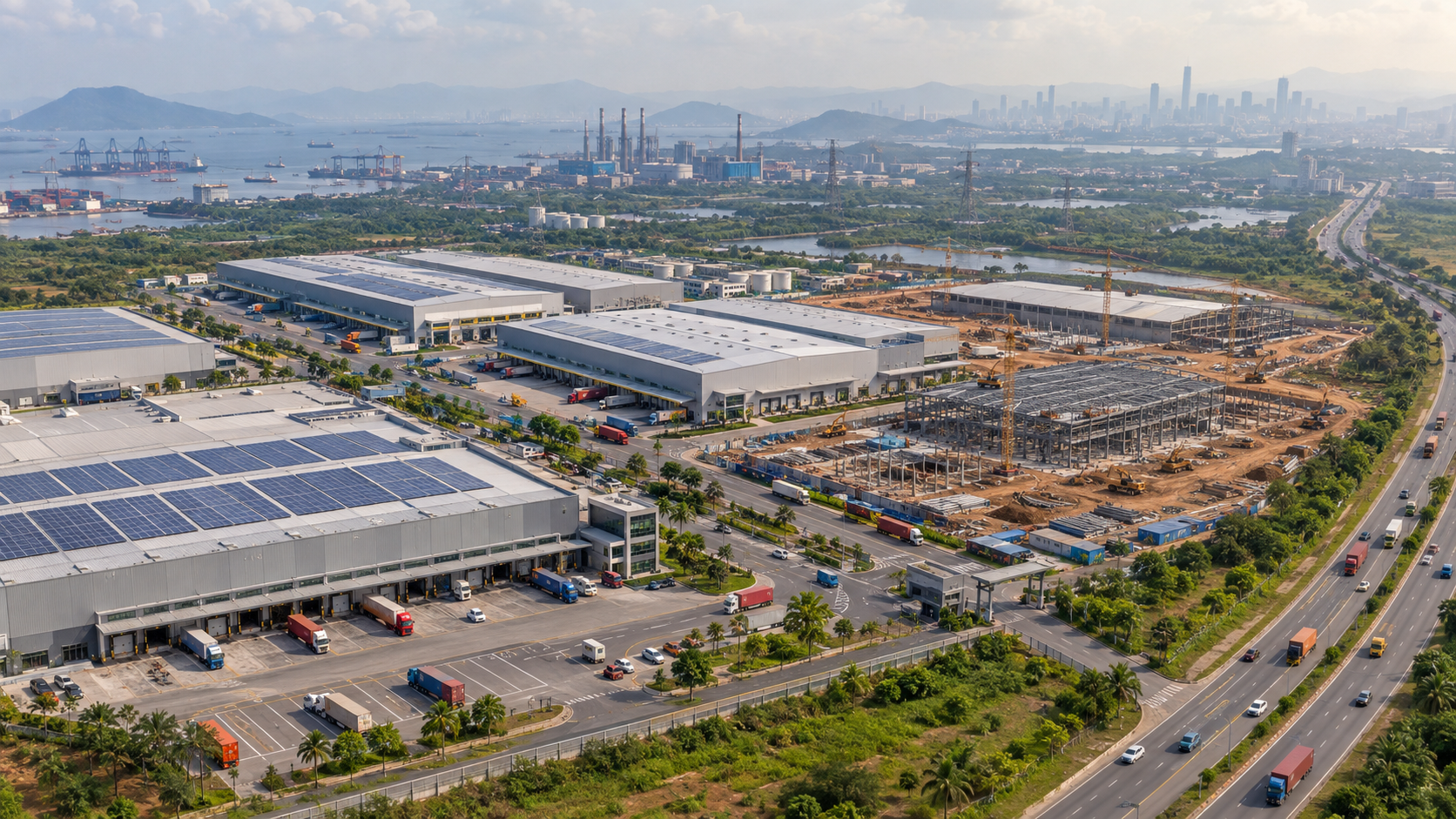
From Hamburg to India: How three mega-projects are forever changing our supply chains – Creative image on the topic, with AI: Xpert.Digital
More than just square meters: Why the new logistics era needs completely different locations
From harbor basin to high-tech hub: The secret operating system of our goods flows
Amazon's secret weapon and Hamburg's port trick: This is what the logistics of the future looks like
Logistics properties were long considered the unspectacular, solid gold of the real estate industry – but that era is definitively over. Modern warehouses and terminals are no longer passive shells, but highly specialized operating systems that determine the resilience, speed, and success of global supply chains. Three completely different projects in the Port of Hamburg, the up-and-coming Indian city of Taloja, and the metropolis of Kolkata illustrate a fundamental structural transformation. Whether through the intelligent consolidation of value creation within existing buildings, gigantic speculative bets on land values, or tailor-made high-tech centers for giants like Amazon: the risk models are shifting dramatically. Anyone who wants to understand the logistics of the future must recognize that the new question of power is no longer how many square meters are available – but rather how intelligently, sustainably, and efficiently each individual square meter is integrated into a global network.
From the port basin to the last mile: How logistics properties become strategic infrastructure
The construction of logistics centers, warehouses, and terminals is often viewed as a classic real estate transaction: secure land, erect buildings, lease space, and generate long-term returns. This view isn't wrong, but it's increasingly falling short. Modern logistics properties are no longer passive shells, but highly specialized operating systems for the flow of goods. Their economic performance arises from the interplay of location, transport connections, automation, energy supply, space efficiency, regulatory compliance, and the ability to offer additional services in close proximity to goods handling.
The three developments in the Port of Hamburg, in Taloja near Navi Mumbai, and in the greater Kolkata area illustrate three different manifestations of this structural transformation. In Hamburg, BLG Logistics is not primarily investing in additional parking space, but rather in consolidating high-quality services within an existing car terminal. In Taloja, Lloyds Realty Developers is attempting to transform a large land area into a flexibly usable logistics, industrial, or potentially data center location. Amazon, in turn, is committing early to a large property in Kolkata specifically designed for its own operations, thereby creating the physical prerequisites for faster, automated e-commerce processes in East India.
Economically, the projects represent three different risk models. Hamburg is a brownfield investment in an existing business with established demand, transport links, and a relatively clear use. Taloja is a development-oriented bet on land value, permits, land aggregation, and future users. Kolkata is a user-driven, built-to-suit model where a major tenant shapes the property even before completion. The real estate risk, operational risk, and demand risk are therefore distributed differently in each case.
What these projects have in common is that they respond to a fundamental shift in global supply chains. Companies are no longer solely focused on low rents per square meter. They are increasingly evaluating total costs, delivery speed, resilience, energy availability, digital controllability, and proximity to customers, ports, or production clusters. A more expensive property can be more cost-effective if it shortens transport routes, reduces inventory, lowers turnaround times, or enables value-added activities directly on-site. This is precisely the difference between a warehouse and strategic logistics infrastructure.
Hamburg is shifting value creation to the terminal
BLG Logistics' investment in the Port of Hamburg, at around €25 million, is not a megaproject by international standards. However, its strategic importance stems less from the absolute sum than from the nature of the investment. A multifunctional hall is being built on approximately 10,300 square meters, consolidating vehicle preparation, technical services, and other automotive logistics processes. Existing halls are being merged, the terminal layout is being adapted, and the workshop, car wash, and paint shop are being organized under one roof. Completion is scheduled for September 2027.
The project thus represents a qualitative expansion of the port's business. A vehicle port doesn't just earn money from handling and temporarily storing cars. Additional margins arise when vehicles are washed, inspected, repaired, painted, fitted with accessories, prepared for specific sales markets, or technically modified before delivery. Such services increase the added value per vehicle and can simultaneously strengthen the ties between manufacturers, importers, and fleet customers and the location. The port is evolving from a mere transfer point into an industrial service center.
This development is particularly relevant for Hamburg because, while the port handles considerable volumes, it also faces competition from other European seaports. In 2025, Hamburg handled 114.6 million tons of seaborne goods and 8.3 million standard containers. The entire BLG car terminal covers approximately 324,000 square meters and offers parking spaces for around 10,000 vehicles. At the Hohen Schaar site, roughly 130,000 vehicles were handled and temporarily stored last year. Against this backdrop, the new hall does not change the overall size of the port, but it does significantly improve the quality of the automotive services offered.
The planned optimization of space by approximately 35 percent is a key economic factor. Port land is scarce, expensive, and politically sensitive. Additional space cannot be created at will because port development competes with interests related to nature conservation, housing, transportation, and urban development. Productivity increases must therefore often be achieved within existing sites. If BLG can extract more output from the same area through a new layout, shorter distances, and the consolidation of previously separate functions, the site's operational capital productivity will increase.
The central logistics area of approximately 4,500 square meters will be designed to allow workshop processes and lifting platforms to be arranged according to customer requirements. This flexibility is more than just a structural detail. The automotive industry is undergoing profound change, requiring the simultaneous handling of combustion engines, electric vehicles, different software versions, new manufacturers, and regionally varying equipment requirements. A rigid, fixed building could quickly become inadequate due to changing vehicle types or process requirements. In contrast, a modularly organized space reduces the risk of the building becoming technically obsolete before its economic depreciation is complete.
The approximately 1,900-square-meter mezzanine level, housing offices and social areas, is also economically significant. Modern logistics continues to require workers, even as automation increases. Good break rooms, changing rooms, and administrative areas influence a location's attractiveness to employees and thus indirectly affect absenteeism, turnover, and productivity. Especially in metropolitan areas with tight labor markets, the quality of the work environment becomes a competitive factor. A warehouse that only optimizes vehicle movement but ignores the needs of employees would therefore be incompletely planned.
Space efficiency replaces expensive expansion
The Hamburg investment exemplifies why brownfield projects often have a different return-on-investment logic than new builds on undeveloped land. An existing site already has customer relationships, transport infrastructure, operating permits, technical expertise, and established processes. This reduces the market entry risk. At the same time, conversion while operations are ongoing is complex. Construction work must not unduly disrupt vehicle flow, safety requirements must be met, and existing structures must be integrated. A seemingly smaller project can therefore be more operationally demanding than a warehouse on a vacant lot.
The return on investment in Hamburg is expected to come from several sources. Shorter distances reduce travel times and internal transport costs. Pooling technical services improves the utilization of personnel and equipment. Additional services increase revenue per vehicle processed. Better space utilization can enable higher throughput without requiring proportionally more land. Finally, a modernized infrastructure strengthens the company's negotiating position for long-term customer contracts.
Crucially, these effects don't happen automatically. A new warehouse initially generates depreciation, financing costs, and additional fixed costs. Whether the investment is economically viable depends on capacity utilization, process discipline, order prices, and the development of vehicle handling. The German and European automotive industries are under pressure from weak demand in certain markets, high costs, trade policy uncertainties, and the rise of Chinese manufacturers. A terminal operator cannot control these risks. However, they can design their infrastructure flexibly enough to serve both established manufacturers and new market entrants.
The mix of import and export flows can have a stabilizing effect. The Hamburg terminal is connected to road, rail, and waterways and serves, among other things, short-sea and transshipment traffic to Great Britain, Scandinavia, and the Mediterranean. Such multimodal integration offers several options if individual routes are disrupted, become more expensive, or are rerouted. However, multimodality is only a real advantage if timetables, transshipment technology, data flows, and capacities are reliably coordinated. The mere existence of multiple modes of transport does not guarantee a resilient supply chain.
This investment can also be seen as a response to the growing complexity of finished vehicles. Cars are high-value, software-intensive products with sensitive surfaces, battery systems, and numerous configuration options. Damage, misconfigurations, or delayed rework result in high costs. The closer inspection and rework take place to the point of delivery, the faster problems can be identified and resolved. This reduces unnecessary transport to external workshops and can shorten the time to delivery.
Sustainability becomes a question of operating costs
The planned photovoltaic system with approximately 749 kilowatts peak, the green roof covering about 1,900 square meters, and the targeted DGNB Gold certification are not merely communication tools. They influence operating costs, permitting, financing conditions, and the long-term rental and usability of the property. A significant portion of the generated solar power will be used directly on-site, including for operational processes and charging vehicles such as cars or trucks. Self-consumption is often more economically attractive than feeding all the generated power into the grid because it partially offsets electricity purchase costs and grid fees.
The economic viability of the system still depends on the load profile, self-consumption rate, investment costs, maintenance, electricity prices, and potential storage integration. Vehicle logistics has the advantage that many activities take place during the day and can therefore align relatively well with solar power generation. At the same time, paint shops, car washes, workshops, and charging infrastructure can cause high peak loads. Intelligent energy management is therefore more important than the installed capacity alone.
Green roofs and sustainability certification also generate benefits that cannot be fully captured by a simple amortization calculation. Green roofs can retain rainwater, reduce heat gain, and improve resistance to heavy rainfall. Certified buildings can offer advantages to banks, insurance companies, public authorities, and international clients. Conversely, they also incur additional planning, documentation, and construction costs. Therefore, the economic value lies primarily in the reduction of long-term risks and not necessarily in a short-term increase in returns.
From a strategic perspective, the combination of process optimization and sustainability is more compelling than a purely symbolic green new building. The most ecologically sound area is often the one that doesn't require additional sealing. When existing port areas are used more productively, modernized technically, and improved in terms of energy efficiency, competitiveness is combined with resource efficiency. The Hamburg investment is therefore less spectacular than a completely new terminal, but potentially more robust because it addresses specific bottlenecks in an existing business model.
Taloja is becoming a bet on land and permits
Lloyds Realty Developers' project in Taloja follows a fundamentally different logic. The plan is to initially invest in a project of approximately 99 acres, which is roughly equivalent to 40 hectares. There is also the potential to aggregate an additional 32 acres, potentially increasing the total area to around 53 hectares. Lloyds Realty Developers intends to acquire a 51 percent stake in Calculus Logistech for 60 crore rupees and provide up to 242 crore rupees in structured, secured debt financing. This represents a total planned financial commitment of up to 302 crore rupees, or 3.02 billion rupees.
For German-speaking readers, the Indian numerical system can be easily confusing. One crore equals ten million. The investment structure mentioned thus comprises 600 million rupees for the acquisition of shares and up to 2.42 billion rupees for land consolidation and regulatory approvals. The company cites a potential revenue of more than 1,250 crore rupees, or over 12.5 billion rupees, within approximately three to four years. However, this figure is neither an expected profit nor a guaranteed sale price. It explicitly depends on the final use, the permitting situation, and market absorption.
These limitations are precisely what define the risk profile. The agreement was initially concluded as a non-binding letter of intent. Before economic implementation, final contracts, due diligence reviews, the aggregation of contiguous properties, and regulatory approvals are required. In rapidly growing metropolitan areas, the consolidation of numerous properties can enable significant increases in value. However, it can also fail due to unclear ownership structures, diverging seller interests, development problems, or delays.
Taloja is inherently attractive because it is located in an established industrial area within the Mumbai metropolitan region. Depending on the precise location and route, the Jawaharlal Nehru Port, the future Navi Mumbai International Airport, the Mumbai-Pune Expressway, and major rail and road connections are all within easy reach. This combination links maritime trade, industrial production, urban consumption, and regional distribution. Such a hub location is valuable for logistics properties because it can appeal to multiple user groups and is not solely dependent on a single flow of goods.
Land only becomes an asset through use
The key concept in the Taloja project is optionality. The site could be used as a warehouse and logistics park, an industrial location, or partially for data centers. At first glance, this flexibility reduces risk: if one segment falters, another can become more attractive. In practice, however, repurposing is not arbitrary. Logistics, industry, and data centers have different requirements for power supply, water, wastewater, fire protection, access, building geometry, noise control, and permits. A plot of land suitable for warehouses is not automatically a competitive data center location.
The mention of data centers, in particular, should be assessed with a critical eye. While the boom in cloud services and artificial intelligence increases the demand for computing capacity, the availability of large and reliable power supplies is often the limiting factor. Added to this are cooling, fiber optic connections, network redundancy, security requirements, and long lead times. Data center options can increase the perceived value of a property, but they should not be prematurely treated as guaranteed demand. Without sound energy and network planning, this use remains a strategic option and not a predictable source of baseline revenue.
For a logistics park, the economic calculation is also more complex than simply comparing land costs and sales prices. Internal roads, drainage, electricity, water, security infrastructure, fire department access, truck waiting areas, and potentially rail connections are all required. In monsoon regions, flood protection, terrain elevation, and efficient drainage are crucial. A cheap plot of land can become expensive due to costly development. Conversely, a professionally planned, approved, and cohesive park can command a significant premium compared to fragmented individual plots.
Lloyds appears to be pursuing a model where value is not only created through the construction and long-term leasing of completed warehouses. Selling or leasing developed plots to end users is also an option. This allows capital to flow back more quickly than would be the case with decades of holding the property. At the same time, with an early sale, the developer forgoes future rent increases and potential long-term value appreciation. The right balance depends on financing costs, the market cycle, risk tolerance, and the ability to professionally manage a real estate portfolio.
LTW Intralogistics Solutions

LTW Intralogistics – Engineers of Flow - Image: LTW Intralogistics GmbH
LTW offers its customers not individual components, but integrated complete solutions. Consulting, planning, mechanical and electrotechnical components, control and automation technology, as well as software and service – everything is networked and precisely coordinated.
In-house production of key components is particularly advantageous. This allows for optimal control of quality, supply chains, and interfaces.
LTW stands for reliability, transparency, and collaborative partnership. Loyalty and honesty are firmly anchored in the company's philosophy – a handshake still means something here.
Related to this:
Automation and efficiency in modern logistics centers
India's land expansion boom requires quality discipline
The Taloja project is entering a dynamic Indian market. In the eight largest cities, industrial and logistics space leasing reached approximately 27.1 million square feet in the first half of 2025, a 63 percent increase over the same period of the previous year. More than 30 million square feet were absorbed in the second half of the year. Third-party logistics providers, e-commerce companies, and industrial and mechanical engineering firms were key tenants. These figures demonstrate a structurally growing market, but they do not justify every project in every location.
Supply responds to demand. In the first half of 2025, approximately 16.7 million square feet of new space were added, and nearly 18 million in the second half. With increasing institutional involvement, standards for floor load-bearing capacity, ceiling height, fire safety, access, energy efficiency, and digital building technology are rising. Older or poorly connected halls can lose competitiveness despite low rents. For Taloja, this means that size alone is no longer a unique selling point. The park must impress with its quality, permitting reliability, and accessibility.
The Indian logistics market benefits from urbanization, growing consumption, production relocations, e-commerce, and government infrastructure programs. At the same time, traffic congestion, inconsistent local permitting processes, high land prices, and last-mile delivery quality remain challenges. The official estimate of Indian logistics costs at 7.97 percent of GDP is significantly lower than the long-held assumption of 13 to 14 percent. This illustrates how cautiously common market claims must be treated. Even improved measurement does not eliminate all logistical inefficiencies. Considerable differences between regions, modes of transport, industries, and company sizes persist.
For Lloyds, the project represents a diversification from existing activities in technology, metals, and related sectors. Diversification can create synergies, for example through industry contacts, project expertise, and access to capital. However, it can also overstretch management resources. Real estate development requires different skills than trade or manufacturing: local site knowledge, permitting, construction supervision, leasing, and long-term asset management. Entering the market through a majority stake in a local developer can narrow this gap, but it does not eliminate it.
The stated timeline is ambitious. Land aggregation is planned to take place within nine months of the signing of binding contracts; sales or leases of developed properties are targeted approximately 24 months after aggregation. Even moderate delays can significantly reduce the project's return, as interest payments continue to accrue while revenues are received later. With an investment largely financed through structured debt, collateral, priority of claims, and repayment terms become particularly important. The publicly stated revenue potential should therefore always be considered in conjunction with time, cost, and permitting risks.
Kolkata demonstrates the power of the anchor tenant
The Amazon project in Kolkata represents a third development model. The company has leased a specially designed logistics space in the Oswal Logistics Park. The original English-language report refers to 6 lakh square feet. This corresponds to 600,000 square feet, not six million square feet. This equates to approximately 55,700 square meters. This common misinterpretation increases the project's size tenfold and therefore needs to be corrected.
The facility will have a footprint of approximately 400,000 square feet and a mezzanine area of about 200,000 square feet. Handover is expected between 2027 and 2028. The agreed monthly rent is approximately 32 rupees per square foot. Based on this calculation, and considering the full 600,000 square feet, the base rent is approximately 19.2 million rupees per month and 230.4 million rupees per year. This simplified calculation does not include rent increases, rent-free periods, operating costs, taxes, area delineations, or other contractual clauses and is therefore only an estimate.
The rent is above the usual asking prices for key warehouse corridors in Kolkata, which at the end of 2025 were roughly between 19 and 23 rupees per square foot per month. This represents a premium of approximately 39 to 68 percent. This doesn't necessarily mean Amazon got a bad deal. A built-to-suit project often includes costs for custom-designed technology, higher construction quality, automation preparation, special security requirements, mezzanine space, and long-term availability. Furthermore, the precise micro-location, lease term, and handover obligations can significantly influence the price.
Amazon isn't just paying for the physical space it occupies. The company is also securing capacity, process design, and speed. A modern fulfillment center must seamlessly integrate receiving, storage, order picking, packing, sorting, returns, and handover to shipping partners at a high rate. Mezzanine levels increase the usable process area without proportionally enlarging the property. Automation can boost throughput but requires suitable flooring, power supply, fire safety concepts, data connectivity, and precise building dimensions.
Built-to-suit shifts opportunities and risks
For the developer, a major tenant with a long-term commitment is attractive because it reduces the leasing risk before completion and can facilitate financing. Banks generally view a creditworthy anchor tenant more favorably than a speculatively constructed building without a tenant. The lease agreement can thus indirectly become a financing instrument. At the same time, this creates a concentration risk: If the building is heavily tailored to a single tenant, subsequent re-leasing can be expensive or difficult.
For Amazon, the built-to-suit approach offers the advantage that the location can be adapted to its own supply chain without the company having to develop the land itself and tie up capital in real estate long-term. This improves capital flexibility. The disadvantage is a long-term commitment to fixed costs. If demand growth slows, technologies change, or networks are restructured, the lease obligation remains. Therefore, selecting a location for such a large center is a bet on the long-term importance of the region.
Kolkata is the economic gateway to East India, serving not only the metropolis but also large parts of West Bengal and adjacent regions. The city can act as a distribution hub for a vast consumer market, but it suffers from infrastructural bottlenecks and varying quality of its warehousing corridors. Large e-commerce hubs function particularly well when connected to smaller sorting and delivery stations. A fulfillment center alone, therefore, does not guarantee fast last-mile delivery. It must be integrated into a tiered network of long-distance transport, regional sorting, and local delivery.
Market data for Kolkata also illustrates why individual figures must be interpreted with nuance. One market report estimated leasing volume in the first half of 2025 at approximately 3.3 million square feet. Other surveys arrived at figures of 3.8 or 4.6 million square feet for the entire year, reporting declines of 9 or 30 percent, respectively, depending on the data source. Such discrepancies arise from differing market areas, building classes, survey periods, and transaction definitions. The robust conclusion is not a single, precise figure, but rather a mixed picture: Kolkata possesses substantial demand, but the market is not growing linearly and is heavily influenced by a few large deals.
This is precisely why the Amazon lease is significant. Depending on the annual statistics used, 600,000 square feet represents approximately 13 to 16 percent of a total annual leasing volume of 3.8 to 4.6 million square feet. A single contract can therefore visibly influence the market. It sends a signal to developers, investors, suppliers, and competing tenants. This signal can trigger further investment, but it also carries the risk of generating excessive speculative supply based on a single high-profile deal.
High rents can be rational
In logistics, the lowest rent isn't what matters; what counts is the lowest total cost per delivered unit. Building rent is only one part of the overall cost. Personnel, transport, energy, packaging, error rates, returns, inventory, and delivery times can have a significantly greater impact. A more expensive center can be economically superior if automation, a better location, and higher throughput reduce the cost per package.
The agreed-upon 32 rupees per square foot per month can therefore only be assessed within its context. If, for example, the building enables higher sorting performance, lower damage rates, and better utilization of vertical space, the rent increase may be justified. Conversely, the calculation becomes problematic if access roads are congested, power outages necessitate expensive backup power, or regional demand falls short of expectations. The quality outside the property is just as important as the quality inside the warehouse.
The planned handover between 2027 and 2028 provides both planning certainty and forecasting risk. Multi-year lead times are common for large, customized projects. However, construction costs, technology, consumer behavior, and regulatory requirements can change before commissioning. Therefore, developers and tenants must agree on clear rules for cost overruns, delays, acceptance, technical specifications, and force majeure. The more complex the automation, the more important the coordinated commissioning of the building and its technical systems becomes.
Another factor is labor productivity. Automation doesn't simply replace employees, but rather changes their tasks. Fewer purely manual movements are needed, while more technical maintenance, process control, data analysis, and troubleshooting are required. Regions with a large labor supply can still experience shortages of qualified technicians. The economic success of the center therefore also depends on training, employee transportation, shift planning, and occupational safety.
Three projects and three capital models
In direct comparison, Hamburg is the most defensive of the three projects. The investment is being made at an established terminal, its use is defined, and the infrastructure is in place. The main risk lies in the development of the vehicle market and whether the expected productivity gains and additional revenues are actually realized. The capital is embedded in an existing operational context, making the benefits relatively easy to measure.
Taloja is the most promising, but also the most speculative, model. A large, contiguous site in the Mumbai metropolitan area can gain considerable value if land aggregation, permits, and development are successful. Flexible use increases the potential but complicates a clear valuation. The stated sales volume is attractive but should not be confused with guaranteed cash flow. The key value drivers initially lie outside of completed buildings: in the land, building rights, development, and the ability to attract users or buyers.
Kolkata lies between the two models. The property is newly constructed, but the anchor tenant reduces the sales risk. However, this increases technical specialization and dependence on a single user. The developer gains a more predictable revenue base but assumes construction and handover risks. Amazon avoids ownership, commits to long-term lease payments, and bets on the future importance of East India within its own network.
The time horizons also differ. Hamburg aims for commissioning in September 2027 and long-term improvement of ongoing processes. Taloja plans to initially aggregate the properties and then market the developed spaces within approximately two years; delays there will directly impact financing and capital turnover. Kolkata is scheduled for handover between 2027 and 2028 and is likely geared towards a long-term lease. Thus, the focus ranges from operational efficiency and project development to long-term secured real estate returns.
Ports are becoming industrial service platforms
These examples demonstrate that the lines between port, warehouse, industry, and digital infrastructure are becoming blurred. In the Port of Hamburg, vehicles are not only moved but also technically processed. In Taloja, a single plot of land is designed to accommodate logistics, industry, or data centers, depending on demand. In Kolkata, a warehouse is planned as an automated element of a digital trading network. Logistics properties are thus taking on functions that were previously spatially and organizationally separate.
This integration can reduce costs, but it also creates new dependencies. When many processes are concentrated at one location, its importance for the entire supply chain increases. A power outage, flood, cyberattack, fire, or traffic jam can then have a greater impact. Resilience therefore requires redundancies, contingency plans, alternative routes, and a careful separation of critical systems. Maximum efficiency without safety margins may be inexpensive in the short term, but costly in the long run.
Ports and logistics parks are also evolving into energy hubs. Photovoltaics, charging infrastructure, battery storage, and potentially hydrogen systems are becoming integral parts of the real estate concept. Energy is already the central bottleneck for data centers, and its importance is increasing for e-commerce and automotive sites with electrification and automation. In the future, an available grid connection could be more valuable than additional land. Developers who only consider energy after securing land risk years of delays or permanently limited development potential.
Data, too, is becoming part of the infrastructure. Vehicles, packages, containers, gates, charging points, and workstations continuously generate information. A modern warehouse must be able to capture this data and connect it to customer, transport, and customs systems. This increases productivity, but at the same time, it raises the bar for cybersecurity and system compatibility. A building with poor digital infrastructure can become economically obsolete, even though its roof, walls, and floor could still be used for decades.
The location advantage arises from the network
Location remains the most important value driver, but it shouldn't be understood solely as distance on a map. Reliable travel times, bottleneck risks, toll costs, weight restrictions, bridge heights, rail capacities, port access, and accessibility for employees are crucial. Taloja may be geographically close to the port, airport, and expressway; its actual advantage depends on how quickly and predictably these destinations can be reached. The same applies to Kolkata and Hamburg.
Network effects arise when many complementary players come together in one location. Freight forwarders, workshops, customs brokers, packaging companies, staffing agencies, and technology providers reduce search and coordination costs. This makes established logistics clusters resilient and makes it harder for new locations to compete. Taloja benefits from an existing industrial environment, Hamburg from an established port cluster, and Kolkata from its role as a regional trade center.
At the same time, cluster formation can increase land prices, wages, and traffic congestion. Successful locations risk being stifled by their own growth. New logistics parks must therefore not only construct warehouses but also consider public and private infrastructure together. Truck parking, employee traffic, drainage, security services, and local acceptance are not secondary considerations. If these factors are neglected, the property shifts costs to the surrounding area and provokes regulatory resistance.
The key performance indicators lie within the company
Investment amount, area, and nominal rent are insufficient for evaluating such projects. In Hamburg, throughput per hectare, processing time per vehicle, the proportion of higher-value services, energy consumption, and workshop utilization are crucial. Only these key performance indicators demonstrate whether the announced space optimization will be economically effective. A beautiful, certified building without sufficient orders would be a failure.
In Taloja, other factors are initially paramount: cost per aggregated acre, permitting time, development costs, pre-leasing rate, sales prices of developed lots, and financing costs. Later, warehouse occupancy, rental income, and operating expenses will be added. Particularly important is the distinction between gross revenue potential and Lloyds' actual profit after land, financing, construction, taxes, and partner shares.
For Kolkata, rental costs per package, throughput per hour, inventory turnover, level of automation, personnel costs, delivery time, and return rate are more meaningful than warehouse size alone. The 600,000 square feet are only an advantage if the space is used productively. Oversizing ties up capital and increases fixed costs, while undersizing creates bottlenecks and necessitates additional off-site storage. The right capacity depends on peak loads, seasonal patterns, and the ability to transfer volume between locations.
Sustainability indicators should also be closely aligned with operational needs. Installed photovoltaic capacity, certificates, and green roofs are important metrics, but they reveal little about the actual impact. Crucial factors are self-consumed solar power, avoided grid peaks, energy per unit processed, water consumption, land sealing, and life-cycle costs. The market is thus moving from symbolic, isolated measures to measurable operational performance.
The clear perspective: Quality beats square meters
The three projects point to a clear yet nuanced perspective. Demand for logistics space remains structurally supported by e-commerce, urban supply, industrial restructuring, and the desire for more resilient supply chains. Nevertheless, not every new warehouse is automatically a good investment. After the extraordinary pandemic years, many international logistics real estate markets have normalized; rising vacancy rates and temporary declines in rents have demonstrated that this segment, too, is cyclical.
Value will increasingly be generated by quality rather than sheer size. Hamburg is focusing on higher added value and increased land productivity. Taloja must prove that a large plot of land can be transformed into an approved, developed, and sought-after location. Kolkata must demonstrate that an expensive, custom-designed property actually reduces costs per order and supports regional expansion. In all three cases, the company's performance, not its architectural scale, will determine the return on investment.
For port operators and municipalities, this means that land-use policy must be linked to industrial, energy, and transport policies. For developers, the ability to integrate energy connections, permits, data infrastructure, and user requirements early on is becoming increasingly important. Tenants need a comprehensive cost analysis that considers not only rent but also transport, personnel, inventory, default risks, and speed. For investors, it is crucial to distinguish between guaranteed cash flow, operational efficiency, and speculative land value.
Hamburg, Taloja, and Kolkata thus represent more than just three real estate projects. They mark three paths by which physical infrastructure becomes a strategic platform. The Hamburg model concentrates value creation within an existing port. The Taloja model transforms land and permitting into a development option. The Kolkata model translates digital demand into a long-term, automatable operational property. Understanding these differences reveals why the most important question is not how many square meters are built. What matters is the economic function each square meter actually fulfills within the network.
Consulting - Planning - Implementation

Konrad Wolfenstein
I would be happy to serve as your personal advisor.
You can contact me at wolfenstein∂xpert.digital or
Just call me on +49 7348 4088 965 .
Your intralogistics experts

Consulting, planning and implementation of complete solutions for high-bay warehouses and automated storage systems - Image: Xpert.Digital
More information here:










