
Published on: November 7, 2024 / Updated on: November 7, 2024 – Author: Konrad Wolfenstein

Industry 5.0: Origin, significance and further development compared to Industry 4.0 – Image: Xpert.Digital
Technology meets people: The revolution of Industry 5.0 compared to Industry 4.0
The human-centered future: How Industry 5.0 is replacing Industry 4.0
Industrial development has accelerated rapidly in recent decades. While Industry 4.0 drove the digitalization and automation of production processes, Industry 5.0 represents a new phase that places people more firmly at the center. But what exactly does Industry 5.0 mean, who initiated the concept, and how does it differ from its predecessor?
Who initiated the topic of Industry 5.0?
The term Industry 4.0 was first publicly presented at the Hannover Messe in 2011 and originates from Henning Kagermann (former SAP CEO), Wolfgang Wahlster (former CEO of the German Research Center for Artificial Intelligence), and Wolf-Dieter Lukas (later State Secretary in the Federal Ministry of Education and Research). This fourth industrial revolution was characterized by the integration of automation, digitalization, and the Internet of Things (IoT) into manufacturing.
The concept of Industry 5.0, on the other hand, was significantly advanced by scientists such as Birgit Vogel-Heuser and Klaus Bengler from the Technical University of Munich. They emphasized that industrial automation is facing a paradigm shift, in which collaborative cooperation between humans and machines takes center stage. The European Commission has also adopted the term and enshrined it in a document entitled "Industry 5.0: Towards a Sustainable, Human-centric, and Resilient European Industry." This is increasingly anchoring Industry 5.0 at the political level as well.
What does Industry 5.0 mean?
Industry 5.0 builds on the achievements of Industry 4.0, but goes a step further by placing people more firmly at the center of the production process. While Industry 4.0 focused on automation through technologies such as the Internet of Things (IoT), artificial intelligence (AI), and big data, Industry 5.0 aims to create a symbiotic collaboration between humans and machines.
A key aspect of Industry 5.0 is human-machine interaction. Here, humans and robots work together in a collaborative environment to combine human skills such as creativity, decision-making, and problem-solving with the precision and efficiency of machines. This collaboration takes place, for example, through so-called cobots (collaborative robots), which can interact directly with humans.
Another important goal of Industry 5.0 is sustainability. In contrast to Industry 4.0, which focused primarily on increasing efficiency through automation, Industry 5.0 places great emphasis on environmentally friendly production processes and the use of renewable energies. This helps to reduce the carbon footprint and promote more sustainable production.
Differences between Industry 4.0 and Industry 5.0
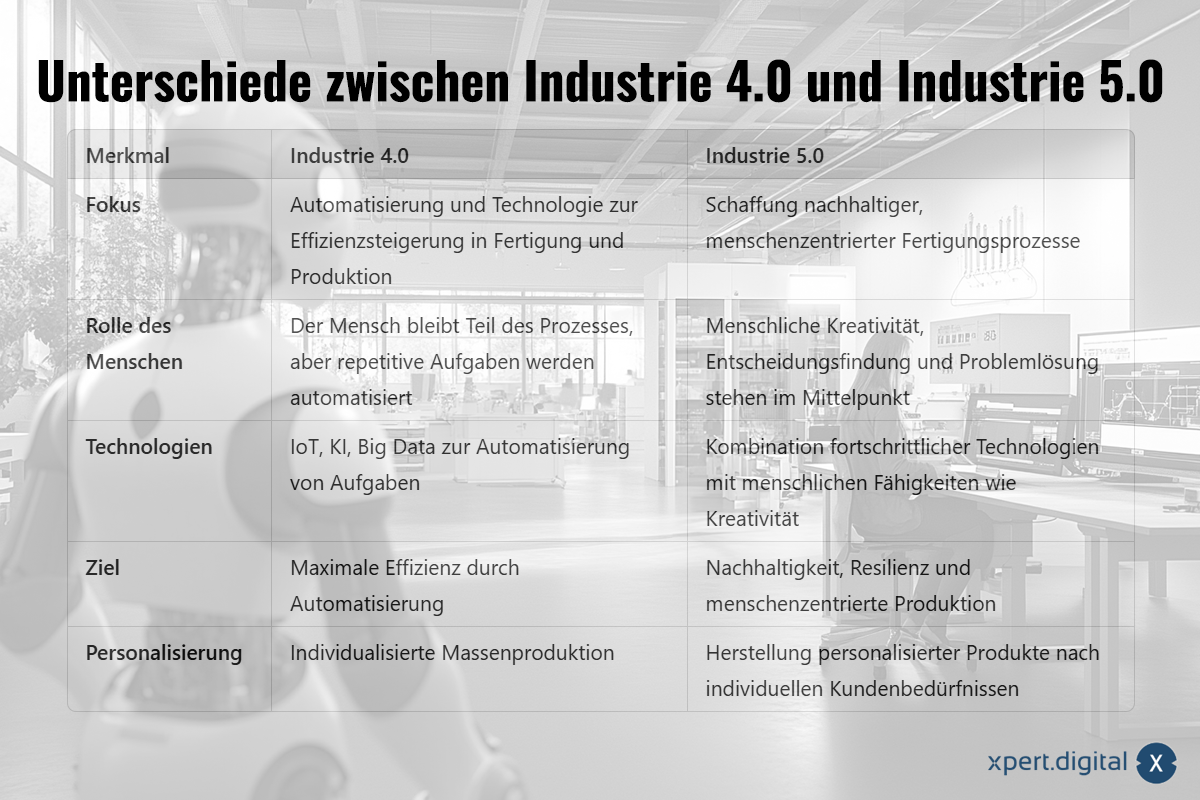
Differences between Industry 4.0 and Industry 5.0 – Image: Xpert.Digital
More about it here:
Further development: From automation to collaboration
A key difference between the two concepts lies in the nature of the interaction between humans and machines:
- Industry 4.0 was primarily about automating processes through technologies such as robotics or IoT. While humans still played a role in the production process, many repetitive or dangerous tasks were delegated to machines.
- In Industry 5.0, however, humans are viewed as creative partners who not only monitor or control machines, but actively collaborate with them. This collaboration is supported by technologies such as cobots or exoskeletons, which enable humans to more easily manage physically demanding tasks.
Furthermore, personalization plays a greater role in the new industrial era: While Industry 4.0 optimized individualized mass production, Industry 5.0 is about adapting products even more closely to the individual needs of customers.
Sustainability as a core principle
Another important aspect of Industry 5.0 is the pursuit of sustainable production processes. While Industry 4.0 focused on increasing efficiency – often without regard for environmental aspects – Industry 5.0 aims to integrate environmentally friendly technologies and utilize renewable energies.
This is reflected in the development of energy-efficient systems and the reduction of CO₂ emissions through optimized production processes. Companies are encouraged not only to pursue economic goals but also to assume social responsibility.
Resilience: Robustness against external disturbances
In addition to sustainability, Industry 5.0 also places great emphasis on resilience, i.e., the ability of a company or production system to be robust against external disruptions. This includes, for example, supply bottlenecks or fluctuations in demand.
Through close cooperation between humans and machines, companies can react more flexibly to such challenges: While machines can ensure consistent quality, humans contribute their ability to adapt quickly to changing conditions.
A paradigm shift in industrial production
Industry 5.0 does not represent a complete replacement for Industry 4.0 – rather, it is a further development of the existing concept. The technological foundations remain the same: IoT, AI, and Big Data continue to play a central role in production.
The crucial difference, however, lies in the fact that humans are once again taking center stage: Instead of merely monitoring machines or performing simple tasks, they actively collaborate with them – supported by advanced technologies such as cobots or exoskeletons.
This development offers enormous opportunities for both companies and employees: companies can increase their efficiency while establishing more sustainable production processes; employees benefit from more attractive jobs and better integration of their creative skills into the production process.
Overall, Industry 5.0 thus marks an important step towards a human-centered future of industrial production – a future in which technology not only serves to increase efficiency, but also promotes human well-being.
Industry 5.0: The fusion of robotic precision and human flexibility
Industry 5.0 marks the next evolutionary stage of industrial development and goes beyond Industry 4.0. While Industry 4.0 focuses on digitalization and the networking of machines through the Internet of Things (IoT), Industry 5.0 centers on collaboration between humans and machines. It combines technologies such as artificial intelligence (AI), robotics, machine learning, and big data with human creativity, flexibility, and problem-solving skills to enable even more efficient and personalized production.
Key aspects of Industry 5.0 for industry, production and mechanical engineering
1. Human-machine collaboration
Machines and robots no longer operate autonomously or in rigid sequences, but interact directly with people. This allows employees to be integrated into the production process as "cobots" (collaborative robots), enabling complex and personalized production workflows. This promotes flexibility and adaptability, allowing individual customer needs to be better met.
2. Personalized production
Industry 5.0 promotes mass customization, meaning mass production combined with the possibility of individual adaptation. This development is made possible in particular by the use of advanced AI algorithms and the processing of massive amounts of data (Big Data). Companies can tailor products precisely to customer requirements while still producing efficiently and cost-effectively.
3. Sustainability and resource efficiency
In manufacturing, the focus is increasingly on sustainability and the efficient use of resources. Industry 5.0 plays a key role here, utilizing digital twins and intelligent energy management systems to optimize resource consumption. The circular economy, in which resources are recycled and reused, is also promoted by intelligent systems that minimize waste and conserve raw materials.
4. Artificial Intelligence and Machine Learning
AI and machine learning play a central role in Industry 5.0 by optimizing production processes in real time. These technologies enable proactive maintenance and the detection of failures before they occur. Machines can learn from data and adapt to changes, further increasing the efficiency and productivity of production facilities.
5. Ethics and Social Issues
Another key aspect of Industry 5.0 is the human and ethical factor. People should be at the heart of these developments, with the creation of jobs and the improvement of working conditions through collaborative technologies. Ethics plays a major role here, as human-centered production aims for fair, safe, and pleasant working conditions for employees.
Advantages for companies in industry, production and mechanical engineering
Increased flexibility
The collaboration between humans and machines makes production more adaptable and allows it to respond more quickly to changes in the market and customer demands.
Productivity increase
The use of AI and automation reduces downtime and increases efficiency, thereby increasing productivity.
Cost reduction
More precise use of resources and the avoidance of errors and failures reduce production costs.
Better working conditions
Collaboration with intelligent machines relieves employees of dangerous and monotonous tasks, increasing safety and satisfaction in the workplace.
Competitive advantage
Companies that embrace Industry 5.0 early on can position themselves as innovation leaders and assert themselves in the market.
Industry 5.0 therefore brings significant advantages to the industrial, manufacturing and mechanical engineering sectors and represents a crucial step towards a human-centered, sustainable and efficient mode of production.
Suitable for: