
Europe is flying blind on industrial policy: While China is strategically reshaping the world market, Europe is still debating whether industrial policy is permissible
Xpert Pre-Release

Available in 27 languages 📢
Prefer Xpert.Digital on GoogleⓘPublished on: June 17, 2026 / Updated on: June 17, 2026 – Author: Konrad Wolfenstein
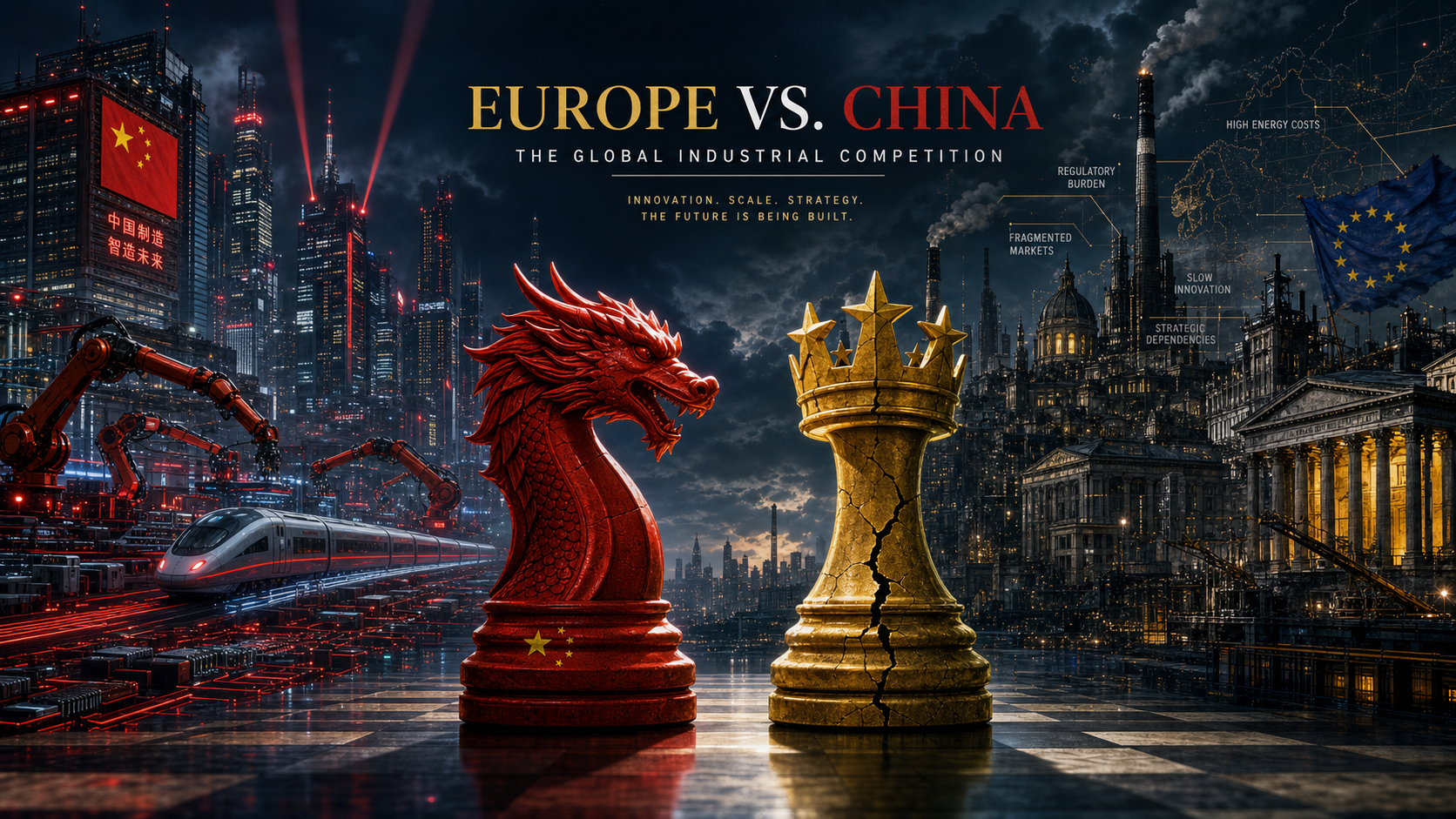
Europe is flying blind on industrial policy: While China is strategically reshaping the global market, Europe is still debating whether industrial policy is permissible – Image: Xpert.Digital
Solar and automotive crisis: How our own naivety is financing China's rise
The myth of the free market: China's master plan and Europe's dangerous passivity
Draghi's dramatic wake-up call: Does European industry still have a chance?
Global economic competition has entered a new, relentless phase – and Europe risks falling behind for good. While China, with a strategically sound industrial policy, massive state support, and clear five-year plans, is reshaping the world market in key sectors such as solar and electromobility, the European Union remains mired in a dangerous institutional paralysis. Blinded by a partly outdated free trade dogma and hampered by endless bureaucratic hurdles, the continent prefers to debate the theoretical permissibility of industrial policy rather than actively shaping it in practice. The bitter result: In the asymmetric competition with Chinese state capitalism, the free market is increasingly proving to be an Achilles' heel, which has already cost Europe hundreds of thousands of jobs. The following analysis ruthlessly exposes why purely defensive measures such as punitive tariffs are ineffective and why the real core problem is not China, but rather Europe's lack of political will. It is high time for a radical reorientation of our location policy – before the window of opportunity for a European industrial renaissance closes forever.
Bureaucracy instead of strategy: Why corporations are turning their backs on Europe as a business location
The bitter truth about our economy: Why tariffs can no longer save us
The trade conflict between Europe and China is often discussed in public debate as a matter of mutual deterrence – tariffs against tariffs, subsidies against lawsuits, restrictions against retaliatory tariffs. This framing, however, misses the real issue: China is not the structural problem that Europe must solve. The structural problem is Europe itself. More precisely: It is the deep-seated inability or lack of political will to represent its own industrial interests with the same consistency that other economic regions have taken for granted for decades.
Since at least the 1990s, and intensified and systematized since the launch of the "Made in China 2025" program in 2015, China has pursued a state-coordinated industrial policy aimed at technological independence and global market leadership in key sectors. The EU, and Germany in particular, long resisted a classical industrial policy, ideologically bound to the dogma of the free market and the ordoliberal conviction that state intervention in market processes is inherently inefficient. This contradiction—a rules-based, market-oriented Europe competing with a strategically managed state capitalism—is not new. But it has taken on a new, threatening dimension.
China's strategic logic: Growth as a national interest
Anyone who misunderstands China's economic policy as an expression of an expansionist or even imperial agenda misjudges the system's internal logic. China itself is under enormous economic pressure. The real estate crisis, which long served as an engine of growth, has not been structurally overcome. Domestic demand is stagnating, the economy is on the verge of deflation, and youth unemployment stood at 16.3 percent in April 2026 – a figure representing millions of young people without adequate employment prospects. The paradox of the Chinese economy in 2025 was a record trade surplus of nearly US$875 billion coupled with plummeting domestic demand and falling consumer prices.
In this context, the aggressive export orientation of Chinese companies is not an expression of lust for power, but rather an economic survival strategy. Companies that can no longer find sufficient sales in the overheated Chinese domestic market are seeking – with state encouragement and subsidies – international markets to reduce their overcapacities. This dynamic is visible in the steel industry as well as in the solar sector, battery manufacturing, and increasingly in electric vehicles. In June 2026, the OECD explicitly warned of a worsening global steel crisis resulting from subsidized overproduction, primarily originating in China.
China's 15th Five-Year Plan for the period 2026 to 2030 continues this approach and explicitly focuses on technological sovereignty – that is, the substitution of foreign technology with domestic developments in areas such as semiconductors, quantum computing, artificial intelligence, and green energy technologies. The state does not steer this through crude central planning, but rather through what observers describe as "managed competition": state-owned enterprises are pitted against each other in controlled competitive situations, generating efficiency gains without relinquishing the state's control. In this logic, markets are not an end in themselves, but rather tools serving state development goals.
The European answer: debate instead of decision
For a long time, Europe reacted to this challenge with what could be described as institutional paralysis. The regulatory debate surrounding the legitimacy of industrial policy had a paralyzing effect in Germany and parts of the EU. For decades, state interventionism was branded as a relapse into outdated economic policy missteps. The European Union's state aid rules, conceived as a bulwark against distortions of competition in the internal market, proved to be a structural obstacle to coordinated industrial policy responses to waves of external subsidies.
The ideological irony of this situation is remarkable: for decades, the avoidance of industrial policy was justified by the argument that free markets were more efficient than state intervention. Now it turns out that the result of this belief in free trade is a competition in which strategically managed state capitalism is systematically gaining market share – leaving European companies unprotected under the guise of market efficiency. The free market is proving too weak to compete against the strategic market.
Under pressure from this realization, the European Commission began to readjust its economic policy direction. The Draghi Report of September 2024—more than 300 pages long and personally authored by Mario Draghi—unflinchingly diagnosed Europe's structural competitive weakness and recommended drastic investments in innovation, infrastructure, and strategic industrial sectors. The report demanded action on a scale that many considered a paradigm shift in European economic policy. In March 2026, the European Commission presented the Industrial Accelerator Act—a law intended to introduce "Made in EU" requirements for public procurement and funding programs, and aimed at building resilient supply chains in strategic sectors. The irony remains, however: while China has long since taken action, Europe is still defining the conditions under which it might be permitted to act.
The solar sector as a textbook example of industrial policy failure
The solar sector is perhaps the most vivid example of how industrial policy naiveté in Europe leads to serious and potentially lasting damage. China has not only subsidized and undercut prices in the solar sector – according to industry experts, it has also systematically violated patent rights and driven European module manufacturers out of the market through targeted dumping. The result: Over 250,000 jobs in European module production – a significant proportion of them in Germany alone – have been lost. By 2026, 88 percent of photovoltaic modules imported into Germany will come from China.
The irony of history: The very expansion of renewable energies, considered a central goal of European climate policy and massively subsidized by the Renewable Energy Sources Act (EEG), co-financed the Chinese solar industry – while its European competitors went under. For European solar manufacturers, this was a double defeat: They lost their domestic market and, through taxes, indirectly paid for the establishment of Chinese market dominance.
The fact that the responsible political actors long failed to take China's expansion strategy in the automotive sector seriously, because they did not treat the solar crisis as a structural warning sign, exacerbated the situation. The EU Commission only imposed final countervailing tariffs on electric vehicles from China in October 2024 – after the Chinese market assault on the European automotive industry was already well advanced. And even this measure was met with considerable skepticism in Germany, because many manufacturers feared that the Chinese retaliatory tariffs could damage their own export business – a dilemma that exemplifies how deeply the German economy is dependent on the Chinese market.
Energy prices, bureaucracy and the erosion of the competitive base
Besides its industrial policy passivity, Europe suffers from structural competitive disadvantages that are largely self-inflicted. Energy prices for industrial consumers in Germany are among the highest in the world. In April 2026, the average electricity price for small and medium-sized industrial companies was 16.7 cents per kilowatt-hour – a price level that makes energy-intensive production processes fundamentally less attractive compared to locations in China, the USA, or other energy regions. The German government initiated a first response with the subsidized industrial electricity price starting in 2026, but experts see this at best as damage control, not a structural solution.
The EU's Green Deal, which on paper embodies an industrial policy vision, has in practice weakened rather than strengthened the competitiveness of European industry in several areas. Stricter climate regulations, rising CO₂ levies, and a density of regulations unparalleled internationally have influenced investment decisions. The Northvolt project in Heide, planned as a flagship for European battery cell production, exemplifies the difficulties of translating ambitious industrial policy goals into economic reality. Anyone in Europe wishing to invest in strategic future industries faces a thicket of approval procedures, state aid restrictions, and regulatory uncertainty unheard of elsewhere.
The comparison is sobering: China, with its five-year plan, sets clear technological priorities and mobilizes state resources for their implementation. The US, with its Inflation Reduction Act, has launched a $370 billion reindustrialization program. Europe is debating. Investments flow to where planning certainty and economic conditions are most attractive – and this competition for investment is real.
Our China expertise in business development, sales and marketing

Our China expertise in business development, sales and marketing - Image: Xpert.Digital
Industry focus areas: B2B, digitalization (from AI to XR), mechanical engineering, logistics, renewable energies and industry
More information here:
A thematic hub offering insights and expertise:
- Knowledge platform covering global and regional economies, innovation and industry-specific trends
- A collection of analyses, insights, and background information from our key areas of focus
- A place for expertise and information on current developments in business and technology
- A hub for companies seeking information on markets, digitalization, and industry innovations
Europe vs. China: Why defense alone is the wrong strategy – From protection to shaping the future
The wrong front line: defense versus build-up
The conceptual choices made in the European debate reveal much about the fundamental misunderstanding. When political actors and commentators speak of "strikebacks," "defensive measures," or a "fight against China," this language traps Europe in a reactive position. The strategic error here is that those who only defend themselves manage the retreat—they do not shape the future.
Chinese strategic thinking operates differently. It doesn't ask about retaliation, but rather how to shape the playing field so that it tips in the desired direction on its own. While European debates revolve around tariffs and anti-subsidy measures, China is forging new international partnerships, securing access to raw materials, developing technological standards, and positioning its companies in global value chains – often in countries that would be accessible to Europe. The result is structural dominance, which tariffs can at best slow down, but not reverse.
Tariffs on Chinese electric cars, for example, do not solve the structural problem. They make imports more expensive, but they do not create European manufacturing capacity. If imports from China are reduced, there is good reason to assume that other non-European production locations will fill the resulting gap – without creating a single industrial job in Europe. Worse still, punitive tariffs can increase inflation, weaken export capacity, and even lower the level of innovation due to a lack of competitive pressure. Protectionism does not make products better – it merely protects them from the need to improve.
What Europe really needs: An active location policy
The more productive question is not: What can Europe do against China? The more productive question is: What must Europe do for itself?
A serious European industrial policy would have to address several levels simultaneously. First, it requires a systematic safeguarding of technological expertise. Technologies of strategic importance—whether in energy production, semiconductor manufacturing, battery production, or communications infrastructure—must not be transferred to third parties without oversight. This does not mean autarky, but it does mean consistent control of technology transfers, intelligent local content requirements, and, where necessary, export restrictions in sensitive sectors. China has long used these instruments quite naturally. It would only be fair to apply them reciprocally.
Secondly, massive public investment in research and development is needed. Europe's comparative strength does not lie in the mass production of cheap goods – China can and will continue to supply those more cheaply. Europe's strength lies in the development of complex, knowledge-intensive products and processes, in engineering expertise, in precision technology, and in the ability to coordinate industrial ecosystems. These strengths must be actively developed and defended, not passively managed.
Thirdly, the structural disadvantages of energy and bureaucracy must be seriously addressed. An industrial electricity price that is temporary and dependent on political majorities is not a reliable foundation for long-term investment decisions. Energy costs are a hard competitive factor, not an abstract concept. Anyone who wants to keep energy-intensive industries in Europe must make energy permanently competitive – through the expansion of renewable energy capacities, market reforms, and European coordination of energy supply.
Fourth, a coherent European procurement policy would be a powerful instrument. The Industrial Accelerator Act addresses precisely this by aiming to introduce "Made in EU" requirements for public contracts and funding programs. A single European market with 450 million consumers is an enormous lever – if used strategically. Public procurement can generate demand for European products and send investment signals that mobilize private capital. China has been doing this for decades, and it works.
The partnership question: Neither naivety nor paranoia
It would be a mistake to conclude from what has been said that Europe must view China as an enemy. China is Europe's most important trading partner – and in 2025, it once again became Germany's most important trading partner. The economic interdependence is so deep that a decoupling-oriented policy would not only be unrealistic but also counterproductive. China's leadership itself signaled, by relinquishing its WTO developing country privileges in September 2025, that it sees itself as a fully equal player in the global trading system – a statement that also implies obligations.
Partnership with China is possible – but only on the basis of consistently representing one's own interests. Those who negotiate must flex their muscles. A European trade policy that insists on mutual openness, demands fair competition, and consistently prosecutes WTO violations is not an attack on China – it is the prerequisite for a robust partnership. Partnerships between unequal parties are not partnerships; they are dependencies.
Germany and Europe possess considerable leverage that they rarely utilize. The European single market is highly attractive and strategically important for Chinese companies – as a sales market, a source of technology, and a platform for building reputation. This potential is a bargaining chip that Europe should use intelligently: not as a threat, but as a natural basis for reciprocity. Market access for market access. Rules of law on both sides. Technology protection as a shared norm.
The real failure: A question of political culture
Behind the economic policy debate lies a deeper problem that is harder to solve than a lack of subsidies or a lack of state aid law: a European, but especially German, political culture that is structurally geared towards consensus and maintaining the status quo – and that only carries out radical readjustments under extreme pressure, if at all.
The warnings were numerous and early. Draghi consolidated them and gave them institutional legitimacy. But a dangerous gap remains between diagnosis and treatment – filled with budget debates, coalition compromises, and questions of institutional jurisdiction. While China implements its 15th Five-Year Plan in 2026 and Germany debates an industrial electricity price that is only valid until 2028, the clock is ticking.
The central question Europe must ask itself is not a technical one. It is a political and strategic question that touches upon the very foundations of European self-understanding: Is Europe prepared to pursue its own industrial interests with the same vigor that other economic areas take for granted? Is Europe prepared to understand the rules of global competition as they truly are – not as they are ideologically desired? And is Europe prepared to muster the political energy required for a consistent industrial policy, instead of settling into the familiar rhetoric of free trade while other market participants strategically exploit this free trade for their own benefit?
The answer to these questions is open. But the window of opportunity for a convincing answer is closing. Those who lose value creation, technological expertise, and industrial jobs won't regain them through debate. They will gain them through decisions – and then through their consistent implementation over years and decades, with the long-term perspective that China has always demonstrated.
Your global marketing and business development partner
☑️ Our business language is English or German
☑️ NEW: Correspondence in your native language!

Konrad Wolfenstein
I and my team are happy to be available to you as your personal advisor.
You can contact me by filling out the contact form here [email protected]:or simply call me at +49 7348 4088 965. My email address is
I'm looking forward to our joint project.
☑️ SME support in strategy, consulting, planning and implementation
☑️ Creation or realignment of the digital strategy and digitization
☑️ Expansion and optimization of international sales processes
☑️ Global & Digital B2B trading platforms
☑️ Pioneer Business Development / Marketing / PR / Trade Fairs
🎯🎯🎯 Data-driven B2B industry hub as a quasi-in-house solution

The quasi-in-house solution: How Xpert.Digital closes operational gaps in B2B marketing and sales – Smart Content-Driven Business - Image: Xpert.Digital
Xpert.Digital is a data-driven B2B industry hub led by Konrad Wolfenstein . The company acts as an external, quasi-in-house solution for industrial partners, closing operational gaps in marketing, content, and sales – without requiring additional resources on the client side.
More information here:





