
“Epicenter of the China shock”: How a misconception is ruining our industry
Xpert Pre-Release

Available in 27 languages 📢
Prefer Xpert.Digital on GoogleⓘPublished on: June 7, 2026 / Updated on: June 7, 2026 – Author: Konrad Wolfenstein
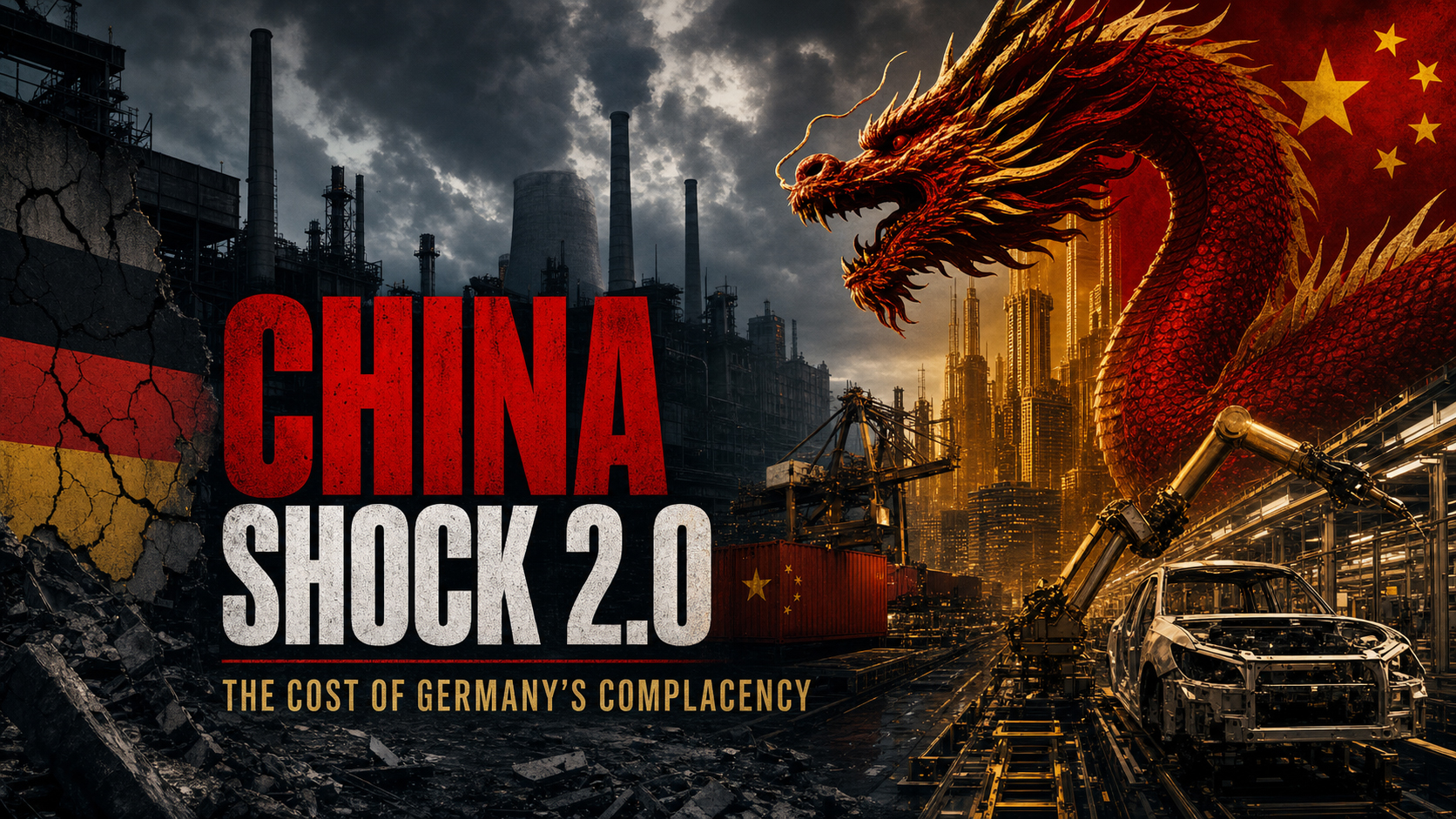
“Epicenter of the China shock”: How a misconception is ruining our industry – Image: Xpert.Digital
Bureaucracy is not the main problem: The inconvenient truth about the German economic crisis
The silent escape: Why the German middle class is now secretly migrating to Bulgaria
The German economy is experiencing not just a temporary economic downturn, but an unprecedented historical turning point. While heated debates rage in Berlin over high energy costs and rampant EU bureaucracy, a far more dramatic structural transformation is taking place behind the scenes. The London-based think tank Centre for European Reform (CER) puts it bluntly in a recent study: Germany is the epicenter of the "China Shock 2.0." Unlike in the 2000s, Beijing is no longer just targeting the fringes of the global market, but is now aiming directly at the industrial heart of the German economy – from mechanical engineering to the automotive industry – with massive subsidies and strategic overcapacities.
Related to this:

The consequences are already measurable: shrinking export markets, creeping deindustrialization, and a drastic loss of global competitiveness. But instead of addressing this existential threat with a coherent industrial policy, policymakers are turning a blind eye to reality and treating symptoms instead of tackling the root causes. Meanwhile, German SMEs have long since taken matters into their own hands, quietly relocating entire value chains to neighboring European countries like Bulgaria. The following analysis dissects the mechanics of this unprecedented industrial offensive and reveals why yesterday's German recipe for success has become tomorrow's deadly trap.
Related to this:

The China Shock 2.0 and Berlin's Silence
How Germany's complacency leads to deindustrialization — and why yesterday's recipe for success becomes tomorrow's trap
In May 2026, the London-based think tank Centre for European Reform (CER) published a study that begins with a remarkably sober statement: Germany is the epicenter of the second China shock. What follows is a detailed, empirically supported indictment of Berlin's economic policy passivity in the face of a structural threat that has been looming for years but has been systematically downplayed.
Phantom pain instead of a clear diagnosis: The extent of growth loss
Germany's economy finds itself in a macroeconomic situation unprecedented in its entire post-war history. Total economic output is roughly six percent below its pre-crisis growth trajectory—a slump comparable in magnitude to the British Brexit shock. Industrial production has been declining for six consecutive years, and private consumption has also failed to recover from the pandemic-induced downturn. Two engines that had driven the German economy for decades have now simultaneously ground to a halt.
The political debate is responding with a misdiagnosis. Energy costs and EU bureaucracy dominate the discussion, even though neither provides the central explanation. The Netherlands, Denmark, and Poland—all subject to the same EU regulations—have experienced robust growth since 2019. The European Commission itself estimates that its entire simplification program generates savings of around €15 billion annually, which is less than 0.07 percent of EU GDP—far too little to explain Germany's industrial decline. An analysis by Bloomberg Intelligence already quantified at the end of 2024 that around 40 percent of Germany's GDP shortfall was attributable to lost export markets, another 40 percent to higher energy prices, and the remainder to domestic factors such as bureaucracy and weak demand. Berlin has thus turned the Pareto principle on its head: it is addressing the 20 percent causes while ignoring the 80 percent cause.
Three driving forces that don't disappear on their own: The mechanics of the second shock
To understand why the lack of export volume is not a cyclical but a structural problem, one must understand the mechanics of the China Shock 2.0. Since the pandemic, China's export volumes have increased by more than 40 percent, while imports have barely grown. In the first quarter of 2026, China's export volume grew by 15 percent—more than twice as fast as global trade.
Behind this lie three mutually reinforcing structural distortions. First, China's extremely high savings rate, coupled with weak household consumption, keeps domestic demand persistently low. What was masked by the real estate boom in the 2010s has become blatantly obvious since the bursting of the housing bubble in 2021: falling property prices, a flawed pension system, and underdeveloped public health protection are forcing Chinese households to save heavily and consume little.
Second, Beijing did not respond by strengthening domestic demand, but rather with an unprecedented expansion of state industrial policy. The IMF estimates Chinese industrial subsidies at around $800 billion annually—roughly 4.4 percent of China's GDP. The OECD determines that Chinese manufacturers receive state support three to nine times higher than in developed economies. These subsidies flow into key industries such as semiconductors, machinery, electric vehicles, and aircraft manufacturing, creating massive domestic overcapacity and forcing companies that want to generate profits to export. Volkswagen itself now localizes its design and supply chains entirely in China—including the use of Chinese robots in its factories.
Third, China benefits from a structurally undervalued exchange rate. An economy with a large current account surplus should, in theory, experience an appreciating currency, making exports more expensive and imports cheaper. Instead, Chinese state-owned banks, led by the central bank, have systematically bought dollars to prevent the renminbi from appreciating. The IMF estimates that the renminbi is currently undervalued by around 16 percent—and, taking into account the significant statistical irregularities in China's balance of payments, this figure could be as high as 30 percent. China unilaterally changed its methodology for calculating the 2022 current account surplus by now reporting the sales of foreign firms that are generated entirely within China as its own trade deficit—a statistical distortion that significantly obscures the true foreign trade imbalance.
Lost on three fronts simultaneously: The three-front problem of German industry
The first China shock after Germany's accession to the WTO in 2001 primarily affected labor-intensive industries such as toys, furniture, and basic electronics. Germany even benefited at the time because China, as a rising industrial nation, imported massive quantities of machinery, chemicals, and vehicles. That's no longer the case. The second China shock is hitting precisely those sectors where German value creation is highest.
China's manufacturing surplus now stands at around two trillion dollars—roughly comparable to Italy's entire national income. This has three direct consequences for Germany. Chinese companies are displacing German products from the Chinese domestic market, where China has been importing less and less since 2001, relative to its own economic output. At the same time, Chinese suppliers are aggressively expanding into third-party markets where German exporters have previously had a strong presence. And increasingly, they are also expanding into the European domestic market itself. The product similarity between Chinese exports and those of the Eurozone has increased more than among any other major industrialized nation—China is deliberately specializing in Europe's industrial strengths.
The consequences are already statistically measurable. German exports to China have fallen by more than 40 percent of their GDP share. According to an analysis by the German Economic Institute (IW Cologne), at the height of the China export boom in 2021, around 1.1 million German jobs depended directly or indirectly on final demand in China—almost 2.5 percent of total employment. The cumulative net decline in exports since 2023 amounts to three percent of German GDP. Since 2019, around 245,000 industrial jobs have been lost in Germany. VW is cutting around 50,000 jobs by 2030, and Audi and Porsche are experiencing massive profit declines.
Related to this:

The Solar Allegory: A Lesson Germany Ignores
The history of the German solar industry provides a particularly sobering illustration. In 2010, China was still producing solar modules using German machinery. Today, global solar production runs on Chinese machines. Germany and Europe cover almost 90 to 95 percent of their solar energy needs with Chinese imports. In the middle of this decade, China accounted for roughly 80 percent of global solar manufacturing capacity.
What began as a cost-effective technology transfer ended in complete strategic dependence. When China announced export restrictions on machinery for manufacturing photovoltaic components in early 2023, 24 German companies, in an urgent letter to the Federal Ministry for Economic Affairs and Energy, realized what they had ignored for years: Germany's dependence on China in the solar sector is far greater than its previous dependence on Russian gas. While the German Bundestag held this debate, the consequences remained modest.
This pattern now threatens to repeat itself in the automotive, mechanical engineering, chemical, and clean technology sectors. China already has manufacturing capacity for around 55 million passenger cars per year—roughly 65 percent of global demand. With a production capacity of at least 25 million electric vehicles and a domestic market only half that size, China can meet virtually all of the incremental global EV demand. Germany exported around 4.4 million passenger cars at its peak in 2016; today, that number is only about 3.2 million and declining—while China's exports have skyrocketed from around two million to over ten million vehicles per year.
From capital goods exporter to importer: The symbolic turning point in mechanical engineering
Since mid-2025, Germany has been buying more capital goods from China than it exports there—a symbolically significant turning point that barely attracted attention. The trade balance with China for mechanical engineering, electronics, transport equipment, and medical technology, once a stable export surplus in the tens of billions, has slipped into deficit.
Even aircraft manufacturing, the last sector in which Germany still held a strong position in China, is showing signs of weakness. German aircraft exports to China have fallen by 50 percent compared to their peak, because Airbus is increasingly relocating its production lines to Tianjin. At the same time, China is developing its own narrow-body jet, the C919, which will challenge Airbus in the medium to long term.
China is focusing its industrial ambitions specifically on German small and medium-sized enterprises (SMEs). The "10,000 Small Giants" program, one of China's flagship industrial policy projects, explicitly targets the product niches in which German SMEs have held global market leadership for decades. Price disadvantages from Chinese suppliers, often 30 percent or more, are putting immense pressure on SMEs.
The American buffer breaks down: Double pincer movement
At times, the North American market offered partial compensation for the losses in China. EU car exports to the US rose from $25 billion in 2019 to almost $50 billion in 2024. But this buffer is now evaporating. The Trump administration eliminated most of the tax incentives of the Inflation Reduction Act, scaled back subsidies for charging infrastructure, and introduced new tariffs on European car imports. Under the US-EU trade agreement of August 2025, EU cars pay a tariff of 15 percent—six times the previous level—and Trump has threatened further increases to 25 percent.
Goldman Sachs estimates that Chinese export pressure could reduce German growth by 0.2 to 0.3 percentage points annually until 2029. The analysis by the French planning agency is even more dramatic: Chinese competition could threaten up to 70 percent of German industrial production in the medium term—far more than the 35 percent in France and the 55 percent European average. Germany is thus facing a double bind: Market access barriers are rising in its most important non-European market, the USA, while China is simultaneously launching a direct attack on the European market stronghold.
Our EU and German expertise in business development, sales and marketing

Our EU and German expertise in business development, sales and marketing - Image: Xpert.Digital
Industry focus areas: B2B, digitalization (from AI to XR), mechanical engineering, logistics, renewable energies and industry
More information here:
A thematic hub offering insights and expertise:
- Knowledge platform covering global and regional economies, innovation and industry-specific trends
- A collection of analyses, insights, and background information from our key areas of focus
- A place for expertise and information on current developments in business and technology
- A hub for companies seeking information on markets, digitalization, and industry innovations
Germany is losing its technological leadership: What the CER study conceals and how Bulgaria is becoming a rescue option
A critical appraisal: What the study achieves — and where it falls short
The CER study provides an analytically consistent and well-documented macroeconomic diagnosis. It deserves recognition for its precise deconstruction of German self-deception: While the narratives of blame for the energy transition, the imperative of electric cars, or excessive bureaucracy are not entirely wrong, they are simply inadequate as primary explanations for Germany's weak growth. The sector-specific analysis—from the automotive industry to mechanical engineering and aircraft manufacturing—is meticulous and supported by a multitude of independent data sources.
Nevertheless, the study can be questioned on several points. First, the analysis of European policy options remains strategically optimistic: The recommended introduction of a European equivalent to America's Section 301 trade instrument, which can address systemic economic distortions, sounds convincing—but overestimates the EU's political capacity for consensus. Germany actively lobbied against its own trade defense interests in the dispute over the EV tariffs, and the reason is no mystery: German automotive companies like VW produce in China and fear Chinese countermeasures against their investments there.
Secondly, the study tends to underestimate the adaptation capabilities of German SMEs. Companies like Kayser Automotive, which are already transferring German industrial standards to Bulgaria and supplying BMW, Porsche, VW and Daimler, demonstrate that adaptation strategies are already underway – but quietly, without a political framework and largely outside the mainstream discourse.
Thirdly, the study lacks a differentiated assessment of Chinese foreign direct investment (FDI) in Europe. While the study rightly warns of a technology drain due to Chinese investments—research data on over 160,000 companies in 159 countries shows that after Chinese acquisitions, the patent activity of the target companies stagnates, while the Chinese parent company quadruples its number of patents—the potential contribution of joint ventures as a vehicle for establishing Chinese production in Europe—as an alternative to pure goods exports—is not sufficiently considered.
Fourth, the time horizon of the policy recommendations is too short. Safeguards and sectoral tariffs are effective in the short term, but they do not solve the fundamental problem: that Germany has not yet achieved comparable world-class strength in 21st-century technologies—AI, quantum computing, battery chemistry, power electronics—as it did in 20th-century technologies. Moritz Schularick, President of the Kiel Institute for the World Economy, put it succinctly: Germany was once a world champion in 20th-century technologies, but is no longer one in 21st-century technologies. This is the real core of the challenge, which the CER study identifies but does not fully explore in its institutional and educational policy dimensions.
Related to this:

The silent transformation: Bulgaria as a European alternative to the extended workbench
Away from the media mainstream, a process has begun whose economic significance is widely underestimated: the emergence of Bulgaria as a new European extended workbench for German companies. What was East Asia for decades—and especially China—is now gradually developing in Southeast Europe under changed geopolitical and cost-structural conditions.
The concept of the extended workbench has a precise historical meaning in Germany. From the 1990s onward, Eastern Europe—particularly the Czech Republic, Poland, and Slovakia—took over labor-intensive manufacturing steps for West German industry, while product development, research, and engineering remained in Germany. In a second wave beginning in 2001, China primarily took over activities where market development and low-wage production coincided. Now the cycle is beginning again.
Bulgaria offers a combination of advantages that is becoming increasingly relevant for German companies: With a corporate tax rate of ten percent—the lowest in the EU—and labor costs that are still below average compared to other EU countries, as well as full EU membership including the Schengen Area since 2025 and the introduction of the euro on January 1, 2026, a regulatory-secure and cost-efficient production environment is emerging. Germany's bilateral trade with Bulgaria already exceeds twelve billion euros annually, and according to the Bulgarian National Bank, German investments in Bulgaria alone amounted to around 4.2 billion euros in 2025.
The industries establishing themselves in Bulgaria are by no means randomly chosen. They are precisely the sectors hardest hit by the economic shock from China: automotive suppliers, electrical engineering, and mechanical engineering. Kayser Automotive produces fluid lines for BMW, Porsche, VW, and Daimler in Pleven. Liebherr Hausgeräte has been operating in Plovdiv since 1999. A Bavarian automaker is supplied by a new component plant in Ruse. In Sofia, companies from the German automotive industry have opened engineering centers where nearly 400 software developers are working on driver assistance systems, automated driving, and electromobility. Rheinmetall is cooperating in the defense industry to produce munitions according to NATO standards.
Nearshoring to Bulgaria also offers a structural advantage over the China model: Its geographical proximity to Germany is approximately 1,500 kilometers, the time zone is identical, engineers can be on-site for a few days at a time, and EU membership guarantees full legal certainty, duty-free access, and access to European funding. At the same time, Bulgaria is also observing growing Asian interest: In 2024, a Chinese company producing aluminum components for the automotive industry established operations in the country's largest industrial park, the Trakia Economic Zone. Even China, therefore, recognizes that a physical presence in the EU reduces customs risks and improves market access.
However, it would be an oversimplification to describe Bulgaria as a problem-free solution. A Strategy& study from the PwC network warns that the era of simple production relocations without fundamental business model adjustments is over: Labor costs in Central and Eastern Europe are rising 3.5 times faster than productivity. Skilled labor shortages are even more pronounced in Bulgaria in some areas than in Germany, energy prices have almost tripled in the past five years, and corruption and bureaucratic opacity remain structural risks.
The shift is therefore not linear, but hybrid: German companies are increasingly combining automated plants in Germany, specialized nearshoring locations in Southeast Europe, and—where unavoidable—high-volume production sites in Asia. What is developing in the background is less a single strategic bet on Bulgaria than a profound reorganization of global value chains, driven by resilience rather than pure cost optimization.
Between structural change and strategic autonomy: What would be needed now
The real question raised by the CER study is not merely economic: it is a question about the self-image of an economic power. If Germany continues to wait—hoping that China will rebalance itself—it risks progressive deindustrialization. All three drivers of the China Shock 2.0 are structural: China's 15th Five-Year Plan for 2026 to 2030 focuses on further industrial expansion, technological self-reliance, and national security—none of these priorities point to a consumption-driven rebalancing.
The analogy to ASML's emergence in the Netherlands is instructive. When Philips shrank from a global corporation to a niche specialist, it was government funding for research and development and the preserved density of industrial ecosystems around optics, precision engineering, and semiconductor technology that enabled ASML to emerge as a new global champion. What was missing was a premature collapse of these ecosystems. When factories close, not only machines disappear, but also knowledge repositories, engineering networks, supply chains, and thus the seeds of future innovation.
The criticism leveled at the CER study—that it essentially engages in mainstream criticism of an easy target—is not entirely unfounded. The study clearly identifies the problem, but the political instruments—European safeguards, sectoral tariffs, a European equivalent of Section 301—require a level of political consensus that is structurally difficult to achieve in Brussels. Germany itself initially blocked the EU EV tariffs and watered down the substantive requirements of the Industrial Accelerator Act. In Brussels, Berlin protects the interests of its corporations producing in China, rather than representing the interests of its domestically produced economy—a fundamental conflict of interest that the study addresses but does not analyze in sufficient depth.
There is no shortage of diagnoses. What is lacking is the institutionalized will to implement them. An economic power that observes new trade protection measures against China in 52 of its 70 major trading partners in the Global South cannot continue to pretend that the Chinese export offensive is a force of nature against which law and industrial policy are powerless. The critical mineral issue—rare earths, gallium, germanium, permanent magnets—demonstrates where passive dependence leads: to strategic blackmail at precisely the moments when sovereignty matters most.
Conclusion without nostalgia: The recipe for success has an expiration date
Germany has proven in the past that structural change is possible—from the Ruhr region's coal industry to the solar initiative of the early 2000s, from Agenda 2010 to the energy transition. But each time, the change was forced by external pressures, not by proactive planning. The difference with the China Shock 2.0 is the speed and simultaneity: automotive, mechanical engineering, chemicals, and aerospace are all under pressure simultaneously—and without a decisive response, there is a real danger that creative destruction will occur without a creative new beginning. Not Schumpeterian renewal, but simple deindustrialization.
The Bulgaria strategy, the debate surrounding European trade defense instruments, the call for a differentiated industrial policy—all these are pieces of a mosaic that still lacks a coherent framework. The real failing is not that Germany lacks the necessary instruments. It is that Germany still hasn't decided whether it views its industrial base as a strategic asset that must be actively protected—or as a dying breed that can be left to global competition. This decision is not technocratic. It is political, and it will not be made by the next strategy paper, but by the next budget debate, the next EU Council summit, and the next negotiating table with Beijing.
What remains is the insight that Moritz Schularick so succinctly formulated: Germany was a world champion in 20th-century technologies—and is no longer one in those of the 21st. This is not an accusation. It is a finding. And findings that are ignored become judgments.
Consulting - Planning - Implementation

Konrad Wolfenstein
I would be happy to serve as your personal advisor.
You can contact me at wolfenstein∂xpert.digital or
Just call me on +49 7348 4088 965 .
🎯🎯🎯 Data-driven B2B industry hub as a quasi-in-house solution

The quasi-in-house solution: How Xpert.Digital closes operational gaps in B2B marketing and sales – Smart Content-Driven Business - Image: Xpert.Digital
Xpert.Digital is a data-driven B2B industry hub led by Konrad Wolfenstein . The company acts as an external, quasi-in-house solution for industrial partners, closing operational gaps in marketing, content, and sales – without requiring additional resources on the client side.
More information here:










