
“The Middle Corridor” – the Eurasian supply chain: How Kazakhstan could become the biggest winner of global crises
Xpert Pre-Release

Available in 27 languages 📢
Prefer Xpert.Digital on GoogleⓘPublished on: May 27, 2026 / Updated on: May 27, 2026 – Author: Konrad Wolfenstein
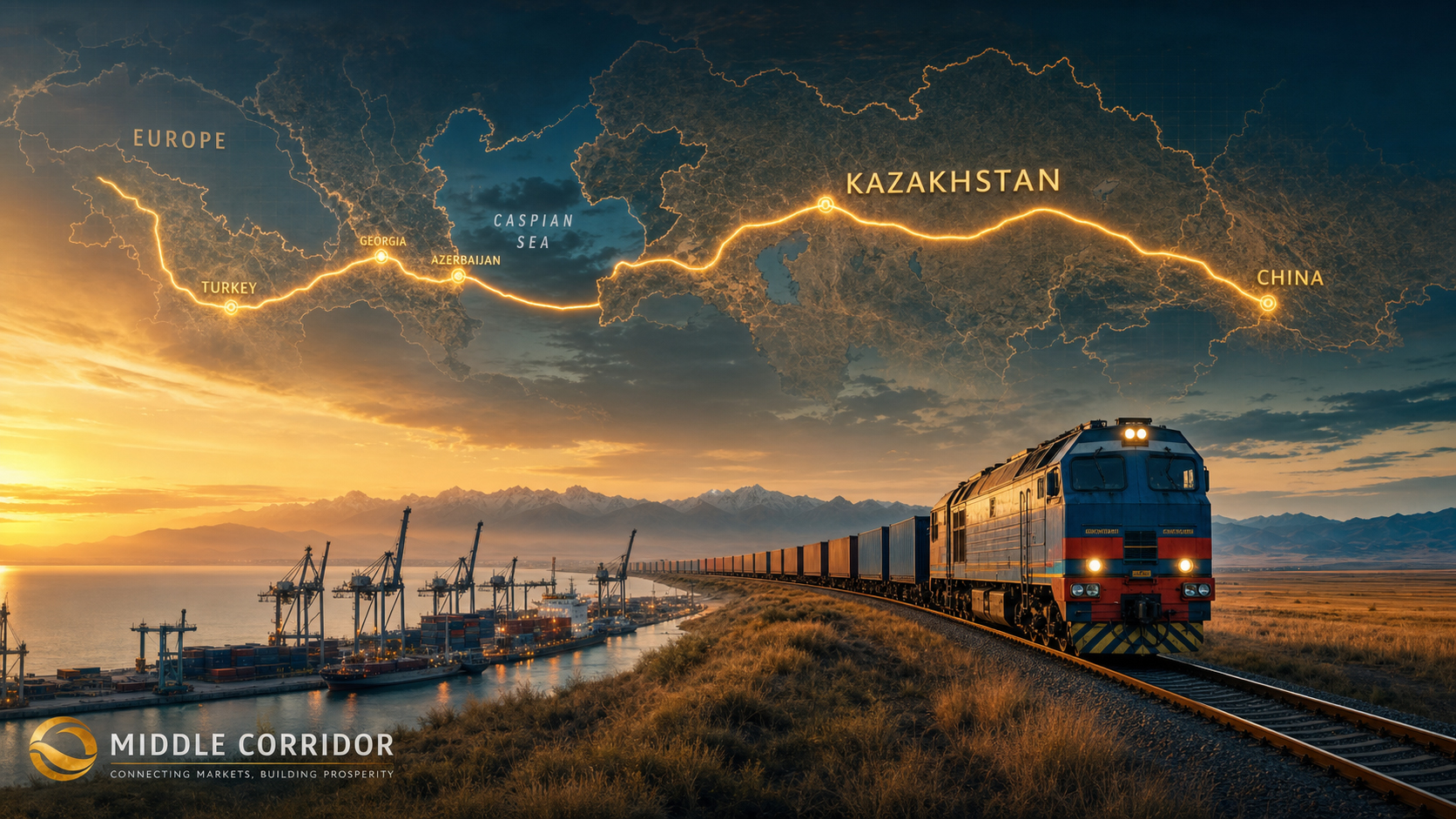
“The Middle Corridor” – the Eurasian supply chain: How Kazakhstan could become the biggest winner of global crises – Image: Xpert.Digital
From landlocked country to logistics superpower: Kazakhstan's ingenious plan for the new Silk Road
Putin's transit monopoly broken: Why everyone is now pinning their hopes on Kazakhstan's "Middle Corridor"
Eurasian logistics is facing a historic turning point
As geopolitical upheavals—from Russia's war of aggression in Ukraine to the ongoing Houthi attacks in the Red Sea—increasingly cripple traditional trade routes between Asia and Europe, one country is quietly but resolutely positioning itself: Kazakhstan. With an unprecedented investment offensive of up to ten billion US dollars, the Central Asian nation is massively expanding the so-called "Middle Corridor." What was considered a logistical niche just a few years ago is rapidly developing into a genuine and heavily trafficked alternative to Russia's northern route and the vulnerable sea lanes. For Kazakhstan, however, this undertaking is far more than just an infrastructure project. It is a geopolitical masterstroke and an ambitious attempt to transform itself from a mere exporter of raw materials into an indispensable logistics hub between East and West. But the fine line between strategic autonomy and dependence on global superpowers carries enormous risks.
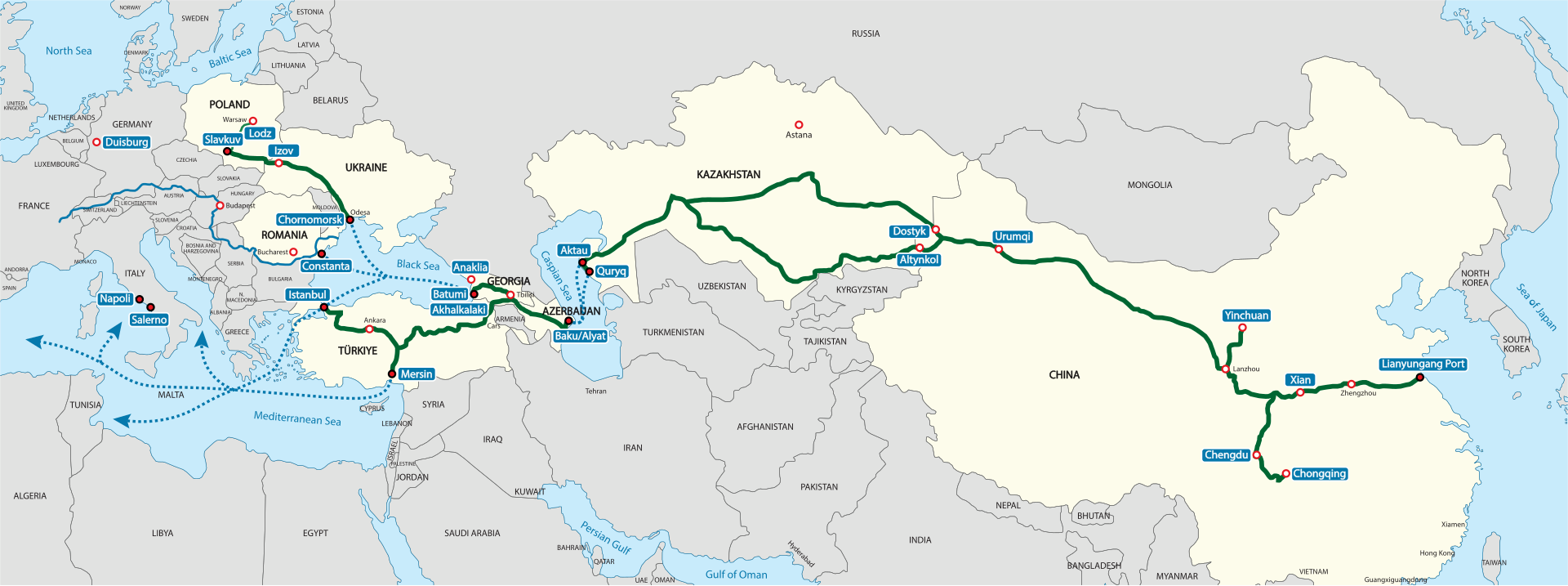
Why everyone is now pinning their hopes on Kazakhstan's "Middle Corridor" – Image: Tanvir Anjum Adib – Own work based on official route map, CC BY-SA 4.0, Link
When geopolitics becomes a growth strategy: How a landlocked country is rewriting global trade flows
Kazakhstan is not a country one typically associates with global trade revolutions. However, anyone observing the logistical landscape of Eurasia since Russia's invasion of Ukraine in February 2022 will notice that no other country has profited from the geopolitical realignment of world trade routes as consistently and with such significant state capital investment as this Central Asian steppe nation. The destruction of the old trade order—through sanctions against Russia, Houthi attacks on ships in the Red Sea, and escalating tensions in the Persian Gulf—has proven to be a strategic golden opportunity for Astana.
The state-owned railway operator Kazakhstan Temir Zholy (KTZ) has responded as only a state-owned company with the full backing of its government can: with an investment offensive of up to ten billion dollars by 2030 in rail infrastructure. The stated goal is to expand transport capacity on the so-called Middle Corridor, the more than 4,250-kilometer-long multimodal transport axis that connects China to Europe via Kazakhstan, the Caspian Sea, Azerbaijan, Georgia, and Turkey. This investment decision is driven by more than just business calculations—it reflects a comprehensive repositioning of Kazakhstan within the Eurasian power structure.
The perfect storm: Why now, why the Middle Corridor
To understand the scale of Kazakhstan's investment gamble, one must consider the disruptions that have shaken global trade flows in recent years. Three developments are crucial, and together they create an unprecedented pressure to find alternative routes.
First: the war in Ukraine and Russia's isolation. The so-called Northern Corridor—the rail route that handled the majority of Eurasian land trade between China and Europe until 2022—ran through Russian and Belarusian territory. Following Russia's invasion of Ukraine, both countries were subjected to massive Western sanctions. As a result, China-EU rail freight via this Northern Corridor plummeted by around 40 percent. European shippers, who had avoided Russian transit routes for compliance reasons, were suddenly faced with the question: What alternative is there? For time-sensitive goods that cannot be transported by ship, the answer was almost inevitably: the Middle Corridor.
Secondly, the Red Sea crisis. Since the end of 2023, Houthi rebels from Yemen have systematically attacked merchant ships in the Red Sea—with over 190 attacks by October 2024. The consequences were dramatic: Suez Canal traffic, which normally handles about 15 percent of global maritime trade, collapsed by 50 percent in the first two months of 2024 compared to the previous year. Shipping companies resorted to the longer route around the Cape of Good Hope, which extended delivery times by 10 to 14 days and drove up freight rates and insurance costs. For the alternative sea transport route between China and Europe, which already took 40 to 55 days, this meant a further deterioration of its competitive position.
Thirdly: the escalation in the Persian Gulf. The situation around the Strait of Hormuz, the most important passage for global oil transport, remained tense in 2025. KTZ CEO Talgat Aldybergenov attributed the increase in freight volumes on the Middle Corridor precisely to these developments: Chinese shippers were increasingly seeking reliable land connections, as sea routes were burdened by uncertainties. This analysis is not an exaggeration—it simply describes the new reality of the global logistics market.
The result of this triple disruption can be seen in a single data point: Since the Russian invasion of Ukraine in 2022, freight volumes on the Middle Corridor have increased tenfold, according to the British investment firm Abrdn. In 2024 alone, freight volumes on the Trans-Caspian transport route grew by 62 percent to 4.5 million tons. In the first three quarters of 2025, 4 million tons were already reported, an increase of 38 percent compared to the previous year. The route, which before 2022 handled only two to three percent of Eurasian container freight, has become a serious strategic alternative.
Ten billion dollars: Anatomy of an infrastructure offensive
KTZ's investment strategy is remarkably nuanced. It does not address a single weakness, but rather the entire value chain of rail transport — from track capacity to port infrastructure and rolling stock, all the way to logistics terminals in key markets.
The centerpiece is the massive expansion of rail capacity. This year, 900 kilometers of new track will be laid, including a 300-kilometer stretch from Ayagoz to Bakhty, which will create a third rail corridor along the border with China. By 2030, rail capacity between Kazakhstan and China is expected to nearly double from the current 55 million tons to 100 million tons annually. This target is not arbitrary: it is based on World Bank projections, which anticipate a threefold increase in current freight throughput—up to 11 million tons annually—along the entire corridor route by 2030.
The strategic cooperation agreement with the China State Railway Group, signed in Almaty in July 2025, underscores China's strong support for the project. The agreement envisions joint investments in railway modernization, logistics centers, and multimodal terminals. The focus is on expanding container traffic and implementing digital solutions for cross-border rail transport. For China, the partnership is far more than a friendly gesture—it secures a controlled alternative to its reliance on maritime freight infrastructure and diversifies its logistical vulnerability in the event of a potential blockade of the Straits to the south.
In parallel, KTZ is focusing on a strategic market presence at critical endpoints. The company already operates a terminal in Xi'an, China—a hub handling approximately 40 percent of all container trains from China to Europe. In 2024, over 5,000 trains were processed from China to Europe, a new record, with around a quarter of all shipments passing through the Kazakh logistics center in Xi'an. KTZ is now in talks to acquire terminals in Romania, Hungary, and Germany—a move that would ensure vertical integration along the entire corridor route and significantly increase revenue per unit transported.
The Caspian Sea: The bottleneck that determines success or failure
The Middle Corridor has a structural weakness that fundamentally distinguishes it from the purely land-based Northern Route: it is not continuously traversable by rail. The Caspian Sea must be crossed by ferry—a maritime transshipment operation that requires time buffers, is susceptible to weather conditions, and necessitates significant investments in port and shipping capacity. This multimodal nature has been the corridor's key competitive disadvantage compared to the Russian route for many years.
KTZ is directly addressing this structural problem. Its planned investment of over $100 million in six new cargo ships, built by China's Jiangsu Hantong Group and Azerbaijan's Baku Shipyard, aims to significantly expand cargo capacity on the Caspian Sea. The new ferries will transport goods between the Kazakh ports of Aktau and Kuryk and Baku, Azerbaijan. Industry analysts at the European Institute for Asian Studies predict that if these bottlenecks are successfully eliminated, container capacity on the Middle Corridor could rise to 130,000 TEU annually by 2040—with a theoretical potential of up to 1.4 million TEU if all obstacles are removed.
The Kazakh ports of Aktau and Kuryk, as well as the Azerbaijani port of Baku/Alat, currently have an annual throughput capacity of 5 to 17 million tons, which is far from being fully utilized. This implies two things: Firstly, there is considerable short-term growth potential through better utilization of the existing infrastructure. Secondly, the discrepancy between current volumes and theoretical capacity suggests that the decisive obstacles are not infrastructure alone, but rather operational efficiency, reducing bureaucracy, and harmonizing tariffs.
Rolling stock as a geopolitical signal: Between East and West
KTZ's procurement strategy for rolling stock is a textbook example of geopolitical ambiguity. Kazakhstan is placing orders simultaneously with Western and Chinese manufacturers — sending a signal that could hardly be more ambiguous: The country does not want to make an enemy of either side.
Framework agreements for locomotives were concluded with the US corporation Wabtec and the French manufacturer Alstom, including 300 units from Wabtec over a ten-year period. Simultaneously, 270 locomotives were ordered from a Chinese manufacturer. This dual procurement strategy is not a sign of indecisiveness, but rather an expression of Kazakhstan's doctrine of multi-vector foreign policy—the foreign policy philosophy the country has pursued since its independence in 1991, which aims to maintain good relations with all major powers simultaneously without permanently committing to any one partner.
This balancing strategy is particularly risky under current conditions, but also particularly lucrative. Russia, which has traditionally exerted the strongest political influence over Kazakhstan, observes the growing importance of the Middle Corridor with mixed feelings: On the one hand, it is a route that explicitly bypasses Russian territory. On the other hand, Kazakhstan continues to cooperate with Russian Railways (RZD) on expanding cross-border infrastructure and digitizing border traffic—an agreement reaffirmed in Moscow in July 2025. Kazakhstan is thus navigating a narrow path between strategic autonomy and the need to avoid alienating its northern neighbors.
Transit times compared: What the Middle Corridor can really do
The competitiveness of the Middle Corridor ultimately hinges on a simple question: Is it fast enough to be attractive compared to the sea and northern routes? The answer is more nuanced than the booster rhetoric of some investment brochures would suggest.
The official TITR specification states 31 to 34 days for transport from Xi'an to Constanța in Romania, and 32 to 37 days to Budapest, Duisburg, or Milan. This puts the corridor significantly longer than the Russian northern route, which takes only 12 to 14 days from Xi'an to Małaszewicze in Poland. The difference is considerable—and explains why the Middle Corridor would not be a preferred alternative for time-critical goods under normal circumstances.
However, normal conditions have been the exception since 2022. When cargo ships have to be diverted around the Cape of Good Hope, the sea freight route extends to 40 to 55 days. In comparison, the Middle Corridor, at 31 to 34 days, is simply faster. Furthermore, in July 2025, Chongqing tested a new "Ultra-Express Service" via the Middle Corridor through Kazakhstan and Turkey, which is expected to reduce transit time to Europe by another 10 days. This propels the corridor into a completely new performance class.
Against this backdrop, BCG's forecast that transit volumes on the Middle Corridor could reach three to four times their current levels in the current decade does not appear as unrealistic optimism, but rather as a sound estimate based on structural shifts in demand. However, for the time being, the route remains a supplement, not a substitute, for the Northern route. The total volume of the Middle Corridor—4.5 million tons in 2024—is comparatively modest compared to the over 100 million ton capacity of the Russian route.
Your container high-bay warehouse and container terminal experts

Container high-bay warehouses and container terminals: The logistical interplay – expert advice and solutions - Creative image: Xpert.Digital
This innovative technology promises to fundamentally change container logistics. Instead of stacking containers horizontally as before, they will be stored vertically in multi-story steel racking structures. This not only allows for a drastic increase in storage capacity within the same area, but also revolutionizes all processes at the container terminal.
More information here:
The Middle Corridor on the rise: Opportunities and risks for Europe
KTZ as a corporation of the future: From state railway to global logistics player
One of the most remarkable features of KTZ's strategy is its ambition to transform the company from a pure infrastructure operator into an integrated, international logistics group. Entering the air freight market—with the acquisition of its first cargo aircraft planned for this year—expands the business model into a new dimension, responding in part to the growing demand for alternative air corridors, a consequence of geopolitical upheavals. GTAI (Germany Trade and Invest) points out that Kazakhstan is increasingly sought after as an alternative not only by land but also by air, due to airspace restrictions over Russia and Iran.
The planned IPO is the logical culmination of this transformation strategy. What was initially communicated as a possible listing in London or Hong Kong has now solidified into an ambitious triple listing on the London Stock Exchange, the Hong Kong Stock Exchange, and a local Kazakh stock exchange. The underlying government resolution from October 2025 stipulates that the IPO should take place in 2026. The coordinating role of the state holding company Samruk-Kazyna, as well as the involvement of Citigroup, JPMorgan, and Société Générale as accompanying investment banks, signal that this is a serious and well-prepared entry into the capital market. According to market analysts, the estimated company value exceeds ten billion dollars.
Particularly noteworthy is the structural design of the IPO: it is conceived as a pure primary offering, in which only new shares are issued. All proceeds therefore remain within the company and flow directly into further infrastructure development. The combination of a government guarantee, international capital, and a strategic growth story makes KTZ a potentially attractive investment for institutional investors who want to participate in the Eurasian connectivity thesis—provided the geopolitical environment remains stable.
The great geopolitical game: Kazakhstan between the blocs
The KTZ investment strategy cannot be analyzed in isolation from the broader geopolitical context. Since its independence, Kazakhstan has pursued a foreign policy officially termed a multi-vector strategy: no permanent alliance partner, but instead pragmatic cooperation with all relevant powers—Russia, China, the West, and Turkey. This doctrine was often a theoretical construct in the past. Today, under conditions of maximum geopolitical polarization, it has become reality.
The European Union has recognized the importance of the Middle Corridor and responded with substantial funding. At the EU-Central Asia Connectivity Investor Forum in January 2024, €10 billion was pledged for the Trans-Caspian Transport Route. This was followed by a further €12 billion Global Gateway investment package at the first EU-Central Asia Summit in Uzbekistan in April 2025. These figures far exceed KTZ's own resources and demonstrate that the Middle Corridor has long since become an instrument of Western foreign and economic policy—a means of diversifying European supply chains away from Russian transit corridors.
China, for its part, views the Middle Corridor as a complementary component of its Belt and Road Initiative. The strategic agreement between KTZ and the China State Railway Group from July 2025 demonstrates that Beijing is actively investing in an alternative to routes that could be threatened by US or Western geopolitics. Strengthening a land route through allied or at least neutral states is in the strategic interest of the People's Republic.
Kazakhstan benefits in this Great Game from its geographical location—and from the fact that all sides have a vested interest in the route's success. The country already generates more than half of Central Asia's total GDP and is growing at a pace that has surprised even conservative forecasters: In 2025, the Kazakh economy expanded by an impressive 6.5 percent. For 2026, the World Bank and the Asian Development Bank are forecasting real GDP growth of 4 to 5 percent, supported by rising oil production in the Tengiz field and increasing transit revenues.
Structural boundaries: What the corridor still lacks
As impressive as the growth of the Middle Corridor is, a sober analysis must also identify the structural weaknesses and risks that could slow its rise.
The first and most fundamental problem is the lack of uniformity. The Middle Corridor runs through four countries—Kazakhstan, Azerbaijan, Georgia, and Turkey—with different track gauges, customs regimes, tariff structures, and digital operating systems. There is no single operator, no harmonized tariffs, and no fully interoperable IT infrastructure. Transit times vary considerably and are difficult to predict—a critical disadvantage for shippers who need reliable planning information. The OECD, in a comprehensive analysis of the corridor, found that the main reform priorities lie in regional integration, trade facilitation, and supranational coordination—precisely those areas that infrastructure investments alone cannot address.
The second structural risk is dependence on geopolitical instability, which could, in principle, subside again. If Russia achieves a favorable solution to the Ukraine conflict and sanctions are eased, the Northern Corridor could become more attractive again and regain freight volumes. The Middle Corridor would then revert to the status of a supplementary route. This dependence on exogenous factors is the greatest strategic risk for Kazakh investments.
Thirdly: Climate risks and water scarcity in the Caspian region. The Caspian sea level has dropped significantly in recent years, which could affect port and ferry operations in the long term. The EU has explicitly addressed this issue in its funding programs and given climate adaptation a prominent role in the financing architecture of the Global Gateway.
Fourth, the difference in absolute capacity remains dramatic. In 2024, the Middle Corridor had a throughput capacity of only six million tons—compared to over 100 million tons on the Russian route. Even if all investments are realized as planned and capacity increases to 11 million tons by 2030, the corridor will remain a niche player in Eurasian freight transport in relative terms.
Europe's renewed interest in Central Asia: More than railway policy
The European perspective on the Middle Corridor is more complex than the infrastructure commitments might initially suggest. For the EU, the corridor is not merely a logistical alternative—it is a geopolitical instrument for diversifying dependencies and strengthening Central Asia's sovereignty against Russian and Chinese influence.
From a European perspective, interest in the transport route is linked to a broader interest in Kazakh raw materials. Kazakh oil exports to Europe have multiplied since the beginning of the war in Ukraine. The diversification of European energy supplies away from Russian oil alone has made Kazakhstan a significant supplier for Western European refineries. The transport route and raw material deliveries are inextricably intertwined: whoever controls the infrastructure ultimately determines the reliability of the supply chain.
The first EU-Central Asia Summit in April 2025 marks a qualitative deepening of this engagement. The EU thereby signaled that it no longer considers Central Asia a peripheral aspect of its neighborhood policy, but rather a strategically relevant region where European interests should be actively shaped. For Kazakhstan, this European engagement is a welcome counterweight to its structural dependence on Russia and China and strengthens its negotiating position vis-à-vis both.
Kazakhstan's transformation moment: From raw material exporter to logistics hub
The broader strategic rationale behind KTZ's investments is Kazakhstan's attempt to diversify its economic model. The country suffers from the classic resource trap: crude oil accounts for the vast majority of its export earnings and government revenue. Any drop in oil prices or any disruption to production directly impacts the Kazakh economy. The strategic development into a logistics hub for Eurasia is a direct attempt to mitigate this structural risk and develop a second, more sustainable source of income.
The results of this diversification strategy are already measurable. In the first half of 2025, freight volume on Kazakh rails exceeded 45 million tons, an increase of 4.1 percent compared to the previous year. Container transit rose by 18 percent to 273,300 TEU. These figures reflect not only the growth of the Middle Corridor but also the broader boom scenario of the Kazakh transit sector as a whole, which is benefiting from the geopolitical realignment.
KTZ's ambitions to acquire terminals in Romania, Hungary, and Germany, as well as to develop the air freight sector, reflect a vision that extends far beyond operating railways: KTZ is positioning itself as a fully integrated Eurasian logistics group, moving goods from Xi'an to Hamburg using its own infrastructure. Whether this vision can be fully realized depends on a multitude of external factors—from the geopolitical climate and competitive dynamics in the European logistics market to the willingness of Western terminal operators to accept Kazakh state capital as a co-investor.
A look into the future: Scenarios for the Middle Corridor until 2030
What scenarios are conceivable for the Middle Corridor up to 2030? A serious analysis must consider three different development paths.
In the optimistic scenario, Kazakhstan succeeds in expanding the planned infrastructure capacities on schedule, harmonizing the tariff structure along the entire corridor, and generating sufficient multimodal transshipment volume. The World Bank forecast of eleven million tons by 2030 would then be met or even exceeded. The KTZ IPO would mobilize international capital and broaden the base of growth financing. In this scenario, Kazakhstan would indeed become an indispensable connectivity hub for Eurasia—with sustainable transit revenues that would significantly reduce the state budget's dependence on oil prices.
In the medium scenario—which most analysts consider the most likely—the Middle Corridor continues to develop as a viable supplementary route, without, however, jeopardizing the dominant position of the Northern Route or ocean freight. BCG's forecast of three to four times the current volume appears achievable in this scenario. KTZ would grow as a logistics service provider, the IPO would mobilize capital, and Kazakhstan would permanently expand its share of the Eurasian transit market.
In the pessimistic scenario, the geopolitical situation normalizes faster than expected. A diplomatic solution to the Ukraine conflict would reopen the Northern Corridor and redirect a significant portion of the freight volumes diverted to the Middle Corridor. Simultaneously, a calming of the situation in the Red Sea would restore the attractiveness of sea freight. KTZ would then face considerable overcapacity, the financing of which would burden the company's debt and ultimately Kazakh state finances.
Reality will likely lie somewhere between these scenarios. What seems certain is that the Middle Corridor has crossed a critical threshold. Investments in infrastructure, international partnerships, and the growing geopolitical awareness among all stakeholders of its strategic importance make a complete relapse to pre-2022 levels unlikely. Kazakhstan has recognized a strategic advantage and decisively exploited it—and this decisiveness in itself is already a significant economic policy signal.
The silent revolution in Eurasian logistics
What is happening on Kazakhstan's railways is more than just an infrastructure project. It is the visible expression of a fundamental reorganization of the Eurasian trade architecture, triggered by wars, sanctions, and climate events that have shaken the old certainties of the global logistics market. Kazakhstan has seized the opportunities arising from these upheavals with a clarity of strategic vision that one wouldn't necessarily expect from a landlocked country.
The ten billion dollars that KTZ is investing by 2030 are not gigantic in absolute terms by Western European standards. But they have a strategic leverage effect that extends far beyond their nominal size: They are transforming one of the world's fastest-growing transport corridors, securing Kazakhstan a lasting role in the Eurasian connectivity network, and sending a signal to international investors that the country is ready to position itself as a serious global logistics player. The planned triple IPO in London, Hong Kong, and Kazakhstan is the final proof of these ambitions—and at the same time a test of whether the international capital market shares the same conviction in Kazakhstan's growth story as the state strategists in Astana.
Consulting - Planning - Implementation

Konrad Wolfenstein
I would be happy to serve as your personal advisor.
me at wolfenstein∂xpert.digital contact
Just call me on +49 7348 4088 965 .
Our global industry and economic expertise in business development, sales and marketing

Our global industry and economic expertise in business development, sales and marketing - Image: Xpert.Digital
Industry focus areas: B2B, digitalization (from AI to XR), mechanical engineering, logistics, renewable energies and industry
More information here:
A thematic hub offering insights and expertise:
- Knowledge platform covering global and regional economies, innovation and industry-specific trends
- A collection of analyses, insights, and background information from our key areas of focus
- A place for expertise and information on current developments in business and technology
- A hub for companies seeking information on markets, digitalization, and industry innovations
Your container high-bay warehouse and container terminal experts

Container terminal systems for road, rail and sea transport in the dual-use logistics concept of heavy-lift logistics - Creative image: Xpert.Digital
In a world marked by geopolitical upheavals, fragile supply chains, and a new awareness of the vulnerability of critical infrastructure, the concept of national security is undergoing a fundamental reassessment. A state's ability to guarantee its economic prosperity, the provision of essential goods and services to its population, and its military capability increasingly depends on the resilience of its logistical networks. In this context, the concept of "dual-use" is evolving from a niche category of export control to a broader strategic doctrine. This shift is not merely a technical adjustment but a necessary response to the "paradigm shift" that demands a profound integration of civilian and military capabilities.
Related to this:










