
250,000 jobs at risk: Why the dispute between bosses and unions is now escalating
Xpert Pre-Release

Available in 27 languages 📢
Prefer Xpert.Digital on GoogleⓘPublished on: June 6, 2026 / Updated on: June 6, 2026 – Author: Konrad Wolfenstein
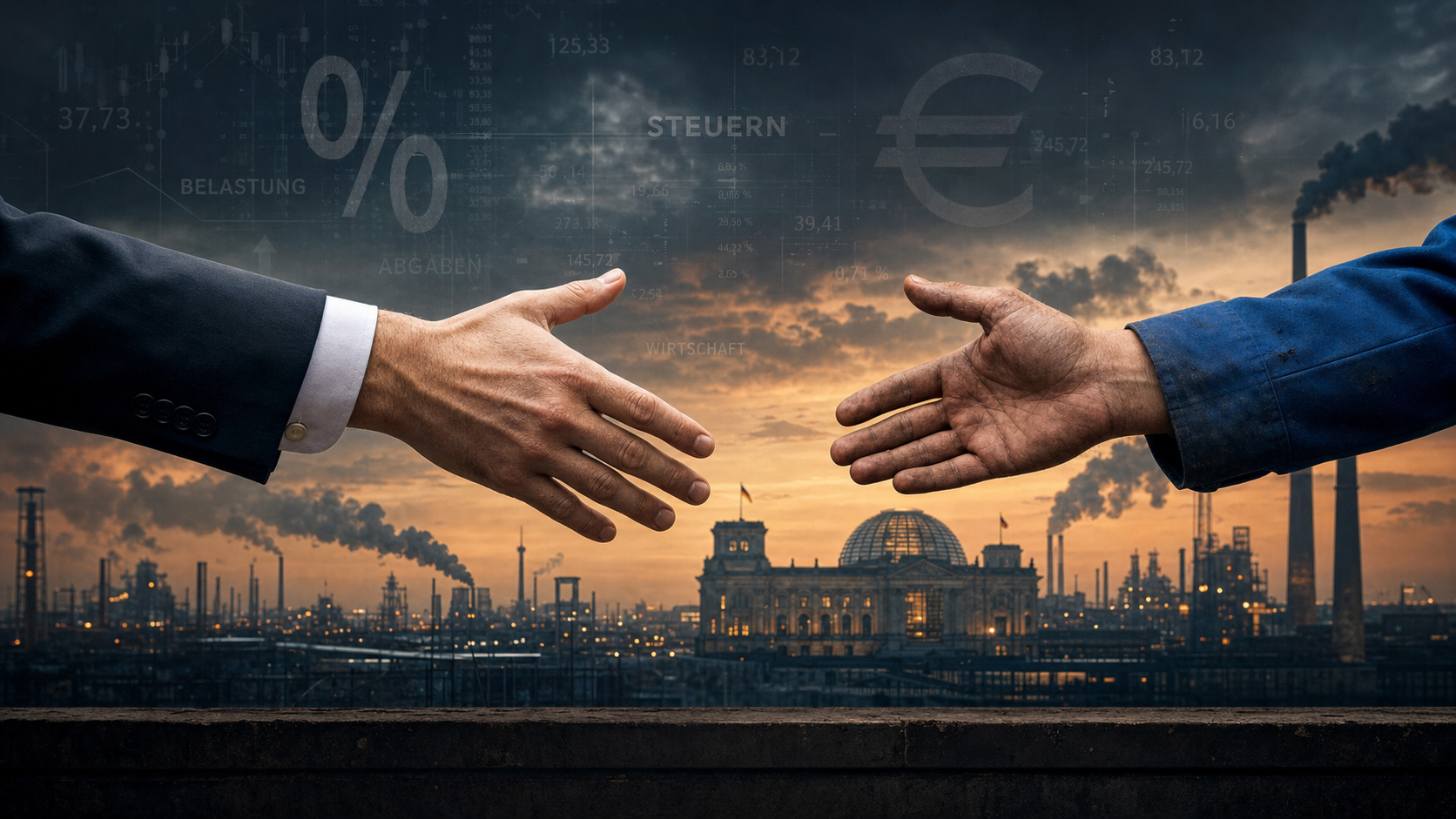
250,000 jobs at risk: Why the dispute between bosses and unions is now escalating – Image: Xpert.Digital
Escalation in the tax dispute: Is the German economic model on the verge of collapse?
The German Trade Union Confederation's (DGB) radical tax plan: Will this finally drive Germany into deindustrialization?
Powerful unions remain silent: The real reason for the DGB tax chaos
Germany is mired in a historic economic crisis – and now, of all times, the decades-long, proven model of social partnership is threatening to collapse. A radical tax proposal from the German Trade Union Confederation (DGB), which envisions massive increases for companies and the wealthy, is driving employers' associations to the barricades. While industry is cutting hundreds of thousands of jobs and fighting deindustrialization, Oliver Zander, head of Gesamtmetall, accuses the DGB of "radical egalitarian fantasies" and openly questions cooperation. But who is right from an economic perspective? Is the DGB plan a threat to Germany's economic competitiveness or a necessary step towards distributive justice? This is an in-depth analysis of escalating distributional conflicts, the silence of industrial unions, and the question of whether Germany is currently jeopardizing its most important economic policy foundation.
Tax dispute, location crisis and the end of unity
When employers and unions stop speaking the same language — an economic analysis of the German model at its limit
The conflict between Oliver Zander, CEO of the employers' association Gesamtmetall, and Yasmin Fahimi, head of the German Trade Union Confederation (DGB), appears on the surface to be a dispute over tax rates. In reality, however, it reflects something deeper: a fundamental debate about how Germany should overcome its structural economic crisis—and who should bear the costs. The decades-old, proven institutional framework of German social partnership is coming under pressure from several directions simultaneously: an industrial crisis of historic proportions, a radical tax proposal from the DGB, and an employers' association that has publicly run out of patience with its traditional negotiating partner.
The foundation: What social partnership has historically achieved
Social partnership is not a bureaucratic construct, but the result of a long, often conflict-ridden history. Its institutional foundation was laid in the post-war period: within the framework of collective bargaining autonomy, trade unions and employers assumed responsibility for shaping working conditions, while the state set the legal framework without directly intervening in the negotiations. Federal President Frank-Walter Steinmeier once called this principle "a stroke of luck for our country," and Ingo Kramer, former president of the Confederation of German Employers' Associations, described it as "unprecedented within Europe.".
The concrete economic value of this model becomes particularly evident when crises need to be managed. During the COVID-19 pandemic, for example, the German Trade Union Confederation (DGB) and employers declared their shared responsibility as a priority over internal differences as early as March 2020. In the 2020 and 2022 collective bargaining rounds, agreements were reached within a short time that secured employment while simultaneously enabling operational flexibility. The model works—but it only works as long as both sides are willing to accept compromise as a legitimate goal. It is precisely this willingness that now appears to be in question.
The situation of the metal and electrical industries: a crisis without historical precedent
To understand Zander's reaction to the DGB's tax proposal, it is essential to understand the industrial reality in which Gesamtmetall operates. The figures are sobering. In the metal and electrical engineering industries, around 250,000 jobs were lost between the peak in 2019 and the end of 2025—a decline of 6.1 percent. Production is even 15 percent below pre-crisis levels. In 2025, the sector lost an average of almost 10,000 jobs per month, and the balance of job creation and loss was negative for the 29th consecutive month—the longest period of decline since the early 2000s. Gesamtmetall predicts that a further 150,000 jobs could be lost by the end of 2026.
Managing Director Zander described the situation in March 2026 with rare clarity: “We are in the midst of deindustrialization, and the outlook is very bleak. The situation is truly dramatic.” He spoke of the “biggest crisis since the founding of the Federal Republic” and cited high energy costs, excessive corporate taxes, inflated social security contributions, and rampant bureaucracy as the causes. This assessment is not mere verbal exaggeration—it aligns with external data. The Bavarian metal and electrical engineering industry recorded almost 30,000 job losses in the first quarter of 2026 compared to the previous year, since the last peak in January 2024, and production fell by 4 percent. The managing director there, Brossardt, commented: “Because the crisis is lasting so long, many companies have no option but to reduce staff instead of retaining them through short-time work allowances.”
At the same time, the German economy as a whole is in the midst of a fragile recovery attempt. After two years of recession (minus 0.9 percent in 2023, minus 0.5 percent in 2024), GDP grew by a mere 0.2 percent in 2025. The Bundesbank expects growth of 0.7 percent for 2026 and 1.2 percent for 2027—driven less by private investment than by government spending on defense and infrastructure. Germany is far from a self-sustaining industrial upswing. Economists warn that the anticipated growth impetus could prove to be a flash in the pan without structural reforms.
The DGB tax concept: Distributive justice or hostility towards investment?
In this economic climate, the German Trade Union Confederation (DGB) presented its tax concept for 2026—a document that goes far beyond individual tax rate changes. The concept follows a clear guiding principle: 95 percent of employees should receive income tax relief, while very high incomes and large fortunes should be taxed more heavily. The financing side comprises a comprehensive package, the individual elements of which are expected to generate additional revenue of over €120 billion per year in the medium term.
Specifically, the proposal calls for: raising the basic tax allowance to €15,400 (currently €12,348), increasing the top tax rate from 42 to 49 percent—but only for taxable income exceeding €88,800, which corresponds to a gross income of more than €100,000. A new top tax rate of 52 percent is proposed for taxable annual incomes above €140,000. The flat withholding tax of 25 percent on capital gains is to be abolished, and capital gains are to be taxed like earned income. Furthermore, the proposal includes: reinstating the wealth tax, which has been suspended for 25 years (1 percent on net assets exceeding €1 million, generating additional revenue of at least €28 billion); a one-time wealth levy of 10 percent on the wealthiest one percent of the population (over 20 years: €350 billion); eliminating inheritance tax privileges for business assets; and introducing a financial transaction tax.
The core issue that most provokes Gesamtmetall and large parts of the economy is the treatment of corporate tax. In 2025, as part of its immediate investment program, the German government decided to gradually reduce corporate tax from 15 to 10 percent—starting in 2028, with a one percentage point reduction per year until 2032. The German Trade Union Confederation (DGB) explicitly rejects this reform, which aimed for a total tax burden of just under 25 percent for corporations from 2032 onward and is considered a key component of Germany's economic policy. The DGB calculates that abandoning the planned reduction would save a total of 75 billion euros between 2028 and 2032 alone. In the medium term, the DGB even proposes raising corporate tax to 25 percent—which would generate an additional 40 billion euros in tax revenue annually.
Is the corporate tax increase economically justifiable?
The central economic question is: Can an increase in corporate tax to 25 percent be justified in the current situation? To answer this question, several perspectives must be considered.
First, an international comparison: Germany already has a total tax burden of around 30 percent for corporations, taking into account corporate income tax, the solidarity surcharge, and trade tax. With trade tax based on a typical multiplier of 438 percent, the combined burden is approximately 31.1 percent—significantly above the OECD average and considerably higher than in the USA (25.6 percent), Ireland (21.7 percent), or France (25 percent). While many OECD countries have systematically reduced their corporate taxes since 2008, the burden in Germany has even increased slightly due to higher trade tax multipliers. Raising corporate income tax to 25 percent while maintaining the trade tax rate would drive the total burden to around 38 to 40 percent—thus definitively placing Germany at the top of the list of high-tax countries, far ahead of all major competitive locations.
Secondly, the investment argument: The German Trade Union Confederation (DGB) disputes that lower corporate taxes lead to more investment, pointing out that the rate was reduced from 25 to 15 percent in 2008 without resulting in sustained increases in investment. This argument is not entirely wrong, but it falls short. Tax regulations are one factor among many—alongside energy prices, bureaucracy, infrastructure, and the availability of skilled workers. Precisely because all these other factors have been a burden in Germany for years, a simultaneous tax increase would be an additional strain that would further worsen the overall attractiveness of the business environment.
Thirdly, the reality for businesses: When Gesamtmetall laments that production is "simply no longer profitable" for many companies, this is not a rhetorical complaint, but a fact borne out by employment figures. Rising corporate taxes in this situation would not only hinder new investments, but could also drive existing production sites into unprofitability. In international tax competition, Germany is competing with locations in Poland, the Czech Republic, Hungary, and Ireland, where the tax burden is sometimes drastically lower.
Fourth, the perspective of fairness: From a distributional perspective, the DGB's argument is understandable. Wealth is indeed very unequally distributed in Germany: The richest one percent of the population holds around a third of the net wealth, while the poorer half possesses no significant assets. The DGB also argues that the corporate tax rate was still at 25 percent in 2000 and that a return to this level would not be a historical anomaly. This is true—but it ignores the fact that the international tax competition landscape has fundamentally changed since then.
The total metal demands: Justified or tactical overreaction?
Oliver Zander's sharp reaction—that the DGB concept is "profoundly anti-performance, unjust, and an expression of radical egalitarian fantasies"—must be read in context from the outset: Employers' associations regularly raise maximum demands in order to have room for maneuver in later negotiations. This is a structural characteristic of collective bargaining and interest-based disputes.
Nevertheless, it is a mistake to reduce Zander's criticism entirely to negotiating tactics. The demands of Gesamtmetall—lower corporate taxes, reduced social security contributions, deregulation, and flexible working hours—essentially reflect a broad consensus among independent economists regarding the structural weaknesses of Germany as a business location. The German Council of Economic Experts has repeatedly pointed to the need for reform of corporate taxation. Even the adopted immediate investment program, which provides for a gradual reduction in corporate tax, is criticized by business associations as correct, but too slow and insufficient.
Gesamtmetall, in its basic position, calls for a maximum total tax burden of 25 percent for companies, a reduction of social security contributions to below 40 percent of gross wages, and consistent working time flexibility through a move away from the rigid daily working time model in favor of a weekly approach. These demands are not maximalistically constructed to later achieve the "actual" goal of a 35 percent total tax. They correspond to an economic policy agenda whose basic direction has already been partially adopted by the federal government—keyword: immediate investment program.
At the same time, it should be noted that the announcement that cooperation with the DGB (German Trade Union Confederation) is being called into question is clearly rhetorical overreach. The statement that they will "have to go without it" if the DGB blocks all reforms is a publicity-savvy threat with limited practical consequences. Collective bargaining autonomy operates between employers' associations and individual unions—not between Gesamtmetall (the German metalworkers' association) and the DGB as an umbrella organization. The DGB has no authority to negotiate collective agreements anyway; this lies with IG Metall and IG BCE (the German Mining, Chemical and Energy Industrial Union). The fact that both unions did not respond to BILD's inquiry as to whether they would support an increase in corporate tax is an interesting signal: It suggests that the industrial unions have considerable reservations about the DGB's proposal on this point—but do not want to publicly risk a conflict with the umbrella organization.
Our EU and German expertise in business development, sales and marketing

Our EU and German expertise in business development, sales and marketing - Image: Xpert.Digital
Industry focus areas: B2B, digitalization (from AI to XR), mechanical engineering, logistics, renewable energies and industry
More information here:
A thematic hub offering insights and expertise:
- Knowledge platform covering global and regional economies, innovation and industry-specific trends
- A collection of analyses, insights, and background information from our key areas of focus
- A place for expertise and information on current developments in business and technology
- A hub for companies seeking information on markets, digitalization, and industry innovations
When social partnership crumbles: What the dispute over corporate tax means for Germany as a business location
Signal effect on the social climate: More than just a dispute between associations
The real significance of the conflict lies not in the details of the tax rate debate. It lies in the signal it sends to the broader social and business climate. When the most influential employers' association in Germany's largest industrial sector publicly questions whether cooperation with the DGB (German Trade Union Confederation) still makes sense, it sends a message that resonates far beyond the association's own circles.
For entrepreneurs and investors at home and abroad, this dispute signals that the institutional consensus that has provided Germany with a reliable economic order for decades has become fragile. Planning certainty—one of Germany's key competitive advantages—suffers when the fundamental coordinates of the economic system are publicly called into question. At a time when Germany is already struggling to attract foreign direct investment and companies are considering relocating production, such a public breakdown of the dialogue between social partners reinforces the negative perception of Germany as a business location.
For the workforce in the metal and electrical industries, this signal is also worrying. They see themselves in a sector that has been continuously losing jobs for 29 months, where short-time work no longer serves as a buffer because the crisis has lasted too long, and where now even the institutional foundation of employee representation is being publicly questioned. This emotional context is economically relevant: when employees lose confidence in the stability of the system, it affects consumer behavior and the willingness to invest privately.
The dispute is also leaving its mark on the political arena. DGB (German Trade Union Confederation) chairwoman Fahimi was re-elected by a large majority at the DGB's national congress in May 2026 and immediately announced that she would confront the federal government with a "major conflict" should it remain on course with pension reform and other social projects. At the same time, Gesamtmetall (the German metalworkers' association) is demanding bold structural reforms from the federal government and warning of a "massive loss of confidence among businesses." The coalition of the CDU/CSU and SPD is thus caught between two powerful interest groups whose demands are hardly compatible.
Future viability: Whose model has a future?
The question of which concept offers the better answer to Germany's structural challenges cannot be answered with a simple left-right dichotomy. Both sides identify real problems.
The German Trade Union Confederation (DGB) is correct that inequality in Germany has increased, that wealth is taxed relatively little here compared to other countries, and that tax relief for middle and lower incomes makes economic sense because these groups consume the majority of their additional income, thereby strengthening domestic demand. A higher tax on capital gains through the abolition of the withholding tax is difficult to challenge from a distributional policy perspective.
Gesamtmetall is right that raising corporate taxes in the current crisis would be the wrong thing to do at the wrong time. As long as the metal and electrical industries are shrinking, production relocations are looming, and Germany is no longer internationally competitive, an additional tax burden on companies would be structurally counterproductive. The INSM study shows that with a total tax burden of over 30 percent and a record tax rate of almost 42 percent, Germany is already a high-tax country by international standards.
The core problem with the DGB's concept regarding corporate tax is that, while fiscally justifiable—more revenue for the state—it neglects the micro-level of entrepreneurial decisions. Companies don't choose investment locations based on averages or historical comparisons, but rather on the concrete, marginally available return on invested capital. If this return is further reduced by rising taxes, while it remains at significantly more attractive levels in Ireland, Poland, or the Czech Republic, the outcome is predictable.
That the demand for a corporate tax increase from industrial unions like IG Metall and IG BCE went so conspicuously uncommented on is probably no coincidence. Unions, which are directly responsible to their members for every job in a German factory, know that investment deductions ultimately hurt employment—not the owners, who can simply reallocate their capital.
The structural problem: When debates about distribution overshadow debates about reform
What this conflict ultimately reveals is a deep structural problem in German political economy: In a growth crisis, the country is primarily debating distribution rather than the conditions for growth. The German Trade Union Confederation (DGB) proposes a fairer way to cut the pie—without adequately addressing how to make it grow again in the first place. The employers' association Gesamtmetall demands better conditions for businesses—without giving equal attention to the real social tensions that have arisen from years of stagnation.
After three years of recession and stagnation (2023: -0.9 percent, 2024: -0.5 percent, 2025: +0.2 percent), Germany has structural wounds that cannot be healed by either tax increases or tax cuts alone. What is lacking is a shared diagnosis: Which industries have a future in Germany? What infrastructure and energy supply do these industries need? What skills development initiative is required? And how can the costs of the transition be distributed fairly? These questions could be answered in the tradition of social partnership—if both sides were willing to think beyond their respective core demands.
The Bundesbank expects GDP growth of 0.7 percent for 2026, supported by expansionary fiscal policy with the €500 billion infrastructure package and increased defense spending. This provides a boost, but not structural change. A sustainable upswing requires a willingness to invest in the private sector—and that depends on confidence in the stability of the economic environment.
The signal of silence: Industrial unions caught between two fronts
The most striking phenomenon in this dispute is not what was said, but what was not said. IG Metall and IG BCE—the two largest industrial unions, whose members are directly dependent on the investment and employment decisions of metal and electrical engineering companies—have not commented on the specific questions regarding corporate tax.
This institutional silence is politically significant. IG Metall represents the interests of millions of employees in an industry that has been shrinking for 29 months. Its chairwoman, Christiane Benner, has described the export model as "in danger," pointed to US tariffs, China's rapid development, and high energy prices as extreme challenges, and advocated for investments in digitalization and future technologies. This is a specifically industrial policy agenda that differs considerably from a general redistribution logic. The umbrella organization DGB is, by definition, more broadly based—it also represents service sector unions whose members are hardly directly affected by corporate tax increases. Their interests are not identical.
This points to a fault line within the German trade union movement, which is at least as interesting as the public conflict between Zander and Fahimi: The balancing of interests takes place not only between capital and labor, but also within the workforce — between industrial manufacturing occupations and the service sector, between export orientation and domestic orientation, between protecting existing jobs and redesigning the world of work.
Between negotiating power and persuasiveness: A sober assessment
The question of whether Zander's sharp rhetoric is tactical bargaining chips or genuine conviction cannot be answered definitively—it is probably both. That he cannot or will not seriously "terminate" the social partnership is inherent in the situation: Collective bargaining in the metal and electrical industries takes place with IG Metall, not with the DGB (German Trade Union Confederation). What Zander is signaling, rather, is an exhaustion of the compromise model at the level of fundamental economic policy principles.
This rift at the level of fundamental convictions is real and goes beyond the usual friction. When an employers' association, during a period of massive job cuts, accuses a trade union federation of systematically blocking reforms and publicly questions the viability of cooperation, it damages institutional trust—regardless of whether the statement is tactically motivated. Institutions thrive on mutual recognition. When this is publicly denied, the damage is difficult to repair.
The DGB's tax concept is, on the whole, more forward-looking than the employers' association portrays it: Relieving the burden on the majority of employees actually strengthens domestic demand, abolishing the withholding tax eliminates a real inequality, and reforming inheritance tax privileges would be constitutionally required anyway. But the critical core point—the corporate tax increase—would send a disastrous signal in the current economic crisis.
Conversely, Gesamtmetall's demands for tax relief for companies, more flexible working hours, and lower social security contributions are economically justified but socially one-sided: they address the costs for companies but say little about how the transformation should be structured for the affected employees. "Agenda 2040," as Gesamtmetall President Stefan Wolf called it, sounds like structural policy—but without a social burden-sharing mechanism, it will not gain a social mandate.
A conclusion that doesn't want to be one
There is no simple answer to the question of who is right in this dispute. What can be said with certainty is that the DGB's tax concept, with its corporate tax agenda, is ill-timed and fails to recognize the international competitive dimension. Gesamtmetall's reaction hits the right point, but in the wrong way—the intensity of the public attack damages institutional trust more than it helps.
What Germany needs at this stage is not another battle over distribution, but an industrial policy pact: a joint strategy outlining which sectors will be strengthened, which transformed, and which systematically phased out—and how the resulting social costs will be borne collectively. Such packages have been possible in the past within the framework of social partnership. The question is whether the institutional prerequisites for this still exist—or whether the public dispute of recent weeks has left a rift that cannot be easily mended.
The overall economic situation is well-known: three years of economic downturn, the longest continuous period of job losses in industry in two decades, and a fragile recovery sustained by government spending, not private investment. In this context, an escalating fundamental dispute between the central organizations of German labor is not a luxury the country can afford. It sends a signal—and not a good one.
🎯🎯🎯 Data-driven B2B industry hub as a quasi-in-house solution

The quasi-in-house solution: How Xpert.Digital closes operational gaps in B2B marketing and sales – Smart Content-Driven Business - Image: Xpert.Digital
Xpert.Digital is a data-driven B2B industry hub led by Konrad Wolfenstein . The company acts as an external, quasi-in-house solution for industrial partners, closing operational gaps in marketing, content, and sales – without requiring additional resources on the client side.
More information here:
Your global marketing and business development partner
☑️ Our business language is English or German
☑️ NEW: Correspondence in your native language!

Konrad Wolfenstein
I and my team are happy to be available to you as your personal advisor.
You can contact me by filling out the contact form here [email protected]:or simply call me at +49 7348 4088 965. My email address is
I'm looking forward to our joint project.










