
Shared debt, productivity crisis and protectionism: The Franco-German dispute over Europe's economic future
Xpert Pre-Release

Available in 27 languages 📢
Prefer Xpert.Digital on GoogleⓘPublished on: February 13, 2026 / Updated on: February 13, 2026 – Author: Konrad Wolfenstein
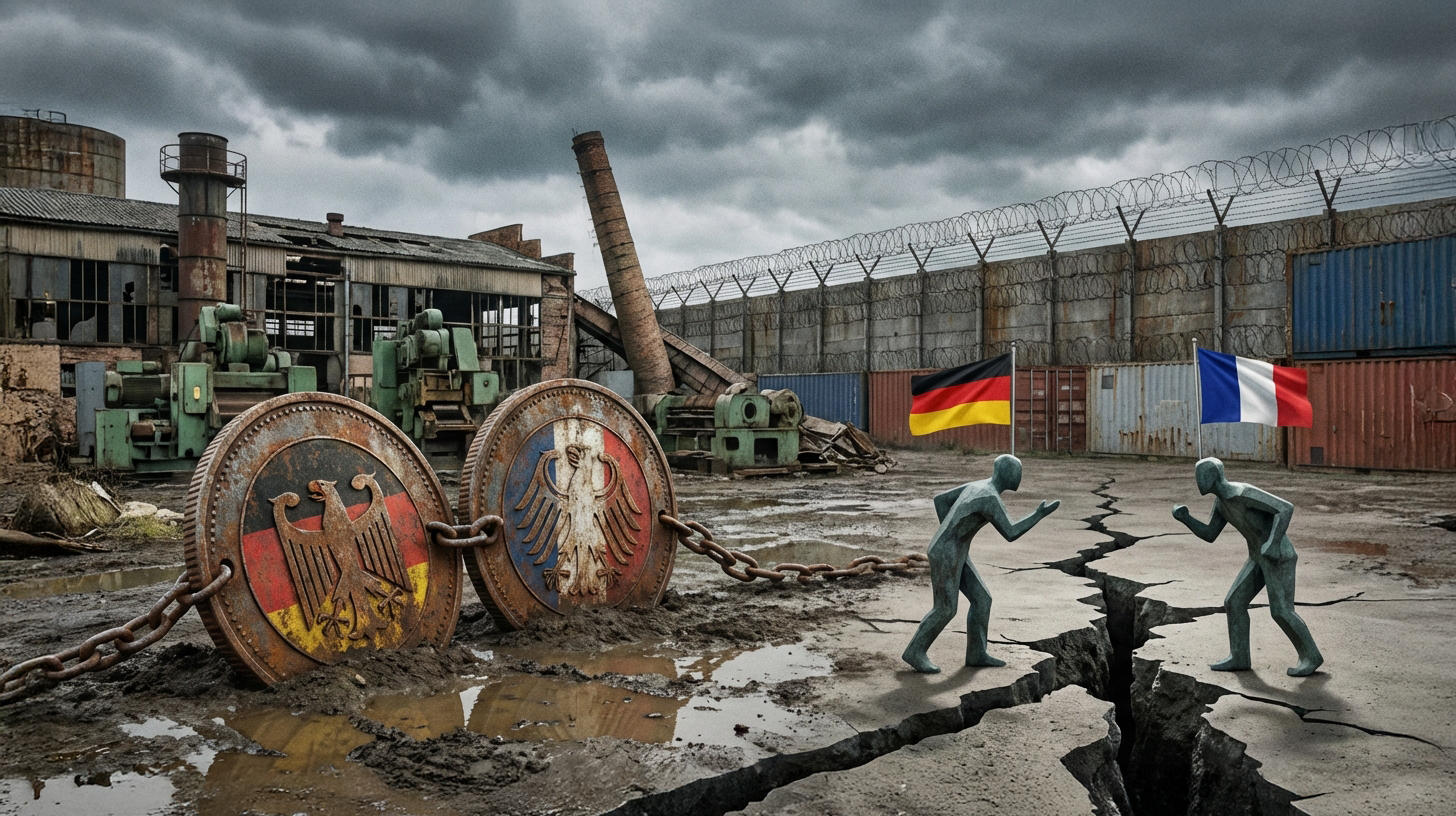
Shared debt, productivity crisis and protectionism: The Franco-German dispute over Europe's economic future – Image: Xpert.Digital
Berlin vs. Paris: The dangerous dispute over debt, steel, and Europe's future
A choice of direction for Europe: Between pressure for reform and the debt brake
Loss of prosperity looms: 70 percent gap compared to the USA – the figures behind the dispute
It is a conflict that goes far beyond day-to-day political disagreements and touches the core of the European economic model: At the informal EU summit on February 12, 2026, at Alden Biesen Castle in Belgium, two fundamentally different philosophies on how to save European competitiveness clashed. On one side is French President Emmanuel Macron, who strongly advocates for new joint debt and protectionist measures for domestic industry. On the other side is German Chancellor Friedrich Merz, who clearly rejects these demands and instead focuses on a profound problem that has often been overshadowed by financial debates: the European productivity crisis.
The background to this dispute could hardly be more serious. The report by former ECB President Mario Draghi has ruthlessly exposed the fact that the European Union is in danger of losing its economic footing with the US and China. While incomes and the technology sector are flourishing in America, Europe is struggling with a static industrial structure, overregulation, and a dramatic innovation deficit. But while Paris sees the solution in a massive state investment program modeled on the Marshall Plan – financed by Eurobonds – Berlin diagnoses a structural problem that cannot be cured with fresh money.
The German government is focusing on deregulation, the completion of the single market, and a "savings and investment union" to mobilize private capital. The rejection of Macron's "Made in Europe" initiative and the call for open markets instead of protectionism mark a clear dividing line. The following analyses illuminate the background of this power struggle, explain the ominous "productivity problem," and show why the decisions of the coming months will determine the continent's prosperity.
Why did the German government reject Emmanuel Macron's demands?
The German government has firmly rejected key demands made by French President Emmanuel Macron ahead of the informal EU summit on February 12, 2026, at Alden Biesen Castle in Belgium. In an interview with six European newspapers, Macron reiterated his support for joint European debt in the form of Eurobonds and for stronger protection of European industry. Berlin deemed these proposals a distraction from the real challenges. Government sources stated unequivocally that Macron's proposals "distract somewhat from what it's really about: namely, that we have a productivity problem." Instead, "profound structural reforms and the completion of the single market" are now the central priorities. Germany and France are thus pursuing diametrically opposed economic policy approaches to overcoming the European competitiveness crisis.
What exactly is the productivity problem that Berlin is referring to?
The European productivity problem is one of the continent's most profound economic challenges. The EU Competitiveness Report, presented by former ECB President Mario Draghi in September 2024, starkly illustrates this problem. According to Draghi, economic growth in the EU has consistently been slower than in the US for two decades, primarily due to a significant slowdown in productivity growth. Around 70 percent of the gap in per capita GDP compared to the US can be attributed to lower productivity in the EU.
The productivity gap has a direct impact on the living standards of the European population. Real disposable income per capita in the US has risen almost twice as fast as in the EU since 2000. In the 2000s, GDP per capita in the EU was around 70 percent of the US figure; currently, it stands at just under 66 percent. While EU productivity was still at about 95 percent of the US level in the 1990s, it has since fallen to 80 percent. Draghi himself described this development as an “existential challenge” and warned: “Do it, or it will be a slow decline.”.
Why does Berlin see the productivity problem as the real cause and not the lack of investment?
The German government argues that Europe's fundamental problem is structural and cannot be solved primarily by increasing spending. The productivity gap between the EU and the US is primarily due to the technology sector. Europe has largely missed out on the digital revolution and the associated productivity gains. Only four of the world's 50 largest technology companies are based in the EU. The EU is also weak in the new technologies that will drive future growth.
From Berlin's perspective, new joint debt would not resolve these structural deficits, but merely mask the symptoms. The problem, therefore, lies in a static industrial structure, insufficient innovation, low investment in research and development, and excessive regulation. At the summit, Chancellor Friedrich Merz emphasized his demand for "far-reaching deregulation" and a systematic reduction of EU regulations "in all sectors." Berlin is convinced that the structural framework conditions must first be improved before additional investments can have their full effect.
What exactly does the required completion of the internal market mean?
The completion of the EU Single Market is one of Berlin's key demands. Despite its more than 30 years of existence, the Single Market still exhibits significant fragmentation and obstacles. On May 21, 2025, the European Commission presented a new EU Single Market strategy aimed at making the Single Market "simpler, smoother, and more efficient." The EU Single Market comprises 26 million businesses and 450 million consumers.
The Commission identified the “ten worst obstacles” to the Single Market, including complicated establishment and business conditions, complex EU regulations, a lack of ownership by Member States, limited recognition of professional qualifications, a lack of uniform standards, fragmented packaging regulations, insufficient product conformity, and restrictive national regulations for services. Further completion of the Single Market could double its economic impact, which would correspond to an additional GDP growth of three to four percent.
High energy prices, excessive bureaucracy, and a fragmented internal market are hindering entrepreneurial development in Europe, according to the German Chamber of Industry and Commerce. Service markets remain nationally organized, professional qualifications are only partially recognized across borders, and standardization lags behind market demands. All these problems could be solved through reforms without incurring new debt, according to the Berlin-based Chamber.
What role does the Draghi report play in this debate?
The Draghi report, presented in September 2024, significantly shaped the debate on Europe's competitiveness and serves as a reference point for both sides. Mario Draghi estimated the annual investment requirement at 750 to 800 billion euros, which corresponds to approximately four to five percent of the EU's GDP. He compared the undertaking to the Marshall Plan after the Second World War. Draghi recommended, among other things, taking on new joint debt, as was done during the COVID-19 pandemic.
The report, along with Enrico Letta's report on the Single Market, was described as a "wake-up call" at the informal European Council meeting in Budapest in November 2024. Building on this, the European Commission published the "Compass for Competitiveness" in January 2025, which is based on three pillars: closing the innovation gap, decarbonization and competitiveness, and reducing dependencies and increasing security. At its core, the Commission is aiming for a new competitive model based on innovation-driven productivity.
A year after the publication of the Draghi report, the assessment was sobering. Its impact to date was deemed "disappointing." Hardly any political discussion within the EU is possible without reference to the report's findings, yet implementation is lagging. France uses the report to bolster its demand for joint debt, while Germany points to the reform recommendations also contained within it.
Why does Germany reject Eurobonds so vehemently?
Germany traditionally rejects joint debt and only agrees in exceptional cases, such as for the Corona recovery fund or financing support for Ukraine, which was attacked by Russia. At the summit in Alden Biesen, Chancellor Merz made his position unequivocally clear: “I don’t want that. But even if I wanted to, I couldn’t,” and referred to the Federal Constitutional Court, which had set “very clear limits” for the federal government.
From Berlin's perspective, there is "virtually no more room for new debt" and "European debt isn't free either." The German government emphasizes that while additional investments in new technologies and defense are necessary, these must be discussed within the framework of the EU's Multiannual Financial Framework. Berlin also fears that shared debt would reduce the pressure for reform on highly indebted member states like France. The concern is: "It can't be that they call for more money but then don't tackle the reforms."
Macron, on the other hand, argued that creating a common borrowing capacity was necessary to invest “in a reasonable amount and at a reasonable pace” in defense, green technologies, artificial intelligence, and quantum computing. He sees this as a unique opportunity to challenge the dominance of the US dollar and position Europe as an attractive investment location. He has the support of countries like heavily indebted Belgium, while northern European states such as the Netherlands and Sweden side with Germany.
What does Berlin mean by modernizing the EU budget?
The German government is calling for a comprehensive modernization and realignment of spending within the framework of the EU's Multiannual Financial Framework (MFF). The current MFF covers the period from 2021 to 2027 and comprises approximately €1.074 trillion. On July 16, 2025, the European Commission presented a proposal for the next MFF, which envisages an increased total budget of around €2 trillion for the period from 2028 to 2034.
Berlin criticizes the fact that, to date, “two-thirds of the budget flows exclusively into consumption expenditures,” with a major portion going toward agricultural subsidies. While the share of the Common Agricultural Policy in the EU budget has decreased over the past 40 years, from 73.2 percent in 1980 to around 24.6 percent in 2023, it remains one of the largest single items. The Commission's new Multiannual Financial Framework (MFF) proposal allocates €300 billion for agricultural spending.
The German government is calling for a shift towards increased defense spending and future-oriented investment. The current EU budget for 2026 allocates just over €2.8 billion to security and defense. The German government's position on the Multiannual Financial Framework (MFF) from 2028 onwards emphasizes that the future budget must "prioritize spending with European added value," including future-oriented investment, innovation, and transformation spending. At the same time, all existing spending must be reviewed for its effectiveness. The restructuring of the MFF is based on four key policy areas: investment and reform, promoting competitiveness through a new €409 billion Competitiveness Fund, strengthening Europe's role in the world with €200 billion, and protecting citizens with approximately €100 to €110 billion.
Why has the demand for increased defense spending become so central?
The geopolitical situation has fundamentally changed due to the war in Ukraine and the increasingly unpredictable stance of the US under President Donald Trump. Berlin emphasizes that the EU must "assume greater responsibility for security and defense." The German government sees opportunities within the Multiannual Financial Framework (MFF) to close EU capability gaps, primarily by strengthening the security and defense industry through demand aggregation and incentives for collective development, production, and procurement.
The reference to defense is also strategically significant: Berlin argues that the necessary defense investments can be financed within the existing EU budget if consumption spending is reallocated to investment spending. The German government thus directly contradicts Macron's argument that new joint debt for defense spending is unavoidable. According to the Berlin position paper, important dual-use technologies should not be excluded from civilian EU programs, and European corridors for military mobility as well as increased resilience to hybrid threats must be taken into account in the Multiannual Financial Framework (MFF).
Our EU and German expertise in business development, sales and marketing

Our EU and German expertise in business development, sales and marketing - Image: Xpert.Digital
Industry focus areas: B2B, digitalization (from AI to XR), mechanical engineering, logistics, renewable energies and industry
More information here:
A thematic hub offering insights and expertise:
- Knowledge platform covering global and regional economies, innovation and industry-specific trends
- A collection of analyses, insights, and background information from our key areas of focus
- A place for expertise and information on current developments in business and technology
- A hub for companies seeking information on markets, digitalization, and industry innovations
"Made in Europe" or open markets? This dispute is dividing the EU heavyweights
What is Macron demanding regarding the protection of European industry, and why is Berlin rejecting it?
Emmanuel Macron is calling for active preferential treatment of European products in public tenders and procurement. "I don't mean protectionism, but rather giving preference to European products," Macron said. This is particularly about protecting European steel. The French president aims to protect entire sectors, such as the steel industry.
The German government rejects this comprehensive approach. “Our conviction is that protectionism cannot be Europe’s model for prosperity,” government sources stated. Instead of isolationism, more trade agreements are needed, including beyond the Mercosur agreement. France had opposed the Mercosur agreement out of concern for its agricultural sector. The free trade agreement between the EU and the Mercosur countries – Argentina, Brazil, Paraguay, and Uruguay – which was politically agreed upon in December 2024, is intended to create the world’s largest free trade zone, encompassing over 700 million inhabitants.
The debate surrounding steel protection is particularly revealing. The European Commission already tightened protective measures for steel in 2025 to safeguard the EU steel industry from rising imports. The EU steel industry is under considerable pressure due to global overcapacity, increasing exports from China, and growing trade barriers in key markets such as the US. Thirteen EU member states had requested a review of the protective measures, as the industry's situation had deteriorated due to increased import pressure and declining demand.
What is the “Made in Europe” initiative and what is Germany’s position on it?
The European Commission is working on a “Made in Europe” law that aims to give preference to companies that carry out a significant portion of their production in Europe in public tenders and funding awards. The plans also affect companies outside the EU: new requirements will apply to investments exceeding €100 million in strategically important sectors such as batteries, electric vehicles, robotics, and solar energy.
Berlin generally supports the initiative as "centralized," but only under strict conditions. The German position paper advocates for "Made with Europe" rather than "Made in Europe": it should suffice if production takes place in a country with which the EU has a trade agreement. From Berlin's perspective, "Buy European" rules must meet the following criteria: they must remain the exception, be limited to critical and strategic technologies, and not be extended to entire sectors. Furthermore, they must be time-limited, and a rigorous assessment of proportionality and anticipated cost increases is required.
Berlin is most open to the idea of "Made in Europe" standards in matters of economic security, specifically regarding the supply of medicines, chemicals, and semiconductors. Berlin also considers protection justified for strategically important technologies such as batteries and robots, as well as for key industries "that are existentially threatened by unfair practices from international competitors." Macron, however, envisions protecting an entire sector, including the steel industry, which goes far beyond what Germany is willing to accept.
What role does the Savings and Investment Union play as an alternative to Eurobonds?
The Savings and Investment Union, formerly the Capital Markets Union, has become a central topic in the European economic debate. On March 19, 2025, the European Commission presented a strategy to channel savings into productive investments. The starting point is remarkable: around 70 percent of EU household savings, worth €10 trillion, are held as bank deposits, which, while safe, offer little return.
From Berlin's perspective, the Savings and Investment Union offers an alternative to joint debt. Instead of taking on new debt, private savings should be channeled more efficiently into productive investments. EU citizens should have more opportunities to invest their assets in the capital market, and companies should have better access to financing. The strategy comprises four sets of measures: improved opportunities for citizens and savings, increased investment and financing, greater integration and size, and more efficient supervision in the single market.
The savings and investment union was one of the main outcomes of the Alden Biesen summit. However, there is resistance: Luxembourg and Ireland, in particular, are showing reservations regarding cross-border capital market integration. While the banking union, implemented as a response to the financial crisis, has yielded concrete results, the capital markets union has so far remained a draft without sufficient implementation.
How did the EU summit in Alden Biesen go and what decisions were made?
The informal EU summit took place on February 12, 2026, at Alden Biesen Castle in Belgium and focused entirely on competitiveness. Merz and Macron appeared together before the press that morning, demonstrating unity despite their significant differences in economic policy. The Association of the Automotive Industry had previously demanded that the summit "send a very clear signal" and initiate measures that would "advance European competitiveness with the necessary political urgency and strategic clarity.".
There was broad agreement on the further development of the Capital Markets Union into a Savings and Investment Union, on a planned simplified legal form for startups, and on the possibility for individual member states to opt out of cooperation at the EU level. The willing countries should pursue projects in smaller groups if an agreement with all 27 member states is not possible.
Macron set a deadline: concrete decisions on how to make the EU more competitive must be made by June. If the 27 member states fail to make progress by then, the possibility of "enhanced cooperation" with those states willing to participate must be kept open. However, no progress was made on the core points of contention: joint debt and comprehensive industrial protection.
Why is the Mercosur agreement a litmus test for the differing positions?
The Mercosur agreement highlights the fundamentally different economic philosophies of Germany and France. While Berlin prioritizes open markets and more trade agreements, France positions itself as the protector of its domestic industry, particularly its agricultural sector. France vehemently opposed the Mercosur agreement, arguing that it did not adequately protect French farmers.
Negotiations on the EU-Mercosur agreement began in 1999 and were marked from the outset by conflicts over the agricultural sector. Besides France, Poland, Hungary, and Italy also opposed the agreement. In France, the EU's approval of the Mercosur agreement even led to votes of no confidence against the government, which, however, failed to gain a majority.
From Berlin's perspective, French resistance to Mercosur underscores the inconsistency of Paris's position: France is demanding joint European debt for increased investment, yet simultaneously blocking trade agreements that would open up and strengthen Europe's economy. The German government emphasized the need for more trade agreements, "beyond the Mercosur agreement." Europe must open itself to the outside world, not isolate itself.
What structural reforms are needed from Berlin's perspective?
The German government is calling for a broad range of structural reforms that go far beyond individual measures. At its core, this involves reducing regulation and bureaucracy, completing the single market, particularly in services, strengthening the Capital Markets Union to better finance innovation, modernizing the EU budget with a stronger focus on future investments, and concluding further trade agreements.
Berlin expects even those member states calling for new financing to participate in these reform efforts. This message is directed at France and other proponents of joint debt. While Macron is demanding new financing instruments, France itself is among the countries with the highest debt-to-GDP ratios in the eurozone and has repeatedly stalled on structural reforms.
According to the German Association of Chambers of Industry and Commerce (DIHK), the EU Commission's competitiveness compass has raised important questions, but so far "convincing answers and a clear change in policy" are lacking. Heads of state and government must take concrete measures that have an immediate impact on day-to-day business operations. At the same time, the DIHK is calling for more intensive cooperation between the EU and reliable partners, particularly regarding trade agreements.
How do economic experts assess the debate between Berlin and Paris?
The expert opinions reflect the complexity of the debate. DIW President Marcel Fratzscher supports Draghi's diagnosis and emphasizes that without significantly more private and public investment, "productivity and growth will weaken even further, jobs and innovative companies will relocate, and much prosperity will be lost." Henning Vöpel, Managing Director of the Center for European Policy, notes that Ursula von der Leyen's policies are "strongly aligned with the recommendations and analyses of the Draghi report.".
At the same time, there are also more nuanced voices in the productivity debate. Analyses show that productivity in the EU is almost on par with the US when considering productivity per hour worked. The difference is then primarily explained by longer working hours and higher prices in America. While this perspective puts the alarmist rhetoric into perspective, it doesn't change the fact that Europe lags behind in technological innovation and the scaling of new businesses.
Andrea Frank of the Stifterverband emphasizes that Europe is not merely experiencing cyclical fluctuations, but rather “structural upheavals that will fundamentally change the economy, science, and society.” The small number of large technology companies in Europe is the main reason for the productivity gap with the USA. Fewer national solo efforts and a smarter division of labor could significantly improve the EU's competitiveness.
What perspectives does this offer for European economic policy?
The Franco-German dispute is likely to shape European politics in the coming months and years. Macron has set a timeframe with his deadline of June 2026 and outlined an alternative with "enhanced cooperation" should an agreement with all 27 member states prove impossible. Germany faces the challenge of reconciling its opposition to joint debt with the need for massively increased investment in defense and technology.
The negotiations on the next Multiannual Financial Framework (MFF) for 2028 to 2034 will be the real battleground of this conflict. With a proposed total budget of around two trillion euros, they provide the framework within which decisions will be made about the realignment of EU spending. Financing is to be secured not through higher contributions from member states, but through new own resources, such as taxes on tobacco products and electronic waste, corporate levies, and charges under the carbon border adjustment mechanism.
The repayment of the NextGenerationEU coronavirus recovery fund, which must begin in 2028, is further exacerbating the budgetary situation. The German government categorically rejects making this extraordinary and temporary instrument permanent. This further restricts the financial leeway for new joint initiatives, strengthening Berlin's position but also raising the question of how the €800 billion in annual investments demanded by Draghi can be achieved without new sources of financing.
Your global marketing and business development partner
☑️ Our business language is English or German
☑️ NEW: Correspondence in your native language!

Konrad Wolfenstein
I and my team are happy to be available to you as your personal advisor.
You can contact me by filling out the contact form here or simply call me at +49 7348 4088 965. My email address is: [email protected]
I'm looking forward to our joint project.
☑️ SME support in strategy, consulting, planning and implementation
☑️ Creation or realignment of the digital strategy and digitization
☑️ Expansion and optimization of international sales processes
☑️ Global & Digital B2B trading platforms
☑️ Pioneer Business Development / Marketing / PR / Trade Fairs
🎯🎯🎯 Benefit from Xpert.Digital's extensive, five-fold expertise in one comprehensive service package | BD, R&D, XR, PR & Digital Visibility Optimization

Benefit from Xpert.Digital's extensive, five-fold expertise in a comprehensive service package | R&D, XR, PR & Digital Visibility Optimization - Image: Xpert.Digital
Xpert.Digital possesses in-depth knowledge across various industries. This allows us to develop tailored strategies precisely aligned with the requirements and challenges of your specific market segment. By continuously analyzing market trends and monitoring industry developments, we can act proactively and offer innovative solutions. The combination of experience and expertise generates added value and provides our clients with a decisive competitive advantage.
More information here:










