
Fuel reserves for only 3 months: Defense contractor uncovers massive security gap – Decentralized energy islands instead of large refineries demanded
Xpert Pre-Release

Available in 27 languages 📢
Prefer Xpert.Digital on GoogleⓘPublished on: February 19, 2026 / Updated on: February 19, 2026 – Author: Konrad Wolfenstein
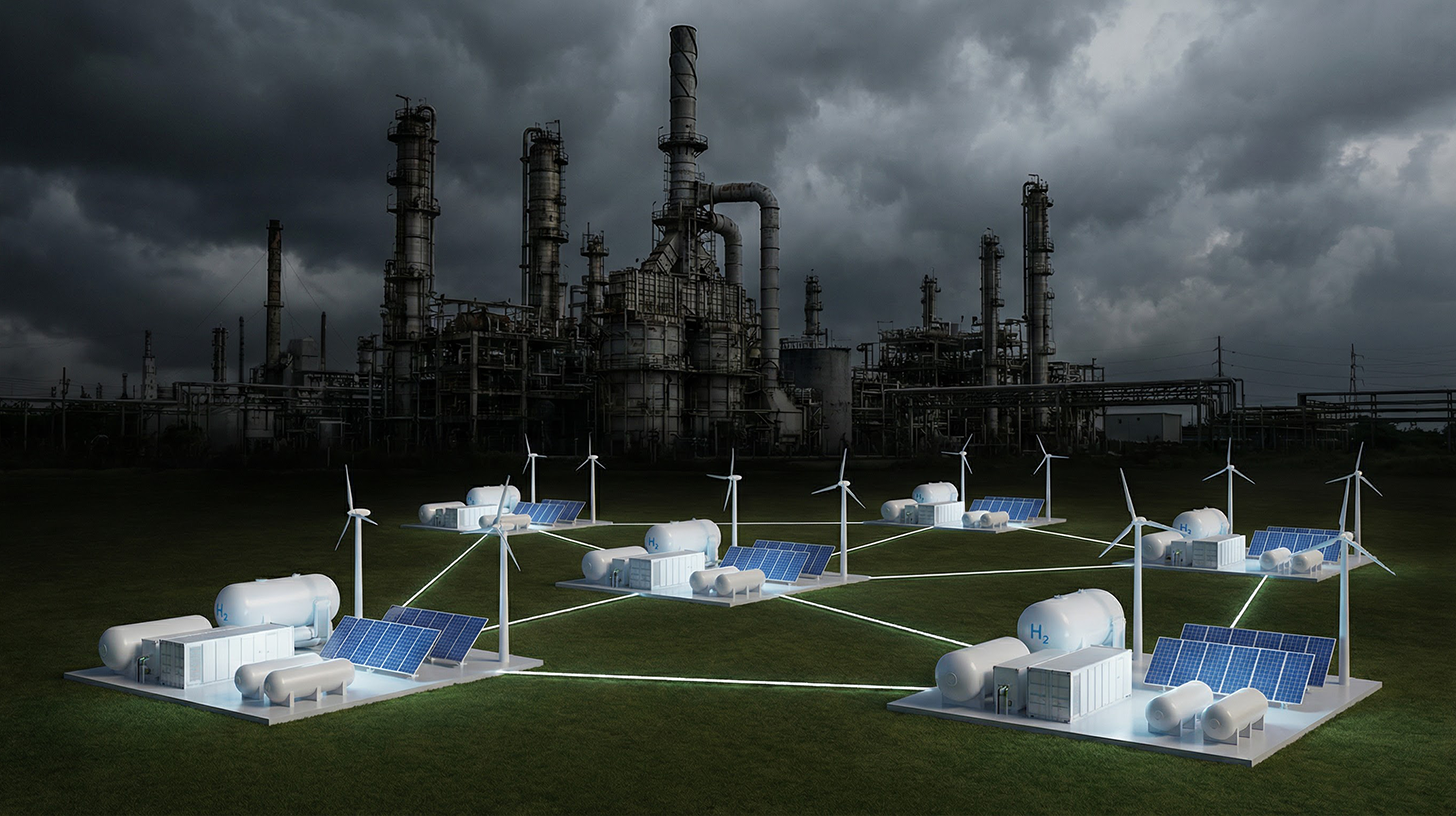
Fuel reserves for only 3 months: Defense contractor uncovers massive security gap – Decentralized energy islands instead of large refineries demanded – Image: Xpert.Digital
Rheinmetall sounds the alarm: Why the energy transition is suddenly vital for the German Armed Forces
Forget climate protection: The reason why Rheinmetall is focusing on solar and wind power
In February 2026, an alliance is emerging in the European security architecture that would have been considered pure utopia just a few years ago. Not environmental activists, but strategists from the arms giant Rheinmetall are currently providing the most compelling arguments for a massive acceleration of the energy transition. While the company is traditionally known for steel, ammunition, and heavy weapons systems, photovoltaics, wind power, and the production of synthetic fuels (e-fuels) are now moving into the focus of military planning.
The backdrop to this is an alarming analysis of supply security: In the event of a national emergency, European fuel reserves would barely last longer than three months. After that, a standstill threatens – not only for tanks and aircraft, but also for critical civilian infrastructure. The war in Ukraine has dramatically demonstrated how vulnerable central refineries are to drone attacks. The logical conclusion for security experts is therefore decentralization. Rheinmetall is calling for the development of autonomous "energy islands" to end dependence on global supply chains and vulnerable large-scale facilities.
But at precisely this moment, a political conflict threatens to torpedo the necessary measures. The German government's new "Grid Package 2026" proposes restrictions on the expansion of renewable energies in order to relieve the strain on the electricity grids – a step that, according to industry experts and military strategists alike, would be disastrous. This article examines why the energy transition is no longer simply a matter of climate protection, but has become a crucial factor in Europe's survival, and why the stalled expansion of wind and solar power could become the continent's biggest security vulnerability.
Why the arms industry, of all industries, provides the strongest argument for wind and solar power
The European energy debate took a turn in February 2026 that would have been unthinkable just a few years ago. Not environmental groups or climate activists are providing the most compelling argument for expanding renewable energies, but rather Europe's largest arms manufacturer. Rheinmetall, the company whose name has always stood for tanks, ammunition, and conventional military strength, is positioning photovoltaics, wind power, and green hydrogen as indispensable pillars of European defense capabilities. This paradigm shift is more than a strategic maneuver. It reveals a fundamental weakness in the European security architecture, one that has been criminally neglected in the political debate surrounding special funds and defense spending.
Europe's Achilles heel: Three months until a standstill
The figures presented by Shena Britzen, head of the hydrogen program at Rheinmetall, in an ntv interview in February 2026 are alarmingly clear. In the event of a defense emergency, Europe's fuel reserves would only last for approximately three months of warfare. After that, the reserves would be depleted, and everything that European states are currently procuring for trillions of euros in military equipment would come to a standstill: fighter jets, tanks, ships, transport vehicles. But the consequences would extend far beyond the military sphere. Hospitals, emergency services, and the entire civilian supply infrastructure would also collapse.
The root cause of this vulnerability is structural. An EU regulation in effect since 1968 obliges member states to maintain oil reserves sufficient for at least 90 days of normal civilian consumption. This regulation was designed for peacetime scenarios, not for a defense scenario with massively increased military consumption and simultaneous attacks on refinery infrastructure. Europe has approximately 60 refineries, which form the backbone of its fuel supply. In a conflict scenario, these centralized facilities would be highly vulnerable targets, as the war in Ukraine dramatically demonstrated.
Lessons from the Ukraine war: Refineries as strategic targets
The war in Ukraine has revealed a new dimension of warfare with immediate consequences for European security strategy. Ukraine has systematically attacked Russian oil refineries, fuel depots, and energy infrastructure with long-range drones. More than 45,000 Ukrainian combat drones penetrated Russian territory in 2025 alone. Sixteen major Russian refineries, representing approximately 38 percent of the country's nominal refining capacity, were hit multiple times. According to expert estimates, Russia has lost about a quarter of its oil refining capacity as a result.
This strategy has proven to be one of Ukraine's most effective weapons. In some Russian regions, gasoline had to be rationed. Britzen himself cites these attacks as a key reason why Russia became willing to negotiate, as it could not prevent drone attacks on its energy infrastructure. The lesson for Europe is unequivocal: In the age of inexpensive drone swarms, centralized energy infrastructure is a strategic risk of the first order. A single hit on a large substation or refinery can cripple an entire region. To achieve the same effect on thousands of decentralized solar power plants, an attacker would have to expend an effort that is completely disproportionate to the benefit.
Giga PtX: Rheinmetall's vision of decentralized energy islands
Rheinmetall's response to this strategic vulnerability is ambitious and consistent. In November 2025, the company presented its Giga PtX project, which envisions the construction of a Europe-wide network of several hundred modular e-fuel production plants. Depending on its application, each of these plants is designed to produce between 5,000 and 7,000 tons of diesel, marine diesel, or kerosene per year. The fuel will be produced decentrally and independently of global fossil fuel supply chains. Wind and solar power will provide the energy for electrolyzers that generate green hydrogen, which will then be further processed into synthetic fuels using the Fischer-Tropsch process.
Rheinmetall has assembled a consortium of German technology companies for this project. Sunfire from Dresden is supplying industrial electrolyzers, Greenlyte from North Rhine-Westphalia is contributing technology for direct CO2 capture from the air, and INERATEC from Karlsruhe is responsible for the Fischer-Tropsch synthesis. Rheinmetall itself is acting as the general contractor and is responsible for system integration, design, construction, maintenance, and operation of the plants.
Armin Papperger, CEO of Rheinmetall, formulated the core security policy aspect of this project with unmistakable clarity: Military capability requires a resilient energy infrastructure, and maintaining supply chains for fossil fuels will be challenging for European states in the event of a defense crisis. Britzen puts it simply: Wind and sun are always there, regardless of whether there is war or peace.
The economic dimension: From cost factor to security investment
The economic reality behind the Giga-PtX project is complex, however. A liter of synthetic kerosene currently costs four to five euros. This is many times the price of conventional fuel and makes a market-driven ramp-up virtually impossible without government support. Nils Aldag, CEO of Sunfire, acknowledges that this price difference complicates the ramp-up. Rheinmetall and its partners are therefore hoping for government assistance, which is quite understandable given the security policy arguments.
Britzen estimates that Europe needs at least 20 million tons of e-fuels per year to maintain its defense capabilities. For Germany alone, this would equate to seven to eight gigawatts of electrolysis capacity. These are enormous quantities that require massive investments. However, NATO already determined last year that Russia could be ready to attack again within five years. Britzen says they are working against this clock, and the European cleantech sector is capable enough to build these capacities within five years. The technology is available; it simply needs to be scaled and replicated.
Kira Vinke of the German Council on Foreign Relations puts this development into a geopolitical context: Rheinmetall is demonstrating that the energy transition is in Europe's strategic interest. She points out that in Afghanistan, 60 percent of the wounded and killed NATO soldiers were involved in logistics, particularly fuel logistics. A base is easier to secure than a transport operation. Endurance is also a military capability, and military operations ultimately require funding.
Hub for Security and Defense - Advice and Information

Hub for Security and Defense - Image: Xpert.Digital
The Security and Defence Hub offers expert advice and up-to-date information to effectively support companies and organizations in strengthening their role in European security and defence policy. Working closely with the SME Connect Defence Working Group, it particularly promotes small and medium-sized enterprises (SMEs) that wish to further develop their innovative capacity and competitiveness in the defence sector. As a central point of contact, the Hub thus creates a crucial bridge between SMEs and European defence strategy.
Related to this:
When professionals talk about logistics: The new, crucial role of renewable energies
Decentralized resilience: A paradigm shift in defense logic
From eco-project to security issue: Why the arms industry is now relying on solar power
The strategic logic of decentralized energy supply is shared not only by Rheinmetall, but increasingly by NATO strategists and military experts. In October 2025, an alliance of military veterans and security experts, including retired British Lieutenant General Richard Nugee and retired Dutch General Tom Middendorp, called on NATO member states in an open letter to radically change course in energy policy. EU member states had transferred around €22 billion for Russian oil and gas imports in 2024, more than the €19 billion in financial support for Ukraine during the same period. Since the beginning of the war, Europe's gas bill to Moscow had accounted for roughly three-quarters of Russia's military budget.
The US Pentagon has long recognized renewable energies as a so-called combat power multiplier. The primary goal is not simply a greener conscience, but rather the reduction of logistical backbone—those vulnerable supply chains that become the decisive weak point in asymmetric conflicts. Decentralized solar power plants, wind turbines, and storage facilities form a distributed energy network that, due to its redundancy and dispersion, is far more resilient against targeted attacks than centralized large-scale infrastructure.
In December 2025, NATO Secretary General Mark Rutte discussed the links between energy and security policy with the EU energy ministers. Energy security has thus definitively arrived at the highest level of the transatlantic security architecture, not as an abstract topic, but as an operationally relevant question of defense capability.
The Network Package 2026: A frontal assault at the wrong time
Against this security policy backdrop, the so-called "Network Package 2026" by Federal Minister for Economic Affairs Katherina Reiche appears downright paradoxical. The draft bill, which was made public in February 2026, proposes far-reaching restrictions on the expansion of renewable energies. The core logic of the draft law is that the construction of new wind and solar power plants is progressing faster than the expansion of the electricity grid. In order to give grid operators more time to catch up, the expansion of renewables is to be restricted.
Specifically, the draft legislation proposes several significant measures. The existing nationwide priority for connecting and feeding renewable energies into the grid is to be effectively weakened. Grid operators will be permitted to develop their own prioritization criteria for connection requests for installations of 135 kilowatts and above, meaning that new fossil fuel installations, such as planned natural gas power plants or energy-intensive data centers, could be given priority over renewables. A so-called redispatch reservation of up to ten years is to apply in capacity-limited grid areas, whereby grid operators can designate a grid area as capacity-limited and refuse compensation payments for curtailed installations if the curtailment rate is as low as three percent. Furthermore, construction cost subsidies are to be expanded, increasing the investment costs for renewable energy projects.
The industry is sounding the alarm: From low-risk to high-risk business
The energy sector's reactions to the grid package have been scathing. Carolin Dähling of Green Planet Energy described the draft legislation as a frontal assault on the energy transition. She warned that if the priority grid access and connection rights for renewable energies are abolished, the expansion of wind and solar power is threatened with a massive collapse. The German Association of New Energy Industries (BNE) cautioned that a redispatch reservation lasting up to ten years would create massive uncertainty about future returns, dramatically worsening financing conditions for renewable energy plants.
The fragmentation of the grid connection rules is particularly problematic. In the future, grid connection will be subject to an individual prioritization logic by over 800 distribution network operators. Different procedures and criteria mean more bureaucracy, greater legal uncertainty, and a noticeable slowdown in expansion. The German Solar Association warns that without reliable compensation, financing new projects will be virtually impossible. Investments in renewables would thus transform from a low-risk to a high-risk business. Naturstrom states that the positive aspects of the draft are disproportionate to its detrimental effect.
The consequences for the expansion targets are foreseeable. Germany has set itself the goal of covering around 80 percent of its electricity from renewable sources by 2030. In 2025, the share was around 60 percent. At the end of 2025, the cumulative installed photovoltaic capacity in Germany was 117 gigawatts. To reach the expansion target of 215 gigawatts by 2030, 19.6 gigawatts of new PV capacity would have to be added annually. Already in 2025, the increase was declining, at 16.4 to 16.5 gigawatts, compared to 17.5 gigawatts in 2024. The grid package threatens to drastically exacerbate this negative trend.
The strategic contradiction: Armaments without an energy base
The real paradox of the network package lies in its timing, coinciding with the largest European rearmament offensive since the Cold War. The EU's ReArm Europe plan aims to mobilize up to €800 billion to strengthen defense capabilities. Germany has created a special fund for the Bundeswehr (German Armed Forces) and plans to permanently spend over two percent of its gross domestic product on defense. At the same time, the network package is hindering precisely those technologies that, according to the arms industry and NATO strategists, are indispensable for defense capabilities.
Rheinmetall itself is already leading by example. At its Neuss site, a 1.5-megawatt photovoltaic system with a battery storage capacity of over one megawatt-hour was commissioned in early 2026, and further projects with a total PV output of over 20 megawatts and more than 10 megawatt-hours of storage capacity are in the planning stages. The goal is energy self-sufficiency and the optimization of self-consumption. The PV systems primarily use components from European and regional suppliers to shorten supply chains and guarantee long-term availability.
When Europe's largest arms manufacturer classifies wind and solar power as operationally indispensable for defense capabilities, while at the same time the German government systematically hinders the expansion of precisely these energy sources, a fundamental strategic contradiction exists. SPD politician Nina Scheer believes the grid package fails to fulfill the requirements of her own coalition agreement, which stipulates that all the potential of renewable energies should be utilized and grids synchronized with renewable energy sources.
From eco-niche to security infrastructure
The reassessment of renewable energies as security infrastructure marks a profound shift in the energy policy discourse. The old dichotomy between economic pragmatism and ecological idealism dissolves when the arms industry itself becomes an advocate for wind and solar power. Britzen summarizes this insight in a sentence attributed to a US general from World War II: Strategy is for amateurs, professionals talk about logistics.
For the photovoltaic industry, this shift in perspective represents a fundamental upgrade. PV installers are no longer just building power generation plants; they are constructing security infrastructure. Decentralized energy systems comprised of photovoltaics and storage form the basis for the energy islands that Rheinmetall is designing as the foundation for e-fuel production and thus for European defense capabilities. Austrian military planning has already recognized the consequences: The civilian energy transition poses risks due to the decreasing availability of fossil fuels for armed forces and simultaneously creates new vulnerabilities that can be mitigated by decentralized renewable energy systems.
The political task arising from this analysis is clear. Renewable energies are not an optional luxury of a prosperous, peaceful society, but a prerequisite for Europe's ability to act in an increasingly uncertain world. Every law that hinders the expansion of wind and solar power weakens not only climate policy, but also the continent's defense capabilities. The question is no longer whether Europe can afford renewable energies, but whether it can afford to do without them.
Consulting - Planning - Implementation

Markus Becker
I would be happy to serve as your personal advisor.
Head of Business Development
Chairman SME Connect Defense Working Group
Consulting - Planning - Implementation
Konrad Wolfenstein
I would be happy to serve as your personal advisor.
contact me at wolfenstein ∂ xpert.digital
Just call me on +49 7348 4088 965 (Munich) .





