
Oil crisis & solar boom: How the war in the Persian Gulf is fueling the global energy transition
Xpert Pre-Release

Available in 27 languages 📢
Prefer Xpert.Digital on GoogleⓘPublished on: April 23, 2026 / Updated on: April 23, 2026 – Author: Konrad Wolfenstein
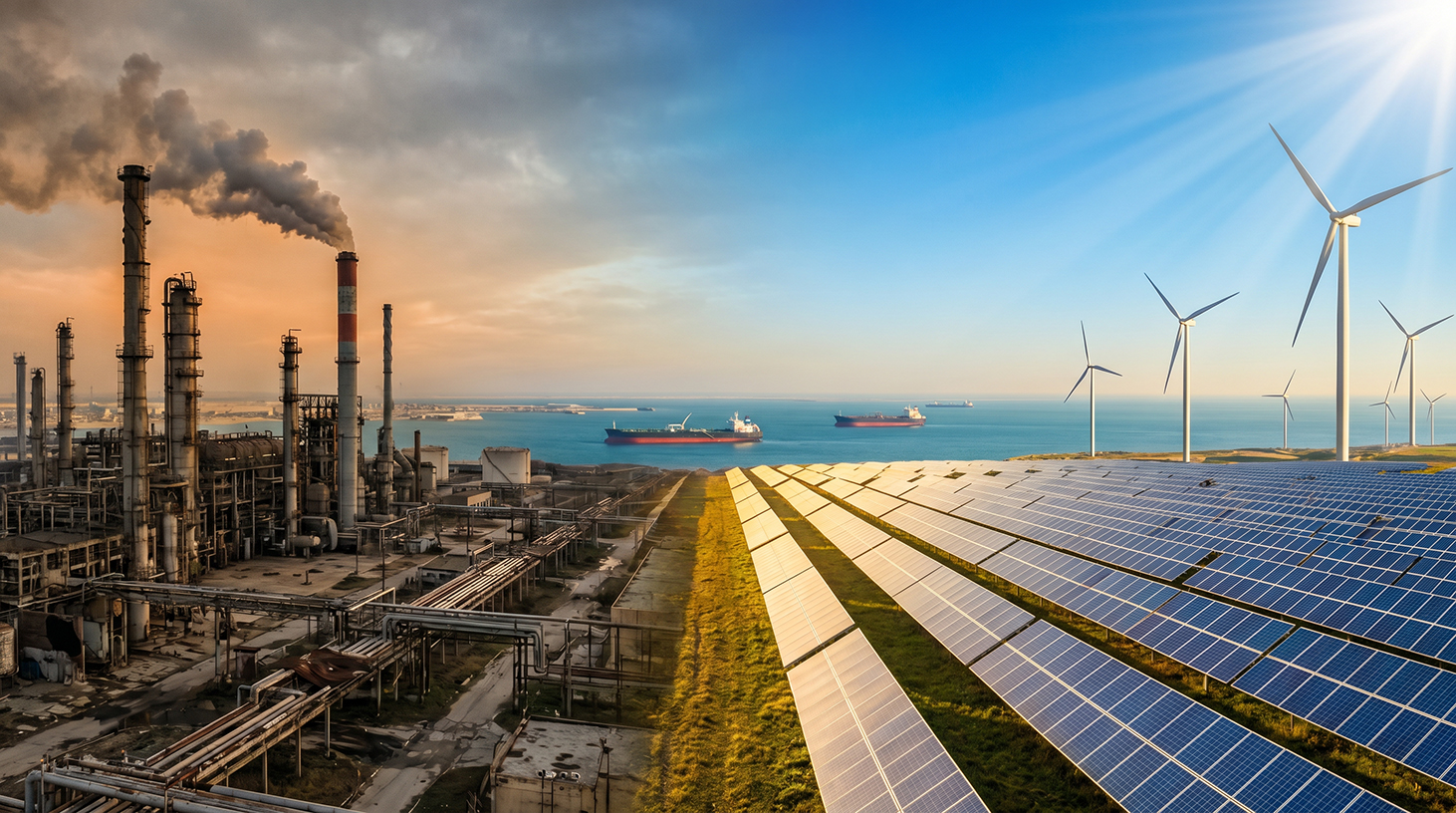
Oil crisis & solar boom: How the war in the Persian Gulf is fueling the global energy transition – Image: Xpert.Digital
The $120 Oil Shock: How the Gulf Conflict Will Trigger the Biggest Energy Transition of All Time in 2026
Historic turning point: Why solar energy will finally displace coal after the oil crash
Unprecedented crisis in the Persian Gulf: The day the age of electricity began
The year is 2026: An unprecedented military conflict in the Persian Gulf and the blockade of the Strait of Hormuz plunge global energy markets into a tectonic upheaval. Within days, the price of oil explodes, while millions of barrels are missing from the world market. It is a supply shock that exposes the dramatic vulnerability of an economic system still heavily reliant on fossil fuels. But this historic crash comes at a world that has already passed the crucial turning point. As "black gold" becomes a geopolitical bargaining chip, another force is inexorably taking the lead: solar energy. Driven by a radical price collapse, technological breakthroughs in battery storage, and the rapid electrification of our daily lives, renewable energies displace coal from the top of the global electricity mix for the first time in history. Accompanied by a quiet renaissance of nuclear power, an unprecedented transformation is underway. The geopolitical crisis in the Gulf isn't causing this shift – but it's acting as a brutal catalyst, ruthlessly exposing the economic superiority of renewables. A detailed analysis of the biggest energy transition of all time.
The shock in the Persian Gulf: A break-in without historical precedent
On February 28, 2026, the US and Israel launched their attack on Iran – a military event that, within a few days, sent global energy markets into a tectonic upheaval. What followed was unprecedented in the history of oil markets: Daily production plummeted by 10.1 million barrels per day. To understand this scale: One barrel is equivalent to 159 liters, meaning the decline amounted to roughly 1.6 billion liters less crude oil on the world markets every day. Cumulatively, production losses in March 2026 alone exceeded 360 million barrels – and a further increase to at least 440 million barrels was projected for April.
The International Energy Agency's (IEA) monthly oil market report, which documents these developments for March 2026, states unequivocally: No previous energy crisis – neither the 1973 Arab oil embargo, nor the 1991 Iraq War, nor the 2022 supply shock – has seen a greater decline in production. This makes the conflict the most severe supply shock in the history of the global oil market.
The near-complete blockade of the Strait of Hormuz had particularly devastating consequences. This narrow strait in the Persian Gulf connects the oil-producing regions of Saudi Arabia, Iraq, Kuwait, the United Arab Emirates, and Iran to the open ocean. Before the war, more than 20 million barrels of oil, liquefied natural gas, and refined products passed through this narrow passage, only 39 kilometers wide, every day. After the blockade, flow rates plummeted to 3.8 million barrels per day—a decline of more than 80 percent compared to pre-war levels. While countries like Saudi Arabia, the United Arab Emirates, and Iraq attempted to reroute some of their exports via pipelines and alternative shipping routes, these capacities covered only a fraction of the lost volume. Total export losses exceeded 13 million barrels per day.
The price shock: An explosion in slow motion, then a sudden fall
The immediate market reaction was dramatic. Within a single trading night, the price of Brent crude oil from the North Sea surged by up to 29 percent to nearly $120 per barrel – an intraday increase of a magnitude not seen since the pandemic-induced price collapse in April 2020. The American benchmark, West Texas Intermediate (WTI), even rose by up to 31 percent. Compared to the starting level of around $70 per barrel before the war, the price had thus almost doubled in less than two weeks. Experts spoke of a possible rise to $150 per barrel if all oil-producing countries in the Persian Gulf were forced to halt production. The Handelsblatt newspaper described this development as the highest energy price increase since the 1970s.
The opposing forces possessed a similar brutality. When Iran announced in mid-April 2026 that it would temporarily open the Strait of Hormuz to merchant ships, Brent crude oil fell by more than twelve percent in a single day to $87.20. WTI even lost over 13 percent. Before this opening could take effect—Iran reversed its announcement a few days later after the US Navy seized an Iranian freighter—it became clear how nervous and price-sensitive the global oil market had become. By April 20, 2026, Brent crude was already trading at nearly $96.
These price fluctuations illustrate a structural vulnerability that energy economists have been describing for decades, but which is only now becoming fully apparent: The extreme geographical concentration of global oil production around the Persian Gulf makes the global supply system susceptible to military conflicts and the political decisions of a handful of actors. Around 20 percent of global oil transport flows through the Strait of Hormuz – a single bottleneck that can hold the global economy hostage.
Demand slump: From price shock to consumer crisis
Such a supply shortfall naturally impacts demand. The IEA significantly revised its demand forecasts for 2026 downwards, now expecting an average annual demand of 104.259 million barrels per day – a decrease of 730,000 barrels per day compared to its March forecast. Overall, global demand fell by around 10 percent due to the price increase. Between the second and fourth quarters of 2026, the IEA anticipates the sharpest decline in demand since the outbreak of the COVID-19 pandemic in 2020.
Air traffic and industry are particularly affected. The suspension of flight operations at many airports in the Gulf region and the resulting disruption of flight connections worldwide have measurably reduced kerosene demand. Diesel and kerosene are considered especially vulnerable to a prolonged disruption of Middle Eastern production, as there are hardly any short-term capacities elsewhere to replace these fuels. At the same time, on March 11, 2026, IEA member countries unanimously drew on their emergency reserves and made 400 million barrels available to the market – a coordinated response reminiscent of the measures taken after the Iraqi invasion of Kuwait in 1990.
The shock makes it clear that economies still heavily reliant on imported oil are in a strategically precarious position. Countries like the US and Brazil, which have significantly expanded their domestic production in recent years, benefited in the short term from the high prices and were able to increase their market share. For the European Union, however, which remains highly dependent on oil imports, the crisis intensified the already existing debate about security of supply and import dependency.
Structural break before the conflict: The solar signs had already been set
But the Iran war merely catalyzed and dramatically accelerated a development that was already well underway. The IEA's Global Energy Review 2026, published alongside the oil market report, paints a picture of the global energy system undergoing a fundamental transformation. For the first time in history, solar energy has become the largest single contributor to global energy demand growth – a turning point that experts have been predicting for years, but which is now statistically proven for the first time.
In 2025, photovoltaics added an additional 600 terawatt-hours of electricity generation capacity worldwide. To put this figure into perspective, its magnitude is crucial: 600 terawatt-hours is roughly equivalent to Germany's entire annual electricity demand. This represents the largest single year's increase ever recorded for any single electricity technology – not the largest for solar, not the largest for renewable energies alone, but the largest the IEA has ever recorded for any energy source. This single year's increase alone accounted for approximately 70 percent of total global electricity demand growth.
Expressed in power units, this increase corresponds to a newly installed total capacity of approximately 500 gigawatts of photovoltaic systems. The land area required for this is nearly 2,400 square kilometers – roughly the size of the Saarland region in Germany. For the first time, the cumulative global solar capacity exceeded 2,800 terawatts, making solar the technology with the largest installed generation capacity worldwide. This has structurally shifted the global electricity generation portfolio.
Solar beats all others: The new hierarchy in the energy system
Solar energy accounted for more than 27 percent of the global increase in energy demand in 2025, more than any other energy source. By comparison, natural gas came in second with a 17 percent contribution to demand growth, oil contributed 15 percent, and coal only 9 percent. Low-emission sources combined—solar, wind, nuclear, and hydropower—covered nearly 60 percent of the total global energy increase. IEA Executive Director Fatih Birol emphasized the significance of these figures, stating that solar energy would, for the first time, cover more than a quarter of global energy demand growth—more than any other source, and for the first time ever.
Global renewable energy capacity expansion reached a new record high of around 800 gigawatts in 2025, with solar power alone accounting for 75 percent of this addition. This marked the 23rd consecutive record year for renewable energy expansion. At the same time, battery storage systems surpassed the highest annual expansion of gas-fired power plants ever recorded – a technological milestone of central importance for the system integration of intermittent renewable energies. This increasingly undermines one of the most traditional arguments against solar and wind power – the perceived lack of storage capacity.
The geographical pattern of solar expansion is by no means limited to China, even though the People's Republic remains the driving force. In 2025, China accounted for 55 percent of global solar growth, followed by the USA with 14 percent, the European Union with 12 percent, India with just under 6 percent, and Brazil with over 3 percent. The United States, India, and the Middle East all reported growth rates in solar power production of at least 20 percent per year. The energy transition is therefore no longer a Western phenomenon, but has taken on a truly global character.
The real driver behind the cost revolution is
Behind this growth lies, above all, a radical reduction in costs, the speed of which hardly any economist dared to predict. The International Renewable Energy Agency (IRENA) documented that the cost of generating electricity from photovoltaics has decreased by 87 percent between 2010 and the present. For onshore wind power, the cost reduction amounts to around 55 percent, and for battery storage, over 90 percent. In 2023, the global weighted average cost of solar power from large-scale plants was around four US cents per kilowatt-hour – 56 percent cheaper than the average price of fossil fuel alternatives. At that time, onshore wind power was even, on average, 67 percent cheaper than electricity from fossil fuels. The Fraunhofer Institute for Solar Energy Systems (ISE) confirms for Germany that, with costs of 4.1 to 9.2 cents per kilowatt-hour, ground-mounted photovoltaic systems and onshore wind energy are not only economically leading among renewable technologies, but also compared to conventional power plants.
This cost revolution is the result of a self-reinforcing dynamic of economies of scale, technological improvements, and targeted industrial policy—primarily in China, but increasingly also in the USA and the European Union. Economies of scale arise when larger production volumes reduce unit costs, which in turn generates more demand, further amplifying the economies of scale. In photovoltaics, this cycle unfolded with such reliability over two decades that it serves as a classic textbook example of Wright's learning curve. The same applies to batteries: The combination of electric vehicle production and the growing market for stationary storage has driven costs down to below €100 per kilowatt-hour—a reduction of more than 90 percent in ten years.
The economic consequence of this cost dynamic is clear: New power plant capacities based on fossil fuels are simply becoming unprofitable in more and more regions of the world. According to IRENA, 81 percent of the renewable energy power plants commissioned worldwide in 2023 were cheaper than their fossil fuel alternatives – even at the then-reduced commodity prices. The Iran-Iraq War, with its renewed price shock for oil and gas, has once again made this economic superiority of renewable energies strikingly clear to everyone.
New: Patent from the USA – install solar parks up to 30% cheaper and 40% faster and easier – with explanatory videos!

New: Patent from the USA – Install solar parks up to 30% cheaper and 40% faster and easier – with explanatory videos! - Image: Xpert.Digital
The core of this technological advancement is the deliberate departure from conventional clamp mounting, which has been the standard for decades. The new, more time- and cost-effective mounting system addresses this with a fundamentally different, more intelligent concept. Instead of clamping the modules at specific points, they are inserted into a continuous, specially shaped support rail and held securely in place. This design ensures that all forces – whether static loads from snow or dynamic loads from wind – are distributed evenly across the entire length of the module frame.
More information here:
Oil crisis as an accelerator: Why geopolitical shocks strengthen the energy transition
Coal replaced: A historic turning point in the electricity mix
What the monthly IEA oil market report and the Global Energy Review 2026 reveal for the supply side, the simultaneously published Global Electricity Review 2026 by the British think tank Ember documents for the electricity generation side. The result is historic: For the first time in roughly 100 years, renewable energies have overtaken coal in the global electricity mix. The share of renewable energies in global electricity generation reached exactly 33.8 percent in 2025, while coal fell back to 33.0 percent. This marks the end of a century of coal dominance.
Ember analyzes data from 215 countries and bases its 2025 forecast on actual figures from 91 countries, covering 93 percent of global electricity demand – providing a solid data foundation for this historic finding. Global coal-fired power generation fell by 63 terawatt-hours, or 0.6 percent – the first decline since the COVID-19 pandemic in 2020. Within renewable energy sources, solar surpassed wind for the first time in 2025 and is approaching nuclear power. Ember predicts that both solar and wind will overtake nuclear power generation as early as 2026. Ember CEO Aditya Lolla commented on the development, saying: "The world has finally entered the era of clean growth.".
The decline of coal is not a new phenomenon, but rather the endpoint of a long development. While coal consumption initially grew from 1950 to around 2015, stagnated in the later stages, and has been declining since 2015, the growth of renewable energies has been almost exponential since around 2000. The competitive pressure triggered by solar and wind power has now crossed the threshold at which renewables become structurally dominant. This turning point marks more than a statistical anomaly: it is changing the investment logic, the planning basis for energy suppliers worldwide, and the political economy of energy supply.
Nuclear power on the rise: The silent third player
Amid the solar revolution and the oil crisis, another, less noticed development is taking place: the renaissance of nuclear power. The IEA recorded record production of nuclear electricity worldwide in 2025, rising by 1.2 percent compared to the previous year to approximately 2,900 terawatt-hours. IEA Director Fatih Birol stated that the strong comeback of nuclear energy is well underway. At the time of reporting, over 70 gigawatts of new nuclear power capacity were under construction worldwide, and more than 40 countries were pursuing plans to expand their nuclear power.
In 2025, construction began on nuclear power plants with a total capacity of 12 gigawatts, which are expected to generate around 100 terawatt-hours annually over the next ten to fifteen years, depending on operating times. The driving force behind this development is clearly China: According to IEA forecasts, the People's Republic will account for around 40 percent of the global increase in nuclear power by 2030, with nearly 30 gigawatts of new nuclear power capacity expected to be connected to the grid by that year. Japan is focusing on restarting reactors, France has reported higher production following scheduled maintenance work, and new reactors are coming online in India, South Korea, and parts of Europe.
The return to nuclear power is not a contradiction to the solar revolution, but rather a complement to it. In a world where electricity consumption is growing rapidly and security of supply has regained importance in an age of geopolitical conflicts, many countries are seeking a low-emission baseload capacity that reliably delivers electricity regardless of weather conditions. The IEA forecasts average annual growth in nuclear power generation of 2.8 percent until 2030 – more than double the growth seen between 2021 and 2025.
Electrification as a driver of the energy transition
A key finding of the IEA's Global Energy Review 2026 is that electricity demand has increased more than twice as much as overall energy demand. Global energy demand grew by 1.3 percent in 2025, while electricity demand increased by around 3 percent. This gap is no coincidence, but rather reflects a profound structural shift: economies worldwide are electrifying at a pace long considered unrealistic.
Drivers of this electrification include the rapid spread of electric cars, the increase in electric heating sources such as heat pumps, the growing energy demands of data centers and artificial intelligence, and industrial processes that are increasingly switching to electricity instead of direct combustion of fossil fuels. In China, the world's largest electric car market, electricity consumption rose by seven percent in 2024 and is projected to grow by around six percent annually until 2027. China's share of electricity in its total energy consumption is already at 28 percent, significantly higher than that of the US (22 percent) or the EU (21 percent).
IEA chief Birol described the overarching trend as the dawn of the electric age – a paradigm shift in which electricity is taking over the role of oil in the last century. This electrification is not only changing the energy demand structure but also the economic logic of investments in grids, storage, and generation capacity. Since the new electricity demand will be met predominantly by renewable energies, electrification structurally reinforces the displacement of fossil fuels: Every new electric car, every new heat pump is a step away from oil and toward electricity – and thus, in the medium term, toward solar and wind power.
Emissions: The increase is slowing noticeably
Despite the dramatic impact of the oil crisis and the historic milestones in renewables, global CO₂ emissions remain the true measure of success. Here, an encouraging, albeit still insufficient, trend is emerging. Global greenhouse gas emissions rose by only 0.4 percent in 2025 – a figure almost an order of magnitude below the long-term annual average of 2.4 percent between 1950 and 2025. This slowdown in the growth rate is not a statistical anomaly, but rather reflects the structural shifts in the energy system.
Particularly significant are the developments in China and India, the two largest emitters after the US, which accounted for 93 percent of the global increase in emissions in the decade leading up to 2024. In China, energy sector emissions declined for the first time in 2025 – by around 40 million tonnes of CO₂ equivalent, or 0.7 percent. In India, emissions from power generators fell by 38 million tonnes of CO₂ equivalent in the eleven months to November 2025 – also for the first time. The Centre for Research on Energy and Clean Air (CREA) interpreted this development as a harbinger of future structural emissions declines, as both countries added record amounts of clean power generation capacity in 2025, more than enough to meet rising demand.
The picture would be incomplete without mentioning the outliers. The US saw a 3.3 percent increase in power plant emissions in 2025 – the fastest rise this century – due in part to a 13.1 percent increase in coal-fired power generation. At the same time, the Global Carbon Project, in its November 2025 report, indicated that global CO₂ emissions from fossil fuels likely rose by around 1.1 percent to 38.1 billion tons in 2025 – showing that while the absolute turnaround is still pending, the momentum for change is undeniable. According to the Global Carbon Project, the remaining carbon budget for staying within the 1.5-degree target is around 170 gigatons of CO₂ – a figure that would be exhausted in just a few years if current rates continue.
Geopolitics and the energy transition: Mutual reinforcement
The Iran-Iraq War and the Strait of Hormuz crisis have ambivalent implications for energy policy. In the short term, they cause immense economic damage, increase production, transportation, and consumer prices worldwide, and threaten the energy security of fossil fuel-dependent nations. In the medium term, however, they accelerate the diversification of energy supplies, strengthen the economic rationale for renewable energies, and provide governments worldwide with the political justification for investing in domestic, largely crisis-resistant generation capacities.
In this sense, the oil price at $120 is not merely a geopolitical shock, but also a market-economic signal of historic significance: It makes every investment in photovoltaics, wind power, and storage even more attractive, further increases the economic advantage of renewable energies, and accelerates substitution processes that are already well underway. The Iran war did not create the long-term trend of the energy transition, but it made it suddenly visible.
The strategic pattern is structural: Every time fossil fuel price shocks shake the global economy—in 1973, 1979, 1991, 2008, 2022, and now 2026—the relative economic advantage of non-fossil energy sources increases. And since their costs, unlike those of fossil fuels, follow a steady downward learning curve, the fluctuations in renewable energy become more significant with each shock. What once required government subsidies is now market-driven. What was technologically experimental yesterday is now industrially scaled. The global energy system is in transition, the logic of which stems from economic laws—and which can at best be slowed, but not stopped, by geopolitical conflicts.
Outlook: What remains after the shock
The combined data from the IEA Oil Market Report, the Global Energy Review 2026, and the Ember Global Electricity Review 2026 paints a coherent picture of an energy sector undergoing structural change. Solar power has surpassed all other energy sources in its contribution to growth. Renewable energies have replaced coal as the leading electricity generation sector worldwide. Battery storage is making the expansion of renewables increasingly independent of grid constraints. Electrification is further decoupling economic growth from oil consumption.
At the same time, the current energy mix remains far from what would be necessary for a 1.5-degree-compatible development pathway. Global CO₂ emissions are still rising in absolute terms. Dependence on oil and gas in many sectors—industry, aviation, shipping, petrochemicals—cannot be replaced by electricity for years to come. And the vulnerability of the global market due to geopolitical concentration in the Persian Gulf will remain structurally intact as long as the energy transition has not progressed further.
The IEA predicts that global electricity consumption will increase by 40 percent over the next ten years – driven by artificial intelligence, air conditioning, electric vehicles, and emerging economies. This surge in demand simultaneously presents the largest investment window in energy history: Whoever can provide the new capacity at prices and under conditions that economically outperform fossil fuel-based alternatives will shape the energy supply of the coming decades. That solar power is leading the way in this competition is no longer a prediction – it's a diagnosis of the present.
Your partner for business development in the fields of photovoltaics and construction
From industrial rooftop PV to solar parks and larger solar parking lots
☑️ Our business language is English or German
☑️ NEW: Correspondence in your native language!

Konrad Wolfenstein
I and my team are happy to be available to you as your personal advisor.
You can contact me by filling out the contact form here or simply call me at +49 7348 4088 965. My email address is : [email protected]
I'm looking forward to our joint project.







