
The silent disappearance of an infrastructure: Who really needs the coil warehouse in Hagen – When a logistics warehouse closes
Xpert Pre-Release

Available in 27 languages 📢
Prefer Xpert.Digital on GoogleⓘPublished on: July 3, 2026 / Updated on: July 3, 2026 – Author: Konrad Wolfenstein
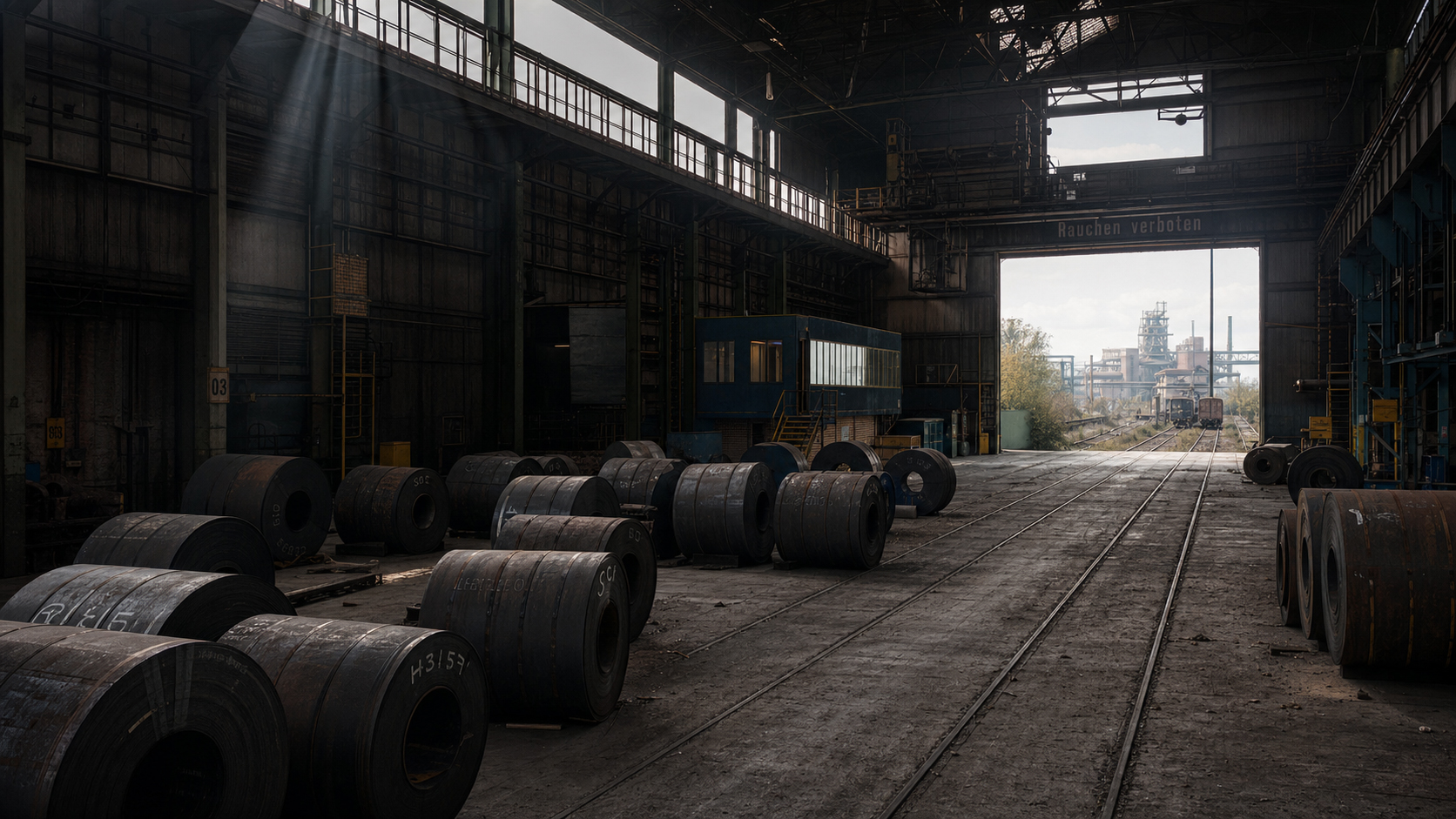
The quiet disappearance of an infrastructure: Who really needs the coil warehouse in Hagen – When a logistics warehouse closes – Creative image: Xpert.Digital
Trucks instead of rail: How the closure of the Hagen coil depot makes a mockery of the transport revolution
Major layoffs at DB Cargo: How the closure of a single warehouse is affecting small and medium-sized enterprises in the Ruhr region
Nobody knows about it, yet an entire industry needs it: The dramatic end of the Hagen steel hub
A network hub is being eliminated. What at first glance appears to be a mere business footnote, on closer inspection reveals itself to be an unprecedented systemic failure. When the Steel Logistics Center (SLC) in Hagen-Boele closes its doors, it's not simply a warehouse that disappears. An indispensable piece of infrastructure is dying, one that for decades formed the backbone of the steel processing industry in the Ruhr region and Sauerland. DB Cargo's state-of-the-art coil warehouse was a prime example of how climate-friendly rail freight and just-in-time last-mile logistics can successfully merge. But instead of expanding this concept, it is now being dismantled – without any equivalent replacement in sight. The consequences of this dismantling affect far more than just the directly employed staff: they threaten the competitiveness of countless medium-sized businesses, jeopardize the resilience of German automotive supply chains, and undermine all political efforts toward a transportation revolution. This in-depth analysis reveals how this silent disappearance could have occurred, who it will affect most severely, and what solutions could still prevent the impending truck chaos.
Related to this:

A network node is lost. What sounds like a minor business detail is in reality a systemic failure with consequences for steel, cars, climate, and small and medium-sized enterprises.
When a logistics warehouse closes, the public usually reports on job losses. This is understandable, but it only tells part of the story. The Steel Logistics Center (SLC) in Hagen-Boele wasn't just any warehouse. It was a key node in a supply chain that forms the backbone of German industry – quieter, more indispensable, and more vulnerable than most people realize. Its closure affects far more than the 20 employees who will lose their jobs. It affects an entire industrial ecosystem that has developed around this hub over decades.
The real problem is not the closure itself. The real problem is that there is no equivalent replacement – and that this is hardly noticed by the public.
The Hagen SLC: A hub, not a warehouse
What the camp actually accomplished
DB Cargo AG's Steel Logistics Center on Niedernhofstraße in Boele, with its 8,500 square meters of hall space, was one of Germany's most efficient coil handling facilities. It offered capacity for 60,000 tons of steel coils, 1,300 variable floor spaces, and 170 meters of track inside the hall – enough for 13 freight cars simultaneously. However, the decisive factor was not just the capacity, but the principle: the SLC combined just-in-time logistics with rail-bound access and flexible truck delivery for the last mile.
Coils – rolled-up steel strips weighing up to 35 tons each – are bulky, heavy, and delicate. They require cranes, specially trained personnel, climate-controlled warehouses with humidity regulation, and an infrastructure that minimizes handling costs. SLC Hagen offered all of this. It wasn't a simple interim storage facility, but an active distribution center: coils arrived by train, were sorted according to customer specifications, picked, checked for dimensions, and delivered by truck just in time to processors in the region.
The share of coils delivered by rail rose from 23 percent in 2012 to over 90 percent by 2018 – an exceptionally high figure for the industry, demonstrating that the concept worked. The SLC was one of the few places in Germany where rail and the steel industry truly came together in an optimal way.
The catchment area: steel in the Sauerland and Ruhr regions
The region served by SLC Hagen is one of the most industrially densely populated areas in Europe. The Märkisches Sauerland region – with towns like Iserlohn, Lüdenscheid, Plettenberg, Hemer, and Arnsberg – is nicknamed "Märkisches Nickel" (the Nickel of Brandenburg) and is home to hundreds of metalworking companies: steel service centers, cold rolling mills, stamping plants, spring manufacturers, pipe producers, and automotive suppliers. In addition, there are the industrial fringes of the Ruhr area with further plants in Dortmund, Schwerte, Hagen, Witten, and Bochum.
The Böcker steel service center in Schwerte-Westhofen, the coil processors at Stahlform Schulte in Arnsberg/Neheim-Hüsten – the SLC Hagen was the regional supply hub for all these companies. Regionalverkehr Ruhr-Lippe (RLG) used the SLC as a network partner, extending its reach deep into the Sauerland region: steel coils were delivered from Hagen via the RLG network to the Arnsberg-Neheim-Hüsten warehouse, which served as a buffer storage facility for nationwide steel traders. This was not a random network, but a well-functioning system that had developed over many years.
Who is affected? The three affected groups
District 1: Steel processing SMEs without their own storage capacity
The first and most affected group are small and medium-sized enterprises (SMEs) in the metalworking industry that do not operate their own coil storage facilities and do not have a rail connection. They obtained coils via the SLC on demand – in quantities that were too small for direct deliveries by block train, but too large and heavy for efficient truck transport from distant warehouses.
For these companies, the SLC (Steel Logistics Center) was the solution for the so-called "last mile": The train brought the coils cheaply and bundled from the large steelworks to Hagen, and the SLC handled the disaggregation and truck distribution to the region. If this hub disappears, the companies will either have to store larger quantities in stock – with corresponding capital commitment and land costs – or switch to more frequent direct truck deliveries, which is more expensive, slower, and more environmentally damaging.
While the region's steel service centers are technically capable of switching over, the increased costs are real. Those who previously benefited from favorable transport conditions through rail pre-carriage will now pay road transport prices – or must process their orders through more distant large warehouses in Mannheim, Cologne, or Nuremberg, which lengthens lead times and reduces flexibility.
District 2: Steel service center with its own rail connection – but without a network
The second group affected comprises larger companies with their own rail sidings, which, however, depend on a functioning shunting and train formation network. A rail siding is worthless if no trains arrive. The SLC Hagen was a hub where train formation, shunting, and distribution traffic were coordinated.
The Robert Schmitz freight forwarding company – now part of the Rhenus Group and equipped with its own rail siding in Hagen, capable of handling more than 250 railcars per week – is an example of this type of company: technically rail-oriented, but operationally dependent on a functioning network. When acquiring Schmitz, Rhenus explicitly emphasized the strength of the Hagen location as a gateway to the Ruhr, Siegerland, and Sauerland regions. If DB Cargo thins out its network and consolidates marshalling yards, such private providers with their own rail sidings will be structurally weakened – not due to their own shortcomings, but because of the shrinking network infrastructure.
District 3: The automotive industry and its suppliers
The third group affected is less obvious at first glance, but strategically important: the automotive industry. Steel coils are the main material for body parts, structural components, and safety components in vehicle construction. Automakers and their suppliers operate with extremely tight just-in-time delivery windows, where delays of even a few hours can trigger production stoppages.
The Hagen Logistics Center (SLC Hagen) acted as a regional buffer, cushioning fluctuations in the supply chain. The "Bavaria Shuttle" model, developed by DB Cargo and voestalpine – which supplies three Bavarian car manufacturers with steel coils daily, with scrap metal from the car plants being transported back to the steelworks in Linz – exemplifies how rail-based steel logistics can function when network hubs are in place. This model saves 8,000 tons of CO₂ per year compared to truck transport. It only works because reliable transshipment points exist. The Hagen Logistics Center was one such hub. Its closure weakens the regional resilience of the automotive supply chain in Westphalia and South Westphalia.
Why there is no equivalent replacement
The infrastructure problem: Once it's demolished, it's demolished
The fundamental reason for the lack of an equivalent replacement is the irreversibility of infrastructure dismantling. A warehouse with rail access, crane system, climate control, and 1,300 floor spaces doesn't build itself in a few months. It requires years of planning, permitting, and investment. Those who close today won't rebuild tomorrow – especially not in an economic environment where rail freight is under structural pressure.
DB Cargo itself has announced plans to relocate its coil logistics to the remaining major single-wagonload hubs in Mannheim, Cologne-Gremberg, Nuremberg, and Seelze. This will significantly lengthen transport routes for customers in the southern Ruhr region and the Sauerland. What was previously organized as a short-distance, same-day delivery from Hagen will now require overnight transport from Cologne or multi-day deliveries from Mannheim. Flexibility will decrease, costs will rise, and delivery reliability will suffer.
The competition problem: Private companies cannot absorb everything
Theoretically, a private operator could fill the gap. In practice, this fails due to the economic viability of single wagonload traffic. The SLC Hagen functioned as a hub in a network operated by DB Cargo, which handled train formation, shunting, and the main run. A private operator wishing to continue operating the SLC would either have to rely on DB Cargo as a network partner – which is becoming more difficult after DB Cargo's withdrawal – or build its own local network.
Regionalverkehr Ruhr-Lippe (RLG) demonstrates that such regional network models exist: RLG has already provided DB Cargo with flexible support in serving the Sauerland region and operated the Arnsberg-Neheim-Hüsten steel depot as a satellite of SLC Hagen. However, RLG is a small regional company that complements DB Cargo, not replaces it. And its own network is limited.
Captrain and Rail Cargo Group (RCG) are the most realistic private alternatives at the network level. RCG moves over 7 million tons annually across Europe in the steel and energy sector. Captrain, together with Salzgitter Flachstahl, has established the "SLoT Ost" network for coil transport in eastern Germany, handling 150,000 to 200,000 tons annually. These models demonstrate that private rail freight can work in steel logistics. However, they are not a direct replacement for the SLC Hagen: they serve different catchment areas, operate with different production volumes, and require lengthy partnership negotiations.
The volume problem: No complete train without mass
The core structural problem of all rail alternatives is the minimum volume requirement. A block train from Linz to Bavaria is profitable because the voestalpine steelworks' output is sufficient for daily round trips. In contrast, the Sauerland region and the southern Ruhr area are characterized by fragmented infrastructure: numerous medium-sized companies with moderate demand, which together are significant, but individually often too small for their own block train services. This very fragmentation was the reason why the SLC (Salzburg Rail Terminal) existed as a central hub – and it is precisely this network hub that is now missing.
Without consolidated infrastructure, rail transport is not economical for these customers. The inevitable result is a shift to trucks – not out of conviction, but due to a lack of alternatives.
LTW Intralogistics Solutions

LTW Intralogistics – Engineers of Flow - Image: LTW Intralogistics GmbH
LTW offers its customers not individual components, but integrated complete solutions. Consulting, planning, mechanical and electrotechnical components, control and automation technology, as well as software and service – everything is networked and precisely coordinated.
In-house production of key components is particularly advantageous. This allows for optimal control of quality, supply chains, and interfaces.
LTW stands for reliability, transparency, and collaborative partnership. Loyalty and honesty are firmly anchored in the company's philosophy – a handshake still means something here.
Related to this:
Steel, rail, strategy: This is how a regional logistics consortium could succeed
What would be possible: Realistic solutions
Solution 1: Privatization of the SLC concept under new ownership
The most obvious solution would be a change of operator: A private logistics provider – such as Rhenus, which is already strongly established in the Hagen steel logistics market through its acquisition of Robert Schmitz Spedition – could take over and continue operating the SLC or a comparable facility. Rhenus already has 200,000 square meters of warehouse space in Hagen, its own rail siding with a capacity for 250 railcars per week, and in-depth industry expertise in coil logistics.
The catch: Such an operator needs assurance regarding train formation and shunting services. If DB Cargo reduces its single wagon traffic and no longer guarantees access to the Hagen region, the private operator also loses its foundation. The privatization of the SLC would therefore have to be accompanied by a binding agreement on network services – between the private operator, DB Cargo or an alternative railway undertaking, and the Federal Railway Authority as the funding body.
Related to this:

Solution 2: Regional consortium including RLG
A second approach would be an industry-backed consortium: The region's steel processing companies – steel service centers, cold rolling mills, automotive suppliers – would form a joint logistics company that would continue the SLC concept and operate as a cooperative or limited liability company. RLG would handle train formation and shunting during the regional pre-carriage, while Captrain or another railway undertaking would handle the main carriage.
This sounds complex, but it's not just a theoretical construct. Such industry-driven rail logistics models are widespread in other European countries. In Austria and Switzerland, shipper-railway partnerships have existed for decades, solving similar structural problems. The incentive for the participating companies is real: lower transport costs, more reliable supply chains, and a transparent CO₂ balance, which is increasingly required in the automotive supply chain.
Solution 3: Use of operating cost subsidies for single-wagon transport
Since June 2024, the federal government has offered a new "Operating Cost Subsidy for Single Wagonload Transport" (BK-EWV), which runs until May 2029. It explicitly subsidizes the first and last mile of rail freight operations, as well as bundled and direct services. The 2026 federal budget allocates €707 million for the entire rail freight sector, of which €300 million is for the BK-EWV and €265 million for track access charge subsidies.
This is political capital that, in practice, is still too rarely directed towards regional rail logistics infrastructure. A private operator who continues the SLC concept in Hagen and utilizes first-mile funding could substantially improve the company's profitability. The Federal Railway Authority, as the granting authority, would generally welcome such applications – the model is designed precisely for such scenarios. The problem is not the lack of the funding instrument, but the lack of a private operator willing to take the plunge.
Solution 4: Consistently implement Master Plan Measure 5.1
The Federal Ministry of Transport's Master Plan for Rail Freight stipulates in measure 5.1 that rail sidings must be taken into account in the approval and construction of high-volume industrial and logistics sites. The corresponding siding funding guidelines are scheduled to come into force in a new version on January 1, 2027.
This is the right approach – but it doesn't help Hagen today. It prevents future losses of rail connections, but it doesn't protect the existing infrastructure that is currently being dismantled. What's missing is a supplementary safeguard for existing infrastructure: a mechanism that prevents federally owned or affiliated companies from simply closing existing rail infrastructure with supra-regional supply functions without providing transitional or alternative services.
Solution 5: DAK pioneer trains as leverage for the Sauerland region
The Digital Automatic Coupler (DAK) is not an immediate solution, but a strategic lever. Starting in 2026, the German government will fund so-called "PioDAK trains"—pioneer trains operating commercially with automatic couplers and continuous data connectivity. The budget for 2026 to 2029 is approximately €36 million. Companies that design and register a steel shuttle train between the Sauerland region and a major production site as a DAK pioneer train can combine technology, economic viability, and environmental responsibility. The window for such applications is narrow, but open.
The real failure: structural policy through omission
The closure of SLC Hagen is the result of three interacting omissions.
The first is the years-long delay in structural reforms at DB Cargo, which prevented the company from developing business models in time that could sustain the electric vehicle (EV) on a private-sector basis. The second is the insufficient commitment of federal policymakers to protecting network-relevant logistics infrastructure: Funding programs exist, but no protective mechanisms for existing network nodes. The third is the silence of the affected industry: The steel processing companies of the Sauerland and Ruhr regions have used the SLC for decades without jointly advocating for its preservation or preparing a viable alternative structure.
The result is a vacuum that trucks will fill – not because trucks are the better solution, but because they are the only available one. Every coil transported by road instead of rail in the future is another small step in the wrong direction: more expensive for the customer, more harmful to the climate, worse for road infrastructure, and completely nonsensical given a political commitment to shifting traffic to rail.
The costs of non-replacement
The SLC Hagen had an inconspicuous but systemic function. It made rail transport accessible to customers who do not have their own rail siding, cannot consolidate block train volumes, and yet depend on a reliable, cost-effective, and climate-friendly coil supply. Its closure does not affect a single corporation, but rather an industrial ecosystem comprised of dozens of medium-sized companies whose competitiveness depends significantly on their logistics costs.
A truly equivalent replacement doesn't exist because no one is building it. It isn't being built because its economic viability is uncertain without a government network and funding framework. And this funding framework isn't effective because political attention and industrial self-organization are currently lacking.
This could be changed – if Rhenus, as the strongest regional player with a rail connection in Hagen, RLG as a regional railway company, the steel industry as a shipper, and the Federal Railway Authority as the funding agency could all sit down together. The instruments are available: BK-EWV funding, the PioDAK program, the connection funding guidelines, and Master Plan measure 5.1. What's missing is the will to use them – before the window of opportunity closes for good.
Consulting - Planning - Implementation

Konrad Wolfenstein
I would be happy to serve as your personal advisor.
You can contact me at wolfenstein∂xpert.digital or
Just call me on +49 7348 4088 965 .
Your intralogistics experts

Consulting, planning and implementation of complete solutions for high-bay warehouses and automated storage systems - Image: Xpert.Digital
More information here:










