
Intelligent coil storage – no more space constraints: How automated coil storage triples industrial area productivity
Xpert Pre-Release

Language selection 📢
Published on: February 11, 2026 / Updated on: February 11, 2026 – Author: Konrad Wolfenstein
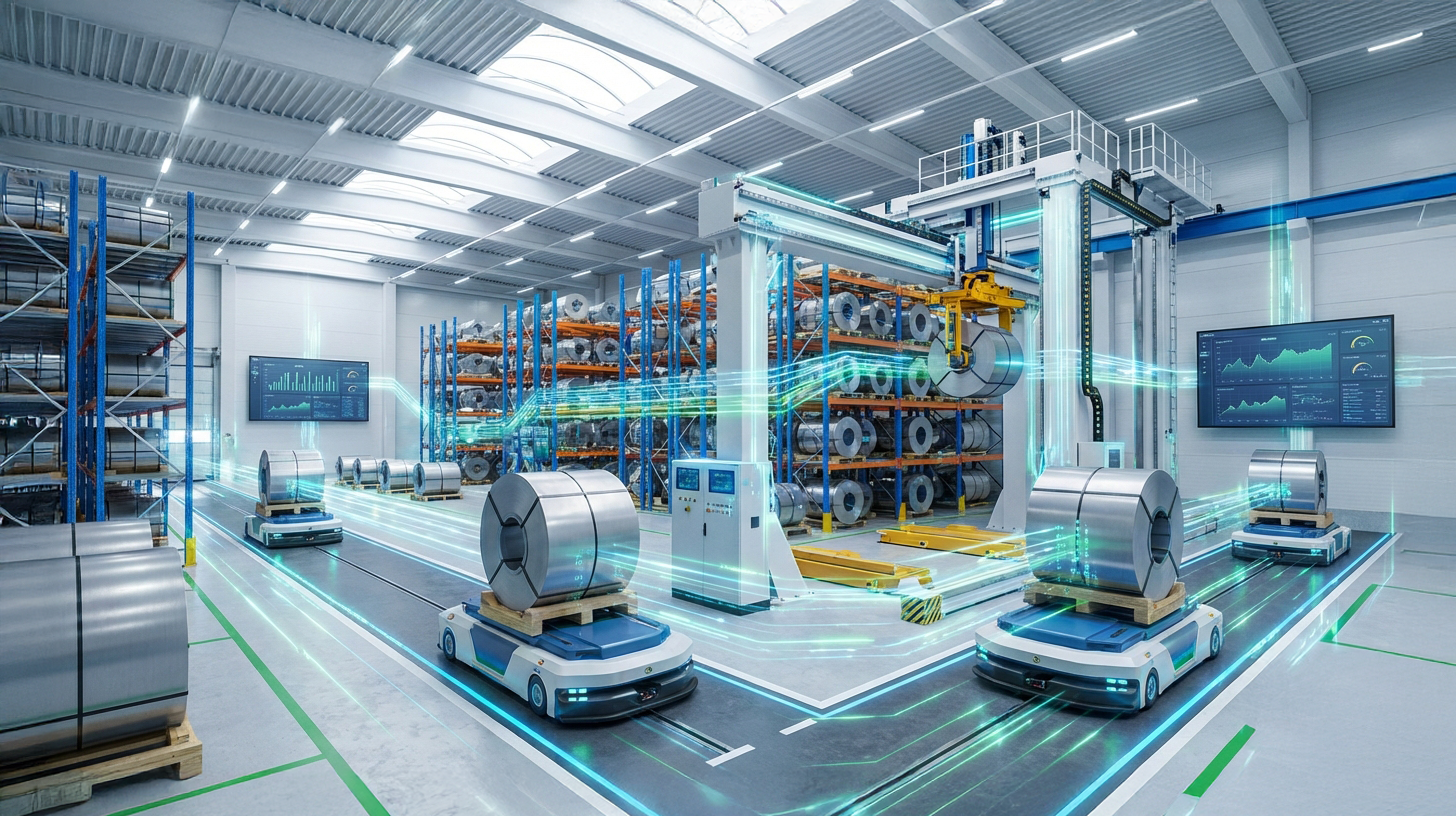
Intelligent coil storage – no more space constraints: How automated coil storage triples area productivity in industry – Creative image: Xpert.Digital
The giant in the high-bay warehouse: How Industry 4.0 is revolutionizing the handling of 30-ton coils
The heart of the value chain beats in the warehouse: Why modernizing coil logistics is indispensable for industry
Steel, aluminum, and copper are far more than simple raw materials; they form the indispensable foundation of our modern economy. Whether in the automotive industry, mechanical engineering, construction, or electrical engineering – without the continuous availability of these metal strips, known as coils, entire production sectors would grind to a halt. Given global supply chain uncertainties, increasing cost pressures, and the need for maximum flexibility, the storage of these often multi-ton goods has evolved from a purely logistical task into a crucial factor for economic success.
While production lines are becoming increasingly digitized and automated, coil storage in many companies still resembles a bottleneck from the past. Manual crane systems, large footprints, and opaque inventory not only hamper productivity but also tie up capital unnecessarily and pose safety risks. In an industry moving towards just-in-time and batch size one, no company can afford to waste time searching for materials or repairing transport damage.
The coil storage of the future is therefore no longer a static storage location, but a dynamic, intelligent buffer warehouse that merges physical logistics with digital data streams. Automated high-bay racking systems and smart material flow computers mark the next logical step towards Industry 4.0. They not only guarantee a drastic increase in efficiency and space savings, but also ensure the quality of the final product through traceability and process stability. Those who invest in the automation of their raw material logistics today will secure the necessary resilience and speed for international competition tomorrow.
What is meant by coil storage and what role does it play in industrial value creation?
Coil storage refers to the process of storing wound metal strips – so-called coils – in the metalworking industry. These coils are typically made of steel, aluminum, copper, or other metals and are the raw material for numerous production processes in the automotive, construction, mechanical engineering, and electrical industries. The handling process includes not only storing and retrieving the coils, but also their identification, transport, intermediate storage, quality control, and preparation for further processing.
Traditionally, coil storage often takes place in manually operated warehouses using cranes or forklifts. However, this method has several disadvantages: limited storage density, safety risks with heavy loads, and restricted control over storage locations and circulation. Especially with increasing material diversity and growing cost pressures, these processes become a bottleneck in production logistics. Automating this area therefore makes a crucial contribution to improving productivity, safety, and transparency.
Coil storage is a key component of the metalworking value chain, as it forms the bridge between raw material production and subsequent processing. It influences not only material availability but also production planning and efficiency. In modern manufacturing environments, the way coils are stored and moved can be a decisive factor in competitiveness.
Why is manual coil storage becoming increasingly inefficient?
Traditional, manual coil storage is reaching its limits in several respects. Firstly, coils are heavy and bulky goods, often weighing several tons. Handling them with conventional cranes or forklifts requires highly skilled personnel and precise organization to prevent damage and accidents. Secondly, manual warehouse management relies on visual inspection and experience – a situation that seems hardly appropriate in times of digital networking and data-driven processes.
Added to this is the fact that production volumes and product variety are increasing. This necessitates smaller batch sizes, more frequent material changes, and precise traceability. A manual system struggles to meet these requirements. There is a lack of transparency regarding the exact position of the coils, their condition, temperature, or dwell time. This often results in longer search times, chaotic processes, and suboptimal space utilization.
Another aspect is space productivity: In conventional coil storage facilities, sufficient space must be left between storage locations to allow cranes and vehicles to maneuver. This significantly limits storage capacity. Given rising real estate costs and limited factory space, space efficiency is becoming a key economic factor. Automated systems can solve these problems through intelligent racking and conveyor systems.
What fundamentally distinguishes automated coil storage systems from conventional storage systems?
Automated coil storage systems utilize mechatronic systems to store and move coils efficiently and safely. Key components of such systems include automated storage and retrieval systems (AS/RS), cranes with precise sensors, conveyor systems, warehouse management systems (WMS), and often ERP interfaces. Every movement is controlled, logged, and analyzed based on digital data, resulting in fully transparent, traceable, and controlled material management.
Unlike manual storage systems, automated coil storage systems are designed to make optimal use of available space. Coils can be stacked in high-bay racking or dedicated storage channels with minimal spacing, as no safety clearance is required for human operators. Movements are automated and collision-free, controlled by algorithms and sensors. This significantly reduces the risk of damage and increases personnel safety.
Furthermore, aspects of integration into higher-level production systems must be considered. An automated coil warehouse acts as a central data hub. It communicates with ERP, MES, and quality systems, allowing each coil to be linked to its relevant process data at any time. This enables end-to-end traceability, precise inventory management, and automated replenishment control.
What technological elements define an automated coil storage system?
A modern automated coil warehouse typically consists of several central technical components that work seamlessly together:
- Storage and retrieval machines or automated cranes handle the storage and retrieval of the coils. They are equipped with sensors, cameras, or RFID readers to precisely record the position and condition of the coils.
- Special storage racks and supports that optimize load distribution and prevent damage.
- Intelligent conveyor systems or rail systems for in-plant coil transport.
- A higher-level control unit (WMS/PLC) that coordinates all movements and processes orders automatically.
- Sensors and IoT devices that collect information about temperature, weight, position, or humidity.
- Digital twins that virtually map the warehouse and enable simulations or optimizations.
All these components are interconnected and form a cyber-physical system – a core idea of Industry 4.0. This allows coil storage to be optimized not only mechanically, but also data-driven.
Why are automated coil storage systems considered part of Industry 4.0?
Industry 4.0 describes the increasing networking and digitalization of industrial processes. Automated coil storage systems fit ideally into this concept because they combine data, sensors, control systems, and human-machine communication. While in older storage systems information about coils was predominantly analog or stored in isolated systems, an Industry 4.0-compatible coil storage system offers a seamless digital infrastructure.
In such a system, each coil is a digital unit – identifiable via RFID, barcode, or sensor and tagged with metadata. This data flows into central IT systems, where it is analyzed for production planning, quality assurance, and logistics. Intelligent algorithms allow storage strategies to be automatically adapted to demand. Simultaneously, a real-time digital representation of the inventory status is created – the so-called digital twin.
Furthermore, the principle of self-optimization plays a role. By analyzing historical data, bottlenecks or inefficiencies can be identified early on. The system can then react by optimizing storage positions, adjusting transport routes, or automatically planning maintenance cycles. This makes automated coil storage systems far more than a mechanical rationalization measure – they are an integral part of a learning, adaptive production environment.
What advantages do automated coil storage systems offer in terms of time savings?
Time is a crucial competitive factor in industry. Automated coil storage systems enable a drastic reduction in material retrieval times. While locating and transporting a specific coil in manual storage can take several minutes or even hours, this is accomplished at the push of a button in an automated system. The coil is automatically identified, located by the system, and transported to the dispensing area – often within minutes.
Another aspect is synchronization with production processes. Because the warehouse communicates with manufacturing in real time, material requirements can be prepared automatically. For example, if a press or coil line requires a specific coil format, the coil warehouse can provide this material just-in-time. This virtually eliminates interruptions due to material shortages.
Automation also reduces maintenance and inventory times. Inventories are conducted digitally, often without interrupting operations. The system always knows which materials are available and in what condition. This saves not only personnel time but also planning effort in production control.
How can automated coil storage systems save space?
Space requirements are a significant cost factor in industrial logistics. Automated coil storage systems are designed to maximize the use of available space. Since no wide aisles or safety zones for operators are required, coils can be stacked more densely and higher. Furthermore, specialized storage systems such as high-bay warehouses or compact cantilever storage systems enable multi-level utilization of storage space.
In many cases, storage capacity can be doubled or even tripled while requiring the same amount of space. Precise control algorithms ensure that every coil remains accessible at all times, despite dense storage. The intelligent layout of an automated warehouse takes into account factors such as access frequency, weight classes, and temperature zones.
Space optimization encompasses not only the horizontal area but also the vertical dimension. Modern storage systems can safely move coils weighing several tons to heights exceeding 20 meters. Integrating conveyor technology into the vertical storage structure creates highly efficient systems that enable high throughput rates with a small footprint.
LTW Solutions

LTW Intralogistics – Engineers of Flow - Image: LTW Intralogistics GmbH
LTW offers its customers not individual components, but integrated complete solutions. Consulting, planning, mechanical and electrotechnical components, control and automation technology, as well as software and service – everything is networked and precisely coordinated.
In-house production of key components is particularly advantageous. This allows for optimal control of quality, supply chains, and interfaces.
LTW stands for reliability, transparency, and collaborative partnership. Loyalty and honesty are firmly anchored in the company's philosophy – a handshake still means something here.
Related to this:
Safely moving 30 tons of steel | The brain of the smart factory: Why there's no way around the coil storage system
What economic advantages arise from automated coil storage?
Even though the initial investment in an automated coil storage system may seem high, it usually results in a very positive overall cost balance. The return on investment (ROI) can be achieved through several factors, including lower personnel costs, reduced storage space, decreased material losses due to damage, and more precise material usage.
Furthermore, plant availability and production reliability are increased. Production downtimes due to material shortages are minimized, and internal logistics become more predictable. Digitizing all material movements also reveals previously unseen optimization potential.
Another important aspect is quality assurance. Because automated systems individually record each coil, potential errors in further processing can be identified early. Damaged or defective materials can be automatically sorted out or treated separately. This reduces scrap and rework.
Last but not least, the scalability of production improves. When the warehouse functions as an integral part of a digitally networked factory, it can react flexibly to fluctuations in demand or product changes – a crucial advantage in increasingly volatile markets.
How does automation affect safety in coil storage?
Safety plays a central role in metal processing. Coils weigh between 5 and 30 tons, and their handling is a potential source of danger. In manual storage facilities, accidents repeatedly occur due to faulty crane controls, unsecured movements, or human error. Automated systems drastically minimize these risks.
Since humans are largely removed from the immediate danger zone, the risk of accidents is significantly reduced. Handling is performed by machines that execute their movements precisely and reproducibly. Sensor-based safety concepts, such as laser scanners or light barriers, prevent collisions or incorrect positioning. Automated systems also play a role in fire protection, as they can be more easily integrated into monitoring and extinguishing systems.
Furthermore, digital process monitoring improves compliance with safety standards. Complete documentation and automatic logging make it easier to meet inspection requirements and conduct risk analyses. This not only creates safety but also legal certainty with regard to authorities and customers.
What role does data management play in an automated coil warehouse?
Data management is the heart of an automated coil warehouse. Every process step generates data – from delivery and intermediate storage to retrieval. This data is collected, stored, and linked. It serves not only for operational control but also for analysis, optimization, and traceability.
A modern WMS (Warehouse Management System) is the central hub. It manages all inventory, order movements, and system status. Production orders are fed directly into the warehouse via interfaces to ERP or MES systems. This enables a seamless process chain without any media breaks.
Integrating sensors generates valuable metadata. This data can document, for example, temperature profiles, weight changes, or stress states. Such data is particularly relevant for high-quality materials whose quality must be monitored throughout their entire storage period.
Furthermore, data management forms the basis for machine learning systems. AI algorithms can be used to analyze movement patterns and derive optimization opportunities. For example, the system can identify which coils are needed most frequently and automatically position them closer to transfer points.
How are different coil types handled in automated coil storage systems?
Coils differ in material, dimensions, weight, and surface finish. An automated coil storage system must therefore offer flexible handling solutions. Special handling techniques, such as adjustable crossbeams or flexible support racks, enable the system to process mixed stocks.
The control software contains parameters such as diameter, weight, and material type. The system takes these attributes into account when assigning storage locations and handling materials. This prevents heavy coils from being stored too high or sensitive materials from being placed too close together.
This flexibility is particularly relevant in production environments with changing product portfolios. A modern coil storage system can dynamically respond to new products without requiring physical retooling – a key requirement for smart manufacturing structures in Industry 4.0.
How can an automated coil storage system be integrated into existing production environments?
Integration requires careful planning and interface management. Modern systems are designed to be introduced gradually or connected to existing infrastructure. IT integration plays a central role in this process.
The warehouse is connected to ERP, MES, or PPS systems via standardized interfaces (e.g., OPC UA, REST API). Production orders, material transactions, and quality data are exchanged automatically. Mechanical integration runs in parallel: conveyor technology, racking systems, and cranes are adapted to the existing material flows.
In many cases, integration takes the form of modular expansions. A company can initially automate individual warehouse areas and add further modules later. This keeps the system adaptable, which is particularly advantageous when modernizing older plants.
What role does sustainability play in the automation of coil storage facilities?
Sustainability is becoming increasingly important in industrial logistics – including coil storage. Automated systems contribute to resource conservation on several levels. Firstly, energy consumption is reduced because modern cranes and storage and retrieval systems operate with energy recovery systems. Secondly, more precise storage and handling reduce damage, which in turn reduces material waste and rework costs.
Another aspect is space efficiency: Less space required means less land sealing and heating needs. Furthermore, data analysis and intelligent control can avoid empty runs, which further reduces electricity consumption.
Sustainability also plays a role in the context of life cycle management. Automated systems are modular in design and can be modernized over decades rather than replaced. In combination with predictive maintenance, their service life is extended, while downtime and spare parts consumption decrease.
What current developments are shaping the market for automated coil storage?
The market for automated coil storage systems is undergoing a period of intensive technological development. Manufacturers are increasingly relying on modular systems that can be flexibly adapted to material flows and plant layouts. Software solutions are also becoming increasingly intelligent – with features such as AI-supported storage space optimization, real-time analysis, and predictive analytics.
A trend is emerging towards the complete networking of industrial value chains. Coil warehouses are no longer viewed in isolation, but as part of a comprehensive smart factory concept. Data from warehouse logistics flows into production planning, quality assurance, and supply chain management.
At the same time, the importance of visualization tools is increasing. Digital dashboards show the warehouse status in real time and enable intuitive interaction with the system. Managers can identify bottlenecks, simulate processes, and perform optimizations via software testing before they are implemented in reality.
What challenges exist when introducing automated coil storage systems?
Despite the advantages, implementing such systems also presents challenges. In addition to the high initial investment, organizational and technical questions arise. Existing processes must be analyzed and, in some cases, fundamentally redesigned. Employees require training and must be integrated into the system's understanding.
IT integration can also be complex, especially when heterogeneous system landscapes or older ERP solutions are involved. Careful interface and security concepts are essential in these cases. Furthermore, data protection and cybersecurity aspects must be considered, as automated systems increasingly operate in a network-based manner.
Another important point is flexibility. Although modern coil storage systems are adaptable, poor planning can lead to the system being too specifically tailored to current needs. Therefore, scalability and modular expansion should always be factored into the planning.
What does the future of coil storage look like in the age of Industry 4.0?
The future of coil storage will be characterized by increasing automation, networking, and data integration. The trend is clearly moving towards fully networked material cycles – from delivery to the final product shipment. Coil storage facilities will become part of a seamless, intelligent process chain in which machines make autonomous decisions and adapt to production requirements.
With advances in AI, machine learning, and edge computing, warehouses will be able to react to changes in real time. Dynamic order prioritization, autonomous transport vehicles, and adaptive warehouse architectures will become standard. Digital twins will enable not only simulation but also predictive control and maintenance.
In the long term, the coil warehouse will be an integral part of the "Industrial Internet of Things"—not an isolated warehouse, but a learning subsystem within a networked production ecosystem. This transformation marks the next evolutionary stage of industrial logistics—from a physical storage location to an intelligent logistical hub of global value creation.
Does automation make human labor obsolete?
Despite increasing automation, humans remain a central player – albeit in a changed role. While physical tasks are increasingly being taken over by machines, human work is shifting towards monitoring, planning, and controlling tasks.
Employees are becoming process coordinators, data analysts, or plant operators. This requires new qualifications, particularly in the use of digital control systems and data analysis. Training and further education are therefore essential to manage the transition from manual warehouse worker to smart operator.
Automation does not replace humans, but strengthens their role in the overall system – by relieving them of dangerous tasks and focusing on value-adding activities.
Why automated coil storage systems are key to Industry 4.0
Automated coil storage systems are far more than a logistics optimization tool. They embody the principles of Industry 4.0 in their purest form: the intelligent integration of mechanics, sensors, data analysis, and autonomous control. Their benefits extend far beyond efficiency gains – they create transparency, security, sustainability, and digital continuity between production and logistics.
Companies that invest in this technology are laying the foundation for future-proof production systems. They gain not only flexibility and efficiency, but also digital sovereignty – an increasingly crucial competitive factor in global markets.
The automation of coil storage thus exemplifies the transition from classic industrial manufacturing to intelligent, data-driven value creation – a step that is not only more efficient, but also more sustainable and safer.
Consulting - Planning - Implementation

Konrad Wolfenstein
I would be happy to serve as your personal advisor.
contact me at wolfenstein ∂ xpert.digital
Just call me on +49 7348 4088 965 (Munich) .
Your intralogistics experts

Consulting, planning and implementation of complete solutions for high-bay warehouses and automated storage systems - Image: Xpert.Digital
More information here:










