
From field to shelf: How automation closes the gap between producers and consumers
Xpert pre-release

Available in 27 languages 📢
Prefer Xpert.Digital on GoogleⓘPublished on: September 1, 2025 / Updated on: September 1, 2025 – Author: Konrad Wolfenstein
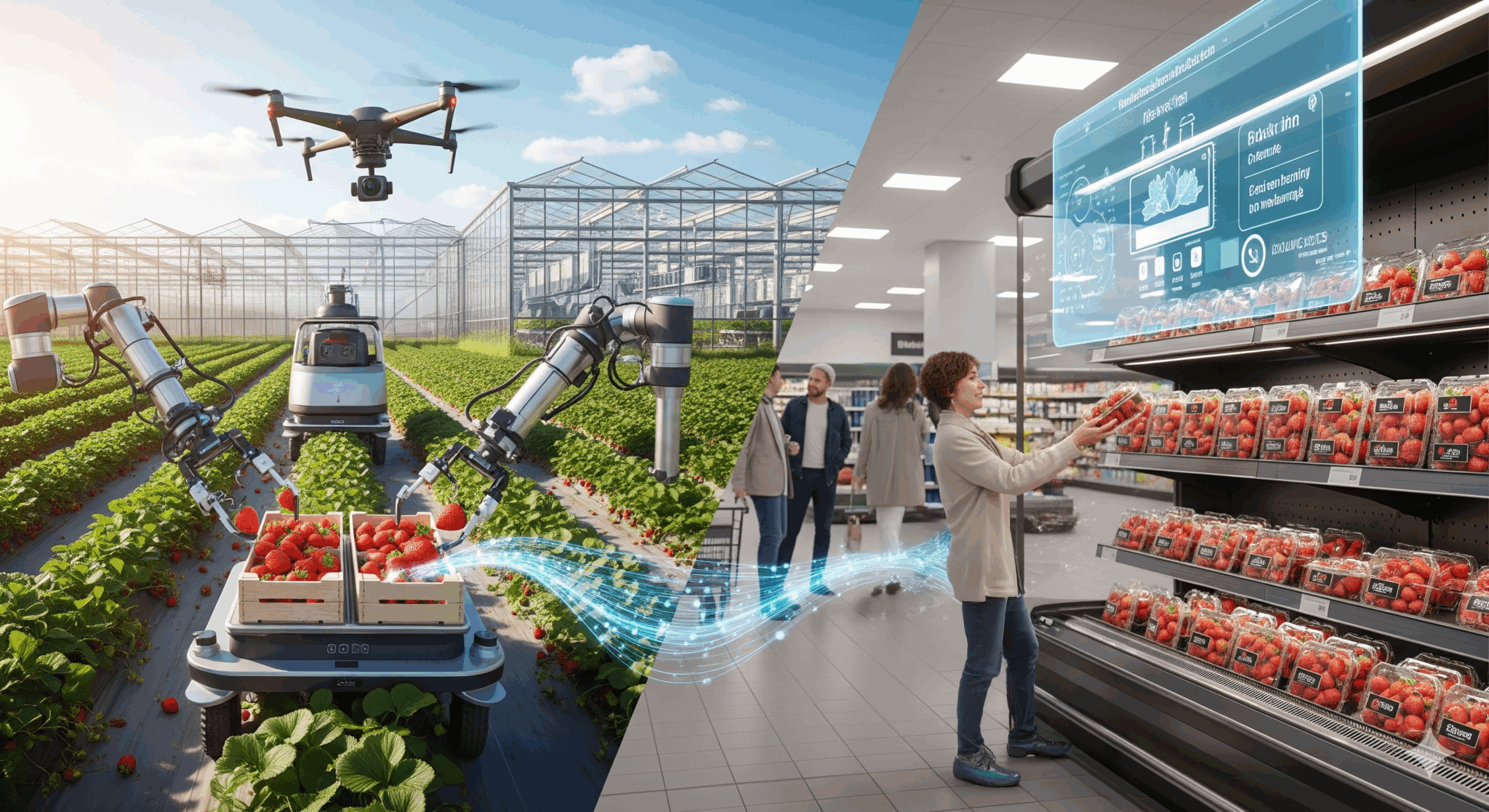
From field to shelf: How automation closes the gap between producers and consumers – Creative image: Xpert.Digital
Fresher, faster, cheaper? What the new robot logistics means for your shopping
The modern supply chain in transition – The invisible revolution in the supermarket: How your food really gets from the field to the shelf
Today's food supply chain faces unprecedented challenges. A growing gap exists between farmers' fields and consumers' supermarket shelves, characterized by complex logistical requirements, rising quality standards, and growing economic pressure. However, automation and digital technologies offer innovative solutions to bridge these gaps and create a seamless supply chain.
The German food industry is undergoing a phase of technological upheaval. While traditional manual processes are reaching their limits, modern automation solutions are opening up new opportunities for efficiency and transparency along the entire value chain. This is particularly evident in the current discussion about sustainable supply chains and the challenges facing farmers and retailers alike.
Breaks in the current supply chain
Protests as a symptom of structural problems
The recent protests by German farmers clearly illustrate the structural weaknesses of the current system. The blockades of distribution centers of major retail chains such as Aldi, Rewe, and Amazon were more than just political demonstrations—they revealed the fragile connections between producers and retailers. These actions led to noticeable supply bottlenecks and empty supermarket shelves, highlighting the vulnerability of the traditional supply chain.
However, the problem lies deeper than the immediate political demands suggest. German farmers receive, on average, only 18 percent of the added value in the food chain, while the European average is 27 percent. This unequal distribution of margins arises from a supply chain dominated by a few large players, in which the original producers often have the weakest bargaining position.
Market power and structural imbalances
Concentration in the German food retail sector further exacerbates this problem. The four largest retailers – Edeka, Rewe, Lidl, and Aldi – control approximately 85 percent of the German food market. This market power allows them to dictate prices and terms, while farmers and smaller suppliers have little room for negotiation.
The effects of these power imbalances extend far beyond individual price negotiations. They lead to the externalization of social and environmental costs, as price pressure in agricultural production leads to compromises on working conditions and environmental protection measures. At the same time, inefficiencies arise in the supply chain because important information is not optimally shared between the various actors.
Challenges for retail
Retail is also facing significant challenges. Rising customer expectations for faster availability, greater product variety, and traceable origins are colliding with the limitations of traditional logistics systems. This is particularly evident in cold chain logistics, where even minor interruptions can lead to significant quality losses and waste.
Cost pressure in retail also leads to constant margin optimization, which negatively impacts the upstream stages of the supply chain. At the same time, retailers must manage increasingly complex product ranges, taking into account different temperature zones, shelf life, and quality standards.
Optimized cold chain logistics as a key element
Technological breakthroughs in temperature control
Cold chain logistics represents the backbone of modern food supply. Automated solutions demonstrate their particular potential here, as they enable seamless temperature control from producer to consumer. Modern systems such as the fully automated system implemented at Ospelt Food demonstrate how intelligent automation can consistently maintain the cold chain.
These systems utilize vertical conveyors across multiple levels in combination with automated guided vehicles to move up to 60 pallets per hour at a constant speed. This ensures seamless temperature control from the production area to the delivery zone. Full integration into existing ERP systems enables continuous monitoring and documentation of the cold chain.
Internet of Things in cold storage logistics
The Internet of Things is fundamentally revolutionizing cold chain monitoring and control. IoT sensors enable real-time monitoring of temperature, humidity, and other critical parameters along the entire transport chain. This technology offers unprecedented transparency and enables proactive measures in the event of impending quality losses.
Implementing IoT solutions in cold chain logistics brings several key benefits. First, all supply chain stakeholders can be informed about the status of goods in real time. Second, intelligent alarm systems enable immediate response to critical situations. Third, the collected data creates the basis for continuous improvements in logistics processes.
Success examples from practice
The Wiesenhof Group's example illustrates how modern cold chain logistics works in practice. Following a major fire, the company seized the opportunity to integrate innovative automation technologies into a new distribution center. The result is a highly automated material flow system with different temperature zones for chilled and frozen food.
Wiesenhof's logistics solution enables automated palletizing, automated goods receipt, and the consolidation of multiple deliveries for efficient shipping. Layer palletizing is particularly innovative, with three gantry robots capable of palletizing up to 16 units in parallel. This automation leads to more flexible and reliable processes and increased efficiency.
The results are similarly impressive at Frisco, where a fully automated solution has quadrupled order capacity. The system operates in four different temperature zones and reduces throughput times, resulting in a reduction in food waste.
Precise inventory management and intelligent systems
Automation of inventory control
Modern inventory management systems form the nerve center of efficient supply chains. They connect all stakeholders from production to retail, creating the transparency needed for optimal decision-making. Automated systems eliminate human errors and ensure that inventory levels are accurately tracked and customer data is processed correctly.
The integration of artificial intelligence into inventory management systems enables a completely new dimension of optimization. AI-powered solutions can accurately predict future demand, minimize storage costs, and avoid bottlenecks. According to a McKinsey study, approximately 75 percent of large industrial companies will be using AI technologies in their demand forecasting by 2025.
Real-time tracking and RFID technology
The implementation of RFID technology and barcode systems lays the foundation for seamless tracking of all goods along the supply chain. These technologies enable product tracking in real time and continuous monitoring of their availability and condition. Modern systems can manage both refrigerated and non-refrigerated products simultaneously and intelligently coordinate different storage zones.
Zebra's retail inventory management solutions demonstrate how hardware, software, and supplies can work seamlessly together. They connect stores, warehouses, and distribution centers and align inventory with demand through real-time tracking. This eliminates manual errors, streamlines operations, and maintains optimal inventory levels.
Integration of merchandise management systems
The seamless integration of various systems along the supply chain is crucial for its efficiency. Modern ERP systems communicate automatically with each other and exchange relevant information in real time. This enables coordinated planning of production, storage, and distribution.
The standardization of interfaces and data formats is particularly important here. Technologies such as QR codes, RFID, and blockchain make it possible to share product information along the value chain and make agricultural products traceable from the plate to the field.
Fast and reliable order processing
Automation of order processes
Order processing automation is a critical success factor for modern supply chains. AI-driven systems can automatically identify incoming orders, extract relevant data, and validate it against master data. This significantly reduces processing times while minimizing error rates.
Modern order processing systems operate across channels and can process various input formats. Whether incoming via email, fax, EDI, or online portal – intelligent systems automatically recognize the format and initiate the appropriate processing. This enables companies to offer their customers various ordering channels without increasing internal complexity.
Elimination of manual processes
Digitizing order processing eliminates time-consuming manual tasks and frees up skilled workers for more value-added activities. Instead of manually recording orders and entering them into systems, employees can focus on customer service, quality control, and strategic tasks.
A key advantage of automated systems is their scalability. While a clerk can traditionally handle around 20 orders per day, AI-based systems enable the processing of hundreds of orders in the same time. This scalability is crucial for sustainable growth and managing peak demand.
Integration into existing system landscapes
Successful automation begins with seamless integration into existing IT infrastructures. Modern solutions can be integrated into any system landscape, regardless of the ERP system used or the document file formats. Special cases such as customer-specific item numbers or configurable services are also taken into account.
Integration takes place via standardized interfaces that enable bidirectional data exchange. Not only are orders automatically imported into the system, but status updates and delivery confirmations are also automatically forwarded to the relevant departments. This creates complete transparency for all parties involved.

Xpert partner in warehouse planning and construction
Automated systems against food waste: Focus on sustainability
Robotics and intelligent automation
Robots in food logistics
Robotics has made significant progress in food logistics in recent years. Modern robotic systems can now perform a wide range of tasks previously performed exclusively by humans. These include palletizing, depalletizing, order picking, and even complex pick-and-place processes for delicate food products.
The challenges in the food industry are particularly diverse. Different product shapes, packaging, and hygiene requirements place high demands on robot technology. Modern systems like the Pick-it-Easy Robot from KNAPP can reliably handle a wide variety of items in the food industry thanks to innovative gripper technology and machine learning.
Mobile autonomous robots in warehousing
Autonomous mobile robots are revolutionizing warehousing with their ability to navigate independently through complex warehouse environments. These systems are equipped with advanced sensors and AI technology to detect obstacles and dynamically adapt to their surroundings.
Exotec's Skypod system impressively demonstrates the capabilities of modern warehouse robotics. These agile robots can navigate in three dimensions between warehouse shelves and picking stations, increasing order processing fivefold compared to manual methods.
Collaboration between humans and machines
The future of warehouse logistics lies not in complete automation, but in intelligent collaboration between humans and machines. Collaborative robots will take over monotonous or physically demanding tasks, while humans make complex decisions and intervene in unforeseen situations.
This distribution of labor creates a win-win situation: Robots work precisely and fatigue-free, while humans can utilize their creativity and problem-solving skills. Studies show that 94 percent of supply chain workers who work with automation technologies experience an increase in productivity and efficiency.
Digital networking and transparency
Blockchain technology for traceability
Blockchain technology offers revolutionary possibilities for traceability in food supply chains. A research project by Molkerei Fuchs AG in collaboration with the University of Zurich demonstrates how processes can be securely and unalteredly mapped onto a blockchain using smart contracts and QR code hierarchies.
This technology enables consumers to trace the entire production history of their food – from raw materials to the finished product. At the same time, transparent supply chains build trust between all parties involved and enable better collaboration along the value chain.
Platforms for real-time data
Modern data platforms enable the exchange of information between all supply chain actors in real time. These platforms can quickly communicate the impact of staff shortages or transport disruptions and help find alternative solutions.
The integration of diverse data sources—from IoT sensors to ERP systems to external weather data—creates a comprehensive picture of supply chain activities. Machine learning algorithms can analyze these data volumes and identify patterns that would otherwise remain hidden to human observers.
Standardization and interoperability
The successful digitalization of supply chains requires uniform standards and protocols for data exchange. Organizations like GS1 Austria are working on developing such standards and supporting companies in implementing transparent supply chains.
Particularly important here is the compatibility of different systems and the ability to exchange data between different platforms. This is the only way to create a truly integrated supply chain that optimally connects all participants.
Sustainability and increased efficiency
Reducing food waste
Automated supply chains contribute significantly to reducing food waste. Accurate demand forecasts, optimized warehousing, and shortened transport times can minimize losses. In the EU, 88 million tons of food are wasted annually, with 40 percent of this never reaching the market.
Real-time transparency in the supply chain enables companies to respond promptly to impending quality losses and find alternative uses for products. IoT sensors, for example, can warn of temperature deviations before they lead to irreversible damage.
Resource optimization through intelligent systems
Digitalized supply chains enable optimal utilization of all available resources. AI-supported route planning reduces transport distances and fuel consumption, while intelligent inventory management prevents overproduction.
Connecting different actors creates synergies that would not be possible in isolated systems. Farmers can better adapt their production to actual demand, while retailers can optimize their orders and reduce inventory costs.
Energy efficiency in automated systems
Modern automation systems are significantly more energy-efficient than their predecessors. LED lighting, energy-efficient motors, and intelligent control algorithms significantly reduce energy consumption. At the same time, precise temperature control and optimized cooling systems enable further savings.
The integration of renewable energy into automated systems is becoming increasingly standard. Many new distribution centers are being equipped with photovoltaic systems, allowing them to cover part of their own energy needs.
Challenges and solutions
Investment costs and profitability
Implementing automated systems requires significant initial investment, which can be a hurdle, especially for smaller companies. However, studies show that these investments typically pay for themselves within a few years through cost savings, increased efficiency, and improved service quality.
Modern financing models such as leasing or service-based approaches make automation technologies accessible even to smaller companies. Furthermore, falling technology costs are making more and more solutions economically viable for medium-sized businesses.
A shortage of skilled workers as the driver of automation
The shortage of skilled workers in logistics is further increasing the pressure for automation. 89 percent of German executives plan to expand the automation of their supply chains in the next two years. 85 percent believe that investments in automation will significantly reduce employee workloads.
This development is leading to a transformation of jobs: Routine tasks are being automated, while more complex tasks such as programming, maintenance, and strategic planning are gaining importance. Skill requirements are rising, but at the same time, new, often more attractive jobs are emerging.
Cyber security and data protection
The increasing digitalization and interconnectedness of supply chains brings with it new cybersecurity risks. Companies must implement robust security concepts to protect themselves against hacker attacks and data theft.
The protection of production data and supply chain information is particularly critical. Modern security solutions include encryption, access controls, and continuous monitoring of all system components. At the same time, data protection regulations must be adhered to and consumer privacy must be protected.
Modular, flexible, scalable – This is what the future of the supply chain looks like
Artificial intelligence as a gamechanger
Artificial intelligence will significantly shape the development of automated supply chains in the coming years. Machine learning enables increasingly precise predictions, while neural networks can solve complex optimization tasks. These technologies will make supply chains even more agile and efficient.
Particularly exciting are developments in the field of computer vision, which enables robots to recognize and handle a wide variety of products. Combined with advanced AI, systems will be able to reliably grasp and transport even unknown objects in the future.
Integration of sustainability goals
Sustainability is becoming an increasingly important factor in supply chain design. 87 percent of executives worldwide view "green real estate" as essential to their company's long-term profitability.
Automated systems can help achieve sustainability goals by optimizing resource consumption, reducing waste, and shortening transportation routes. At the same time, digital technologies enable precise collection and reporting of environmental data.
Development of modular and scalable systems
The future of automation lies in modular systems that can be flexibly adapted to changing requirements. These systems can be gradually expanded and adapted to growing business volumes without the need for complete new investments.
At the same time, cloud-based solutions are becoming increasingly important, as they enable computing power and storage capacity to be scaled as needed. This reduces investment risks and makes modern technologies accessible even to smaller companies.
The fully integrated supply chain
The vision of a fully integrated and automated supply chain is getting closer and closer. In this vision of the future, all components—from sensors in the field to robots in warehouses to smart shelving systems in retail—communicate seamlessly with each other. Predictive analytics make it possible to anticipate problems before they occur, while adaptive systems respond automatically to changing conditions.
This development will not only increase efficiency but also enable new business models. Farmers could establish more direct connections with consumers, while retailers could offer personalized services based on precise predictions of customer behavior. Automation will thus transform not only technical processes but the entire way food is produced, processed, and distributed.
Ultimately, this transformation leads to a supply chain that is not only more efficient and cost-effective, but also more sustainable and transparent. Consumers receive better products at fairer prices, while all stakeholders in the value chain benefit from improved margins and reduced risks. Automation thus not only closes the technological gap between field and shelf but also creates a fairer distribution of value along the entire supply chain.

Xpert.Plus warehouse optimization - high-bay warehouses such as pallet warehouses consulting and planning
We are there for you - advice - planning - implementation - project management
☑️ SME support in strategy, consulting, planning and implementation
☑️ Creation or realignment of the digital strategy and digitalization
☑️ Expansion and optimization of international sales processes
☑️ Global & Digital B2B trading platforms
☑️ Pioneer Business Development

Konrad Wolfenstein
I would be happy to serve as your personal advisor.
You can contact me by filling out the contact form below or simply call me on +49 7348 4088 965 (Munich) .
I'm looking forward to our joint project.
Write to me

Xpert.Digital - Konrad Wolfenstein
Xpert.Digital is a hub for industry with a focus on digitalization, mechanical engineering, logistics/intralogistics and photovoltaics.
With our 360° business development solution, we support well-known companies from new business to after sales.
Market intelligence, smarketing, marketing automation, content development, PR, mail campaigns, personalized social media and lead nurturing are part of our digital tools.
You can find out more at: www.xpert.digital - www.xpert.solar - www.xpert.plus
Keep in touch









