
Coils in industry: From the steel mill to the stamping machine – The enormous pitfalls of coil storage
Xpert Pre-Release

Available in 27 languages 📢
Prefer Xpert.Digital on GoogleⓘPublished on: April 25, 2026 / Updated on: April 25, 2026 – Author: Konrad Wolfenstein
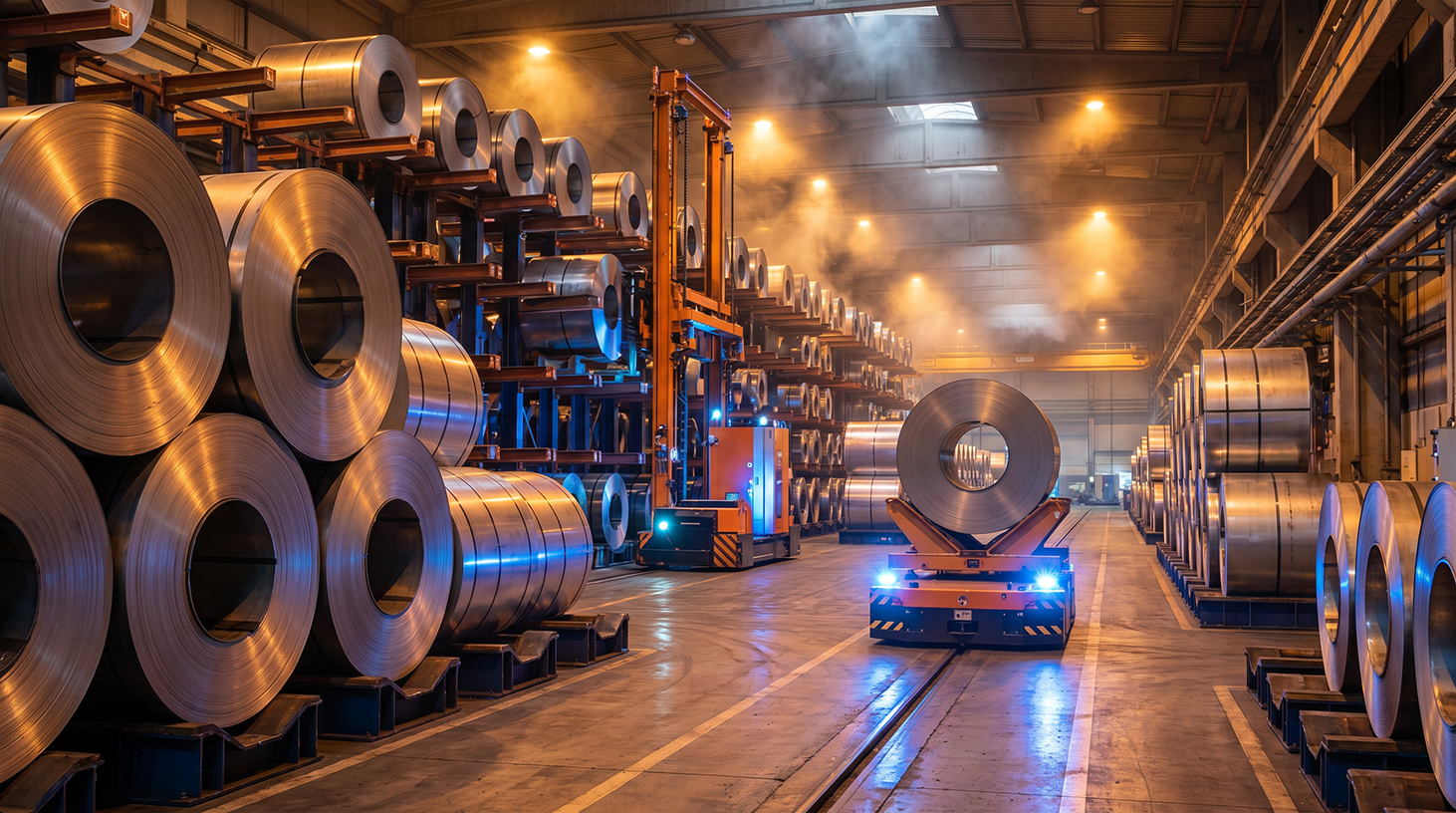
Coils in industry: From the steel mill to the stamping machine – The enormous challenges of coil storage – Image: Xpert.Digital
One mistake and the sheet metal is scrap: Why the invisible logistics behind the steel determine competition and quality
Underestimated risk: Why improperly stored coils cost companies millions
A $500 billion market: Why these unassuming steel rollers are moving the world
Steel coils are the invisible yet indispensable backbone of modern industry – from automotive production to the manufacture of household appliances and transformers. But behind the seemingly simple form of a wound sheet of metal lies a logistical and technical challenge of the highest order. With individual weights of up to 40 tons and highly sensitive surfaces, handling these giants is far more than just a matter of transporting and storing them. Incorrect storage leads to life-threatening accidents and massive material waste, which often only becomes apparent in the stamping press. At the same time, thanks to automation, driverless transport systems, and fully networked Industry 4.0 technology, coil storage is increasingly transforming from a static cost factor into a strategic competitive advantage. This article examines the entire life cycle of a coil – from the glowing steel mill through the treacherous pitfalls of storage to high-precision further processing – and shows why the unassuming sheet metal roll dominates a global multi-billion-dollar market.
What a coil actually is – and why it keeps the world going
A steel coil is essentially a sheet of steel or metal wound into a cylindrical roll. This sheet is hot- or cold-rolled to a defined thickness and then compactly coiled for transport, storage, and further processing. This seemingly simple form has established itself as a key logistical standard in the metal industry because it offers enormous advantages over individual sheets and slabs in terms of handling, storage density, and material efficiency. A single steel coil can weigh between 5 and 40 tons, with outer diameters of up to 2,300 mm and strip widths of over 1,400 mm, making its handling a demanding engineering challenge.
The global market for hot-rolled coils was estimated at approximately US$284.4 billion in 2025 and is projected to grow to over US$516 billion by 2034, representing an average annual growth rate of nearly 7 percent. The Asia-Pacific region already dominates this market with a market share of around 51 percent. Cold-rolled coils will reach a separate market segment with a volume of approximately US$149 billion in 2024, when global steel production volume exceeded 780 million tons and cold-rolled coils accounted for about 28 percent of flat steel production. These figures illustrate that coil logistics and storage are not peripheral issues for the industry, but rather form the core of a global value chain.
From ore to coil: The production chain of the coil
The thermomechanical origin: Hot rolling as the first state of matter
The production of a steel coil begins in the steel mill with the melting and casting of steel into slabs. These slabs are then heated to temperatures of approximately 1,100 degrees Celsius during hot rolling, well above the recrystallization point of steel, and subsequently passed through a series of rolling stands, with each pair of rolls further reducing the cross-section. The result is a so-called hot-rolled strip or hot-rolled strip with thicknesses typically ranging from 1.5 to 3.8 mm, which is immediately coiled at the end of the rolling mill. Hot-rolled coils have a characteristic, rather rough surface with scale flakes and allow for lower dimensional accuracy than cold-rolled material. They are primarily suitable for load-bearing structures, shipbuilding, the construction industry, and pipe manufacturing, where tight tolerances are not essential.
Precision through cold: Cold rolling and surface finishing
Hot-rolled coils often represent only an intermediate stage. For high-quality end products, particularly in the automotive, household appliance, and electrical engineering industries, they undergo a subsequent cold-rolling process. This involves first pickling the coils, which involves removing scale, rust, and surface contaminants in hydrochloric or sulfuric acid baths to create a clean starting surface for cold rolling. Pickling plants are therefore an essential intermediate step that significantly influences the quality of the final products.
In cold rolling, the material is passed through rolling stands at room temperature, resulting in significantly higher strength, improved dimensional accuracy, and a smoother, more visually appealing surface. Achievable material thicknesses in cold rolling range from 3 mm down to 0.1 mm, as is the case in the production of tinplate or electrical steel. Cold rolling is typically followed by an annealing process, which relieves the residual stresses in the material caused by the cold forming and precisely adjusts the mechanical properties. Continuous annealing furnaces at thyssenkrupp Steel, for example, process coils weighing up to 35 tons and with strip thicknesses between 0.15 and 0.55 mm.
Refining and coating: The coil as a functional semi-finished product
For many coils, the production process doesn't end after rolling and annealing. Coil coating, also known as continuous metal strip coating, is another significant finishing step. In this process, the coiled metal strips are first alkaline cleaned, then chemically passivated, and finally coated with primer and topcoat in a fully automated, uninterrupted system before being dried at approximately 240 degrees Celsius and rewound. This process creates a durable composite material consisting of a metallic substrate and an organic coating, which serves as both corrosion protection and an aesthetic design element. Further finishing stages include hot-dip galvanizing (immersion in molten zinc) and electrolytic zinc plating, both of which are widely used in the automotive and construction industries.
This multi-stage process chain, from hot rolling through pickling and cold rolling to surface finishing, illustrates that the coil must be temporarily stored and repositioned at each transition point between process steps. The requirements for the storage and transport system change considerably with each stage, as thin, high-strength, or coated coils are significantly more sensitive to mechanical stress than robust hot-rolled coils.
Between loss of quality and safety risk: The pitfalls of coil storage
Why a coil lying on the floor is not just a space problem
The physical properties of a coil present specific challenges for warehouse logistics that go beyond ordinary heavy-duty storage. Its own weight of several tons, its cylindrical shape with its limited contact area, and the sensitivity of its surface and edges create a delicate balance between material protection, stability, and accessibility that must be considered in every storage decision. Well-known automotive manufacturers have found that pressure marks can be detected in the storage of sensitive sheet metal coils down to the sixth turn – damage that only becomes apparent at the stamping press or in the press shop, leading to scrap and significant rework costs.
Furthermore, the uncontrolled tipping of coils is one of the most frequent causes of serious workplace accidents in metalworking plants. A coil lying on its side or poorly secured can roll or tip over without warning, and its own weight of several tons can have fatal consequences. Corrosion risks are also a concern: steel coils are sensitive to moisture, and the relative humidity in the coil storage area should ideally be kept below 60 percent, while extreme temperature fluctuations can lead to internal stresses in the material. This combination of economic and safety risks explains why choosing the right storage system is not simply a matter of cost, but a strategic management decision.
The six system worlds of coil storage: technology, economics and suitability
Floor storage: The easiest way, but with the biggest price tag
Floor storage is historically the oldest and still widespread form of coil storage. Decades ago, companies working with steel coils had no other option than to store them on the floor, and even today many companies still store their coils on coil racks or directly on the factory floor. The apparent advantage lies in the minimal investment required: no special racking system is needed, no foundation work is necessary, and storage is possible without complex equipment. However, this advantage proves deceptive upon closer economic analysis. Floor storage ties up a disproportionate amount of floor space, completely eliminates the use of ceiling height, complicates inventory, and significantly increases the risk of damage and accidents. It is suitable at best as a temporary buffer storage or for heavy coils with low surface sensitivity.
Floor storage with coil saddles or support rails already represents an improvement over unsecured floor storage. Coil saddles hold the coil in a V-shaped recess, preventing uncontrolled rolling and reducing the contact points to two lines, thus minimizing pressure points. Additional securing with locking bars or hooks prevents lateral tipping. Nevertheless, space efficiency remains low and systematic automation is hardly feasible.
Cantilever racks: The classic rack for medium-sized businesses
Cantilever racks are the most widely used solution for structured coil storage in the metalworking industry. The principle is simple: uprights with horizontally extending arms hold the coils, which can be stored either horizontally or vertically. The cantilever arms allow direct access to each individual coil without the need for repositioning, making them particularly attractive for companies with frequently changing coil sizes and a high degree of product variety. The load-bearing capacity of modern cantilever racks for coils ranges from a few tons per bay to heavy-duty systems for coils in the double-digit ton range.
In its fully automated form, as implemented by AMOVA for litho-coils, a cantilever rack storage system consists of inspection areas, automatic coil manipulators, and a large number of double cantilever arms. The warehouse management software ensures complete traceability and demand-based feeding to the downstream packaging or processing line. The compact design of such systems allows for significantly improved logistics for packaging materials and space-saving integration into existing production environments. For aluminum foil coils with material thicknesses of only 0.04 mm, where any contact with the strip surface can cause damage, the storage and retrieval machine handles the coils exclusively by the spool, without touching the delicate surface.
High-bay warehouses: When space is more expensive than height
High-bay warehouses represent the pinnacle of logistics in coil storage. By definition, experts consider a warehouse with a rack height of approximately 12 meters or more to be a high-bay warehouse, although modern coil storage systems can extend far beyond this. AMOVA, a leading specialist in heavy industrial logistics, claims to hold the world record for the largest high-bay warehouse for steel coils, with around 4,300 storage locations, and supplies fully automated systems for heavy loads weighing up to 50 tons. For an aluminum coil high-bay warehouse, AMOVA implemented a system measuring 76 x 11.6 x 27.8 meters for 680 coils, which can weigh up to 12.9 tons.
Fully automated high-bay warehouses for coils are operated by stacker cranes that travel on rails between the rack aisles, precisely storing and retrieving the coils. The warehouse management system calculates the optimal storage location for each coil, tracks the material, and can automatically trigger replenishment and request the next coil to be processed. In a real-world example, a coil warehouse covering nearly 3,000 square meters offers space for approximately 1,000 coils of varying dimensions and is operated fully automatically with a 30-ton magnetic crane. The integration of IoT solutions enables not only seamless traceability of each individual coil but also predictive control of production supply without manual intervention.
The economic justification for these investments lies in several factors: optimized space utilization at expensive industrial sites, a drastic reduction in material damage through standardized machine handling, minimized personnel costs in warehouse logistics, and end-to-end digital material tracking that makes quality problems traceable back to their source. A fully automated high-bay warehouse for a transformer core manufacturing plant in China, implemented by Vollert Anlagenbau as general contractor, comprises a 150-meter-long and 11-meter-high system with 7 levels, 1,500 coil storage locations, and 90 production buffer locations, served by two stacker cranes and five upstream transfer platforms.
Hammock principle and special constructions: When standard solutions fail
For particularly sensitive coils or specific requirements, specialized storage systems have been developed that go beyond traditional saddle storage. The patented CoilStore system from storemaster supports each coil on two heavy-duty carrying straps using a hammock-like principle, ensuring exceptionally even load distribution and capable of accommodating coils weighing up to 10 tons. The design prevents pressure points that would occur with point-load storage, thanks to the flat, deformation-free support. Complementary systems also allow for the storage of coils delivered on wooden pallets without the need for reloading.
Coil racks and modular load carrier systems like the CSCH system from Carl Stahl offer another category of solutions, particularly useful in intralogistics between production and processing machines. The CSCH system is based on a modular base frame available in various standard sizes with load capacities from 5 to 8 tons, enabling upright floor storage with guaranteed tipping prevention. This upright positioning not only protects the material but also significantly improves workplace safety by eliminating unnecessary tipping and simplifying handling. Such certified systems offer a crucial advantage over custom-designed, in-house solutions: they comply with all relevant safety regulations – an important factor in a market where many companies still rely on uncertified, proprietary solutions.
Eye to Sky or Eye to Face: The underestimated question of orientation
A frequently underestimated factor in coil storage decisions is the storage orientation. In the "eye-to-sky" orientation, the coil's winding axis points vertically upwards, meaning the coil lies flat on its end. This configuration is particularly suitable for smaller and narrower coils, known as slit coils, which, due to their narrow width, can be delivered stably on pallets and easily moved with forklifts. The "eye-to-face" configuration, also called "eye-to-side," means that the winding axis is horizontal and the coil rests on its rounded circumferential surface. This storage method is more common for larger and heavier coils, as it offers better stability with a smaller contact area and can be handled particularly efficiently with magnetic cranes or C-hooks.
The choice of orientation directly influences the space requirements, the weight distribution profile on the floor, the handling equipment, and the risk of material deformation. Coils made of certain materials or with particularly thin strip thicknesses can deform under their own weight if stored in the wrong position for too long – an aspect that must be taken into account during system planning.
Automatic crane storage systems: When the third dimension becomes a competitive advantage
Large steel companies rely on fully automated crane storage systems that utilize the entire width and height of the hall for coil storage. In a real-world example at a German steel service center, aluminum coils weighing up to 30 tons and steel coils weighing up to 40 tons are handled by two process cranes with a track gauge of approximately 41 meters along a crane runway length of 126 meters. Steel coils are moved using magnetic grippers, while aluminum coils are moved using mechanical grippers. The cranes can switch between the different lifting attachments via a connecting beam. Handling with magnets offers the additional advantage of allowing coils to be stacked with smaller gaps – the required spacing is halved from 800 to 400 mm, significantly increasing the hall's storage capacity.
LTW Intralogistics Solutions

LTW Intralogistics – Engineers of Flow - Image: LTW Intralogistics GmbH
LTW offers its customers not individual components, but integrated complete solutions. Consulting, planning, mechanical and electrotechnical components, control and automation technology, as well as software and service – everything is networked and precisely coordinated.
In-house production of key components is particularly advantageous. This allows for optimal control of quality, supply chains, and interfaces.
LTW stands for reliability, transparency, and collaborative partnership. Loyalty and honesty are firmly anchored in the company's philosophy – a handshake still means something here.
Related to this:
From high-bay racking to the stamping press: This is how automated coil supply secures your machines
From spool to die: The logistical path to the processing machine
Buffer storage, sequencing, and the blind spot of production planning
Between coil storage and actual processing lies a logistical process that is often taken for granted in many companies and therefore systematically underestimated: providing the right coil at the right time to the right processing machine. At stamping presses, roll forming lines, slitting lines, and press shops, the material must be available in the correct sequence, in the correct orientation, and without delay. Every machine downtime due to missing or incorrectly positioned coils is directly linked to production losses and increased unit costs.
Fully automated warehouse management systems solve this problem through predictive sequencing: The software knows the production plan, calculates the sequence of required coils, and triggers the picking orders so that the material arrives at the machine precisely when needed. In modern systems, the warehouse management system can even independently request replenishment from the main warehouse and stabilize production supply without manual intervention. The result is drastically reduced relocation costs and stabilized machine utilization.
Coil transport between warehouse and machine: The underestimated link
The physical bridging of the gap between storage and processing machinery requires specialized transport systems that move the sensitive material safely and without damage. Coil transport trolleys with V-shaped supports or special clamping devices form the mechanical backbone of in-house coil logistics. Modern models achieve load capacities from 5 tons to several hundred tons and are custom-designed for the specific coil sizes and weights of each plant.
The technological vanguard in this field is driverless transport systems like the AMOVA Automatic Coil Transporter ACT, a battery-powered, laser-navigated vehicle that transports coils weighing up to 40 tons completely autonomously along pre-programmed routes. A fleet of multiple ACT vehicles is managed by a central computer that selects the optimal route and assigns the next available vehicle to the current transport order. The certified safety system detects people and obstacles in the path and stops the vehicle automatically. In a specific application for aluminum coils weighing up to 32 tons, two ACT vehicles navigate using laser guidance between the high-bay warehouse and the finishing lines, with the material tracking system monitoring every movement 100%.
In front of the machine: Conversion, alignment and quality check
Immediately before being fed into the processing machine, a coil undergoes further preparatory steps. In roll forming lines, the coils typically arrive at the machine with an eye-to-sky orientation, but must then be moved into the horizontal eye-to-side position by a coil tipper in order to be placed in the line's unwinder. In cold rolling mills, the coils are clamped in unwinding reels, the strip is guided through the rolling stands, and on the other side, it is rewound by winding reels – in many plants, the strip passes through the machine several times in both directions. Inspection units integrated into modern transport systems enable the visual inspection of the strips by unwinding and rewinding them, without the need to cut the strip.
In automatic stamping presses and presses, the coils are clamped into braked reeling systems, from which the strip is continuously unwound and fed to the die. Coil widths of 10 to 1,200 mm and strip thicknesses of 0.5 to 8 mm are typical processing ranges in the automotive supply industry. The decisive economic advantage of coil processing over single-sheet processing lies in the continuity of the material flow: The strip runs through the machine without interruption, die changes are bridged by strip welding, and material waste is reduced to a minimum by fully utilizing the coil. Coil stamping machines can reduce material waste by up to 20 percent compared to sheet metal stamping machines.
The overall economic calculation: Total Cost of Coil Ownership
Direct and hidden costs in a warehouse system comparison
In practice, the decision to implement a coil storage system is too often treated as a purely investment-cost-based decision, even though the total life cycle costs paint a much more nuanced picture. Simple floor storage with coil saddles requires minimal initial investment, but systematically incurs higher ongoing costs due to increased personnel requirements for manual coil handling, production downtime resulting from disorganized inventory, material rejects due to pressure marks and damage, and potential costs associated with workplace accidents.
In contrast, a fully automated high-bay warehouse requires a substantial initial investment in steel construction, stacker cranes, conveyor technology, warehouse management software, and control technology. However, the amortization of this investment is accelerated by a combination of several effects: Warehouse productivity increases dramatically because the third dimension is consistently utilized. Material damage is minimized through standardized machine handling. Personnel requirements in warehouse logistics decrease significantly. And production throughput times are stabilized through reliable, just-in-time coil supply. AMOVA defines this added value as a comprehensive package comprising optimized dwell and throughput times, protection against material damage, reduced administrative and transport costs, and ease of handling and operation.
Space efficiency as a strategic resource
In an industrial environment where commercial real estate prices are continuously rising at most German industrial sites and new warehouse construction is subject to lengthy permitting processes, vertical space utilization is gaining strategic importance. A high-bay warehouse utilizing a 3,000-square-meter hall for 1,000 coils achieves a storage density that is far surpassed by floor storage of the same area. The use of magnetic cranes allows for a reduction in the spacing between coils from 800 to 400 mm, which further increases net storage capacity by a significant margin. These efficiency gains are just as relevant to site planning and capacity expansion needs as the pure operating costs.
Quality assurance as a competitive factor
In value chains where automotive manufacturers can detect and claim for pressure marks down to the sixth layer of a coil, quality assurance along the storage and handling chain is not an optional feature, but a prerequisite for reliable delivery in demanding markets. Fully automated systems with seamless material tracking via IoT-based warehouse management software form the basis for this quality assurance by documenting and tracing every coil movement, every storage location, and every handling event. In the event of damage, this allows for precise determination of where and when a problem occurred – information that is equally valuable for quality improvements, supplier management, and legal compliance.
Digitalization and Industry 4.0: The coil warehouse as a networked hub
The future of coil storage will be characterized by increasing networking, automation, and data integration. The transition from conventional warehouses to intelligent, autonomously controlled material buffers is already underway in the steel industry. Warehouse management systems communicate directly with the company's overarching ERP system, receive production orders, autonomously control storage and retrieval sequences, and report deviations in real time. Driverless transport systems, operated via laser navigation, integrate seamlessly into this control architecture and independently negotiate battery charging schedules and route optimization.
Another development trend is the integration of sensors into the warehouse design itself: Weight sensors, temperature monitoring, and optical surface inspection systems positioned directly in the warehouse flow create a continuous quality overview of the stored coils and enable preventative measures before a processing problem becomes apparent. AMOVA's warehouse management software, designed for coils with material thicknesses as low as 0.04 mm, demonstrates how far the differentiation of handling for different product classes has already progressed. The modular software architecture, which flexibly integrates both warehouse and conveyor system extensions, is the technical expression of a strategic philosophy: The coil warehouse is no longer conceived as a static infrastructure, but as a dynamic, adaptive hub of production logistics.
Storage determines more than just space
The analysis of coil storage and the coil production and processing pathway reveals that this area encompasses far more than a technical infrastructure decision. The choice of storage system—from floor storage to cantilever racking and automated high-bay warehouses to fully integrated automated guided vehicles (AGVs)—directly determines the quality of the processed material, the efficiency of production processes, the safety of the workforce, and the company's competitiveness in demanding supply chains. In a global market for hot-rolled coils projected to exceed US$516 billion by 2034, and in an industry where coil imperfections can be traced all the way to the automotive manufacturer's stamping press, coil logistics is no longer a mere backstage of the production process, but rather a strategic area of differentiation.
Companies that can operate their coil logistics as an integrated, digitally controlled, fully automated cycle—from storage and retrieval to traceability in processing—not only secure lower operating costs but also better quality assurance, shorter delivery times, and greater resilience to production fluctuations. It is not the size of the operation that determines the right system approach, but rather a careful analysis of the specific requirements profile, including coil weight, sensitivity, variety of coil types, throughput, and available space. Ultimately, the economic logic of coil storage is the same as in any other area of industrial logistics: those who shy away from seemingly high investment costs and opt for simple solutions pay the difference in the form of scrap, accidents, wasted space, and lost orders.
Consulting - Planning - Implementation

Konrad Wolfenstein
I would be happy to serve as your personal advisor.
contact me at wolfenstein ∂ xpert.digital
Just call me on +49 7348 4088 965 .
Your intralogistics experts
Consulting, planning and implementation of complete solutions for high-bay warehouses and automated storage systems - Image: Xpert.Digital
More information here:










