
China's invisible debt machine: How large corporations are bleeding their own small and medium-sized businesses dry
Xpert Pre-Release

Available in 27 languages 📢
Prefer Xpert.Digital on GoogleⓘPublished on: September 15, 2026 / Updated on: September 15, 2026 – Author: Konrad Wolfenstein
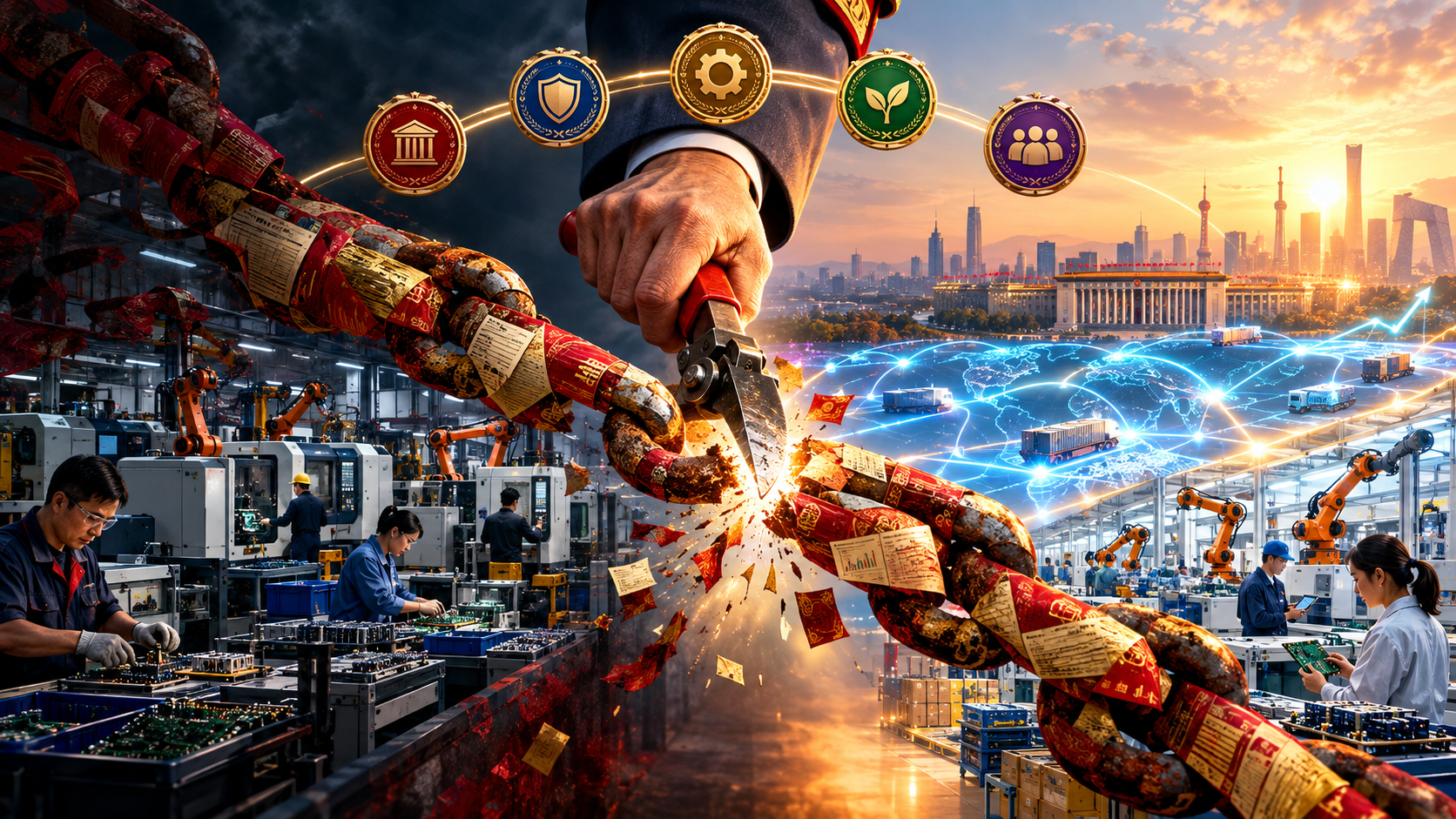
China's invisible debt machine: How large corporations are bleeding their own small and medium-sized businesses dry – Creative image on the topic, with AI: Xpert.Digital
Beijing's 60-day ultimatum: The end of free loans in China's economy?
China's invisible debt machine: How large corporations are bleeding their own small and medium-sized businesses dry
Beijing's 60-day ultimatum: The end of free loans in China's economy?
Those who don't pay on time steal growth: China's radical plan to save its suppliers
A liberating move or an empty promise? How China is reorganizing its economic power structure – Why unpaid bills threaten China's economy
Small and medium-sized enterprises (SMEs) form the undisputed backbone of the Chinese economy. They drive innovation, secure urban employment, and hold regional production networks together. Yet this very productive base is being systematically squeezed: For powerful corporations, tech giants, and state-owned enterprises, late payments are no longer a mere administrative error, but a lucrative business model. By often making their suppliers wait months for payment, they force SMEs into the role of involuntary, free lenders. This invisible debt machine drains the economy of urgently needed liquidity, stifles growth, and exacerbates the crisis in the face of weak domestic demand.
With a new, far-reaching 60-day offensive, Beijing is now declaring war on this practice. The government is targeting the core of the problem: it wants to push shadow financing from supply chains back into the formal banking sector. But the reform is far more than a technical correction in accounting. It is a profound intervention in the power structure of the Chinese economic model. The crucial question for the future is: Will this achieve the urgently needed breakthrough for China's small and medium-sized enterprises (SMEs), or will the initiative degenerate into yet another political campaign riddled with convenient loopholes?
China's invisible debt machine: Those who don't pay their bills steal growth: Beijing's 60-day offensive will decide the future of the middle class
Small and medium-sized enterprises (SMEs) in China are not merely a complement to state-owned enterprises, technology giants, and large export groups. They form the broad productive base of the economy. According to frequently cited official figures, the private sector and its closely related smaller companies account for roughly 60 percent of economic output, about 70 percent of technological innovation, and more than 80 percent of urban employment. Behind these figures are millions of businesses that manufacture components, develop software, maintain machinery, organize logistics, provide services, and maintain regional production networks. Their economic importance is therefore greater than their individual balance sheets would suggest.
These companies fulfill three tasks simultaneously. First, they create employment on a scale that large corporations alone cannot guarantee. Second, they translate new technologies into marketable applications. Innovation arises not only in large research labs but also through smaller improvements to tools, production processes, materials, sensors, software, and business models. Third, SMEs stabilize regional economies because their suppliers, employees, and customers are more strongly tied to the local area. Where a large corporation decides on rationalization measures centrally, smaller companies usually react more flexibly and closer to the market.
China has long since integrated this function into its industrial policy. Special support is given to specialized, technologically advanced, and innovative companies, often referred to as "Little Giants." These companies are intended to occupy critical niches, reduce import dependencies, and close gaps in strategic value chains. Their number is projected to increase significantly by 2030. This includes not only prestigious future fields such as semiconductors, artificial intelligence, and biotechnology, but also specialty alloys, precision bearings, power electronics, industrial chemicals, measurement systems, manufacturing software, and high-quality machine components. Technological sovereignty is built precisely in these less visible intermediate stages.
Yet this very economic backbone often has the smallest financial reserves. Many SMEs operate with tight margins, limited equity, and a high dependence on a few large customers. They have to pay wages, energy, raw materials, rent, and taxes on an ongoing basis, but only receive their money weeks or months later. This creates a fundamental contradiction: The companies that are supposed to drive employment, competition, and innovation are simultaneously, inadvertently, financing the stronger players in their supply chains. Beijing's new offensive against late payments is therefore not a mere technical correction in accounting. It touches upon the distribution of power within the Chinese economic model.
When market power becomes a line of credit
Late payments are economically nothing more than involuntary loans. If a small supplier delivers today and only receives payment after 90 or 120 days, they are essentially providing the customer with capital for that period. The large buyer improves their own liquidity without having to take out a conventional bank loan. However, the financing costs don't disappear. They are passed on to the supplier, who usually receives less favorable credit terms and has less collateral. Thus, what appears to be a harmless payment term becomes a tool for redistribution.
A particularly problematic aspect is that payment terms are not only explicitly extended in the contract. Large clients can delay the start of the payment period, postpone acceptance procedures, demand additional inspections, reject invoices due to minor formal errors, or pressure suppliers into accepting bills of exchange and electronic certificates of receivable. On paper, a claim may then be acknowledged. However, economically, the supplier does not yet possess readily available funds. If they wish to liquidate the claim prematurely, they must sell it at a discount or use it as collateral for financing. The cost of this conversion reduces their profit margin.
The magnitude of the impact can be illustrated by a simplified example. If a company generates annual revenue of 12 million yuan and its average accounts receivable period increases by 30 days, almost one million yuan is tied up in working capital. This money is then unavailable for material purchases, wages, maintenance, research, and market development. With low profit margins, the impact on liquidity can be significantly greater than the reported annual profit. A company can be technically profitable on paper and still become insolvent if receivables are not converted into cash in a timely manner.
The problem worsens when multiple links in a supply chain are affected. An unpaid machine manufacturer pays its component suppliers later. These suppliers, in turn, postpone payments to material traders or subcontractors. This creates a chain of mutual receivables, in which each company is waiting for money that another has not yet received. The seemingly private decision of a large corporation regarding its payment terms thus generates macroeconomic effects. Investments decline, hiring decisions become more cautious, prices come under pressure, and the risk of insolvency increases.
In China, this mechanism is reminiscent of the earlier problem of triangular debt. However, its current form is more complex. It no longer only involves state-owned enterprises, but also a network of government clients, real estate developers, platform companies, industrial conglomerates, banks, factoring providers, and digital receivables platforms. The debt is therefore less visible, but no less real. Supplier credit is becoming a form of shadow financing for the corporate sector.
Lack of liquidity is becoming a brake on growth
The immediate consequence of delayed payments is an increase in working capital requirements. A company must bridge the gap between providing its services and receiving payment. The longer this gap lasts, the more debt financing is needed. Large companies can often refinance themselves through banks or bond markets at relatively favorable rates. Small businesses, on the other hand, have less collateral, shorter credit histories, and often weaker negotiating power. They therefore pay a higher price for the same capital risk, even though the actual cause of the financing gap lies with the large customer.
This mechanism distorts competition. An efficient small supplier can lose out despite having good products because it cannot finance long payment terms. A financially stronger competitor might win the contract not because of better technology or lower production costs, but because it can carry more unpaid receivables. The market then selects not the most productive companies, but the most liquid. This weakens the pressure to innovate and promotes consolidation.
Furthermore, there is a procyclical effect. In economically strong times, companies can more easily absorb longer payment terms. However, during a downturn, order volumes and margins decline, while banks become more cautious. At the same time, large customers try to protect their own liquidity and extend payment terms. Precisely when small businesses need money most urgently, it is withheld from them. This financing crunch thus exacerbates the economic downturn.
This is particularly relevant for China because, following the end of the real estate boom, its economy is grappling with weak domestic demand, high local government obligations, price pressures in numerous industries, and a challenging external economic environment. While real GDP grew by 5 percent in 2025, this rate was masked by significant disparities between export-oriented industries, technology-driven sectors, and parts of the domestically focused economy. Robust production growth alone does not guarantee healthy cash flows at the corporate level.
The effects extend all the way to consumption. When small businesses cut investments, reduce staff, or postpone wage increases, income expectations and job security decline. Households save more cautiously, further weakening demand. The payment chain thus becomes a conduit between corporate financing and private consumption. Those who view late payments merely as a dispute between buyer and supplier underestimate their macroeconomic significance.
Beijing's attack on the 60-day wall
The new political initiative targets several areas simultaneously. At its core is the goal of compelling large companies to make payments within a maximum of 60 days and to establish cash payments or direct bank transfers as the norm. However, the approach is not limited to a single deadline. The government also intends to define when this deadline begins, how acceptance procedures are carried out, which payment methods are permissible, and how long audits may last. It is precisely these details that determine whether a rule is truly effective or merely a formality.
The coordinated involvement of several authorities is significant from an economic policy perspective. The Ministry of Industry can develop sector-specific regulations. The central bank influences banks, refinancing, and payment instruments. State asset supervision can directly control key state-owned enterprises. Market supervision can take action against abusive business practices. Securities supervision can require listed companies to be more transparent. This means the problem is no longer treated solely as a matter for the Ministry of Small and Medium-Sized Enterprises, but rather as an intersection of industrial policy, financial supervision, competition, and corporate governance.
The reform follows a combined approach of pressure and support. Companies that use their market power to deliberately extend payment deadlines will face discussions, public scrutiny, investigations, and sanctions. At the same time, large companies will be given access to credit and bond financing so they can settle their supplier liabilities. The message is clear: suppliers should no longer act as involuntary banks; the formal financial sector should assume this role.
This makes fundamental economic sense. Banks are designed to assess credit risks, transform maturities, and provide financing. Small suppliers are not. Shifting credit from the supply chain back into the banking system makes costs and risks more transparent. However, this also shifts some of the risk onto bank balance sheets or the bond market. The reform doesn't automatically eliminate debt. It restructures it and forces a more transparent disclosure of its price.
The crucial question, therefore, is whether credit checks remain rigorous. If banks were to finance weak large companies solely for political reasons, non-performing trade credit could be replaced by potentially non-performing bank loans. While the reform might offer short-term relief to individual SMEs, it could create new systemic risks. Its long-term success depends on ensuring that viable companies receive liquidity while structurally unprofitable business models are not preserved indefinitely.
Precise rules against convenient loopholes
The definition of four core elements of a payment is one of the strongest parts of the new approach. These elements include the start of the payment period, the payment method and process, the standards and time limits for review or acceptance, and the maximum payment duration. While these elements may seem technical, they address precisely those gray areas where economic power is at play.
A nominal 60-day rule is worthless if the buyer can determine when acceptance is considered complete. It is equally ineffective if timely payment is made via an electronic certificate that cannot be redeemed for months. Effective regulation must therefore be based on the actual availability of funds. Only when the supplier can access the money without any additional deductions is an invoice economically paid.
Industry-specific rules are still necessary. A mass-produced component with standardized quality control can be accepted more quickly than a complex industrial plant or a large construction project. For long-term projects, milestone payments can be more sensible than a rigid deadline after final completion. The challenge lies in allowing objectively justified differences without creating new loopholes. The more complex the exception, the greater the risk that powerful clients will make it the rule.
Standard contracts can improve the position of small businesses because they set minimum standards and simplify negotiations. Nevertheless, a structural problem remains: an SME can possess a right and yet hesitate to enforce it. Those dependent on one or two large customers will rarely aggressively demand default interest or involve a regulatory authority. The economic threat of not receiving future orders can be more effective than formal legal protection.
Therefore, supervisory authorities must do more than simply react to complaints. They need systematic data on average payment terms, the proportion of non-cash settlements, overdue liabilities, and unusual delivery times. Only risk-based monitoring reduces dependence on the courage of individual suppliers. In this context, transparency is not a bureaucratic addition, but rather a substitute for a lack of negotiating power.
State-owned companies between role model and self-interest
Central state-owned enterprises are to play a leading role in the reform. This is logical because they control enormous procurement volumes in energy, infrastructure, telecommunications, transport, mechanical engineering, and other strategic sectors. If these companies pay on time, the liquidity of entire supply networks improves. Conversely, if they adhere to long payment terms, the government loses credibility with large private companies.
The requirement for a dynamic adjustment of overdue payments signals that not only new invoices but also existing balances are to be addressed. Equally important is the demand to generally pay SMEs in cash and to limit long-term bills of exchange or electronic certificates. This would allow the state to directly implement its own industrial policy through procurement practices.
However, state-owned enterprises are not a homogeneous group with unlimited resources. Some have strong cash flows and strategic monopolies, while others operate with low returns, high investment obligations, or considerable debt. If they are forced to settle receivables more quickly, their short-term financing needs increase. The announced support through loans and bonds can ease this transition. However, it should not obscure the fact that some business models only appear stable because suppliers serve as a free source of capital.
The connection to local state-owned enterprises and state-influenced project companies is particularly sensitive. Local authorities are under fiscal pressure in many places. Revenues from land sales have declined following the real estate downturn, while expenditure obligations and debt servicing remain. In such structures, delayed payments can become an informal tool for easing budgetary burdens. A national mandate then meets with local incentives to continue postponing payments.
Enforcement therefore becomes a test of the Chinese state hierarchy. Can the central government compel local authorities and companies to disclose their actual funding gaps? Or will payment deadlines be formally met while acceptances, change orders, and project completions are delayed? Success depends less on the forcefulness of the announcement than on the quality of ongoing monitoring.
Electronic certificates: Innovation or debt hiding place
Electronic certificates of receivable can be useful in a modern supply chain. They document claims, facilitate transfers, and can accelerate financing. Combined with reliable data, receivables can be verified more quickly and pledged at lower costs. The instrument itself is therefore not the problem. The problem arises when a certificate replaces a cash payment, its redemption is far in the future, and the supplier has to bear the financing costs.
In this case, a privately created form of money emerges. The large customer issues a payment promise that circulates within its supplier network. The stronger its market position, the more likely smaller companies are to accept this promise. The corporation's economic power transforms into the ability to create its own short-term credit money. This can be efficient as long as all parties involved have trust. However, if the issuer experiences financial difficulties, the risk can spread abruptly through the supply chain.
The limitation of the validity period of new electronic certificates to six months and the stricter monitoring of the platforms are therefore understandable. It is also important that payment delays become visible and that platforms do not issue new certificates to defaulting companies. This reduces the risk of continuously extending old obligations with new documents.
Six months remains a long time from the perspective of a small supplier. A maximum maturity date is not the same as a desirable payment term. If political communication blurs this distinction, the exception could become the new normal. The crucial metric is not just the formal maturity of an instrument, but the proportion of suppliers who have to liquidate it prematurely at a discount.
In the long run, the cost of such financing should be more readily attributed to the party requesting the payment deferral. If a large company needs 180 days of financing, it should take out the corresponding bank loan itself or at least bear the supplier's financing costs. Only then will procurement decisions be economically sound. Free extensions, on the other hand, encourage overinvestment, aggressive expansion, and ruinous price wars.
Our China expertise in business development, sales and marketing

Our China expertise in business development, sales and marketing - Image: Xpert.Digital
Industry focus areas: B2B, digitalization (from AI to XR), mechanical engineering, logistics, renewable energies and industry
More information here:
A thematic hub offering insights and expertise:
- Knowledge platform covering global and regional economies, innovation and industry-specific trends
- A collection of analyses, insights, and background information from our key areas of focus
- A place for expertise and information on current developments in business and technology
- A hub for companies seeking information on markets, digitalization, and industry innovations
Lending is on the verge of a transformation: How China's banks are set to replace its suppliers
Credit belongs to the bank, not the supplier
Perhaps the most profound idea behind the reform is to replace trade credit with regular financing. Large companies should use bank loans or bonds to settle liabilities to smaller firms more quickly. This will make financing costs transparent and allow for professional assessment of credit risks. This shift can improve capital allocation because banks and investors are better positioned to analyze the solvency of a large company than thousands of dependent suppliers.
Banks face a challenging conflict of objectives. On the one hand, they are expected to improve money flow and inject liquidity into the real economy. On the other hand, they must not underestimate credit risks for political reasons. A company that can only pay its suppliers by taking on new debt is not automatically healthy. The crucial question is whether the financing enables a temporary restructuring of working capital or permanently covers losses.
SMEs require supplementary instruments. Interest-subsidized loans, refinancing programs for technical modernization, factoring, movable collateral, and equity funds can close various financing gaps. A machine manufacturer with stable orders may need short-term working capital. A growing technology company is more likely to need long-term equity because research expenditures do not generate immediate returns. A micro-enterprise without real estate benefits when machinery, inventory, or verified receivables are accepted as collateral.
The planned expansion of the national SME development fund is particularly relevant for specialized growth companies. Patient capital can prevent companies with strategically valuable technology from being prematurely optimized for short-term profits. However, the risk of politically driven misallocation also exists here. If the label "innovative" becomes more important than productivity, customer benefits, and market potential, subsidy cycles will emerge instead of competitive companies.
Sound financing policy must therefore distinguish between liquidity, solvency, and growth capital. Liquidity bridges gaps in time. Solvency requires a viable business model. Growth capital finances uncertainty and expansion. If these categories are conflated, loans can only postpone problems. If they are clearly separated, the reform strengthens both the resilience and the innovative capacity of small and medium-sized enterprises (SMEs).
The demand gap remains open
Punctual payments improve the distribution of existing liquidity, but do not automatically create new demand. This distinction is crucial. A company with empty order books will not invest simply by settling old invoices more quickly. Likewise, overcapacity, price wars, and weak margins will not disappear simply by shortening payment terms.
For years, China has been trying to base its growth more heavily on consumption, services, and high-quality innovation. Nevertheless, investment, industrial production, and exports remain particularly important. In several sectors, rapid capacity building has led to intense price competition. Companies are trying to gain market share through low prices, long warranties, and generous payment terms. Late payments are therefore not only a sign of poor business practices but also part of a business model that prioritizes growth and volume over return on capital.
The campaign against involutionary competition and the offensive against late payments are therefore interconnected. Both target a form of competition in which companies shift costs into the supply chain and squeeze margins to the point of economic exhaustion. When a large company lowers its selling price but simultaneously pays suppliers later, its competitiveness appears better than it actually is. Part of the supposed efficiency gain is financed by smaller partners.
For a sustainable impact, China must improve household income and demand prospects, treat the private sector reliably, and allow unproductive companies to exit the market. Furthermore, public investments should be selected more strongly based on economic benefit and secure financing. New projects whose bills later go unpaid would only exacerbate the problem.
Payment reform is therefore necessary, but not sufficient. It can prevent existing demand from being devalued by poor financing practices. However, it cannot replace what a broader macroeconomic reorientation must achieve. Those who present it as a comprehensive economic stimulus program are overestimating the instrument's potential. Those who dismiss it merely as an administrative regulation are underestimating its structural significance.
Old campaigns and recurring reflexes
China has repeatedly attempted to limit payment arrears and chain debt. As early as the 1990s, mutual receivables between state-owned enterprises burdened production and banks. Administrative adjustments could reduce these balances, but the underlying problem returned when unprofitable companies, lax budget constraints, and unclear lines of accountability persisted.
Even recently, rules to protect small businesses have been tightened. The repeated need for new measures shows that formal regulations alone are insufficient. Large buyers have a strong incentive to optimize their working capital at the expense of weaker suppliers. Local authorities want to proceed with projects even if financing is not fully secured. Banks often favor established large customers. SMEs, in turn, accept unfavorable conditions because they do not want to jeopardize orders and relationships.
The current initiative differs from previous campaigns, however. It combines contract rules, disclosure, competition oversight, public procurement, platform control, and financing. This breadth increases the chances of success because it addresses multiple causes simultaneously. Particularly relevant is the finding that faster payments trigger additional financing needs for large companies. Previous approaches could fail if they ignored this transition.
The weakness remains its campaign-like nature. Companies can adjust their behavior in the short term, reduce backlogs, and wait for waning attention. Sustainability only arises when key performance indicators are published continuously, managers are measured by payment discipline, and violations are automatically sanctioned. The difference between a campaign and an institution lies in the reliability after the political headlines have faded.
The coming years will therefore show whether China establishes a lasting payment standard or merely cleans up an existing backlog. What matters are not spectacular individual cases, but rather decreasing average payment terms, a higher proportion of cash payments, fewer complaints, lower financing costs, and improved investment capacity for small businesses. Without such measurable results, the reform remains just a promise.
What Europe teaches and does not teach
The European Union takes a more legally based approach to late payments. Shorter deadlines generally apply to public authorities, while 60 days is often the standard limit in commercial transactions. Creditors can demand default interest and a lump-sum compensation. The basic idea is similar to the Chinese approach: small businesses should not be forced to finance larger customers free of charge.
However, European experience shows that a legal claim is not automatically enforced. Dependent suppliers often avoid conflicts with key customers. National implementation, court proceedings, and business culture vary. Even clear default interest rates are of little help if a company fears being excluded from the supply chain after making its claim.
China possesses a unique leverage advantage over Europe: The state can directly control key state-owned enterprises and coordinate the mobilization of banks, regulatory authorities, and procurement systems. This enables faster behavioral change. However, there is a drawback: Where political campaigns replace legally sound procedures, their application may be selective or time-limited. Powerful actors could be spared, while less influential companies face strict control.
The best approach therefore combines legal entitlements with automatic transparency and administrative enforceability. Suppliers should not be forced to handle each case individually. Large companies should regularly publish standardized key figures on payment terms and overdue liabilities. Public sector clients should secure budget funds before projects begin. Regulatory authorities should take action themselves when they detect unusual data.
Internationally, it's also important to note that rigid deadlines can trigger undesirable avoidance strategies. Buyers might engage fewer small suppliers, drive down prices, or impose additional requirements before the contract begins. Regulation must therefore consider the overall terms of the business relationship. A timely paid but economically ruinous order is not progress.
Digitization creates evidence, but not trust
China is well-positioned to digitally monitor payment flows. Electronic invoices, platform data, bank transactions, tax information, and digital procurement systems can provide a detailed picture of actual payment discipline. When this data is meaningfully linked, unusually long payment terms, repeated partial payments, or fraudulent certificate chains can be detected early.
Opportunities also arise for lending. An SME with stable, verified cash flows can be creditworthy even without valuable real estate as collateral. Digital transaction data allows for a stronger focus on ongoing business operations rather than traditional collateral. Factoring could become more cost-effective if the authenticity and priority of a receivable are reliably documented.
Blockchain technology is frequently cited as a solution in this context. Its usefulness should be assessed objectively. An immutable chain of data can document when an invoice was issued, verified, or transmitted. However, it cannot determine whether a service was rendered according to the contract or whether a powerful buyer is refusing acceptance for legitimate reasons. Technology can secure evidence, but it cannot create fair incentives.
Artificial intelligence can detect anomalies, assess credit risks, and accelerate review processes. At the same time, new disadvantages threaten if models categorically penalize small businesses based on their industry, region, or short history. Furthermore, widespread data concentration among platforms or large corporations can further increase their power. Fair access rules, data protection, traceability, and opt-out options are therefore essential.
The best digital infrastructure supports clear rights, but it doesn't replace them. An automated payment process is only as fair as the underlying contract. If acceptance criteria are set unilaterally, the platform merely digitizes the power imbalance. Progress lies not in maximum technological advancement, but in an architecture that makes deadlines verifiable, hinders manipulation, and transparently allocates financing costs.
The risks of quick money
Shorter payment terms create winners and losers. SMEs receive liquidity sooner and reduce their financing needs. Large companies, on the other hand, lose a portion of their free or very cheap supplier financing. For sound corporations, this is manageable. However, highly indebted or low-margin companies can come under considerable pressure.
One possible response is vertical integration. Large companies might provide more services themselves if external procurement with shorter payment terms appears more expensive. Another response would be a focus on larger suppliers, who are considered easier to manage. Both could worsen market access for smaller companies. Larger price reductions, quality deductions, or participation fees would also be conceivable alternative strategies.
In government and infrastructure projects, there is a risk that a funding shortfall will be shifted from the client to the general contractor and from there to subcontractors. Therefore, payment discipline must be monitored throughout the entire chain. It is not enough for a government client to pay the main contractor on time if the latter then delays payments to smaller companies.
Another risk concerns banks and capital markets. If large debt levels are rapidly replaced by loans, debt and interest burdens rise noticeably. While this is more economically honest, it can worsen credit ratings. Companies might try to keep risks off their balance sheets or create new financing vehicles. Supervisors must therefore ensure that the reform does not simply produce a new generation of opaque instruments.
Despite these risks, it would be wrong to maintain long payment terms out of consideration for weak large companies. If a business model only works because suppliers are involuntarily providing capital, its profitability is overestimated. The right answer lies in a phased transition, targeted transitional financing, and consistent restructuring of unviable companies, not in permanently burdening the weaker ones.
From creditor protection to industrial policy
The reform has a strategic dimension that extends beyond liquidity. China aims to reduce its technological dependence and expand high-quality production. This requires specialized suppliers who continuously invest in personnel, machinery, software, and research. Uncertain cash flow directly hinders this goal.
Innovation projects are particularly vulnerable to liquidity risks. Research expenditures are incurred early, while returns are uncertain and distant. A company that needs to finance wages and materials in the short term will cut risky development projects first. Therefore, timely payments not only increase financial stability but also extend the planning horizon. Working capital policy becomes innovation policy.
The same applies to the green transformation. Energy-efficient machinery, photovoltaics, storage, process heat, the circular economy, and emissions measurement all require upfront investments. SMEs can implement such investments more easily if their funding requests are predictable. However, the effect is only sustainable if the investments are economically sound and not solely driven by subsidies.
Supply chain resilience is also improving. A network of many healthy specialists can absorb shocks better than a structure dominated by a few large companies and where smaller partners are constantly operating at their liquidity limits. However, resilience comes at a price. Those who expect redundancy, quality reserves, and rapid adaptation from their suppliers must grant them sufficient margins and fair payment terms.
This development is also relevant for foreign companies. International corporations that purchase or manufacture in China benefit from more stable suppliers and more transparent payment practices. At the same time, stricter disclosure and contract rules could affect their own procurement processes. Companies should therefore not only examine statutory minimum deadlines, but also electronic certificates, acceptance procedures, factoring clauses, and the payment discipline of their Chinese partners.
The litmus test is implementation
The quality of the reform can be measured by a few fundamental questions. Does the payment term actually begin with delivery or performance, or can the buyer postpone it through internal processes? Does the supplier receive freely available funds or only a negotiable payment promise? Are existing inventories reduced without creating new ones? Do the rules also apply to powerful state-owned enterprises and local project companies? Can SMEs enforce their rights without fearing economic retaliation?
A publicly transparent system of key performance indicators (KPIs) is needed. This includes average and weighted payment terms, the proportion of overdue liabilities, the use of non-cash instruments, the average duration of acceptance procedures, and complaints and their processing time. A simple average is insufficient because particularly long outliers can be masked. More informative are additional breakdowns by industry, company size, and ownership structure.
Management incentives also need to be adjusted. As long as executives of large companies are primarily measured by revenue, profit, and short-term cash flow, extending supplier credit will remain attractive. Payment discipline should therefore be factored into performance reviews, compensation, and credit ratings. This is especially true for state-owned enterprises.
At the same time, independent and confidential complaint channels are needed. Small businesses must be able to report violations without disclosing their business relationships or risking reprisals. Industry associations could collect aggregated data and identify typical patterns of abuse. Courts and arbitration panels should process undisputed claims quickly so that legal protection itself does not become a liquidity burden.
Finally, the reform must be linked to fiscal discipline. Public projects should only be initiated if financing and payment plans are secured. Otherwise, the state becomes simultaneously the client, regulator, and source of new arrears. Credibility is achieved when the state applies the same standards to itself as it does to private companies.
A liberating move or a postponed bill?
Beijing's initiative is more than symbolic politics because it recognizes the crucial weaknesses of the problem: unclear deadline start dates, delayed acceptance, non-cash payment instruments, lack of transparency, weak enforcement, and a lack of transitional financing. The combination of these elements is significantly more convincing than an isolated 60-day target.
Nevertheless, the reform remains an intervention in a system of deeply entrenched power and financing relationships. Large companies have become accustomed to using suppliers as a flexible source of credit. Local authorities may view payment deferrals as a substitute for missing budget funds. Banks favor established debtors. Small businesses accept unfavorable terms because they need orders. Such incentives do not disappear simply by announcement.
The realistic outlook lies somewhere between euphoria and cynicism. The measures can noticeably improve the liquidity of many SMEs, stabilize investments, and return risks to the formal financial sector. However, they cannot cure weak end-user demand, restructure unprofitable large corporations, or enforce a fair competitive culture if violations go unpunished.
True success would be achieved when the economic norm changes: An invoice is no longer considered a non-binding bargaining chip, but an obligation to be fulfilled promptly. Supplier credit would then be a consciously agreed-upon and appropriately compensated form of financing, not a situation imposed by market power. Large corporations would have to bear the true costs of their growth, while banks would once again assume the role for which they were created.
Much is at stake for China's development model. A country striving for technological self-sufficiency, industrial modernization, and more stable domestic demand cannot afford to financially cripple its most innovative and labor-intensive companies. If the offensive remains consistent, data-driven, and sustained, it could become a crucial building block of a more productive economic order. If it degenerates into a short-term campaign, the debt chains will merely be repainted.
The crucial question, therefore, is not whether 60 days are better than 90 or 120 days. The crucial question is who will bear the cost of capital in China's economy in the future. If the weakest continue to have to finance the strongest, the growth model will remain structurally unbalanced. If financing costs are shifted to where creditworthiness, market power, and control reside, the reform would indeed be a game-changer. Then China would not only pay its bills faster but also reshape a part of its economic power structure.
🎯🎯🎯 Data-driven B2B industry hub as a quasi-in-house solution

The quasi-in-house solution: How Xpert.Digital closes operational gaps in B2B marketing and sales – Smart Content-Driven Business - Image: Xpert.Digital
Xpert.Digital is a data-driven B2B industry hub led by Konrad Wolfenstein . The company acts as an external, quasi-in-house solution for industrial partners, closing operational gaps in marketing, content, and sales – without requiring additional resources on the client side.
More information here:
Your global marketing and business development partner
☑️ Our business language is English or German
☑️ NEW: Correspondence in your native language!

Konrad Wolfenstein
I and my team are happy to be available to you as your personal advisor.
You can contact me by filling out the contact form here [email protected]:or simply call me at +49 7348 4088 965. My email address is
I'm looking forward to our joint project.





