
Why Europe urgently needs a new model of economic division of labor – and why it's already on its own doorstep
Xpert Pre-Release

Available in 27 languages 📢
Prefer Xpert.Digital on GoogleⓘPublished on: June 4, 2026 / Updated on: June 4, 2026 – Author: Konrad Wolfenstein
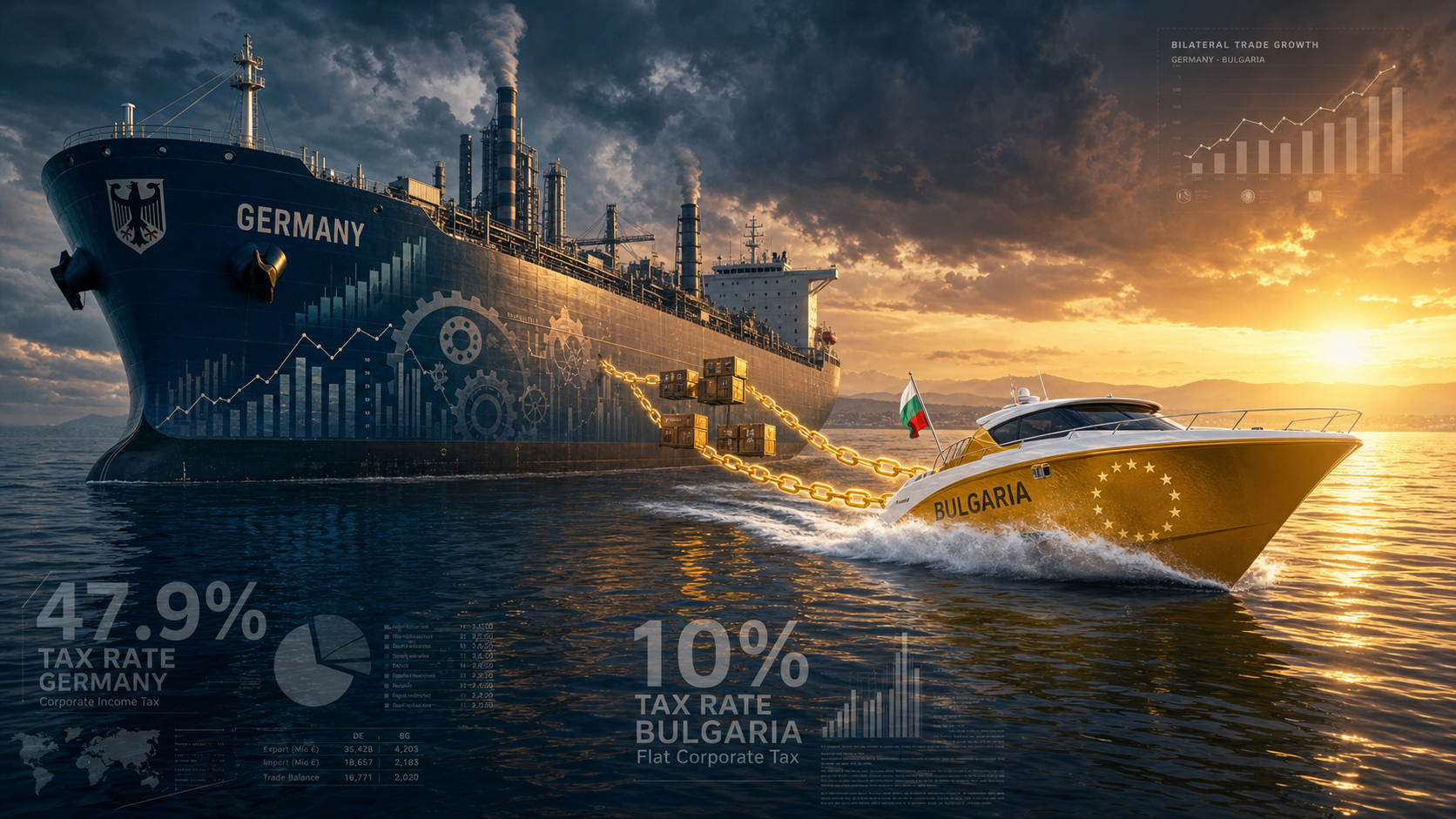
Why Europe urgently needs a new model of economic division of labor – and has already found it right on its own doorstep – Image: Xpert.Digital
Merz calls Germany a sluggish "tanker" – but the saving "speedboat" is already on our doorstep
The tanker and the speedboat: Germany-Bulgaria as an economic partnership
The German economy resembles a cumbersome tanker – a stark assessment not only reached by Chancellor Friedrich Merz. Record taxes on labor, largely untouched millionaires' fortunes, and a sluggish bureaucracy are paralyzing the country's economic dynamism. But while Berlin is still debating major tax reforms, the billions needed for offsetting them, and maintaining competitiveness, a new European success story is already taking shape just a two-hour flight away. Bulgaria, a nimble speedboat, beckons with a 10 percent flat tax, a booming IT sector, and highly skilled professionals. What was once merely an "extended workbench" has become an indispensable strategic partner. This is an in-depth analysis of why Europe needs not forced tax harmonization, but rather a smart economic division of labor – and how the unlikely partnership between Germany and Bulgaria could become a model for the entire continent.
Forget China! Why the future of German industry will be decided in Southeast Europe
At the Employers' Day in Berlin, Chancellor Friedrich Merz chose a memorable metaphor to explain the structural inertia of the German economy: "The Federal Republic of Germany is not a speedboat. The Federal Republic of Germany is a large ship, or at least a rather large tanker, with rather large engines. But even such a large tanker cannot be turned around in a 180-degree turn in just a few days like a speedboat." This metaphor is more precise than it first appears – and it implicitly contains the question this article poses: If Germany is the tanker, where is its speedboat? The answer lies in southeastern Europe, just under a two-hour flight from Berlin.
A tanker in rough waters: The structural crisis of the German tax and economic model
The diagnosis presented to the public on several occasions by Marcel Fratzscher, President of the German Institute for Economic Research (DIW), is devastatingly clear: there is hardly a country in the world that taxes labor more heavily and wealth less at the same time than Germany. This statement is not political polemic, but a sober empirical finding, solidly supported by international comparative data.
According to the OECD study "Taxing Wages," a single person earning an average wage in Germany has to pay 47.9 percent of their salary to the state in taxes and social security contributions – a figure exceeded among the 38 OECD member states only by Belgium, at 53 percent. The OECD average is 34.8 percent. For families with two children where both partners are employed, the burden is still 40.7 percent. Someone earning 50 percent of the average wage in Germany retains only 59 percent net after all taxes and social security contributions – a figure only slightly lower in the EU comparison are found in Hungary and Slovenia.
The flip side of this extreme workload is a striking protection of capital and wealth. While regular wages are taxed at an average of almost 48 percent, capital gains are subject to a flat withholding tax of 25 percent, inheritances are taxed at an average of only 9.4 percent, and wealth itself has been exempt from taxation since 1997. Fratzscher estimates that wealth-related tax revenues, at around 40 billion euros, represent just under one percent of Germany's economic output. With estimated total private wealth of up to 10 trillion euros, assets in Germany are thus taxed at less than 0.4 percent of their value annually. Other OECD countries, such as the USA, France, Canada, and the UK, tax private wealth three to four times more heavily.
This asymmetry has real consequences for economic dynamics. The high taxation of labor reduces working hours and employment incentives, weakens competitiveness, and particularly burdens the middle class, which forms the backbone of German consumption and social stability. The so-called "middle-class bulge" in the German income tax system—a progressive increase in marginal tax rates that begins at middle incomes and makes working hours economically unattractive—has had a dampening effect on the overall labor supply for years.
The imbalance in the system: When work is punished and possessions are rewarded
Wealth distribution in Germany is exceptionally skewed, even within Europe. According to a study by the German Bundesbank, the wealthiest ten percent of households own more than 60 percent of total private wealth. The Gini coefficient for net wealth is 72.4 percent – a figure surpassed in the Eurozone only by Austria. The richest one percent of the population holds around 18 percent of total wealth – as much as the poorest 75 percent of the population combined.
The relationship between average wealth and the more meaningful median is particularly revealing. While average wealth is skewed upwards by a few extremely wealthy individuals, the median net worth – the value exactly in the middle of the distribution – was only €76,000 in 2023. Adjusted for inflation, this figure shrank by 16 percent between 2021 and 2023. The real wealth of the middle class is therefore decreasing, while large sums at the top of the distribution remain untaxed.
Fratzscher's proposal for financing a much-needed income tax reform addresses precisely this imbalance. A wealth tax of two percent on large net assets – especially those exceeding 20 million euros – would generate nearly 42 billion euros in additional revenue for the German state. This amount would enable the federal government to lower income tax for low and middle-income earners as well as corporate taxes, thereby providing a significant economic stimulus. The current coalition government is planning an income tax reform for January 1, 2027, which is primarily intended to provide relief for low and middle-income earners – but the financing for this reform remains unclear. The costs of such a reform are estimated at 20 to 30 billion euros annually.
It is important to be precise at this point: A wealth tax was levied in Germany until 1997, but was abolished following a 1995 ruling by the Federal Constitutional Court. The court did not find the tax fundamentally unconstitutional, but rather criticized the unequal valuation of different types of assets – in particular the use of standardized property values from 1964 – as incompatible with the general principle of equality enshrined in the Basic Law. The wealth tax law itself was never formally abolished and remains in effect today. According to the prevailing legal opinion, a wealth tax designed in accordance with the constitution is fundamentally possible.
Nevertheless, its political feasibility is considerably limited. The CDU/CSU-led federal government rejects a wealth tax, and the practical challenges of a uniform valuation of business assets, real estate, and liquid assets are substantial. Fratzscher himself has pointed out that international coordination on a wealth tax currently seems hardly feasible, and therefore an increase in the value-added tax to 21 percent is the more politically likely scenario. The economic policy debate thus revolves not only around the question of whether a shift from labor taxation to wealth taxation would be sensible—as few economists doubt—but also whether and how it can be implemented.
The tanker's course correction: What the coalition has already achieved
The tanker is beginning to move, even if the course correction will take time. The center-right coalition government has sent initial signals with the immediate tax-based investment program approved by the cabinet in June 2025. Its core element is a gradual reduction of the corporate tax rate from 15 to 10 percent starting in 2028, which is intended to reduce the overall tax burden for companies from almost 30 to almost 25 percent by 2032. This is complemented by accelerated depreciation allowances of 30 percent per year for investments until 2027, as well as increased tax incentives for research and development expenditures.
At the beginning of 2026, Chancellor Merz admitted that competitiveness had "not yet been sufficiently improved" and that the economic situation was, in some respects, "very critical." The planned reduction of the corporate tax rate to 10 percent by 2032 is symbolically significant – not because it is already having an effect today, but because it would bring Germany to precisely the same corporate tax level that Bulgaria has had since 2008. What Germany is striving for as a forward-looking reform is Bulgaria's current situation.
The tanker is indeed turning, but it is turning in the direction of the model that its smaller EU partner to the south has long been operating on. This is no coincidence, but rather the result of Europe-wide tax competition that is increasingly putting pressure on the large, high-tax states. The crucial question is whether Germany understands that tax competition doesn't have to force a zero-sum dynamic, but that a positive-sum system can emerge from a smart economic division of labor.
The speedboat with anchor: Bulgaria's model and its limitations
If Germany is the cumbersome but powerful tanker, then Bulgaria is the nimble speedboat – dynamic, responsive, with low operating costs, but lacking the draft stability and cargo capacity of its larger partner. The term "speedboat" from Merz's metaphor only partially captures the essence: Bulgaria's agility stems not from arbitrariness, but from deliberate structural decisions. A more fitting term in this context would be that of support vessel – or, to remain in maritime terminology, tender. A tender supplies the large tanker, depends on it, benefits from its towing power, and can simultaneously provide services that the tanker, by its very nature, is incapable of performing on its own.
Bulgaria's basic tax model is radically simple: a flat tax of 10 percent on both income and corporate tax – no progressive tax rates, no business tax, and a 5 percent withholding tax on dividends. This means the country still has some of the lowest tax rates and some of the lowest labor costs in the entire European Union. The statutory minimum wage will be €3.74 per hour in 2026. A qualified IT developer in Sofia costs from around €3,800 per month in a nearshoring model – compared to €8,000 for a comparable on-site employee in Germany.
The macroeconomic record of this model is remarkably positive. Bulgaria's GDP growth in 2024, at 3.4 percent, was significantly higher than the eurozone average of 0.9 percent. Growth of 3.1 percent is expected for 2025 and 2.8 percent for 2026. The unemployment rate fell to 3.3 percent in April 2025, and S&P raised its outlook for the country from "stable" to "positive" in May 2026. At the same time, Bulgaria had a gross debt level of just 23.8 percent of GDP when it joined the euro on January 1, 2026—the second lowest of all eurozone countries after Estonia.
Nevertheless, this speedboat has its limits. Inflation stood at 6.8 percent in April 2026. There is a significant shortage of skilled workers, increasingly forcing companies to recruit international staff. Corruption, a sometimes cumbersome bureaucracy, and legal uncertainty are cited by German investors as the main obstacles. And the population decline that has persisted since 1990 has cost the country around 30 percent of its people. These are not marginal problems, but structural limits to growth that prevent the tender from navigating sustainably on its own.
From extended workbench to full-fledged partnership: What Bulgaria used to be and what it can be
The history of the economic division of labor within the global and European systems is repeating itself on different scales. For decades, China was the world's "extended workbench"—a country that produced for Western companies through low wages, state subsidies, and a deliberate strategy of industrial contract manufacturing. China has long since abandoned this role. Today, the People's Republic is the world's largest economy in terms of purchasing power parity-adjusted GDP, a growing technological competitor, and—especially for Germany—a strategic challenge that dangerously exposes the export dependence of the German economic model.
At an earlier stage of its EU integration, Bulgaria did indeed occupy a role similar to that of China at the time: a low-cost manufacturing location for simple industrial processes, textiles, and basic materials processing. This role has fundamentally changed over the past two decades. The structural shift is statistically verifiable: since 2017, Bulgaria has exported more goods to Germany than it imports. Imports from Bulgaria to Germany have increased by 345 percent since Bulgaria's EU accession in 2007 – growth far exceeding that of German exports to Bulgaria. Total trade between the two countries reached a new high of €12.65 billion in 2025. Since 1990, bilateral trade volume has increased approximately eightfold.
What Bulgaria exports to Germany today speaks volumes about the country's economic maturation: electrical equipment, sensor technology, cables, circuit boards, and electronic components. German industry orders around €1.1 billion worth of goods annually from Bulgaria's electrical industry. German automakers and machine manufacturers are automatically considered the main customers of the Bulgarian electrical industry. This is no longer simply an extended production line – these are supplier relationships structurally similar to those Germany has maintained with Poland, the Czech Republic, and Hungary for decades.
The crucial difference with China is that Bulgaria is pursuing this development path within the institutional framework of the European Union. There is no geopolitical fault line, no strategic rivalry, no systemic competition. Bulgaria is an EU member, part of the Eurozone since January 2026, a member of NATO, fully integrated into the Schengen Area, and subject to the same competition, labor, and environmental standards as Germany. What was once China—and has now become a dangerous competitor—can remain for Bulgaria in a domesticated, controlled, and geostrategically harmless form.
Our EU and German expertise in business development, sales and marketing

Our EU and German expertise in business development, sales and marketing - Image: Xpert.Digital
Industry focus areas: B2B, digitalization (from AI to XR), mechanical engineering, logistics, renewable energies and industry
More information here:
A thematic hub offering insights and expertise:
- Knowledge platform covering global and regional economies, innovation and industry-specific trends
- A collection of analyses, insights, and background information from our key areas of focus
- A place for expertise and information on current developments in business and technology
- A hub for companies seeking information on markets, digitalization, and industry innovations
Nearshoring reimagined: Tankers and tenders – How Germany and Bulgaria are forming Europe's new production axis
The complementary logic: Why a tanker needs its tender
The economic complementarity between Germany and Bulgaria does not stem from sentimental partnership rhetoric, but from a sober analysis of the structural strengths and weaknesses of both economies. Germany is rich in capital, technological know-how, market access, and management expertise – but expensive, burdened by bureaucracy, and structurally inert. Bulgaria is poor in capital, but rich in skilled labor at affordable prices, politically stable within the EU framework, and equipped with a tax policy that actively attracts investment.
Over 5,000 German companies are represented in Bulgaria, accounting for almost a third of the country's 100 largest investors. In 2024, Germany was Bulgaria's most important trading partner in both the export and export markets, with shares of nearly 14 percent and just over 12 percent, respectively. Since 1990, German direct investment has built up a total stock that makes Bulgaria the second most important German investment destination in the region.
Nearshoring – the outsourcing of business processes and IT services to geographically nearby but more cost-effective countries – has gained particular momentum in the German-Bulgarian relationship in recent years. Bulgaria is often referred to as the "Silicon Valley of Europe" in the IT sector, which may sound exaggerated at first, but reflects a real reality. IT degree programs are offered at almost every university in the country, German-language programs complement the range of courses, and the outsourcing sector is one of the largest employers. With full Schengen accession, adoption of the Eurozone, and a uniform corporate tax rate of 10 percent, Bulgaria presents itself as the most attractive nearshoring location in Europe for German companies.
The strategic advantage is twofold. Firstly, German companies benefit from cost structures that compete with those of non-European locations, without the legal uncertainties, time zone differences, and geopolitical risks associated with offshore solutions in Asia or Latin America. Secondly, a significant portion of the capital generated in Bulgaria flows back into the European economy – as demand for German capital goods, machinery, and consumer goods. German exports to Bulgaria – led by motor vehicles and parts (€919 million), machinery (€692 million), and food products (€461 million) – grew by 7.2 percent between January and October 2025. The tender supplies the tanker, and the tanker supplies the tender: an economic relationship that strengthens both sides.
The partnership as a European model: Tax differentiation instead of harmonization
The usual political response to tax disparities within the EU is a call for tax harmonization – the alignment of national tax rates to a common European level. This impulse is understandable, but economically questionable. Tax differentiation within the EU single market is not a bug, but a feature of the common market. It allows member states to leverage comparative advantages, steers the allocation of capital and labor across borders, and creates competitive pressure on high-tax states to make their budget structures more efficient.
The deeper question raised by the Germany-Bulgaria partnership is therefore not: Should both countries harmonize their tax systems? Rather, it is: How can the existing differentiation be transformed into a deliberate, collaborative growth strategy that generates added value for both sides? Germany, which aims to reduce its corporate taxes to 25 percent by 2032, is moving in Bulgaria's direction – but it will never reach 10 percent because its welfare state model, infrastructure, and education spending necessitate a certain level of tax revenue. Bulgaria, on the other hand, needs Germany's technology, capital, and market access to continue its development path without falling into the trap of permanent dependence on labor costs.
The partnership therefore works not despite the differences, but because of them. A tanker towed by a tender is more stable. A tender towed by a tanker travels farther. The political task is to recognize this complementary logic and support it institutionally – through targeted investment promotion, improved legal certainty in Bulgaria, industrial policy coordination within the framework of EU cohesion policy, and a pragmatic tax policy that does not enforce false equality.
Structure, capital and the question of productivity: What the pair can achieve
The economic substance of the Germany-Bulgaria partnership ultimately lies in a specific form of international productivity arbitrage. For decades, Germany has built and defended its comparative advantage in highly complex industrial value creation – mechanical engineering, automotive, chemicals, and pharmaceuticals. This advantage is real and will remain so as long as Germany continues to invest in research, education, and infrastructure. But it is also expensive. The high-wage structure of the German labor market, multiplied by the second-highest tax and social security burden of all OECD countries, makes it economically difficult to locate routine processes, service functions, and medium-sized technology sectors in Germany in a cost-effective manner.
This is where the Bulgarian model comes in. The value chain isn't relocated to the Far East, but rather divided across a distance of just a few flight hours. German engineering expertise, German design, and German capital combine with Bulgarian execution quality, Bulgarian engineering talent, and Bulgarian cost structures. The result is a pan-European value chain that is globally competitive – not because it undercuts social and environmental standards, but because it intelligently leverages comparative advantages.
This logic is not new. It has already worked in the relationship between Germany and Poland, and Germany and the Czech Republic. Bulgaria's advantage is that the difference in labor costs and tax rates is even greater, and the country has already moved beyond its early phase of purely labor-based production. The question is no longer whether integration can be deepened, but how deeply and at which stages of the value chain. The electrical industry, the IT sector, and Bulgaria's growing importance as a sourcing market for the German automotive industry demonstrate that this process is already well advanced.
The dangers of analogy: When the tender becomes a competitor
History cautions against overly optimistic partnership narratives. China was once what Bulgaria is today – a cost-effective manufacturing partner for Western industrialized nations. Today, China is Germany's largest trading partner and, at the same time, its fiercest industrial competitor in key sectors such as electromobility and solar energy. The question, therefore, is justified: Could Bulgaria follow the same path?
The short answer is: No – at least not in the same way. The institutional ties of EU membership, the common legal system, competition rules, and democratic control create a basic level of security that was structurally lacking in the relationship with China. China is a sovereign state with its own industrial policy, state aid, capital controls, and a systemic approach that is fundamentally incompatible with the Western European economic model. Bulgaria is a member of the same community of values and is subject to the same rules.
Moreover, Bulgaria simply lacks the scale. With around 6.8 million inhabitants and a GDP of just over €100 billion, the country is ten times smaller than its largest trading partner. It cannot become a systemic competitor, but it can be a valuable complementary partner. Paradoxically, this very size difference presents a strategic opportunity: Bulgaria is large enough to make substantial contributions, but small enough not to pose an existential threat to the German economic model.
The more critical objection concerns internal development dynamics. If Bulgaria grows, if wages rise, if the country catches up technologically—and all of this is already happening—then the basis of complementarity changes. Higher wages in Sofia mean fewer cost advantages for German nearshoring. Greater technological depth in Bulgarian companies means more competition in certain segments. This is unavoidable and not undesirable—a wealthier Bulgaria is a better trading and investment partner. But it requires that Germany base its own competitiveness not on wage cost differences, but on genuine technological and organizational superiority.
What the 2027 income tax reform has to do with Bulgaria
The connection between the planned German income tax reform on January 1, 2027, and the economic partnership with Bulgaria is indirect, but real. Tax relief for middle-income earners in Germany strengthens the purchasing power and labor supply of German small and medium-sized enterprises (SMEs) – and thus the economic foundation of the economy. A more productive and motivated workforce in Germany is essential for ensuring that high-quality value creation remains within the country and that routine tasks can be outsourced cost-effectively to partners like Bulgaria.
Financing this reform is not purely a fiscal question, but rather a matter of economic policy coherence. If the tax relief for labor is financed by raising the value-added tax to 21 percent—as Fratzscher describes as the most politically likely scenario—then it's a step forward and a half-step back: The incentive to work increases, but purchasing power is dampened again by higher consumption taxes, and the middle class once more bears a disproportionate burden. A wealth tax or financing through substantial subsidy cuts—also advocated by Fratzscher—would be more economically consistent, but politically more difficult.
The tanker and its tender can only become an economically successful model if the tanker optimizes its own course while expanding cooperation with the tender. Tax policy, investment incentives, and labor market design are no longer isolated national decisions. They take place within a European competitive environment where every reform step taken by Germany affects Bulgaria's relative position, and vice versa. This makes the political debate in Berlin a debate with a European dimension – even if this is rarely perceived as such by the public.
A sober assessment and a constructive outlook
The German-Bulgarian partnership is not a political project or an ideological program. It is an economic reality manifested in tens of billions of euros in trade volume, thousands of new business establishments, and a structurally complementary business model. The question is not whether this partnership exists—it does. The question is whether Germany and Europe are wise enough to shape it consciously, instead of leaving it to chance.
For Germany, this means that the debate surrounding wealth taxes, relief for the middle class, and how these measures would be financed cannot be conducted solely from the perspective of national distributive justice. It must also be conducted from the perspective of international competitiveness – in a Europe that views countries like Bulgaria not as low-wage competitors, but as strategic partners. Germany needs lower taxes on labor not only to relieve the burden on its own middle class, but also to avoid being permanently relegated to the back of the pack in the global competition for talent and investment.
For Bulgaria, this means that the low-tax model alone is not enough in the long run. Without investments in legal certainty, administrative efficiency, infrastructure, and education—financed partly by EU funds and partly by rising tax revenues from a growing GDP—the speedboat will eventually fail due to its own structural limitations. A tender that wants to sustainably supply its tanker must itself be robust and reliable.
The German-Bulgarian partnership can become an economic success – but not automatically. It requires economic policy courage in Berlin, institutional consolidation in Sofia, and a European framework that accepts complementary development models instead of homogenizing them. Merz is right: The tanker can't move like a speedboat. But it can take a tender alongside it, which gives it the agility it can't generate on its own. And this tender – if you only look – is already there.
🎯🎯🎯 Data-driven B2B industry hub as a quasi-in-house solution

The quasi-in-house solution: How Xpert.Digital closes operational gaps in B2B marketing and sales – Smart Content-Driven Business - Image: Xpert.Digital
Xpert.Digital is a data-driven B2B industry hub led by Konrad Wolfenstein . The company acts as an external, quasi-in-house solution for industrial partners, closing operational gaps in marketing, content, and sales – without requiring additional resources on the client side.
More information here:
Your global marketing and business development partner
☑️ Our business language is English or German
☑️ NEW: Correspondence in your native language!

Konrad Wolfenstein
I and my team are happy to be available to you as your personal advisor.
You can contact me by filling out the contact form here [email protected]:or simply call me at +49 7348 4088 965. My email address is
I'm looking forward to our joint project.










