

Automated high-bay warehouses in India: How e-commerce and "Make in India" are driving the warehouse revolution
Xpert Pre-Release

Available in 27 languages 📢
Prefer Xpert.Digital on GoogleⓘPublished on: August 30, 2026 / Updated on: August 30, 2026 – Author: Konrad Wolfenstein
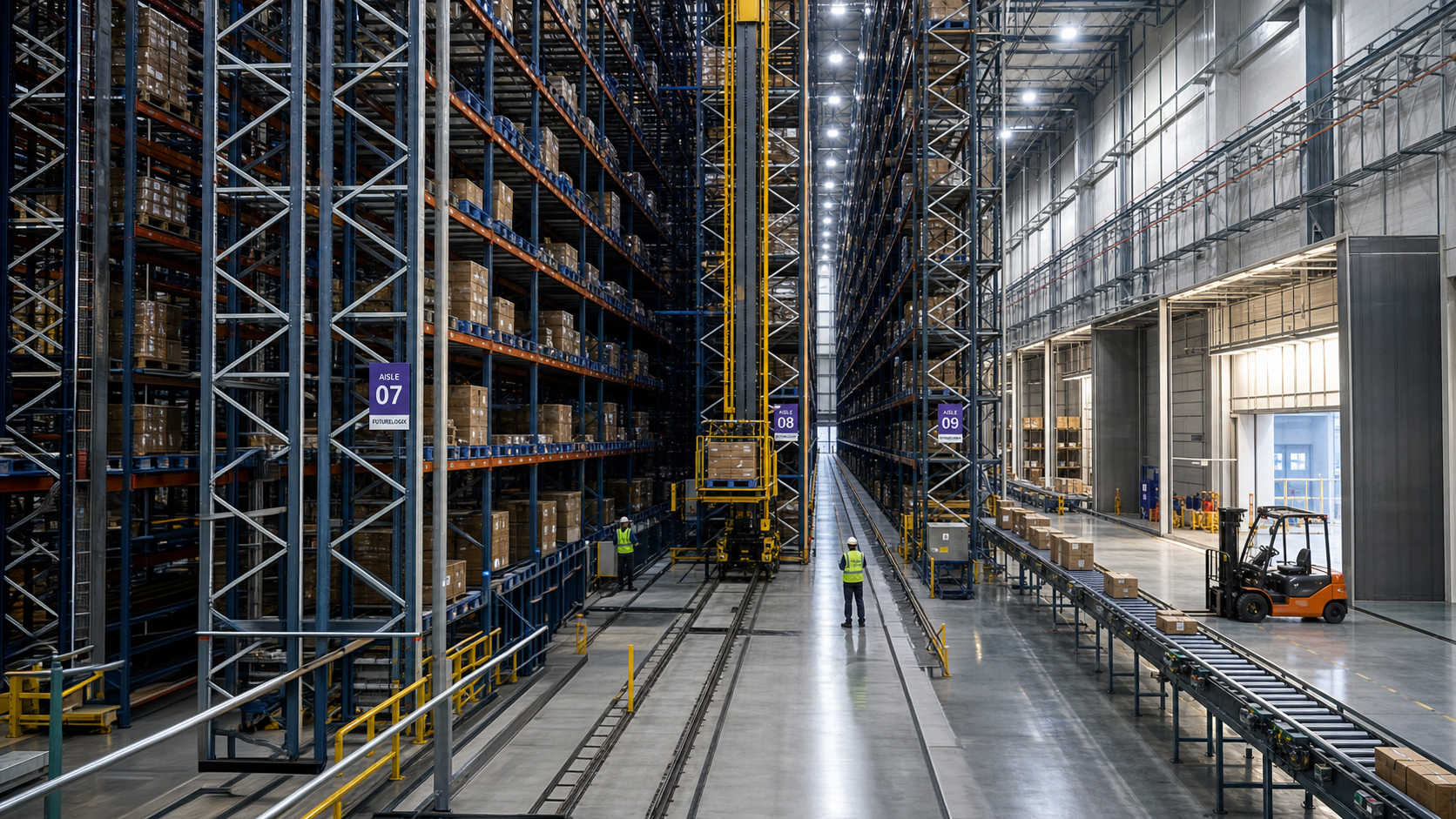
Automated high-bay warehouses in India: How e-commerce and "Make in India" are driving the warehouse revolution – Creative image on the topic, with AI: Xpert.Digital
Between chaos and cloud computing: Why India's warehouse boom is turning global logistics upside down
The billion-dollar bet: Are India's fully automated high-tech warehouses myth or reality?
India is traditionally considered a land of seemingly inexhaustible, inexpensive manual labor – but behind the scenes of the subcontinent's vast logistics parks, a quiet yet massive revolution is underway. Where thousands of hands once stacked crates, fully automated storage and retrieval machines, some reaching up to 36 meters high, now increasingly reach for pallets. Driven by rapidly growing e-commerce, the political "Make in India" initiative, and the stringent requirements of the pharmaceutical and food industries, the country is massively upgrading its infrastructure and transforming itself from a pure import market into a high-tech producer. But the path from chaotic warehouses to cloud-based automation is fraught with challenges: conflicting data, gigantic investment costs, and constant competition from cheap human labor create a tense environment. Is India truly experiencing a widespread automation miracle, or are these merely spectacular flagship projects of large corporations? An investigation into the new logistics centers of a rising economic power.
The silent transformation: How India is reinventing its warehouses: Between chaos and cloud – India's warehouse revolution knows no pause
The Indian logistics sector is currently undergoing a profound structural transformation that extends far beyond the construction of new warehouses. At the heart of this development is the automation of traditional high-bay warehouses – those towering steel structures where automated storage and retrieval systems retrieve pallets from aisles inaccessible to human hands. What has been standard practice in Europe, Japan, and the USA for decades is only now beginning to take hold on a larger scale in India, driven by a combination of exploding e-commerce, shifts in industrial policy, and the growing confidence of domestic technology providers. Looking at the developments of the past twelve months, one sees a country oscillating between two poles: on the one hand, the alluring narrative of a widespread wave of automation, and on the other, the sobering reality of fragmented warehouse structures, unclear cost calculations, and a labor market that still offers an abundance of cheap human labor.
A Japanese corporation is moving to Hyderabad
In April 2025, the Japanese intralogistics company Daifuku opened a new factory in Hyderabad, representing an investment of approximately 227 crore rupees (around €20.5 million). This factory marks a turning point, as it was the first time a roughly 30-meter-high storage and retrieval machine was manufactured on Indian soil, instead of being imported from Japan or Europe. For a country that had previously been almost entirely dependent on imported high-bay racking technology, this is more than a symbolic gesture. It means shorter delivery times, lower import costs, and a response to the political demand for local value creation within the framework of the "Make in India" initiative. Whether this initial production run constitutes series production or merely a prototype for a single customer cannot be definitively determined from the publicly available information. It also remains unclear what the actual local value creation share is and how reliable the acceptance protocols were for this first machine built in India. To assess the industrial policy relevance, a comparison of import figures for storage and retrieval machines before and after this factory opening would be informative, but this is not currently available.
Cold chains as unexpected pioneers
While e-commerce giants usually command public attention, cold chain logistics is emerging as one of the most technically demanding testing grounds for high-bay automation in India. In April 2025, cold storage operator Indicold commissioned a second fully automated deep-freeze warehouse in Detroit, Gujarat, with approximately 10,000 pallet spaces. Equipped with a four-way shuttle system, it operates at minus 20 degrees Celsius. Such facilities place particular demands on material fatigue resistance, energy efficiency, and maintenance reliability, as standard maintenance intervals differ significantly under extreme cold compared to temperature-controlled warehouses. The Detroit facility follows an earlier one in Dholasan, which was touted as India's first silo-style deep-freeze high-bay warehouse. Whether this claim is truly accurate, or whether competitors have implemented comparable projects earlier, is a question that warrants independent investigation. It is also interesting to know how much energy such a shuttle system actually consumes per transported pallet, because this is precisely where the economic leverage lies for the cold chain industry, where electricity costs often make up a significant portion of operating costs.
Tea, pharmaceuticals and steel: Automation beyond online retail
A remarkable signal for the spread of high-bay racking technology in India came in September 2025 from Dakor, Gujarat, where the traditional tea producer Wagh Bakri commissioned an approximately 200-meter-long automated warehouse for around 180,000 tea chests. This investment, embedded in a larger project of about 140 crore rupees, demonstrates that high-bay automation is no longer solely the domain of e-commerce, but is increasingly finding its way into traditional consumer goods industries. An even more impressive example followed in February 2026: The Godrej Group delivered a 36-meter-high, silo-like high-bay racking system with over 6,000 pallet spaces on a footprint of just over 11,000 square feet to an unnamed pharmaceutical client. Such rack-clad structures, in which the racking structure itself supports the building envelope, are considered the most technically sophisticated form of high-bay racking. The fact that the pharmaceutical industry, with its stringent requirements for temperature control, traceability, and validation according to international "Good Manufacturing Practice" standards, is among the pioneers underscores that automation in India is increasingly driven by regulation and not solely a matter of cost efficiency. Alongside this, a less visible but economically significant segment exists: heavy-duty high-bay racking for steel coils, supplied by international providers such as AMOVA or Konecranes. These systems are logistically far more complex than traditional pallet warehouses, as they handle individual coils weighing up to fifty tons.
The rise of the home champions
No company currently embodies India's ambition for automation more clearly than Addverb Technologies from Noida, in which the Reliance Group holds a stake. The company offers a broad portfolio ranging from shuttle and racking systems to autonomous mobile robots and its own warehouse management software, and is increasingly positioning itself in the fields of humanoid robotics and physical artificial intelligence. Addverb reportedly plans a funding round of more than $100 million in 2026, although the company's exact revenue figures vary considerably across different sources, with estimates ranging from approximately 390 to 800 crore rupees. This discrepancy highlights how difficult it remains to obtain reliable financial figures for private Indian technology companies as long as audited financial statements are not publicly available. Alongside Addverb, GreyOrange has established itself as an internationally visible provider, though it focuses more on flexible warehouse automation than on traditional high-bay silo systems. Godrej contributes its decades of experience in steel and racking construction, while smaller specialists like Falcon Autotech or Craftsman Storage Systems occupy niches in sorting and medium-sized storage systems. This mix of large corporations, emerging technology companies, and international partners like Dematic or SSI Schäfer, which participate in the market through local collaborations such as Armstrong Dematic, creates competition that could transform India from a purely import-oriented market to a country with its own value chain in warehouse automation within just a few years.
The battle of numbers among market analysts
Anyone attempting to determine the true size of the Indian automation market encounters a remarkable jumble of contradictory figures. One analyst estimate puts the market for warehouse automation in India at around US$560 million in 2025, with growth to approximately US$660 million the following year and an annual growth rate of nearly 18 percent until 2031. Another estimate, more specifically focused on stacker cranes, cites a market value of around US$222 million for 2024, projected to grow to around US$400 million by 2030. A third source, completely out of the ordinary, estimates the Indian market for automated storage and retrieval systems at US$9.8 billion in 2025 and forecasts growth to US$18.6 billion by 2031. This difference of more than twentyfold can hardly be explained by differing growth assumptions, but rather points to fundamentally different definitions of market size. Presumably, some studies conflate pure hardware sales with software solutions, consulting services, and related automation technology, while others focus strictly on physical storage and retrieval machines. Without access to the methodological foundations of these paid market research reports, a reliable assessment of the actual market size is virtually impossible, and any figure cited in presentations or articles should be treated with appropriate caution.
The enticing but fragile automation forecast
One of the most influential, yet controversial, claims currently circulating through industry events and real estate reports is that the level of automation in Indian warehouses will increase from around 10 percent in 2025 to an impressive 77 percent in 2030. This figure is frequently attributed to a single vendor in reports about events like LogiMAT India, without any publicly documented methodological basis, sample size, or clear definition of automation. Conversely, there are considerably more conservative estimates that put the current level of automation at only 15 to 20 percent and identify a significant need for improvement, particularly for small and medium-sized enterprises (SMEs). This discrepancy is not merely an academic detail, as a 77 percent forecast would mean that virtually the entire warehouse landscape of a country with more than 1.4 billion inhabitants would be fundamentally transformed within just five years – a pace historically unparalleled in any comparable nation. Anyone familiar with the structure of India's warehouse landscape knows that a large proportion of the area consists of small, fragmented, and often informally operated warehouses for which such a leap seems hardly economically viable. The truth probably lies somewhere between these two extremes, with large cities and export-oriented sectors automating significantly faster than the rural or informal sectors.
Your intralogistics experts
Consulting, planning and implementation of complete solutions for high-bay warehouses and automated storage systems - Image: Xpert.Digital
More information here:
High-bay warehouses in India: Between ambitious investments and data gaps
Will automation really pay off in three years?
Another key point of contention concerns the payback period of automation investments. Suppliers and parts of the real estate consulting industry advertise payback periods of just two to three years – an argument that significantly simplifies investment decisions. More independent expert texts paint a considerably more sober picture, citing payback periods of five to seven years, a period that can be extended even further with fluctuating order volumes or uncertain capacity utilization. The investment sums themselves vary considerably depending on the degree of automation: A medium-sized project with semi-automated components typically ranges between two and five million US dollars, while fully robotic systems with comprehensive shuttle and robot technology can cost ten to twenty million US dollars. Entry-level solutions for smaller Indian companies are now available starting at just a few crore rupees, demonstrating that the market is becoming increasingly segmented and is no longer solely aimed at large corporations. This enormous range of costs and amortization periods makes it clear that general statements about the economic viability of high-bay automation in India should be treated with great caution and always considered in the context of the respective industry, capacity utilization and financing structure.
Cheap labor as a silent brake on progress
Perhaps the most interesting, and counterintuitive, insight from the current debate concerns the role of the labor market. While Western discussions about warehouse automation typically assume a shortage of skilled workers and rising labor costs as the driving factors, the situation in India presents a different picture. The still immense pool of inexpensive manual labor acts as a barrier to automation investment in large parts of the country, as the economic advantage of automated systems over human labor is realized less quickly than in high-wage countries. Furthermore, studies in the field of industrial engineering and research on existing e-commerce warehouses indicate that, in practice, automation often leads less to a genuine substitution of human labor and more to an intensification and stronger algorithmic control of the remaining manual tasks. This perspective stands in stark contrast to the management narrative that automation primarily serves to relieve the burden on workers. Reliable data on the employment effects of specific automation projects are still largely lacking, which makes a definitive assessment of this social fault line difficult, but at the same time makes it one of the most exciting open areas of research.
Growing storage areas, but no uniform picture
On the real estate side, two seemingly contradictory trends are emerging. On the one hand, the real estate consultancy Knight Frank reported leasing activity of 36.8 million square feet in the eight largest Indian warehouse markets for the first half of 2026, a 15 percent increase year-on-year, led by the Mumbai region. On the other hand, the consultancy Vestian reported a 14 percent decline in take-up to 38.7 million square feet for the previous fiscal year, suggesting consolidation rather than an unchecked boom. These apparent contradictions can be partially explained by differing survey periods, geographical boundaries, and definitions, but they also illustrate how inconsistent the data remains in the Indian commercial real estate market as a whole. A second trend concerns the quality of warehouse space: According to an analysis by the consultancy JLL, India's total warehouse stock exceeded 610 million square feet in 2025, with 53 percent of this space now said to meet the highest quality standard, "Grade A." Other sources cite a significantly lower "Grade A" share of only 47 percent for a similar period, which again demonstrates that even basic quality categories are not uniformly defined within the industry. Nevertheless, this trend is significant for the automation debate, because modern, high-quality warehouses with greater ceiling heights, more stable floors, and more reliable power supplies provide the necessary structural prerequisites for high-bay racking systems, while older, informal storage areas are generally unsuitable.
Politics as the invisible architect
Behind the visible wave of automation lies a dense network of political initiatives that, while rarely mentioning high-bay warehouses directly, have a significant indirect impact. National logistics policy and the PM GatiShakti initiative aim to better integrate road, rail, port, and warehouse infrastructure, thereby creating the framework in which larger, automation-capable warehouse complexes become economically viable. The Warehousing Regulation Authority has lowered the hurdles for formal warehouse registration in recent years, contributing to the professionalization and standardization of the industry. In June 2026, the state-owned Central Warehousing Corporation announced plans to implement artificial intelligence and Internet of Things (IoT) systems in a total of 216 grain warehouses, while the Food Corporation of India is pursuing similar plans for approximately 150 additional sites. However, it remains unclear whether these digitalization initiatives actually involve high-bay or stacker crane technology or are primarily limited to monitoring systems and inventory management software—a crucial distinction for classifying them as genuine physical automation. In July 2026, the Ministry of Industrial Development and Domestic Trade also relaxed the rules for foreign direct investment in export-oriented online retail inventory models, a measure that could, in the medium term, lead to additional investment in export-oriented, automation-capable fulfillment centers. Additionally, the 2026 budget introduced tax relief for the storage of components in bonded warehouses, which is likely to particularly benefit international manufacturing companies that store components for Indian production.
Amazon, Flipkart and the race for fulfillment centers
The major e-commerce platforms remain the most visible driver of demand for high-bay automation, although details of individual projects are often only fragmentarily documented. Amazon reportedly invested around US$233 million in its Indian infrastructure in 2025, opening new fulfillment centers in cities such as Indore, Bhubaneswar, and Kochi. Flipkart operates a particularly large facility in Haringhata, West Bengal, featuring automated storage systems, robotic packing, and a nine-kilometer-long conveyor system, which the company claims has reduced order processing time by up to fifty percent. The Reliance Group, through its JioMart brand, is also increasingly relying on goods-to-person robotics from Addverb, which, according to industry reports, has increased processing speed by forty percent and reduced staffing requirements by a quarter. However, closer examination reveals that many of these figures come from secondary sources and are rarely confirmed by official company statements from the platforms themselves. Furthermore, it often remains unclear whether the systems described are actually classic high-bay automation with storage and retrieval machines or rather flexible, but technically different solutions such as autonomous mobile robots and sorting systems, which are also automated, but conceptually different from silo-like high-bay racking.
Two philosophies clash
An interesting strategic debate has emerged in Indian industry discussions, extending beyond purely technical questions. Some commentators argue that India should not copy the European approach of massive, costly new silo construction, but instead rely on an intelligent software and sensor layer that enhances existing storage areas through improved control, data analysis, and targeted automation, without requiring a complete overhaul of the physical infrastructure. This position seems quite plausible given the limited capital available to many Indian companies. At the same time, the specific projects of Daifuku, Godrej, and Indicold, all of which utilize classic, thirty- to thirty-six-meter-high silo racking systems, at least partially refute this thesis. Apparently, in certain sectors such as pharmaceuticals, cold chain logistics, and heavy industry, there is genuine demand for the more capital-intensive but more efficient traditional high-bay racking systems. It is likely that in the coming years no uniform Indian approach will emerge, but rather a coexistence of different automation philosophies depending on the industry, company size and regulatory pressure, with export-oriented and highly regulated industries likely to tend towards classic high-bay racking, while more cost-sensitive consumer goods retailers might rely more on software-based efficiency improvements.
What remains in the dark
Despite the abundance of announcements, press releases, and market research reports, the true extent of high-bay automation in India remains surprisingly elusive. No publicly accessible register systematically records how many automated high-bay warehouses are actually operating in India, their height, capacity, and the actual technology providers involved. Furthermore, the distinction between the booming fast-food dark stores and traditional pallet racking is often blurred in reports, even though these are fundamentally different concepts from a technical standpoint. Reliable information on the actual financing structure of such projects, such as the proportion of traditional capital investments versus leasing or robotics-as-a-service models, is scarce. Similarly, little is known about the reliability of storage and retrieval machines manufactured in India under continuous operation, their downtime, and the availability of spare parts outside major metropolitan areas—a crucial factor for the long-term profitability of such investments. Reliable statistics on occupational safety and accident rates in automated versus manually operated warehouses are also entirely lacking. These gaps are not accidental, but reflect a young, still-forming industry in which transparency and uniform standards are only gradually emerging.
A market in the making, not a finished picture
India's high-bay warehouse automation sector is undeniably at a turning point, but anyone expecting a finished, unified picture will be disappointed. Instead, the landscape is one where impressive individual projects in pharmaceuticals, cold chain management, and heavy industry meet a vast array of fragmented, largely manual warehouse structures. The oft-cited predictions of widespread automation within a few years appear, upon closer inspection, more like ambitious marketing hype than a reliable fact, while the actual, documented progress—from the local manufacturing of storage and retrieval systems to concrete reference plants for tea, frozen food, and pharmaceuticals—paints a more realistic, albeit slower, picture of an evolving market. For companies, investors, and policymakers, future success will likely depend less on spectacular growth figures than on establishing reliable data, uniform standards, and robust economic analyses that extend beyond individual success stories.
Consulting - Planning - Implementation

Konrad Wolfenstein
I would be happy to serve as your personal advisor.
You can contact me at wolfenstein∂xpert.digital or
Just call me on +49 7348 4088 965 .
Our Asia expertise in business development, sales and marketing

Our Asia expertise in business development, sales and marketing - Image: Xpert.Digital
Industry focus areas: B2B, digitalization (from AI to XR), mechanical engineering, logistics, renewable energies and industry
More information here:
A thematic hub offering insights and expertise:
- Knowledge platform covering global and regional economies, innovation and industry-specific trends
- A collection of analyses, insights, and background information from our key areas of focus
- A place for expertise and information on current developments in business and technology
- A hub for companies seeking information on markets, digitalization, and industry innovations










