
India between e-commerce boom and automated warehouse industrialization: Heavy-duty logistics as a strategic growth engine
Xpert Pre-Release

Available in 27 languages 📢
Prefer Xpert.Digital on GoogleⓘPublished on: April 13, 2026 / Updated on: April 13, 2026 – Author: Konrad Wolfenstein
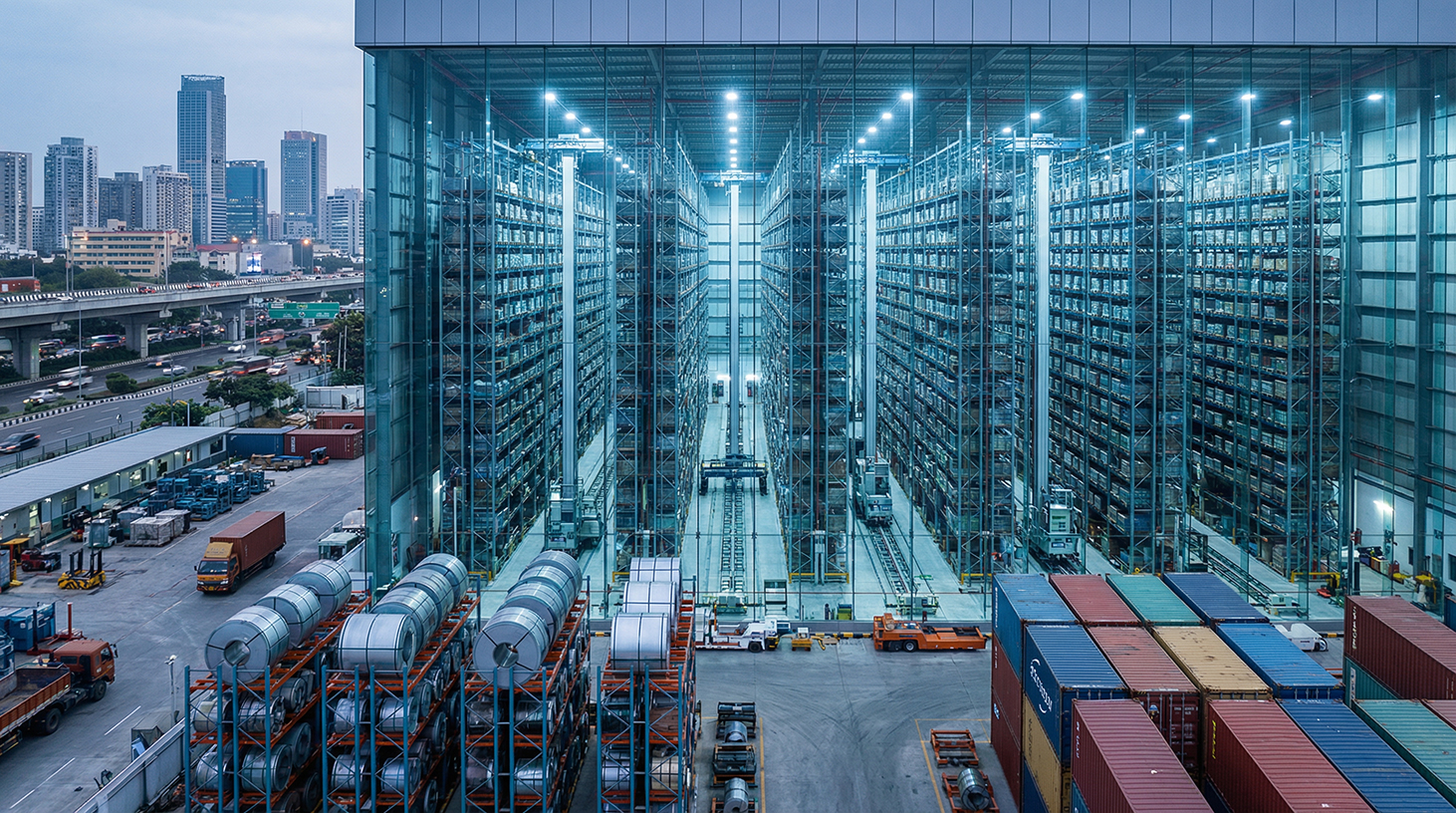
India between e-commerce boom and automated warehouse industrialization: Heavy-duty logistics as a strategic growth engine – Image: Xpert.Digital
Potential of heavy-lift logistics for container storage, container high-bay warehouses, coil storage and classic automated high-bay warehouses for e-commerce in India
Steel, containers & e-commerce: The secret driver behind India's new logistics miracle
India's $100 billion transformation: Why automated heavy-duty warehouses are shaping the global economy
India is currently undergoing an economic and logistical revolution of unprecedented scale. Fueled by an unprecedented e-commerce boom, massive government infrastructure programs, and a rapidly growing steel industry, the subcontinent faces an enormous challenge: How can gigantic flows of goods – from steel coils weighing tons to millions of shipping containers – be managed efficiently, safely, and in a space-saving manner? The answer lies in the massive automation of heavy-lift logistics.
Where traditionally manual labor and simple warehouses dominated the landscape, highly complex container high-bay warehouses, robot-assisted shuttle systems, and specialized coil storage facilities are now rising. This growth is increasingly shifting from expensive metropolitan areas to emerging Tier 2 and Tier 3 cities. This article examines the profound structural transformation of the Indian logistics market, analyzes the remaining obstacles such as the shortage of skilled workers and land scarcity, and demonstrates why a historic window of opportunity is opening now for international technology providers to play a key role in shaping this multi-billion-dollar future market.
Why India's warehouses will decide the next industrial revolution
India is currently undergoing an economic transformation whose scale has quickly made the country one of the world's most important logistics markets. The e-commerce sector, which reached a volume of approximately US$147.3 billion in 2024 and is projected to grow to an estimated US$363.3 billion by 2030 with an average annual growth rate of 21.5 percent, is generating a demand for warehousing infrastructure of unparalleled intensity. At the heart of this development lies a technological challenge that has received too little attention to date: the question of which specific warehousing concepts for heavy goods, steel transport, containers, and highly automated high-bay racking systems will form the backbone of this boom. This is not just about square meters, but about the industrial DNA of a country that aims to be the world's second-largest online consumer market by 2030.
Market dynamics and the structural foundation of growth
The Indian e-commerce logistics market is one of the fastest growing globally. Its value was approximately US$19.54 billion in 2025 and is projected to reach US$103.83 billion by 2034 – a CAGR of over 20 percent. Simultaneously, the overall logistics market is experiencing remarkable growth driven by government initiatives, infrastructure investments, and the private sector expansion of fulfillment networks. The Indian warehousing market was valued at US$14.26 billion in 2024 and is expected to reach US$34.60 billion by 2030.
The decisive structural change is not just the growth itself, but the leap in quality of warehouse space. The average warehouse size increased from around 50,000 square feet in 2023 to over 200,000 square feet by 2025. This scaling of space is what creates the economic foundation for high-performance automated systems such as stacker cranes, high-bay warehouses, and shuttle systems. Large-scale sites in Bhiwandi and Sriperumbudur have already completed this transition: They are using high-bay warehouses (AS/RS) to quadruple pallet density without requiring additional land.
This process is politically supported by the PM Gati Shakti program, which aims to replace the country's fragmented infrastructure planning with an integrated, multimodal network, and by the National Logistics Policy (NLP), which introduces digitalization, standardized processes, and a Unified Logistics Interface Platform (ULIP) for real-time freight management. Logistics costs, which just a few years ago represented a structural competitive weakness at up to 16 percent of GDP, have been reduced to 9 percent – with the stated goal of falling below 8 percent by 2030.
Container high-bay warehouses: Standardization as the key to scaling
Container logistics forms the foundation of India's foreign trade and is also gaining considerable importance for domestic logistics as a result of e-commerce growth. The container market in India had a total volume of approximately US$9.5 billion in 2025, while the shipping container market in the narrower sense reached US$403.7 million and is projected to grow to US$562.9 million by 2034. Container volume at Indian ports has increased at a CAGR of around 8 percent in recent years.
Container high-bay warehouses, i.e., multi-story automated facilities for the compact storage of ISO containers, are of dual strategic importance in this context. On the one hand, they enable a drastic increase in storage capacity on limited, expensive land – an increasingly critical factor given the scarcity of land in metropolitan areas. On the other hand, they accelerate intermodal handling when containers are transferred directly from rail to an automated system without the need for trucks or intermediate storage.
Inland Container Depots (ICDs), which function as the internal infrastructure of inland ports, are already an established tool for relieving pressure on coastal ports. Their further development into fully automated high-bay container warehouses is both logical and economically sound. Even today, ICD infrastructure accelerates customs clearance inland and reduces transport costs. Integrating automated high-bay racking technology into these structures would fundamentally improve throughput speed, space efficiency, and supply chain reliability – and counteract the chronic congestion at the seaports of Mumbai, Chennai, and Nhava Sheva.
Coil storage and heavy industry: Steel as a logistical driver beyond e-commerce
India is the world's second-largest steel producer and consumer, and steel demand is projected to grow by around 9 percent annually in 2025 and 2026, according to the World Steel Association (WSA)—the highest growth rate of any major consumer country worldwide. The Indian market for hot-rolled steel coils generated revenue of US$25.25 billion in 2024 and is expected to grow to US$32.1 billion by 2030. This sheer scale makes coil warehousing a distinct and economically significant logistics segment.
The requirements for coil storage systems differ fundamentally from those of other storage systems. Steel transport coils typically weigh between 5 and 40 tons, are extremely sensitive to pressure, and require specific storage geometries to prevent deformation and damage. Manual handling in this environment is not only inefficient but also dangerous and prone to error. Automated high-bay warehouses for coils, such as those offered internationally by SMS Group (with its subsidiary AMOVA) and Konecranes, can transport and store loads of up to 50 tons fully automatically. SMS Group even holds the world record with an AMOVA system: the largest high-bay warehouse for steel coils with 4,300 storage locations.
In India, the coil storage segment offers significant growth potential that has so far been largely untapped. Leading integrated steel producers such as Tata Steel, JSW Steel, and SAIL, as well as downstream processors (cold rolling mills, service centers), still predominantly operate with manual or semi-automated coil storage systems. The transformation to fully automated systems offers three key economic benefits: first, a drastic reduction in material damage (according to SMS/AMOVA, up to 30 to 60 percent fewer handling operations); second, improved inventory transparency through real-time tracking in the warehouse management system; and third, reduced reliance on physically demanding and accident-prone manual tasks. Industry forecasts predict that automated coil handling systems will account for 41.6 percent of total sales in the coil handling equipment sector by 2026.
Classic automated high-bay warehouses: Between technological promise and investment reality
The market for automated storage and retrieval systems (AS/RS) in India generated revenue of US$222.5 million in 2024 and is projected to grow to US$400.5 million by 2030, representing a CAGR of 10.4 percent. Within the broader context of warehouse automation as a whole, the Indian market was valued at US$822.40 million in 2025 and is expected to reach US$2.84 billion by 2034 – a CAGR of 14.75 percent.
The most dynamic segment is robot shuttle systems, which are ranked as the fastest-growing product segment in the AS/RS sector. This finding aligns with the global trend toward highly flexible, scalable warehouse automation, which is particularly well-suited to volatile e-commerce order profiles: Shuttle systems can respond to order peaks more effectively than traditional single-channel AS/RS systems by operating multiple shuttles in parallel on the same racking level. During peak periods such as the Indian Diwali festival or the festive season in the fourth quarter, when sales increased by 27 percent to over 120,000 crore rupees in 2025, warehouse automation plays a crucial role in the competitiveness of e-commerce platforms.
Amazon and Flipkart are leading the way in this regard. In 2025, Amazon India invested approximately US$233 million in expanding its infrastructure, including five new fulfillment centers in Indore, Bhubaneswar, Kochi, Rajpura, and Delhi-NCR. The Flipkart fulfillment center in Haringhata (West Bengal)—one of India's largest at 110 acres and 2000 square feet of usable space—already features automated storage and retrieval systems, robotic packing systems, cross-belt sorters, and a 9-kilometer conveyor system that reduces turnaround time by 35 to 50 percent. These large-scale projects are not only operational centers of excellence but also serve as demonstration facilities, inspiring similar practices across the industry.
Your container high-bay warehouse and container terminal experts

Container high-bay warehouses and container terminals: The logistical interplay – expert advice and solutions - Creative image: Xpert.Digital
This innovative technology promises to fundamentally change container logistics. Instead of stacking containers horizontally as before, they will be stored vertically in multi-story steel racking structures. This not only allows for a drastic increase in storage capacity within the same area, but also revolutionizes all processes at the container terminal.
More information here:
From containers to AS/RS: Four storage strategies with billions in potential
Tier 2 and Tier 3 cities: The new geographical logic of the warehouse boom
One of the most consequential structural shifts in the Indian warehouse market is the geographic decentralization towards mid-sized cities. Cities like Indore, Coimbatore, Ludhiana, Patna, Varanasi, and Bhiwandi are no longer secondary logistics hubs, but active investment targets for institutional real estate investors and e-commerce operators. According to CBRE data from 2024, 36 percent of all newly leased warehouse space was located in Tier 2 and Tier 3 locations – up from 22 percent in 2021. India's total warehouse stock in 2024 was 533.1 million square feet, of which 100 million square feet were already located in these emerging secondary cities.
The primary drivers of this development are demographic and consumer shifts: More than 55 percent of all e-commerce orders in India now originate from non-metropolitan areas, and according to IBEF data, Tier 2/3 cities already contribute 35 percent of total national e-commerce revenue – with a forecast of 50 percent by 2026. At the same time, land costs in Tier 2 cities are 30 to 60 percent lower than in metropolitan areas, significantly improving the economic prerequisites for high-bay warehouses – namely, large plots of land for vertically structured warehouses.
Decentralization is particularly relevant for heavy-duty warehouses, container high-bay warehouses, and coil storage facilities. These types of storage require not only space but also specific infrastructure: heavy-duty foundation systems for coil storage, high-performance road and rail connections for container depots, and reliable high-power power supplies for AS/RS systems. The PM Gati Shakti initiative, which prioritizes multimodal logistics corridors, creates the physical infrastructure that makes widespread automation investments profitable in this regard.
Structural barriers: What's delaying the breakthrough
Despite the impressive growth figures, there are tangible structural obstacles that should dampen any naive euphoria about growth.
The most serious problem is the land issue. In metropolitan areas, large industrial sites are either scarce or prohibitively expensive, and legally complex ownership structures make land acquisition a process that can take years. At the same time, the warehousing landscape is highly fragmented: The market is dominated by small, unorganized providers who lack both the capital and technological access for automated high-bay racking systems. This creates a structural division of the market into a few highly capitalized players with state-of-the-art systems and a large number of unautomated warehouse operations.
A second structural problem is the shortage of skilled workers in automation technology. While India's labor pool is growing enormously – with between 7 and 12 million new workers entering the market annually – according to the India Skills Report 2026, only around 56 percent of university graduates are directly employable. Qualified personnel are largely lacking for highly specialized tasks such as the maintenance and programming of stacker cranes, warehouse control systems, and robot-assisted shuttle systems. The NLP addresses this problem through training programs and the use of the iGOT platform, but the structural gap between automation ambitions and technical capacity remains a medium-term obstacle.
Third, despite significant progress, India's road infrastructure still suffers from considerable bottlenecks. Around 60 percent of freight volume is transported by road, and congestion in metropolitan areas is estimated to cost the economy US$22 billion annually. This inefficiency must be compensated for by sophisticated warehouse networks, which increases the pressure to invest in automation solutions but also complicates the cost-benefit analysis for individual locations.
Economic potential analysis: Where investments are particularly worthwhile
From an economic-strategic perspective, differentiated potential assessments can be formulated for the four warehouse system types under consideration.
Container high-bay warehouses offer the strongest strategic leverage potential because they address both port and inland challenges. India's container traffic is growing robustly, and connecting ICDs to automated storage systems would systematically reduce logistics costs. Pilot systems are particularly economically viable at the hubs of the Gati Shakti corridors – such as Nhava Sheva, Chennai, and JNPT – as well as along the planned Dedicated Freight Corridors (DFC) West and East.
Coil storage is a largely untapped sector with enormous potential for growth. With India's steel industry growing by around 9 percent annually and downstream processors (automotive, household appliances, construction) ordering technically demanding coil qualities in ever shorter cycle times, speed and material integrity in coil storage are becoming key competitive factors. The availability of proven technology from Europe (SMS AMOVA, Konecranes) enables relatively low-risk technology adoption.
Traditional automated e-commerce high-bay warehouses are already gaining ground, spearheaded by Amazon and Flipkart. However, the mass market will be defined by mid-sized 3PL providers and retailers once falling hardware prices, modular shuttle systems, and cloud-based WMS solutions become affordable for smaller businesses. The rapid growth of the warehouse automation market—from $822 million to a projected $2.84 billion by 2034—demonstrates that this democratization of the technology has already begun.
Standard container warehouses for pure e-commerce warehousing, i.e., the use of modified shipping containers as modular storage units, are a cost-effective interim solution for last-mile delivery and temporary storage capacity in Tier 2/3 cities. Their scalability, mobility, and relatively low costs make them particularly attractive for startup fulfillment providers and D2C brands for whom a multi-billion-dollar high-bay warehouse investment is not yet economically viable.
International technology transfer: Opportunities for European suppliers
The gap between India's automation ambitions and its domestic technology base creates significant market opportunities for international suppliers. European and Japanese companies – including Daifuku, SSI Schäfer, Jungheinrich, Kardex, Mecalux, KNAPP, and BEUMER Group – are all present in India or are expanding their presence. These suppliers benefit from a market that is striving to catch up technologically but currently lacks the domestic system integration expertise for complex stacker crane, container high-bay warehouse, or coil storage projects.
The strategic logic is clear: companies that establish reference installations in Indian megaprojects now secure long-term maintenance, spare parts, and expansion contracts. Daifuku has already demonstrated this with its RBG technology for Indian distribution logistics. Given that India, with a CAGR of 10.4 percent, is the fastest-growing segment in the global AS/RS market in Asia-Pacific, there is a narrow window of opportunity to establish early market positions.
Heavy haul logistics as a systemic link
The four types of storage systems – container storage, container high-bay warehouses, coil storage, and classic automated high-bay warehouses – are not isolated market segments, but rather systemically interconnected components of an industrializing logistics infrastructure. India's e-commerce boom is driving demand for classic automated storage and retrieval systems (AS/RS). India's steel boom is creating the structural need for coil storage. India's foreign trade expansion is increasing the pressure on container high-bay warehouses at ports and industrial distribution centers (IDCs). And the decentralization of e-commerce consumption in Tier 2/3 cities is making standardized container storage facilities attractive as bridging infrastructure.
The overarching context is a country that aims to halve its logistics costs from 16 percent to under 8 percent of GDP in less than a decade, while riding one of the steepest economic growth curves in the world. India's entire warehousing market, currently worth US$14.26 billion, is projected to grow to US$34.60 billion by 2030. Those who help shape the quality and level of automation of India's warehouse infrastructure will also play a key role in shaping the competitiveness of one of the world's most important economies of the 21st century.
Your intralogistics experts

Consulting, planning and implementation of complete solutions for high-bay warehouses and automated storage systems - Image: Xpert.Digital
More information here:
Your global marketing and business development partner
☑️ Our business language is English or German
☑️ NEW: Correspondence in your native language!

Konrad Wolfenstein
I and my team are happy to be available to you as your personal advisor.
You can contact me by filling out the contact form here or simply call me at +49 7348 4088 965. My email address is : [email protected]
I'm looking forward to our joint project.










