
Large load carrier high-bay warehouse: Why the automated heavy-duty high-bay warehouse is the last major efficiency reserve for industry
Xpert Pre-Release

Available in 27 languages 📢
Prefer Xpert.Digital on GoogleⓘPublished on: May 12, 2026 / Updated on: May 12, 2026 – Author: Konrad Wolfenstein
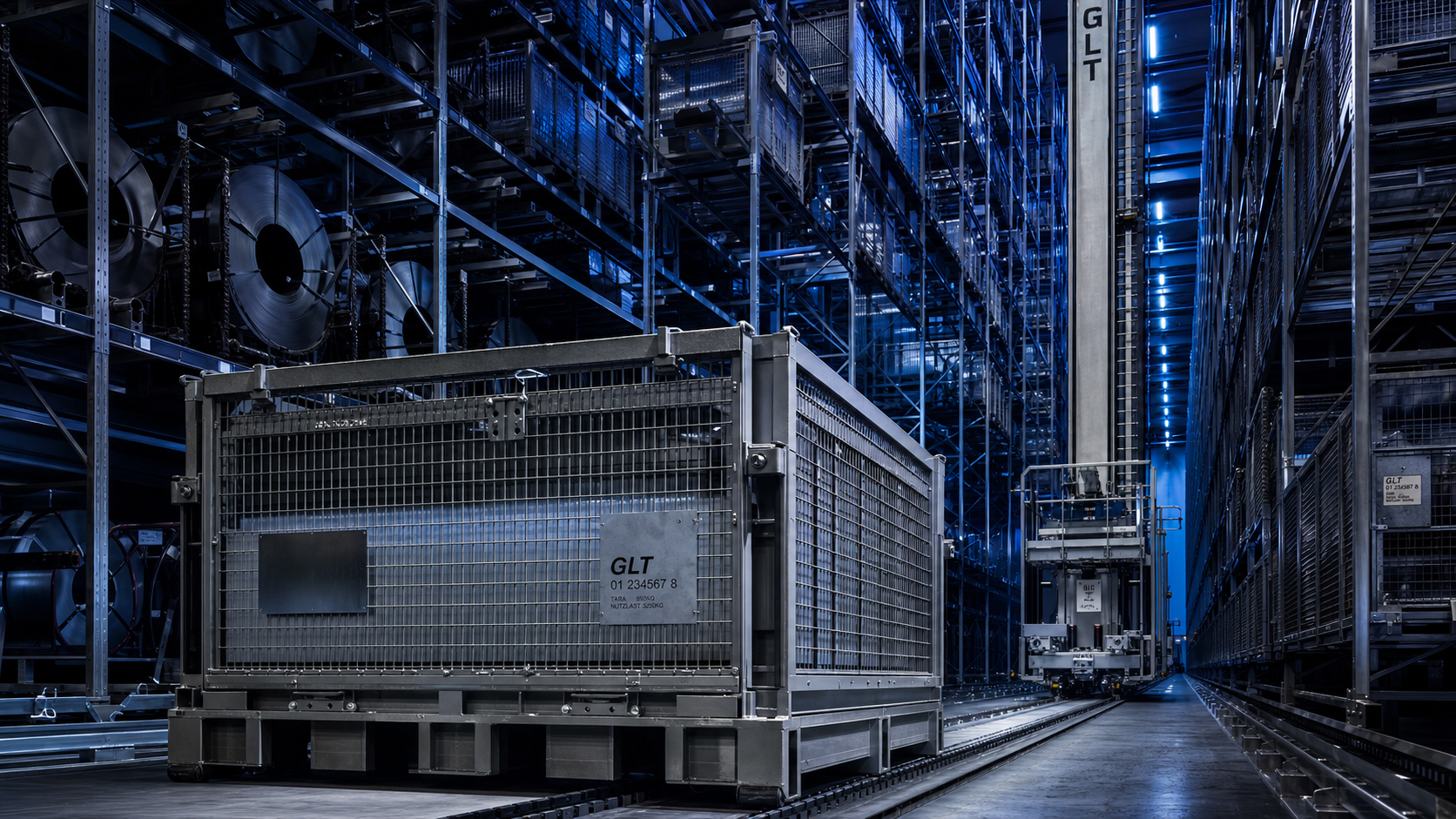
Large load carrier high-bay warehouse: Why the automated heavy-duty high-bay warehouse is the last major efficiency reserve for industry – Creative image: Xpert.Digital
Tons of height: How fully automated heavy-duty warehouses are unlocking the last major efficiency reserve
Fully automated maneuvering of up to 50 tons: The fascinating technology behind modern heavy-duty high-bay racking systems
Euro pallets are a thing of the past: Why industry is now relying on gigantic high-bay warehouses for large load carriers
When things get really heavy, bulky, or highly complex in industrial manufacturing and logistics, the classic Euro pallet inevitably reaches its limits. This is where large load carriers (LLCs) come into their own. Whether it's steel coils weighing tons, oddly shaped car body parts, or enormous battery packs – storing and retrieving such goods with millimeter precision requires a completely new technological approach. Fully automated heavy-duty high-bay warehouses are emerging as the last major efficiency reserve for industry. They not only multiply storage capacity on a small footprint and mitigate the dramatic shortage of skilled workers, but also ensure the precise timing of global supply chains through accurate just-in-sequence delivery. Despite enormous initial investment costs and high structural complexity, these mechatronic masterpieces often pay for themselves in record time thanks to massive savings in space, personnel, and energy. But while the global market – driven by AI and green transformation – is growing rapidly, German SMEs are still conspicuously hesitant. A deep insight into the technological fascination, economic necessity, and strategic urgency of heavy-duty automation.
What a large load carrier really is – and why the distinction from a pallet is crucial
When people in the field of intralogistics talk about high-bay warehouses, they reflexively think of Euro pallets. The 1200 × 800 millimeter dimension is so deeply ingrained in the logistics infrastructure that anything deviating from it is often treated as an exception. However, the world of large load carriers is far larger, heavier, and more economically significant than the common discussion suggests. A large load carrier, technically known as a BLT and standardized according to DIN 30781, is a portable object that combines goods into a single loading unit. The definition sounds simple, but in practice it encompasses an enormous range: from the classic EPAL wire mesh box with a load capacity between 1,000 and 1,500 kilograms, to Magnum-class plastic pallet boxes with capacities exceeding one cubic meter, all the way to custom-welded steel frames for car bodies, engine blocks, or complete powertrains.
The crucial difference between these and the Euro pallet lies not in the footprint, but in three dimensions simultaneously: weight, volume, and geometry. While a loaded Euro pallet rarely weighs more than 1,500 kilograms, the realm of large load carriers begins precisely where conventional palletizing technology reaches its limits. Heavy-duty steel mesh containers can bear loads of up to 6,000 kilograms. Special load carriers for the steel industry, such as coil saddles or slab carriers, move loads of 5 to 50 tons per unit. For a high-bay racking system, this means a completely different engineering starting point than with classic palletizing: foundations, rack statics, load handling devices of the storage and retrieval machines, and the floor panels of the aisle systems must be designed for dynamic point and area loads that would literally cause conventional pallet racking systems to collapse.
In addition, there is the wide variety of types. The market offers standard GLTs for universal applications, specialized GLTs for liquid goods, electronics, or sensitive surfaces, collapsible KLAP GLTs that can be folded down to as little as a third of their volume when empty, and completely customized special load carriers whose geometry is designed exclusively for a single component or a single production line. This diversity is not a luxury, but an economic necessity: Incorrectly sized load carriers cause transport damage, increase empty volumes in truck trailers, and slow down order picking on the production line.
From the ground to the top: The structural logic of the high-bay warehouse for large load carriers
The question of why heavy and bulky goods should be stored vertically at all is answered by the basic economics of land use. Industrial land in Germany, especially in economically strong regions like Baden-Württemberg, Bavaria, or the Rhine-Main area, is scarce and expensive. A square meter of storage space costs many times more in thriving industrial locations than it did ten years ago. A single-story flat warehouse that stores its load carriers close to the ground wastes the entire vertical dimension of the building. A high-bay warehouse, which by definition starts at a height of 12 meters and is legally permitted to reach up to 50 meters in Germany, multiplies the storage capacity on the same footprint by a factor of four to ten, depending on the chosen system height.
For large load carriers, however, a second, often underestimated logic comes into play: sequential production supply. In the automotive, machine manufacturing, and steel industries, it's not just the sheer quantity of stock that matters, but the sequence in which material is delivered to the production line. A manually operated floor storage system for large load carriers inevitably creates the so-called restacking problem: To access a specific large load carrier, previously stored units must be moved, which costs time, creates material risks, and ties up personnel. An automated high-bay warehouse with individually addressable storage locations completely solves this problem: Every large load carrier is directly accessible at any time and in any sequence, fully automatically and without any restacking effort.
The physical architecture of a high-bay warehouse with pallet racking differs from a standard pallet racking system in several key aspects. The aisles between the racking rows must be wider to accommodate the larger dimensions of the pallets and the wider load-handling devices of the storage and retrieval machines. The racking profiles and connecting elements are made of heavier steel profiles. The foundation slabs and floor anchors are dimensioned to withstand the dynamic loads generated during the acceleration and braking of the storage and retrieval machine, multiplied by the inertial mass of heavy pallet racks. The construction is predominantly a self-supporting rack silo, in which the racking structure simultaneously serves as the building envelope: exterior walls and roof are mounted directly to the racking front, eliminating the need for a separate building and significantly reducing the overall investment.
Storage and retrieval machines for large load carriers represent a distinct class of equipment. The market ranges from standard machines for wire mesh containers and industrial pallets up to 1,250 kilograms – such as the psb Maxloader – to medium-duty systems up to 6,000 kilograms in aisle-bound configurations, all the way to the true heavyweights that Vollert Anlagenbau builds for loads of 50 tons and more. Köttgen storage and retrieval machines, for example, operate in silo-style configurations up to 45 meters high and move payloads of up to 8 tons, with special designs allowing for even higher loads. GEBHARDT offers the Cheetah heavy, a machine specifically designed for heavy units such as pallets and wire mesh containers, which is used in high-bay warehouses with system heights of up to 42 meters.
Industries and applications: Who really depends on large load carriers
Demand for high-bay warehouses (GLTs) is concentrated in industries where the manufactured goods themselves are large, heavy, or geometrically complex. The automotive industry is at the forefront, representing one of the pillars of the German economy with annual sales exceeding €400 billion and more than 800,000 employees. Body parts, axle assemblies, transmissions, engine blocks, and, more recently, high-voltage batteries for electric vehicles require customized special load carriers that circulate in global supply chains. ORBIS Europe, for example, offers GLTs for the automotive industry with load capacities of up to 900 kilograms, a folding ratio of 1:3 in empty volume, and proven CO₂ savings compared to single-use packaging for shipping. The requirement for direct access to specific components in a defined sequence makes the fully automated high-bay warehouse a key technology for just-in-sequence production for automotive suppliers.
The steel industry places even greater physical demands on the process. Steel coils from hot or cold rolling processes are coiled strips of sheet metal up to 2 meters wide and weighing between 5 and 30 tons per unit. For a long time, coils were simply stored on the floor, a method that wasted production space, caused damage from pressure points, and made access to specific coil batches virtually impossible. High-bay coil storage systems with cantilever racking and heavy-duty stacker cranes have revolutionized this approach. Vollert Anlagenbau, for example, implemented a fully automated high-bay warehouse with 1,500 coil storage locations, 150 meters long and 11 meters high for a transformer core cutting center in Tianjin. This warehouse, equipped with two stacker cranes and five upstream transfer platforms, ensures the sequential supply of the production lines. The Storemaster systems enable coil racks with bay loads of up to 150 tons per bay and individual coils up to 20 tons.
The paper and printing industries, woodworking, building materials, shipbuilding, and mechanical engineering complete the picture. In paper production, paper rolls with dimensions similar to a coil and weights of up to 4 tons are stored in high-bay warehouses with special handling devices. In mechanical engineering, finished large components, tool carriers, and complex welded assemblies are stored in building management systems (BMS) designed for irregular geometries. Köttgen explicitly cites the woodworking industry, sheet metal processing, automotive, cardboard manufacturing, and shipbuilding as reference sectors. Vollert goes even further, mentioning air freight containers, truck bodies, transformers, and oversized workpieces as objects suitable for storage in heavy-duty high-bay warehouses.
The economic foundation: costs, return and amortization
The investment costs for an automated high-bay warehouse vary depending on the system size, load-bearing capacity, and level of automation. A medium-sized, fully automated high-bay warehouse costs between €5 and €20 million in its standard configuration. For heavy-duty systems handling large load carriers exceeding 3 tons per unit, these figures increase considerably, as foundation work, steel structures, stacker cranes, and load handling devices must be significantly more robust. The complete system, including conveyor technology, warehouse management software, and system integration, can reach investment volumes of €30 to €80 million or more for large facilities.
These figures may sound daunting at first. However, the crucial economic perspective lies not in the absolute investment amount, but in the amortization rate and the total savings in life cycle costs. In practice, automated high-bay warehouses pay for themselves within two to five years, although the currently rising labor costs and the worsening shortage of skilled workers are increasingly shortening this timeframe. A concrete example from real-world experience shows that a medium-sized warehouse can achieve annual savings of around €91,700 through automation compared to manual operation, which corresponds to an amortization period of just 18 months.
The economic advantage comprises several components. Space efficiency is the first and most obvious element: the vertical dimension allows for a significantly higher storage capacity on the same footprint compared to a ground-level warehouse. A sample calculation from warehouse technology practice shows that a channel storage system at a height of 16 meters can accommodate over 2,000 pallet positions on a footprint of only 350 square meters. For larger and heavier warehouse systems, the basic principle remains the same; only the rack geometry is adapted. In expensive industrial locations, the land savings can sometimes exceed the investment costs of the racking system alone.
The second pillar of the economic advantage lies in personnel reduction. A fully automated high-bay warehouse requires no forklift drivers, no stockers, and no manual order pickers for its ongoing operation. It can operate around the clock, without shift premiums, without breaks, and without errors due to human fatigue. The concept of the so-called dark warehouse—a warehouse that operates literally without light or human presence—will no longer be a vision in 2026, but a commercial reality in advanced logistics facilities. This advantage is particularly pronounced in sectors with especially high personnel costs—and heavy-lift logistics requires physically resilient specialists with high qualification requirements.
The third economic dimension concerns the error rate and material damage rate. Heavy, large load carriers with expensive contents—be it a vehicle battery worth €8,000, a steel coil worth €15,000, or a milled engine component worth €25,000—generate significant damage rates when handled manually due to collisions, incorrect storage, and improper stacking. Automated storage and retrieval systems move their loads along precisely calculated trajectories with positioning accuracies in the millimeter range, reducing material damage to almost zero.
LTW Intralogistics Solutions

LTW Intralogistics – Engineers of Flow - Image: LTW Intralogistics GmbH
LTW offers its customers not individual components, but integrated complete solutions. Consulting, planning, mechanical and electrotechnical components, control and automation technology, as well as software and service – everything is networked and precisely coordinated.
In-house production of key components is particularly advantageous. This allows for optimal control of quality, supply chains, and interfaces.
LTW stands for reliability, transparency, and collaborative partnership. Loyalty and honesty are firmly anchored in the company's philosophy – a handshake still means something here.
Related to this:
Why automated high-bay warehouses are now becoming a key strategic investment
The global market: growth, drivers and regional dynamics
The global high-bay warehouse market is experiencing significant growth. Depending on the definition used in the market study, the total high-bay warehouse market was estimated at US$18.2 billion to US$21.7 billion in 2024 and is projected to reach between US$36.7 billion and US$47.1 billion by 2033, representing a compound annual growth rate (CAGR) of 8.1% to 8.9%. The specifically automated segment of the market, i.e., automated high-bay warehouse systems, was valued at US$2.84 billion in 2024 and is expected to grow to US$4.57 billion by 2034, with a CAGR of 7.3%. The overall warehouse racking market, which also includes manual and semi-mechanical systems, was estimated at US$13.89 billion in 2024 and is projected to reach US$27.79 billion by 2032.
The growth drivers are structural in nature. E-commerce is usually cited as the primary driver, but this mainly concerns small-parts automation. For the logistics sector, it is primarily the industrial megatrends that are generating investment pressure. The decarbonization of industry demands denser, more energy-efficient warehouses. Demographic change in all Western industrialized nations is increasingly leaving heavy physical labor in logistics unfilled. The structural shortage of skilled warehouse workers in the heavy-load segment has worsened dramatically: 76 percent of all logistics companies report an acute shortage of skilled workers that extends beyond seasonal fluctuations, and job vacancies in the logistics sector increased by 16 percent from 2024 to 2025 alone.
Germany occupies a structurally significant position in this market. With a market share of 25 percent, Germany is the largest logistics nation in Europe, far ahead of second-placed France. At the same time, the level of investment in German intralogistics is strikingly low compared to other countries. A study by TMG Consultants, which surveyed over 2,500 manufacturing companies between March and July 2024, shows that 63 percent of German industrial companies have not automated their intralogistics or have done so only minimally. Only 11 percent have highly automated processes. This is paradoxical: The country that exports automation technology worldwide is remarkably hesitant to automate its own warehouse processes.
The fastest-growing segment is geographically located in Asia-Pacific. China, South Korea, and Japan are driving massive investments in heavy-duty high-bay warehouses for the steel, automotive, and electrical industries. Accordingly, suppliers like Vollert have been exporting large portions of their project activities to Asia for years, such as the aforementioned transformer core warehouse in Tianjin. Within Europe, the German-speaking countries and the Benelux countries lead the demand, followed by France and Poland, which is increasingly being developed as a production and logistics hub for the European automotive industry.
Technological development: AI, shuttle systems and the next generation high-bay warehouse
The technological core of modern high-bay warehouses has fundamentally changed in recent years. Classic stacker cranes, the only machines moving vertically and horizontally in an aisle, remain the dominant technology for heavy loads over 3 tons – simply because the physical requirements for the supporting structure, drive system, and braking performance do not allow for a lighter alternative. For medium weight classes, however, shuttle systems are also gaining ground in the stacker crane segment. The psb pallet shuttle, for example, enables multi-deep storage, with a stacker crane bringing the shuttle to the channel entrance. The shuttle then autonomously enters the channel, storing the pallets at a significantly higher density and reducing the need for stacker cranes.
Driverless transport systems handle the connection between production and high-bay warehouses. BALYO, for example, has developed a system where counterbalanced AGVs take pallets directly from the packaging line, while autonomous REACHY reach trucks with lifting heights of up to 11 meters navigate high-bay warehouses without infrastructure markers. For heavy loads, specialized autonomous heavy-duty vehicles are being developed that use laser SLAM navigation in 3D warehouse environments to detect and avoid even unknown obstacles.
The decisive technological leap of the current decade lies in the intelligence level. Next-generation warehouse management software combines Warehouse Management Systems (WMS) with real-time AI, integrating inventory forecasting, sequence optimization, and predictive maintenance into a single system. In high-bay warehouses for large load carriers, this means the system not only knows the location of each load carrier but also anticipates which components the production line will need in the next four hours and proactively repositions the storage and retrieval machines to optimize the delivery sequence. Predictive maintenance algorithms analyze vibration signals, current signatures, and temperature data from the storage and retrieval machines and trigger maintenance orders before a failure is imminent, increasing system availability to over 99 percent.
By 2026, the integration of generative AI into warehouse management systems will no longer be a thing of the future, but rather standard practice in new systems from leading manufacturers. Dematic already introduced a new generation of high-performance pallet shuttles in 2024, capable of moving 1,000 pallets per hour – a 20 percent increase over the previous generation. Daifuku describes 2026 as the year in which companies will no longer be testing automation technologies, but rather balancing their optimal place within a portfolio – with a focus on scalability, return on investment, and operational stability.
Sustainability as an economic factor: energy balance, circular economy and ESG pressure
The environmental dimension of GLT logistics has gained a new economic significance in recent years. What was previously considered voluntary reputation management has become a mandatory task with balance sheet relevance due to the EU's Corporate Sustainability Reporting Directive (CSRD). Companies that cannot demonstrate their carbon footprint risk significant regulatory disadvantages in tenders and supply chains from 2025 onwards. Automated high-bay warehouses offer several levers in this context.
The first lever is space efficiency itself. A warehouse that stores five times more units on the same footprint than a flat warehouse requires correspondingly less concrete, less steel in the building envelope, and less operating energy for heating, ventilation, and cooling relative to the number of units stored. In heavy-duty areas, energy-recuperating storage and retrieval machines have become standard: The potential energy recovered when lowering heavy loads is fed back into the warehouse's power grid via energy recovery systems, which can reduce net electricity consumption by up to 30 percent.
The second lever lies in reducing the empty volume of the GLTs themselves. Foldable large load carriers made of plastic, such as those offered by Schoeller Allibert, ORBIS, or con-pearl, reduce their empty volume by a factor of 3:1 to 4:1. This means that when returning empty GLTs to the supplier, a vehicle that would otherwise have needed three trips now only needs one. Multiplied across a Europe-wide supply chain, this results in a significant reduction in truck journeys and thus CO₂ emissions. Contraload, a Belgian specialist in load carrier pooling, manages over 800,000 load carriers across Europe, which complete more than four million round trips annually – a pooling system that significantly reduces users' capital commitment while simultaneously maximizing the utilization of the GLT fleet.
The third lever is systemic in nature: A fully automated high-bay warehouse with a building management system (BMS) operates with LED lighting that is only switched on in active aisles, foregoes heated work areas for people, and can be operated at room temperatures around zero degrees Celsius in winter, provided no refrigerated goods are stored. This reduces energy consumption in the heating area to almost zero. In summer, cooling of workstations is unnecessary. The so-called dark warehouse is therefore not just an automation concept, but an energy efficiency concept.
Investment barriers and structural obstacles: Why expansion is still too slow
The economic logic clearly favors automated high-bay warehouse technology. However, the actual expansion rate is hampered. This has structural causes that go beyond the often-cited high investment costs. The first obstacle is the fear of complexity. An automated heavy-duty high-bay warehouse is not simply a rack that you buy and install. It is a highly integrated mechatronic system that deeply integrates with the company's ERP landscape, production control, and transport planning. The system integration with SAP EWM, as implemented by SSI Schäfer for Losan Pharma, exemplifies the level of complexity that can overwhelm companies without their own intralogistics expertise. Many medium-sized industrial companies, which account for the majority of demand for high-bay warehouse technology, lack both the internal project resources and the integration experience to manage such projects effectively.
The second obstacle is the financing structure. A high-bay warehouse is a long-term fixed asset with depreciation periods of 20 to 30 years. In a business environment increasingly focused on short-term returns on capital, warehouse investment competes with digital projects that promise faster and more visible returns. This is rationally understandable, but strategically short-sighted: The opportunity cost of not investing—rising personnel costs, increasing error rates, space constraints—accumulates silently while the pressure to act intensifies.
The third obstacle is uncertainty about product lifespan. In the automotive industry, the largest user of large load carriers (LLCs), the transformation to electromobility and uncertainties in supply chain geography are leading to significant investment reluctance. If the production of a vehicle model is relocated to another country in five years, or if a new powertrain requires completely different load carrier geometries, investing in a customized heavy-duty high-bay warehouse appears risky. System suppliers' answer is modularity: Modern high-bay warehouses for large load carriers are designed so that rack profiles, load handling devices, and control software can be reconfigured within defined parameters.
The fourth and increasingly significant obstacle is the shortage of skilled workers – this time not on the user side, but on the side of system suppliers. The demand for qualified assembly and commissioning teams significantly exceeds the supply. Project durations are lengthening. Delivery times for specialized components such as heavy-duty storage and retrieval systems, custom-dimensioned steel profiles, and special load-handling devices reach 18 to 24 months during economic booms. Companies that fail to initiate projects now risk missing the next wave of investment.
Strategic recommendation: The time to decide is now
A comprehensive analysis of economic, technological, demographic, and regulatory factors paints a clear picture. The window for a strategically advantageous investment in automated high-bay warehouses is open, but not unlimited. Five lines of reasoning support this assessment.
First, 94 percent of companies that have already invested in intralogistics automation have reported positive or very positive experiences. The technology is proven, and the risks of an initial decision have become calculable thanks to a large pool of references. Second, the actual investment costs in relation to achievable system performance are continuously decreasing due to technological maturation, while personnel costs in the heavy-duty sector continue to rise. Third, the CSRD reporting requirement is increasing the pressure on companies to demonstrate their logistics CO₂ balances, which systematically favors automated, energy-efficient systems over manual warehouses.
Fourth, the regulatory framework is beginning to make manual, opaque supply chains a liability risk: The AI Act and supply chain due diligence requirements demand transparency and traceability in material flows, which only digitized, automated systems with WMS integration can reliably provide. Fifth, high-bay warehouses for large load carriers are no longer a niche technology, but a growing standard component of industrial infrastructure, for which a broad ecosystem of planners, system integrators, financing partners, and operators has emerged, significantly facilitating market entry.
Companies that still operate 63 percent of their intralogistics manually today risk not only rising operating costs but also a structural competitive disadvantage in an era where logistics efficiency directly impacts delivery capability, customer satisfaction, and sustainability ratings. In this context, the high-bay warehouse for large load carriers is more than just a storage solution. It is a strategic infrastructure decision that significantly influences the long-term industrial competitiveness of locations – in Germany, in Europe, and globally.
Consulting - Planning - Implementation

Konrad Wolfenstein
I would be happy to serve as your personal advisor.
me at wolfenstein∂xpert.digital contact
Just call me on +49 7348 4088 965 .
Your container high-bay warehouse and container terminal experts

Container high-bay warehouses and container terminals: The logistical interplay – expert advice and solutions - Creative image: Xpert.Digital
This innovative technology promises to fundamentally change container logistics. Instead of stacking containers horizontally as before, they will be stored vertically in multi-story steel racking structures. This not only allows for a drastic increase in storage capacity within the same area, but also revolutionizes all processes at the container terminal.
More information here:










