
Embodied AI: Europe's last, best chance – When AI gets a body: Why humanoid robots will change our economy forever
Xpert Pre-Release

Available in 27 languages 📢
Prefer Xpert.Digital on GoogleⓘPublished on: July 19, 2026 / Updated on: July 19, 2026 – Author: Konrad Wolfenstein
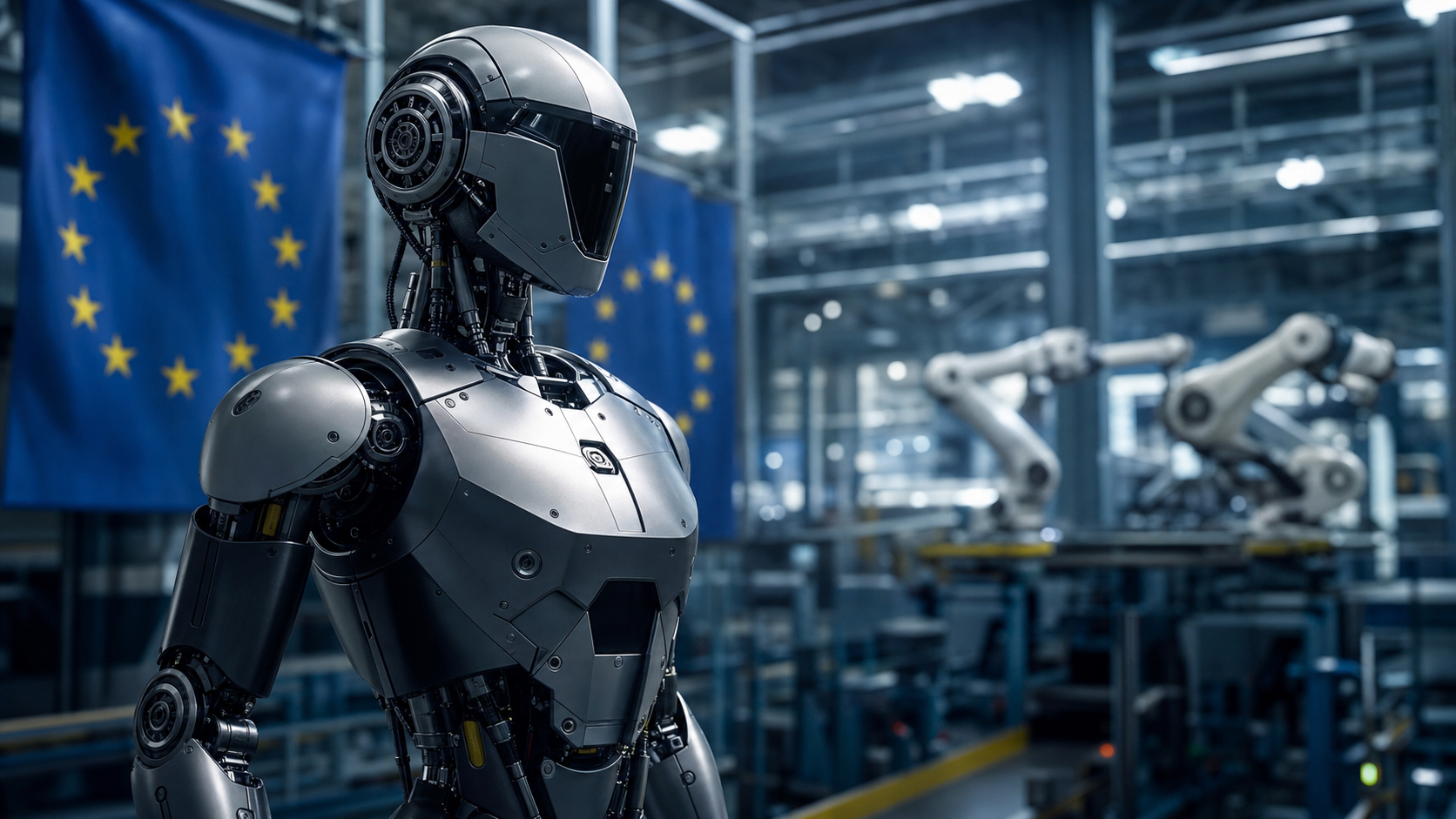
Embodied AI: Europe's last, best chance – When AI gets a body: Why humanoid robots will change our economy forever – Image: Xpert.Digital
The race of the machines: Why the next 3 years will decide Europe's future
Chinese robots are conquering industry: Why Europe urgently needs to wake up now
Humanoid robots have long since left the realm of science fiction behind – they mark the beginning of the next gigantic industrial revolution. While massive government funding and dizzying venture capital are creating a trillion-dollar market for "embodied AI" in China and the USA, Europe stands at a critical turning point. Although the continent continues to boast profound engineering expertise and a world-leading role in traditional industrial robotics, structural weaknesses such as an acute shortage of capital, exorbitant energy costs, and stringent regulations threaten to push Europe to the back of the most important technological trend of the decade. The following analysis ruthlessly exposes the geopolitical and economic dimensions of this global race for machines – and explains which strategic decisions are absolutely necessary in the next two to three years to prevent Europe from being relegated to the role of a mere consumer of foreign technologies.
When machines learn to walk while Europe is still watching
There are moments when technological change ceases to be abstract and suddenly takes shape. When German Chancellor Friedrich Merz visited the Unitree Robotics factory in China and witnessed humanoid robots performing martial arts movements and juggling nunchucks with impressive precision, it served as a wake-up call for many observers. What Western media had long dismissed as a technological gimmick or marketing gimmick has, within just a few years, developed into a serious industrial race. So-called embodied AI, artificial intelligence embedded in physical bodies and thus able to act in the real world, is now considered one of the most significant technological revolutions of the next decade. While multi-billion-dollar industries centered around humanoid robots have long been emerging in China and the United States, Europe is still debating fundamental questions. This is not a mere footnote, but a strategic decision with consequences for prosperity, security, and geopolitical sovereignty.
A new industrial category with explosive growth dynamics
The global market for embodied AI and humanoid robotics has developed astonishing momentum in a very short time. While different market analyses arrive at varying absolute figures depending on the segments and timeframes considered, the trend is clear. Estimates range from a market volume in the high single-digit billions in 2025 to forecasts that anticipate a market of well over two trillion US dollars by 2034, with annual growth rates of around twenty to forty percent. This range illustrates how young and difficult to predict this segment still is, but even the more conservative forecasts describe a technology moving from the research lab to everyday commercial use. Just over thirteen thousand humanoid robots were sold worldwide last year, a tiny number compared to traditional industrial robotics. However, the most optimistic forecasts suggest that annual unit sales could reach several million units within a decade. Should this development prove even remotely accurate, a new basic industrial category would emerge, comparable to the automobile or the smartphone, except that this time the machine would not only transport or communicate, but would independently perform physical work.
China has already achieved manufacturing dominance over the future of robots
Anyone looking at the landscape of embodied AI today will find almost exclusively Chinese names at the top. According to consistent market analyses, companies like AgiBot from Shanghai, Unitree from Hangzhou, and UBTech from Shenzhen together control around 80 percent of global shipments of humanoid robots. AgiBot alone shipped over 5,000 units last year, achieving a market share of nearly 40 percent, followed by Unitree with just over 1,400 units and UBTech with around 1,000 units. According to Chinese government figures, there are now more than 140 manufacturers of humanoid robots in the country, who presented over 330 different models last year. This dominance is no accident, but rather the result of a deliberate industrial policy strategy that enshrines robotics as a key technology in the current five-year plan and supports it with substantial government funding. Furthermore, there is an often underestimated factor: through the massive expansion of its electric vehicle industry, China has already established a highly developed supply chain for batteries, sensors, electric motors, and power electronics. This infrastructure can be transferred almost directly to the production of humanoid robots, enabling Chinese manufacturers to bring new models to market at a pace that Western competitors can hardly match. A Unitree G1 model is already offered at a base price of around thirteen thousand five hundred US dollars – a price level that is currently almost unattainable for European and American manufacturers.
The United States is focusing on capital, computing power, and system integration
While China dominates the manufacturing side, another powerhouse has established itself in the United States, one that focuses on venture capital, software platforms, and semiconductor architecture. Companies like Tesla with its Optimus project, Figure AI, and Agility Robotics have achieved valuations in recent years that must seem staggering to European observers. Figure AI is now valued at around 39 billion US dollars, a figure that dwarfs the entire European robotics industry. At the same time, Nvidia, with its chip and software architecture, has carved out a virtually indispensable position as a supplier of the computing power that humanoid robots need for perception, motion planning, and decision-making. The American strategy thus differs fundamentally from the Chinese one. It is less about the cheapest mass production than about controlling the intelligent layer—that is, the software and chip architecture, on which the physical casing is ultimately just an interchangeable carrier medium. Globally, around 27 billion US dollars in venture capital flowed into the robotics industry last year, more than double the previous year, with the vast majority of this capital going to American and Chinese companies.
Europe's paradoxical starting position between industrial strength and structural weakness
The European situation cannot be reduced to a simple formula because it is more contradictory than it initially appears. On the one hand, the continent boasts the deepest industrial base in the world outside of Asia. Companies like ABB, KUKA, Universal Robots, and Comau pioneered the category of collaborative robots, or cobots, and continue to hold a significant share of this market segment. The European robotics market as a whole is estimated at well over sixteen billion euros for the current year, with particularly dynamic growth in warehouse robotics and healthcare service applications. Four of the ten countries with the highest density of industrial robots worldwide are located in Europe, demonstrating deeply rooted industrial expertise. On the other hand, a painful gap exists when it comes to the next generation of this technology: general humanoid systems. Europe lacks a single company that can compete with the leading Chinese or American suppliers in terms of production volume, investment, or technological market maturity. Even the Norwegian company 1X Technologies, which is occasionally cited as Europe's hope, is largely backed by American capital, so it is more of an example of foreign money on European hardware than of genuine technological independence.
The capital problem as the real bottleneck
Anyone analyzing the reasons for Europe's lagging position repeatedly arrives at the same figure: the share of global venture capital. Last year, European companies accounted for a mere fourteen percent of global robotics investments, while the United States garnered well over half and China a good quarter of the global capital. This difference is no small matter, but rather the very core of the problem, because in an industry where technological iteration speed determines market share, less capital automatically translates into slower development cycles. No European robotics company has yet achieved a valuation that even comes close to the multi-billion-euro funding rounds of its American or Chinese competitors. While over four hundred financing rounds with a total volume of around three and a half billion euros were completed in Europe last year, concentrated primarily in Germany, France, Denmark, and Norway, this volume seems almost modest by international standards. Public funding through programs such as the European Robotics Partnership with a volume of over two billion euros, as well as supplementary funds from the Union's digital program, are welcome, but do not replace a risk-tolerant private capital base such as exists in Silicon Valley or in the Chinese technology clusters of Shenzhen and Hangzhou.
The Schaeffler-Kuka question: When national champions are in foreign hands
A particularly sensitive chapter in the history of European robotics concerns ownership. The German robot manufacturer KUKA, once a symbol of German engineering and automotive manufacturing precision, has been owned by the Chinese Midea Group since 2016. This acquisition, which was already controversial at the time, appears in a new light from today's perspective, as it exemplifies how Chinese companies have systematically integrated European engineering expertise into their own industrial base, while domestic alternatives have barely been able to develop. Similar patterns can be seen in other areas of the value chain, such as among suppliers of precision components. While the political debate about stricter investment screening for the acquisition of critical robotics companies has gained momentum in recent months, experts rightly point out that a purely defensive strategy will not solve the underlying problem. As long as European companies remain undercapitalized, takeover bids from abroad will continue to appear attractive, regardless of how stringent the formal review process is.
Current positions: German companies searching for their own path
Despite the overall sobering results, there are some remarkable individual initiatives within Europe. The German company Neura Robotics from Metzingen has demonstrated with a nine-figure funding round that it is indeed possible in Europe to raise ambitious sums of capital for a software-centric approach to embodied artificial intelligence. The automotive supplier Schaeffler has established a strong position in international competition through its Humanoid Robotics division and is consciously positioning itself as a voice warning against prematurely writing off Europe. Franka Emika from Munich, a spin-off project of the Technical University of Munich and the German Aerospace Center (DLR), continues to be an internationally recognized benchmark for precise, torque-controlled robot arms used in research and precision assembly. These examples prove that European engineering expertise is by no means exhausted. The problem lies less in technical competence than in the ability to transform promising prototypes into truly scalable, globally viable series products before the window of opportunity closes completely.
The regulatory dual role: both a shield and a brake
One aspect often overlooked in public debate concerns the role of European regulation. With the Artificial Intelligence Directive and the revised Machinery Directive, the European Union became the first major jurisdiction in the world to establish an explicit legal framework for autonomous robotic systems, requiring conformity assessments, mechanisms of human oversight, and explainable decision-making processes. This regulation can be viewed from two entirely different perspectives. On the one hand, it undeniably creates additional effort and costs for young companies already struggling with a lack of capital, and it slows the market launch of new systems at a pace that hardly seems appropriate for international competition. On the other hand, decades of experience with CE certification and collaborative safety standards have given Europe a level of expertise that foreign competitors must painstakingly develop if they want to gain a foothold in the European market. Whether this regulatory depth proves to be a competitive advantage or an additional constraint in the long run depends crucially on how consistently the Union balances necessary consumer protection with industrial capability in the coming years. The experience with platform regulation in the area of digital services, where Europe set global standards but produced hardly any of its own global corporations, should be seen as a warning.
🎯🎯🎯 Data-driven B2B industry hub as a quasi-in-house solution

The quasi-in-house solution: How Xpert.Digital closes operational gaps in B2B marketing and sales – Smart Content-Driven Business - Image: Xpert.Digital
Xpert.Digital is a data-driven B2B industry hub led by Konrad Wolfenstein . The company acts as an external, quasi-in-house solution for industrial partners, closing operational gaps in marketing, content, and sales – without requiring additional resources on the client side.
More information here:
When robots become part of geopolitics: Recognizing Europe's strategic dependency
Energy prices as an underestimated competitive factor
Besides capital and regulation, a third factor plays a role that is often neglected in public discourse: energy costs. According to consistent industry analyses, European manufacturers pay two to three times more for electricity than their American or Chinese competitors. For an industry that relies on highly automated, energy-intensive production processes, this is not a minor issue, but a structural cost disadvantage that directly impacts the competitiveness of robotic systems manufactured in Europe. If a Chinese manufacturer can produce its robots with significantly cheaper energy and simultaneously utilizes a fully integrated domestic supply chain, while European manufacturers have to cope with both higher energy costs and fragmented supply structures, the price difference at the end of the value chain becomes almost inevitable. This reality cannot be compensated for solely through subsidies or funding programs, but requires a fundamental reorientation of energy policy that extends far beyond the robotics industry.
The demographic double effect: labor shortage as both an opportunity and a risk
An interesting special factor that should actually strengthen Europe's position is demographic development. In Germany alone, there were recently over two million unfilled positions in the industrial sector, a structural labor shortage that will worsen in the coming years due to the retirement of the baby boomer generation. In theory, this shortage creates enormous demand for automated solutions that can take over repetitive, physically demanding, or unattractive tasks. China uses precisely this connection as the official justification for its investments in humanoid systems, with the stated goal of achieving productivity gains and reducing its dependence on immigration. For Europe, this development presents both an opportunity and a risk. The opportunity lies in the fact that a huge domestic market for robotic systems will exist once the technology is sufficiently mature. The risk lies in the fact that this market will ultimately be served predominantly by imported systems from China or the United States, thus turning Europe into a mere consumer of a technology it could have helped shape.
Geopolitical dimension: When robots become strategic weapons
The geopolitical implications of embodied AI are often underestimated because, at first glance, it appears to be a purely economic question of competitiveness. In reality, the technology carries a deeper security dimension. Whoever controls the production and software architecture of humanoid robots potentially also controls the ability to equip these systems with remote shutdown functions, backdoors, or export restrictions. Analysts are already warning of a scenario in which countries with dominant market positions could use their supremacy as geopolitical leverage against purchasing countries, similar to what is currently being observed with rare earth elements, semiconductors, or energy resources. An example that illustrates this concern is the decision by the European aerospace company Airbus to use humanoid systems from the Chinese manufacturer UBTech in its own production lines. When even Europe's flagship industrial company in the high-tech sector relies on Chinese robotics because no equivalent European alternative exists, it reveals the depth of strategic dependency into which the continent risks becoming entangled.
The fine line between realism and capitulation
Given this starting point, it would be naive to demand complete technological independence for Europe across all application areas of embodied AI. The gap with China in mass production and with the United States in software and chip architecture is now so pronounced that attempting to become competitive in every segment simultaneously would be unrealistic and economically wasteful, given limited fiscal resources. A more realistic and strategically wiser approach seems to be a focused one that concentrates on those use cases where technological sovereignty is genuinely relevant to security, such as in the areas of government infrastructure, critical supply chains, or defense-related applications. For these sensitive areas, Europe should be able to offer its own, albeit potentially more expensive, alternatives to protect itself against external dependencies. For the vast majority of civilian applications, however, a pragmatic coexistence with imported systems appears more economically sensible, as long as no critical data or control structures are transferred to foreign providers.
Structural reforms instead of ad hoc subsidies
The crucial lesson from Europe's past handling of disruptive technologies, from the solar industry to artificial intelligence in software, is that targeted support programs for individual companies rarely generate sustainable competitiveness. Structural reforms that improve the fundamental framework for the entire sector are more effective. This primarily includes easier access to private growth capital, for example, by deepening the European Capital Markets Union, which would make it easier for institutional investors such as pension funds and insurance companies to invest in venture capital funds. It also includes making rigid labor market regulations more flexible, as these regulations hinder growth, particularly for young, rapidly expanding technology companies. And it includes rigorous due diligence on acquisitions of critical hardware manufacturers, coupled with targeted incentives to prevent these companies from ever reaching the point of financial distress that would make a foreign takeover attractive in the first place. These three elements are interconnected and cannot be considered in isolation, because without sufficient capital, any due diligence ultimately only delays the inevitable.
The data issue as the real battleground of the coming years
An increasingly important aspect, extending beyond the purely hardware and capital-related questions, concerns the availability of training data for physical interaction with the real world. While large language models can be trained on enormous amounts of text from the internet, no comparable, freely available data source exists for the physical motion control of robots. Manufacturers must either train their systems in complex simulation environments, which, although they provide large quantities of synthetic data, only incompletely represent the unpredictability of the real world, or they must collect actual operational data from real-world deployment environments, which requires time, patience, and, above all, a critical mass of already deployed systems. This is precisely where one of China's hidden structural advantages lies: the sheer number of units already delivered to factories, warehouses, and public spaces continuously generates new training data, which in turn improves the next generation of models. This self-reinforcing cycle of more deliveries, more data and better models is difficult for latecomers to break unless they succeed in tapping into alternative data sources, for example through Europe-wide cooperation projects between industry and research institutions that share operational data on a large scale.
A European Airbus model for robotics: Ambition meets execution risk
In political circles, the idea of creating a cross-sector European consortium for humanoid robotics, modeled on the historical example of aircraft manufacturer Airbus, is increasingly being discussed. Airbus was originally founded through a collaboration of German, French, and other European partners to create a worthy competitor to the American industry giant Boeing. The basic idea of such a robotics consortium is compelling, as it would pool fragmented national expertise and capital bases, creating a critical mass that individual European companies cannot achieve on their own. At the same time, the historical example of Airbus demonstrates just how long and arduous such a process can be before it truly bears fruit, and how political will alone is no guarantee of entrepreneurial success. Airbus needed decades, substantial government support, and a patient industrial strategy before it became a serious global competitor. Given the rapid pace of development in the robotics industry, where technological leadership can shift within a few years, it is questionable whether Europe has the time to endure a similarly lengthy development process before international competition has already been irreversibly decided.
Why the next two to three years could decide decades to come
The key finding from analyzing all available market data and expert opinions is that the embodied AI industry is currently at a critical juncture where early technological leadership can transform into sustained market dominance. Similar to the development of the internet, smartphones, or, more recently, major language models, such early market phases generate self-reinforcing advantages through network effects, economies of scale in manufacturing, and continuous improvement through usage data. Those who lead at this stage typically consolidate their advantage, while laggards increasingly struggle to close the gap. For Europe, this means that the political and business decisions of the next two to three years will have a disproportionately large impact on the continent's long-term positioning. Delaying action, motivated by fiscal caution, political disunity, or simply an underestimation of the urgency, could prove more costly than any short-term stimulus that seems necessary today. At the same time, this urgency should not lead to blind activism that distributes funding across the entire industry without clear prioritization and without achieving any real leverage.
A realistic roadmap balancing ambition and resource scarcity
If Europe is serious about improving its position in embodied AI, there is no way around clear prioritization. First, political leaders must recognize the gravity of the situation and treat robotics as a key strategic technology, comparable to the importance already accorded to semiconductors or energy security. Next, the focus should be on those areas where Europe still possesses real competitive advantages, particularly in precision components such as actuators, safety-related certification processes, and specialized industrial applications where quality and reliability are more important than pure price competition. In parallel, the issue of capital must be addressed more decisively, for example, by accelerating the completion of the Capital Markets Union and implementing targeted public co-investment programs that complement, rather than crowd out, private venture capital. Finally, Europe should not view its regulatory strength as an end in itself, but rather as a tool for shaping international standards that foreign suppliers must also adhere to if they wish to access the European market. This combination of strategic prioritization, improved access to capital, and intelligent use of regulation does not guarantee success, but it describes the most realistic path on which Europe can still play a relevant role in the embodied AI future, instead of becoming a mere market for foreign technologies.
Your global marketing and business development partner
☑️ Our business language is English or German
☑️ NEW: Correspondence in your native language!

Konrad Wolfenstein
I and my team are happy to be available to you as your personal advisor.
You can contact me by filling out the contact form here [email protected]:or simply call me at +49 7348 4088 965. My email address is
I'm looking forward to our joint project.
☑️ SME support in strategy, consulting, planning and implementation
☑️ Creation or realignment of the digital strategy and digitization
☑️ Expansion and optimization of international sales processes
☑️ Global & Digital B2B trading platforms
☑️ Pioneer Business Development / Marketing / PR / Trade Fairs
Our EU and German expertise in business development, sales and marketing

Our EU and German expertise in business development, sales and marketing - Image: Xpert.Digital
Industry focus areas: B2B, digitalization (from AI to XR), mechanical engineering, logistics, renewable energies and industry
More information here:
A thematic hub offering insights and expertise:
- Knowledge platform covering global and regional economies, innovation and industry-specific trends
- A collection of analyses, insights, and background information from our key areas of focus
- A place for expertise and information on current developments in business and technology
- A hub for companies seeking information on markets, digitalization, and industry innovations









