Alstom invests in Bautzen: Why a new logistics center could be crucial – 30 to 50 million euros for logistics
Xpert Pre-Release

Available in 27 languages 📢
Prefer Xpert.Digital on GoogleⓘPublished on: October 20, 2026 / Updated on: October 20, 2026 – Author: Konrad Wolfenstein
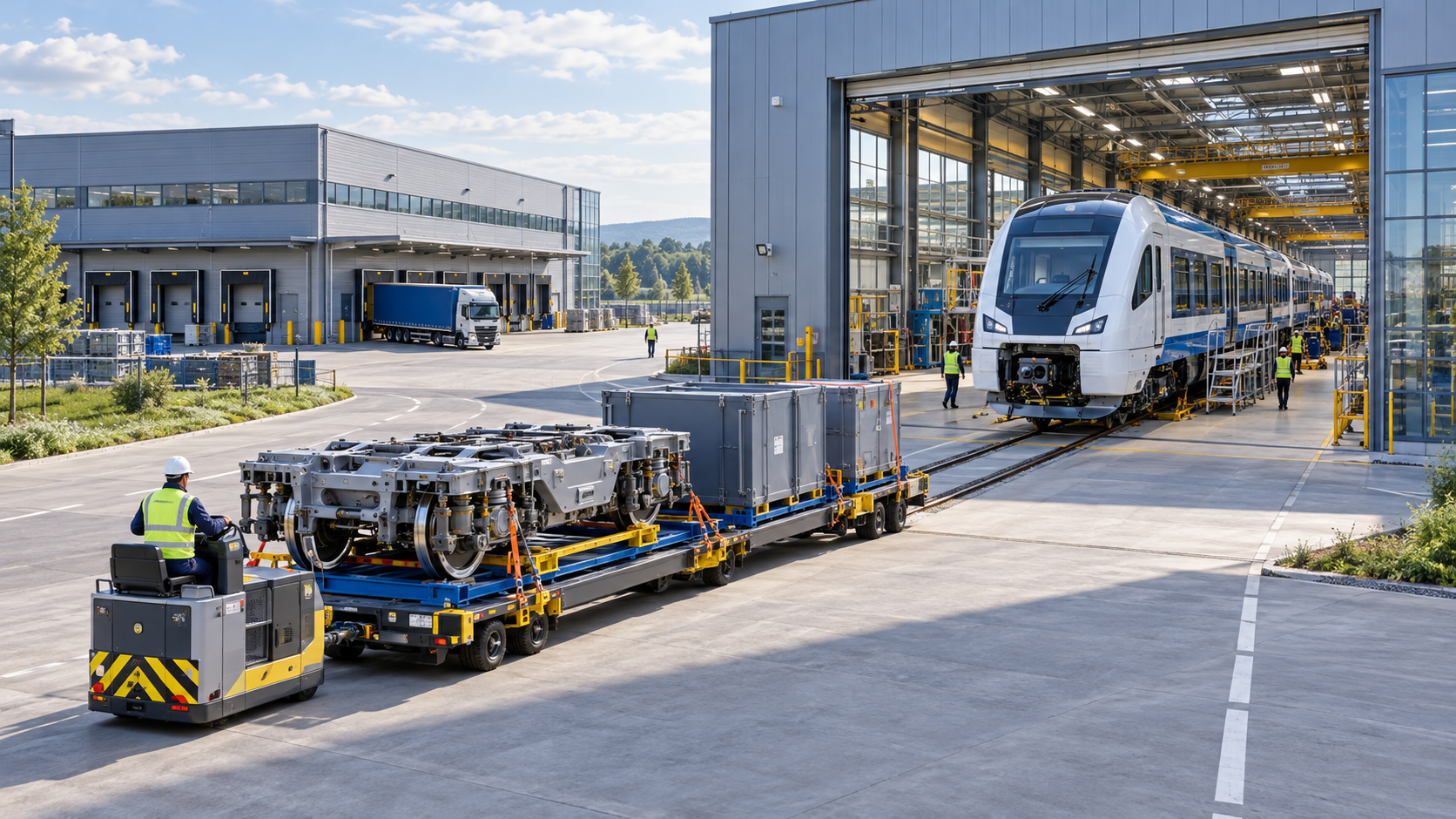
Alstom invests in Bautzen: Why a new logistics center could be crucial – 30 to 50 million euros for logistics – Creative image on the topic, with AI: Xpert.Digital
Full order books, tight deadlines: Bautzen's major challenge in train construction
Alstom plant in Bautzen is growing – but its success depends on the flow of materials
30 to 50 million euros for logistics: What Alstom wants to achieve in Bautzen
Alstom is expanding its Bautzen site: New production areas, a broader vehicle portfolio, and a planned logistics center are intended to strengthen production for upcoming train programs. However, full order books and additional halls do not guarantee on-time deliveries or improved margins. The crucial factor is whether materials, employees, and production work together reliably – and whether the new center eliminates a genuine bottleneck instead of simply creating more storage space. A look at the investments, the order situation, and the economic risks reveals the criteria by which the future of the Bautzen plant will be measured.
Alstom in Bautzen: Why the future of train manufacturing lies in material flow
Full books don't build trains: More trains from Bautzen? Why additional halls alone aren't enough
Alstom's expansion in Bautzen is more than just a regional investment: the site combines additional production capacity with the planned development of a more efficient material supply system. The economically decisive factor is not the size of the next production hall, but whether guaranteed demand translates into on-time delivery of high-quality, cost-effective vehicles. The planned logistics center should therefore be considered as part of the production system, not merely as a real estate project.
This perspective changes the view of site development. A full production program creates planning security, but it doesn't eliminate material bottlenecks or complicated processes. Bautzen's industrial future will have to be measured by how reliably manufacturing, suppliers, employees, logistics, and technical acceptance work together. The central question is not just whether there is enough work, but whether this work can be carried out competitively in the long term.
A traditional company changes its role
In 2026, Bautzen will celebrate 180 years of vehicle manufacturing tradition; the industrial development of the site dates back to 1846. Today, final assembly, commissioning, delivery, and testing of modern rail vehicles are among its core tasks. The production range includes trams, light rail vehicles, commuter trains, and regional trains. This combination makes the plant an industrial hub where diverse components, technical systems, and customer-specific requirements are brought together to create a fully functional product.
A significant expansion took place in July 2024 with the addition of a production line for Coradia Stream regional trains. The first program involved 34 six-car trains destined for Romania, each with 350 seats and a top speed of 160 kilometers per hour. This broadened the industrial portfolio beyond its previous specialization. From an economic perspective, this makes sense because multiple vehicle segments can cover different demand cycles. At the same time, the organizational complexity increases when different designs, configurations, and production sequences require the same space and logistical resources.
Diversification is therefore not a free safeguard against fluctuations in demand. It only works if standards in work preparation, material provision, and quality assurance increase accordingly. Otherwise, a greater product variety leads to additional search times, relocations, and delivery risks. Expanding the portfolio and reorganizing logistics are therefore economically inextricably linked.
Investments must eliminate bottlenecks
In the five years leading up to the start of 2026, approximately €33 million was invested in infrastructure and modernization of the Bautzen site. Of this, around €12 million was allocated for 2025. A further €8.5 million was earmarked for 2026, including funds for production halls, offices, and a small factory railway station. These figures should not be added together indiscriminately: the €12 million is already included in the aforementioned five-year total, while the €8.5 million represents additional planning for 2026.
The investment logic is particularly evident in the case of a hall extension inaugurated in January 2026. The relevant track system was extended from 45 to 100 meters. The measure cost around one million euros and, in its final stage, is intended to enable an additional capacity of up to 60 trams per year. However, this does not imply a corresponding increase in overall factory production: the figure explicitly refers to a single section of the manufacturing process.
This is precisely where a frequently underestimated rule of industrial investment lies. An additional production hall only generates more saleable vehicles if upstream and downstream processes keep pace. If final assembly is the bottleneck, its expansion can yield significant benefits. If the bottleneck then shifts to material supply, commissioning, or acceptance testing, the next improvement must begin there. Economic modernization, therefore, means optimizing the entire system, not simply expanding individual pieces of equipment.
The warehouse becomes production infrastructure
For the planned logistics center, an investment framework of 30 to 50 million euros was announced in September 2026. Cooperation with a logistics partner is planned. The construction costs and economic responsibility should not automatically be attributed entirely to Alstom, as a detailed breakdown of financing, ownership, and operation has not yet been reliably demonstrated.
The objective situation is clear: Storage capacity directly at the plant is insufficient for existing material requirements, which is why materials are currently stored off-site. The planned consolidation aims to increase proximity to production and reduce additional truck movements between storage locations and the plant. Furthermore, the development plans for the Preuschwitz area include additional storage space, improved transport access, and land reserves for other companies.
Caution is advised regarding the timeline. A possible groundbreaking in 2026 and a planned start of construction sometime in 2027 are both mentioned in the timeline for autumn 2026. It is unclear whether these represent different project phases. A binding completion date, a final confirmed floor area, and proven annual savings cannot be derived from this. Therefore, for a sound economic analysis, the center remains a concrete project with considerable potential, but not yet a realized productivity success.
Why short distances save money
The most significant benefit of logistics close to production lies not only in the reduced transport mileage. Efficient on-site logistics can also reduce waiting times, parts searches, supply errors, and disruptions on the production line. For Bautzen, it would therefore be particularly relevant whether the reorganization reduces the likelihood that a vehicle cannot be processed further due to a missing or incorrectly supplied component.
A train can be largely assembled and still block a valuable workstation. For example, if a released door component is missing, the technical completion may not be possible. The problem is then not the value of that single part, but its impact on the entire workflow. Employees have to reschedule, other vehicles are rerouted, materials are moved again, and work already completed remains tied up in the production process for longer. This example describes a general mechanism of action, not a proven specific incident at the Bautzen plant.
From this perspective, a logistics center can act as a productivity investment, even though no trains are assembled there. Its function lies in reliably supplying the assembly line with the right material in the right condition. A good warehouse is therefore not necessarily the one with the most storage spaces. It is the one that supports production with minimal effort, as few errors as possible, and a response time that matches the production flow.
Vehicle programs require reliable material flows
A key factor in ensuring future capacity utilization is the train program for the S-Bahn (suburban rail) in the Rhineland, with production planned for Bautzen. It comprises up to 90 new trains; the two variants are approximately 150 and 170 meters long, respectively. The shorter version consists of nine cars, the longer one of eleven. Trial operations are scheduled to begin in mid-2029; the fleet is expected to be gradually deployed by the 2033 timetable year.
Such programs create a multi-year planning horizon, but at the same time place high demands on space, maneuvering options, and the scheduling of assembly. Long vehicles require suitable workstations and an infrastructure that supports their movement within the plant. Material supply and vehicle movement should therefore be planned together. Additional storage space alone does not solve the problem if the routes to the line are unsuitable or if there is insufficient space for finished and unfinished vehicles.
The economic scale must also be properly assessed. The Rhineland program has a total volume of more than four billion euros, including 34 years of maintenance. This amount is neither a short-term revenue for the Bautzen plant nor a purely vehicle manufacturing value. The development is primarily based in Hennigsdorf, with production in Bautzen and maintenance at depots in the Cologne area. The regional significance is considerable, but a sound evaluation must not equate the entire long-term value chain with local value creation.
Increased demand does not guarantee profitability
The industry environment supports the development of the region. The German rail industry generated revenue of €15.6 billion in 2025, compared to €15 billion the previous year. The value of new orders increased by 19 percent to €21.8 billion. Vehicle orders grew by 12 percent, while the infrastructure business increased by 36 percent. These differences demonstrate that a general rail boom does not have a uniform impact on all sectors.
For Bautzen, these figures are a positive demand signal, but not proof of a specific local profit margin. Industry revenues include vehicle manufacturing, infrastructure technology, signaling technology, components, and services. Furthermore, an increase in revenue initially describes a nominal increase in value and not automatically an equivalent increase in the actual quantity produced. Without appropriate price adjustments, no precise statement about productivity should be derived from this.
This creates an economic tension. Strong demand makes it easier to utilize existing capacities and can justify investments. However, when several programs ramp up simultaneously, the demands on personnel, suppliers, and equipment increase. Growth may then require additional upfront financing and more coordination before it improves profitability. The crucial factor is not just how much a plant could produce, but how much it can reliably deliver under realistic conditions and at a profit.
The global market does not grow without limits
Internationally, demand trends are also generally favorable. The global rail technology market is expected to experience average real growth of 3.2 percent per year between the reference period of 2023 to 2025 and the period of 2029 to 2031. The annual market volume is projected to increase from approximately €221 billion to €266.8 billion. This figure includes not only rolling stock but also infrastructure, signaling technology, services, and other system services.
At the same time, the share of the global market accessible to European suppliers has fallen to 56 percent, down from 59 percent in the previous study. For a location like Bautzen, this is an important counterpoint to the simplistic narrative of growth. A larger global market does not automatically translate into a correspondingly larger sales area for European plants. Market access, local production requirements, and geopolitical conditions can render a portion of the demand economically unattainable.
This results in a sober assessment of the location's future. Bautzen should neither rely solely on increasing global rail investments nor underestimate international markets. Proximity to European customers and the ability to reliably manufacture complex vehicles remain a plausible competitive advantage. However, this advantage must be realized through quality, delivery capability, and efficient processes. Modern logistics can contribute to this, but it does not replace competitive products or a robust international market strategy.
The group demonstrates the implementation risk
The figures from the Alstom Group illustrate why material flow and production control are so economically important. In fiscal year 2025/26, which ended on March 31, 2026, revenue reached €19.171 billion. Order intake amounted to €27.628 billion, and the backlog of work stood at approximately €104.4 billion. At the same time, the adjusted operating margin declined from 6.4 to 6.1 percent. Free cash flow decreased from €502 million to €336 million.
The figures describe a group with strong demand whose economic challenge lies primarily in implementation. Delays in some major vehicle programs impacted earnings and cash flow. This does not imply that Bautzen was responsible for these burdens. However, the group's performance illustrates the structural risk of the industry: A comprehensive production program only becomes economically successful when development, supply, manufacturing, and delivery work together as planned.
In the first quarter of 2026/27, group sales rose to €4.734 billion, while order intake declined by 37 percent compared to the same quarter of the previous year. At the end of June 2026, the order backlog remained at €102.8 billion. This contrasting trend suggests caution regarding individual quarterly figures. Large vehicle programs generate uneven order patterns. Therefore, for location decisions, multi-year capacity utilization, actual production progress, and the quality of economic implementation are more meaningful than an isolated snapshot.
Capital commitment determines room for maneuver
A key problem in complex manufacturing is the time between purchasing materials and the economic completion of vehicle delivery. The longer components are stored or unfinished vehicles wait for the next work steps, the longer operational resources remain tied up in the process. For Bautzen, the new logistics system should therefore not only enable faster transport but also contribute to a better balance between inventory levels, production progress, and actual delivery capability.
However, equating a central warehouse with lower inventory levels would be premature. Replacing several external warehouses with a larger facility initially only changes the storage location. A financial benefit only arises when excess inventory can be avoided, materials are more reliably available, or lead times are reduced. Conversely, a larger building without improved planning can create additional capacity that only exacerbates the same existing problems.
The appropriate objective, therefore, is not to reduce inventories indiscriminately. The crucial factor is determining which stock levels offer genuine protection against production interruptions and which merely mask planning errors. Critical components with long lead times must be handled differently than readily available standard parts. The economic efficiency of modern production logistics lies precisely in systematically considering these differences, rather than managing all materials according to the same blanket rule.
Your intralogistics experts

Consulting, planning and implementation of complete solutions for high-bay warehouses and automated storage systems - Image: Xpert.Digital
More information here:
Alstom Bautzen: The path to modern logistics
Centralization requires a security plan
Consolidating warehousing functions can simplify transportation and increase inventory transparency. At the same time, it creates a greater dependence on a central hub. This dependence should be explicitly considered when evaluating the project. A center that operates cost-effectively under normal conditions but interrupts the entire material supply in the event of a disruption would have limited efficiency.
Therefore, the design should take into account technical failures, IT disruptions, blocked access routes, and short-term production changes. This is not to suggest that such events are imminent in Bautzen. It is about how an economically vital supply center can remain operational even under adverse conditions. Suitable emergency procedures, clearly defined minimum stock levels at the production line, and alternative supply routes should therefore be part of the concept.
The economic value of a reserve also requires a nuanced assessment. Additional space initially appears to be a cost factor. However, if it facilitates future modifications or mitigates a disruption, it can represent a sensible safeguard. Conversely, it would be unconvincing to justify every unused capacity as a necessary resilience measure. Reserves should arise from comprehensible risks and concrete potential uses, not from a vague sense of security.
Partnership does not replace clear responsibility
The planned collaboration with a logistics partner opens up several conceivable organizational structures. For example, various combinations of real estate provision, warehousing, and production-related services would be possible. The specific design planned for Bautzen cannot be reliably determined from the current project status. Therefore, it would be speculative to assume specific rental costs, financing models, or a particular impact on the balance sheet at this time.
The fundamental economic considerations are nonetheless interesting. A specialized partner could contribute experience in warehouse operations, personnel deployment, and technical systems. At the same time, material supply must not become an interface where manufacturing and service providers optimize their respective sub-goals while overall performance suffers. A warehouse can operate efficiently on paper and still be unsuitable for assembly if delivery dates or priorities are not aligned.
Responsibility should therefore be aligned with the supply of production. The crucial factor is not solely the number of units picked per hour, but whether the required parts arrive at their designated workstations complete, without defects, and on time. Changes to the vehicle program must also be quickly incorporated into logistics planning. A good partnership not only shifts tasks but also creates a shared understanding of how performance is measured and how disruptions are resolved.
Digitalization begins with reliable data
Linking warehouse management, production planning, and actual material movements is a key lever of modern intralogistics. Such a seamless view would be particularly valuable for Bautzen because different vehicle programs access shared spaces and resources. A prerequisite would be a reliable database: article descriptions, inventory levels, technical modification statuses, and staging locations would need to be consistent.
A component is not automatically available for assembly simply because it is listed in inventory. Crucial factors are its actual location, correct design, required release status, and timely delivery. Therefore, for effective digitalization, the first step should be to determine what information is needed for production decisions. Only then should the question arise of which technical tools will be used to collect and process this information.
Automatic identification, digital warehouse management, tracking systems, and simulated material flows can help in this regard. A digital twin can examine various layouts and load situations before their construction. However, this does not mean that such systems are already mandatory for the Bautzen center. They describe sensible testing options. Their benefits should be demonstrated by fewer defective parts, shorter search times, and more stable production, not simply by the number of installed sensors or software applications.
Automation must fit into vehicle manufacturing
Regarding the technical equipment, a differentiated solution would be more convincing than a blanket maximization goal. Regularly moved small parts have different requirements than bulky, delicate, or highly variable components. A highly automated process can be advantageous if its workload is well-prepared. For frequently changing dimensions or low repetition rates, a more flexible, partially manual solution may be more economically superior.
Therefore, the evaluation should consider investment costs, ongoing operation, maintenance, susceptibility to malfunctions, and future adaptability together. Space requirements and the safety of people in the vicinity of automated transport systems must also be factored in. General intralogistics planning takes different technology options into account and evaluates them using material data, motion profiles, and simulations.
The use of artificial intelligence should be assessed with similar objectivity. Such methods can, for example, identify unusual trends in demand or impending bottlenecks in supply networks. This could be helpful for a plant with several parallel vehicle programs. However, suitable data and clearly defined decision-making processes remain prerequisites. A forecast alone will not procure a missing part. The real economic benefit only arises when a detected deviation leads to effective action early enough.
Employment needs reliable standards
For Bautzen, figures for September 2026 indicate approximately 1,200 employees and a production of about 40 vehicles per month. These figures reportedly include around 180 people from the former Görlitz plant. However, at the beginning of 2026, depending on the source, higher workforce figures of around 1,400 to 1,500 employees were reported. Without a standardized definition, these figures cannot be interpreted as a precise time series.
In particular, this does not allow for the conclusion that there will be a reduction in staff, nor can it be clearly quantified as an increase in employment. A reliable comparison would require the same reference date, the same employee groups, and uniform rules for external staff or trainees. Furthermore, the figure of 40 cars per month should not be confused with 40 complete trains. A simple extrapolation would also not constitute a binding annual production target.
The central labor market policy question extends far beyond mere headcount. More efficient logistics should relieve assembly workers of avoidable search, transport, and waiting tasks. At the same time, demands on warehouse management, IT, maintenance, and technical coordination may change. Whether this leads to the creation of additional jobs or a shift in existing tasks depends on the specific company organization and production volume. A sound analysis should therefore neither promise a blanket job creation nor automatically equate automation with job losses.
Regional supply chains without isolation
An interesting aspect of the site's development is the increased use of regional suppliers. For example, the company has reportedly shifted its sourcing of toilets and paneling from Bahrain to a company in Königsbrück. The economic benefits of such changes can extend beyond shorter transport distances. Geographical proximity can facilitate coordination during technical modifications and accelerate responses to deviations.
However, regionalization should not be confused with a fundamental superiority of local suppliers. The decisive factor is the total cost of ownership up to the point of reliable use in production. This includes not only the purchase price but also transport, quality, inventory requirements, and adaptability. A regional supplier is economically attractive if this overall performance is convincing. Distance alone is not a sufficient selection criterion.
For Upper Lusatia, a growing industrial core opens up opportunities for specialized companies. However, this requires the necessary technical expertise and sustainable long-term cooperation. Suppliers should also avoid becoming overly dependent on a single plant or vehicle program. A regional production network is particularly resilient when its companies are located close enough to facilitate effective collaboration and sufficiently independent to ensure long-term economic stability.
Upper Lusatia will not automatically win
The regional significance of the Bautzen plant stems from its industrial employment, the demand for its intermediate goods and services, and its role as a training and skills provider. Across Germany, the railway industry directly employed approximately 57,700 people in 2025, compared to around 56,000 the previous year. However, this does not allow for a precise calculation of the employment multiplier for Bautzen. Such a figure would require a separate analysis of local supply chains and expenditure flows.
For the region, what matters most is the proportion of additional value creation that actually takes place locally. Not every construction project is carried out by regional companies, not every technical system is developed locally, and not every component used in a factory is manufactured in Upper Lusatia. At the same time, securing existing industrial expertise can already be a significant benefit. This benefit should not be diminished by exaggerated promises of new jobs.
The developments in Görlitz also demonstrate that regional industrial sites are pursuing different paths. KNDS has driven the transformation of significant parts of the former railway works into a production facility for defense technology. In contrast, Bautzen's perspective lies in the further development of rail vehicle manufacturing. Both examples illustrate that industrial viability does not arise solely from tradition. It depends on translating existing skills into economically sustainable tasks and creating the necessary working conditions.
Rail access remains a location factor
Further site development includes not only storage areas, but also the movement of long vehicles and their connection to the wider transport network. Investments in a small on-site railway station were planned for 2026. At the same time, improved rail connections and the electrification of the relevant line are identified as important future issues. These infrastructure matters should be considered separately from the actual logistics center, even though their effects may be complementary.
A short connection between the warehouse and assembly line initially improves supply within the production system. A suitable rail connection, on the other hand, also affects vehicle movements and transport beyond the factory boundaries. Reducing both issues to the same measure would conflate different technical and economic requirements. Therefore, the evaluation must clarify which specific bottleneck is to be eliminated.
Location policy should therefore focus on functioning interfaces. Transport routes, energy supply, suitable commercial space, and professional qualifications influence competitiveness without the public sector controlling day-to-day production. The company's economic responsibility remains unaffected. Improved infrastructure is an offering to the location, not a guarantee of its profitability. Precisely for this reason, every measure should be measured by its concrete contribution to industrial performance.
Less traffic does not yet mean a positive climate outcome
The planned consolidation of material supplies is intended to reduce additional truck journeys between external storage locations and the plant. This initially suggests potential for environmental improvement. However, a reliable statement about the actual emission reduction is not yet possible. This would require, among other things, information on current routes, vehicle utilization, frequency of journeys, and the future supply concept.
The new building also generates resource consumption that must be considered in a comprehensive analysis. Construction, operation, and technical equipment should therefore be evaluated together with the reduction in transportation costs. It would be particularly useful to consider not only absolute emissions but also the energy expenditure per completed vehicle. With increasing production, total emissions may differ from emissions per unit.
Economically, there is a plausible link between resource efficiency and competitiveness. Unnecessary transport, damaged components, and repeated processing waste materials, energy, and labor. If improved logistics reduce these losses, it can simultaneously support environmental and cost goals. However, this link should be substantiated by actual operational data. A modern appearance or the proximity of two production halls does not replace a verifiable cost analysis.
Profitability arises during ongoing operations
The investment range of 30 to 50 million euros does not yet allow for a reliable statement regarding the profitability of the logistics center. In particular, a clear definition of the scope of services and sufficiently concrete operational data are lacking. Under these conditions, a general amortization period would be a false sense of precision. A more meaningful approach is to assess the actual costs and risks that the project will bring.
On the benefits side, avoided external storage costs, fewer relocations, shorter search times, reduced damage, and a more reliable supply to production should be considered. On the costs side, these include buildings, technology, personnel, energy, maintenance, and integration into existing systems. Additionally, it should be examined whether faster processes enable more productive use of existing assembly areas. A benefit should not be counted multiple times simply because it is reflected in different key performance indicators.
The transition phase deserves special attention. While the new system is being set up, ongoing production must continue to be supplied. Duplicate warehouse structures, training, and the cleansing of material data could initially cause additional work. These points should be understood as planning requirements, not as inherent problems of the Bautzen project. Good implementation takes such burdens into account early on, rather than treating them as unexpected additional costs only after construction is complete.
Success requires verifiable operational goals
For further development, a manageable number of meaningful operational key performance indicators (KPIs) would be more important than the largest possible collection of data. These include the complete and timely provision of materials, the reliability of inventory data, search and relocation times, and interruptions caused by material shortages. These metrics should be linked to throughput time, quality, and actual delivery performance. This would allow us to determine whether the logistics improvements are having a positive impact on daily production.
Equally important is considering different load scenarios. A system can function well under consistent production conditions but reach its limits during multiple parallel production runs. Therefore, high utilization, varying vehicle variants, and delayed deliveries should be examined during the planning phase. Simulations and structured material flow analyses offer suitable methodological approaches for this.
A realistic assessment would also differentiate between construction progress, technical commissioning, and stable operational performance. A completed building is not yet an established process. Only when employees, IT systems, inventory, and material flows work together reliably will the promised impact materialize. For Bautzen, therefore, the decisive economic milestone would not be the center's first day of operation, but rather the demonstrable transition to a permanently improved supply of materials to the manufacturing sector.
Growth must translate into performance
The development of the Bautzen plant points to an active industrial outlook: The product portfolio has been expanded, production areas are being modernized, and the material supply is to be structurally improved. At the same time, the group's figures show that high demand and a substantial backlog of work are no automatic guarantee of rising margins or a correspondingly high cash flow. These two observations are interconnected.
The well-founded economic outlook is therefore cautiously positive. A logistics center located close to production addresses a demonstrable bottleneck and can amplify the impact of existing manufacturing investments. Its strategic value would be particularly high if it not only relocates material storage but also makes the entire supply chain for assembly more reliable. However, if it remains merely an additional space without improved management, some of the potential benefits would go untapped.
For Bautzen, the real opportunity lies in forging a robust production system from industrial experience, multi-year vehicle programs, and modern operational organization. The future will then depend not only on which vehicles are to be built, but also on whether every required part is available on time, each work step is prepared for the next, and every finished vehicle can be delivered without avoidable delays. This is precisely where an investment announcement translates into tangible economic substance.
Your global marketing and business development partner
☑️ Our business language is English or German
☑️ NEW: Correspondence in your native language!

Konrad Wolfenstein
I and my team are happy to be available to you as your personal advisor.
You can contact me by filling out the contact form here [email protected]:or simply call me at +49 7348 4088 965. My email address is
I'm looking forward to our joint project.