
Rheinmetall's €285 million investment in Calden: An arms company is building its own logistics infrastructure
Xpert Pre-Release

Available in 27 languages 📢
Prefer Xpert.Digital on GoogleⓘPublished on: September 7, 2026 / Updated on: September 7, 2026 – Author: Konrad Wolfenstein
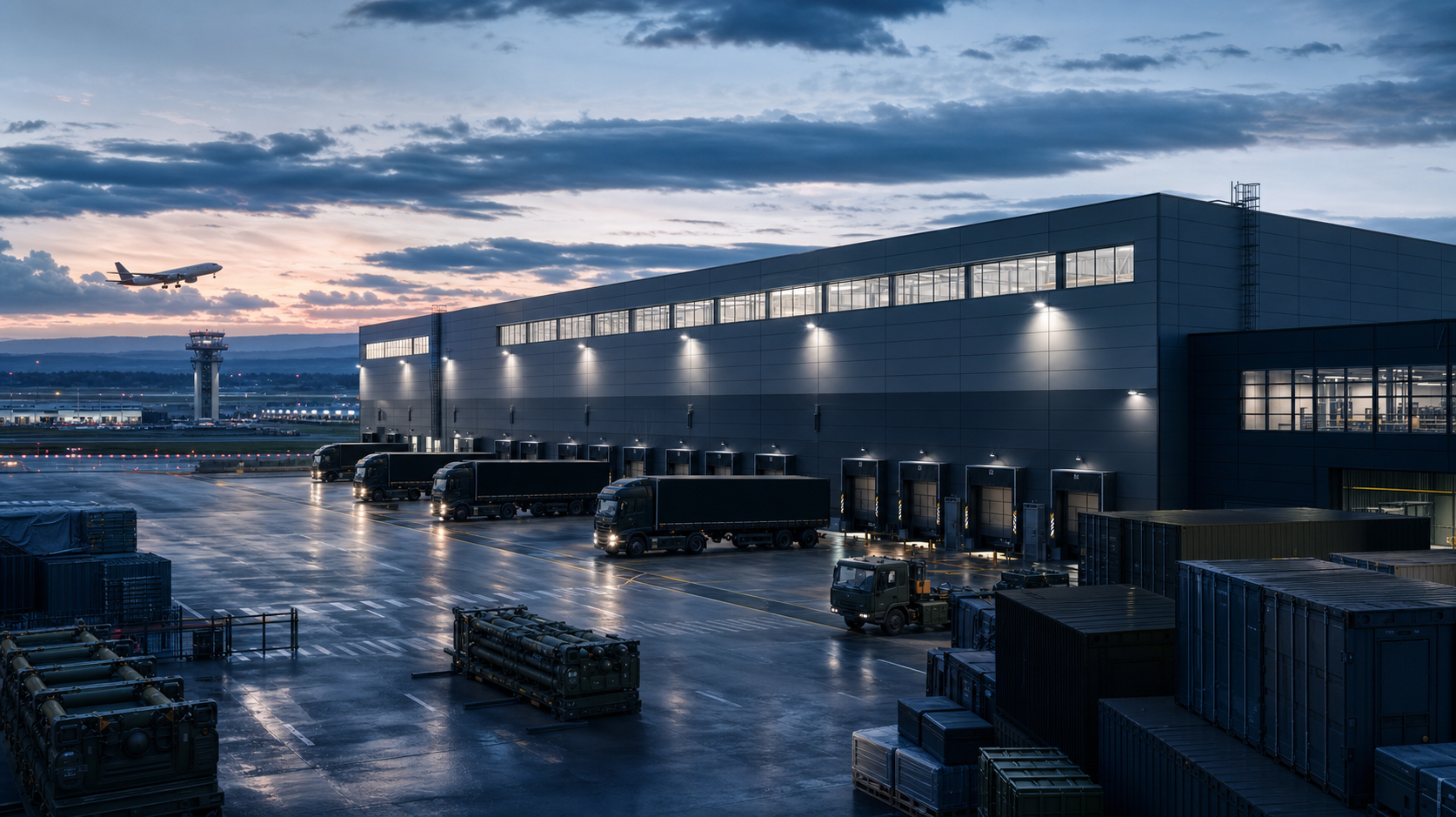
Rheinmetall's €285 million investment in Calden: An arms manufacturer is building its own logistics infrastructure – Creative image on the topic, created with AI: Xpert.Digital
From civilian airport to military hub: Rheinmetall's mega-project at Kassel Airport
Over 1,000 new jobs and secret drone tests: This is what the new Rheinmetall hub means for Northern Hesse
25 million euros of taxpayers' money for arms giant: Why the new Rheinmetall center is so controversial
The geopolitical "turning point" is leaving increasingly visible marks on the German economic landscape and rapidly transforming regional structures. A prime example of this is currently underway in Northern Hesse: With the so-called "Defence Hub North Hesse," the defense contractor Rheinmetall is planning a massive logistics and technology center at Kassel Airport in Calden. Nearly €300 million is being invested in the large-scale project, which is expected to create over 1,000 new jobs in the region and, in addition to traditional logistics, will also house its own drone testing center. However, while Hessian state politicians are celebrating the project as an economic milestone, there is massive criticism of the €25 million in taxpayer money being used to support the highly profitable company, as well as of the gradual transformation of a civilian airport into a military hub. The following article analyzes the strategic and financial background of this deal, examines its industrial policy dimensions, and explores the pressing question of what long-term dependencies arise when arms production becomes the primary driver of regional growth.
Defense: Armaments as location policy
Northern Hesse is becoming the blueprint for a new German defense economy. With the planned "Defence Hub Northern Hesse," the Düsseldorf-based defense company Rheinmetall will link its industrial base in Kassel with a new logistics and technology center directly adjacent to Kassel Airport in Calden. This project is not an isolated location decision, but rather an expression of a profound shift in German economic and security policy that has been unfolding at an unprecedented pace since the so-called "turning point" in history. The announcement, sealed in a Memorandum of Understanding on August 27, 2026, by Hesse's Minister-President Boris Rhein, Rheinmetall CEO Armin Papperger, and Economics Minister Kaweh Mansoori, marks one of the company's largest single industrial investments in Germany and raises fundamental questions about the role of military production in regional structural policy.
An arms company is building its own infrastructure
According to several sources, the project represents an investment of more than €260 million by Rheinmetall itself, supplemented by €25 million in state funding from the state of Hesse. This brings the total investment to a mid-three-figure million euro sum, with some reports specifying a figure of around €285 million. The centerpiece is a new logistics and technology center with a usable area of over 30,000 square meters, to be built in the immediate vicinity of Kassel Airport in the municipality of Calden. It is scheduled to begin operations at the end of 2027. The facility will also include approximately 1,200 square meters of training space, where employees from the Kassel plant, as well as staff from other Rheinmetall locations, will receive initial and advanced training. Also noteworthy is the announcement of a dedicated drone test center on the site, for which Rheinmetall explicitly emphasizes the unique testing opportunities offered by Kassel Airport, which it claims differ from those at other airports.
Rheinmetall currently employs around 2,200 people at its existing Kassel site; the total investment in the plant, logistics center, and training facilities is expected to create more than 1,000 additional jobs in the future, around 130 of which will be directly at the airport itself. This figure illustrates that this is far more than just a warehouse: the project is intended to become a regional employment engine, concentrating training, research, and testing in one location, going beyond mere logistics.
Why military logistics is now a top priority
The strategic logic behind the project only becomes clear in the context of the group's financial dynamics. In the first half of 2026, Rheinmetall's group sales increased by 39.4 percent year-on-year to €5,227 million, with sales to NATO member states, including Germany and the USA, rising even more sharply by 47.4 percent to €4,408 million. For the full year 2026, the group anticipates sales growth of 40 to 45 percent to between €14.0 and €14.5 billion, following €9.9 billion in 2025, and an operating margin of around 19 percent, compared to 18.5 percent in the previous year. Particularly relevant to the Kassel project is the Vehicle Systems division, which manufactures tactical military vehicles and whose sales increased by 28.1 percent to €2,431 million in the first half of 2026. An external industry service estimated the order backlog of this division alone at 28.829 billion euros, illustrating the sheer scale of the capacity bottlenecks that Rheinmetall aims to counteract with the new center.
Against this backdrop, it becomes clear why the company explicitly classifies the investment as a central element of its growth strategy in the area of tactical military vehicles and not as a mere footnote in its real estate portfolio. A company spokesperson made it clear that the new location is intended to prepare the company for expected, substantial orders for military vehicles from Germany and abroad, with Kassel Airport being chosen because of its transport connections, available space, and proximity to the existing plant in the Mittelfeld industrial park. The logic is thus classic industrial: growth that overwhelms the existing infrastructure necessitates additional capacity. However, the political and social dimensions of this capacity expansion extend far beyond purely economic location factors.
Hub for Security and Defense - Advice and Information

Hub for Security and Defense - Image: Xpert.Digital
The Security and Defence Hub offers expert advice and up-to-date information to effectively support companies and organizations in strengthening their role in European security and defence policy. Working closely with the SME Connect Defence Working Group, it particularly promotes small and medium-sized enterprises (SMEs) that wish to further develop their innovative capacity and competitiveness in the defence sector. As a central point of contact, the Hub thus creates a crucial bridge between SMEs and European defence strategy.
Related to this:
Between location policy and weapons production: How Kassel Airport is becoming a military hub
From factory expansion to military hub
Operationally, Rheinmetall is pursuing several clearly defined goals with the new center. Relocating some of the existing logistics processes from the current plant in Kassel to the new site in Calden is intended to significantly reduce inner-city truck and delivery traffic in the north of the city, indicating a deliberate separation of production and everyday urban life. At the same time, according to the company, the new infrastructure is designed to accelerate the processing of national and international orders, optimize supply chains, shorten lead times, and improve overall delivery quality. These formulations are typical of contract logistics, but in the context of a defense company, they take on added significance, because shorter lead times for military vehicles translate in practice into faster supply of military equipment to armed forces.
The direct connection to Kassel Airport is no coincidence, but rather a strategic calculation. A regional airport, in which the state of Hesse holds a 68 percent majority stake, is thus effectively developing into a logistical hub for military equipment, a development already described in public debate as a transformation into a "military hub." This function will be further reinforced by the drone test center and the concurrently planned Hessian Drone Competence Center at the same location, thereby concentrating the development, testing, training, and logistics of military systems at a single geographical point. For the region, this means an integration of civilian airport operations and military-industrial use that has rarely been observed elsewhere in Germany to this extent.
Tax money, military equipment, and the question of legitimacy
The political reaction to the project is mixed. Minister-President Rhein described the "Defence Hub North Hesse" as combining Kassel's industrial strength with the airport's strategic infrastructure and as a boost for investment, innovation, and growth in the region, contributing to greater economic power, defense capabilities, and security in Hesse and Germany. While the business community and state politicians largely welcome the expansion, there is also sharp criticism, primarily directed at the use of €25 million in public funding for a highly profitable, publicly traded arms company and at the role of the majority state-owned airport as military infrastructure. This controversy is symptomatic of a broader societal debate in Germany, where, although the shift in policy receives broad political support, the specific use of taxpayer money to subsidize arms companies repeatedly raises questions of legitimacy – especially when a company like Rheinmetall is already reporting record profits and double-digit operating margins.
From an economic perspective, the subsidies can still be justified if they are understood as a classic instrument of regional economic development, as is common practice in civilian industrial development. The difference, however, lies in the product: While subsidies for semiconductor factories or battery plants are largely uncontroversial in society, the promotion of arms production remains a morally charged area that overlays the usual location-policy logic of jobs, tax revenue, and value chain with security policy and ethical considerations.
Northern Hesse between structural change and rearmament
For the North Hesse region itself, the project offers a rare opportunity for economic repositioning. The site, spanning over 30,000 square meters, and the planned more than 1,000 new jobs in Kassel and Calden provide a clear counterpoint to regions suffering from structural change in traditional industries. Furthermore, consolidating logistics, training, technology development, and drone testing at a single location creates an ecosystem that extends beyond mere manufacturing and could retain skilled professionals in the long term – an aspect that should not be underestimated given the general shortage of skilled workers in Germany.
At the same time, structural dependencies arise. A region that closely links its economic future to a single arms manufacturer and its cyclical, highly politically driven order book is taking on a concentration risk that could prove burdensome if geopolitical priorities shift or Western defense budgets are reduced. Rheinmetall's current growth dynamic is largely based on ongoing geopolitical tensions, particularly the war in Ukraine and the resulting munitions packages for countries like Hungary, as well as artillery and medium-caliber ammunition for Ukraine itself. This supports the thesis that the current exceptional economic boom is largely driven by a historically unprecedented security situation.
Symbolic politics or industrial necessity
To classify the "Defence Hub North Hesse" as a mere symbolic project would be an oversimplification, as the underlying order figures and capacity constraints at Rheinmetall are real and verifiable. The order backlog of nearly €29 billion in the vehicle division alone, the double-digit percentage increases in revenue across almost all business areas, and the concrete target of an operating margin of around 19 percent in the current fiscal year demonstrate that this is not a politically motivated show investment, but rather a necessary business response to a structural shift in demand. At the same time, the project cannot be separated from its political symbolism, as the ceremonial signing of the Memorandum of Understanding by the Minister-President, the Minister of Economic Affairs, and the CEO deliberately signals a close partnership between the state government and the defense industry, a partnership that would have been politically unthinkable just a few years ago.
This shift is part of a larger, Europe-wide trend in which the defense industry is increasingly treated as a strategic economic sector – comparable to the importance previously accorded to the automotive or chemical industries. For regional policymakers, this opens up a new set of tools for revitalizing structurally weak regions through the targeted establishment of security-relevant production, but this also entails a societal normalization of military production as regular economic development.
What the Kassel Airport deal means for Germany
The "Defence Hub North Hesse" is therefore far more than a regional logistics project. It exemplifies a new phase in German industrial policy, in which arms production, government funding, and regional structural development merge into a shared narrative. For Rheinmetall, the investment secures the necessary capacity to operationally realize the projected revenue growth of 40 to 45 percent in the current fiscal year, while the North Hesse region hopes for substantial employment effects and a long-term enhancement as a technology location. Whether the associated dependence on an exceptional geopolitical climate proves to be a viable foundation for sustained regional growth, or whether the current arms boom subsides in the medium term, will only become clear in the coming years, when the facility actually begins operations in 2027 and the geopolitical situation may have changed.
Consulting - Planning - Implementation

Markus Becker
I would be happy to serve as your personal advisor.
Head of Business Development
Chairman SME Connect Defense Working Group
Consulting - Planning - Implementation
Konrad Wolfenstein
I would be happy to serve as your personal advisor.
You can contact me at wolfenstein∂xpert.digital or
Just call me on +49 7348 4088 965 .





