
LogiMAT 2026: Record numbers, but where are the real innovations? Between self-promotion and substance
Xpert Pre-Release

Available in 27 languages 📢
Prefer Xpert.Digital on GoogleⓘPublished on: March 25, 2026 / Updated on: March 25, 2026 – Author: Konrad Wolfenstein
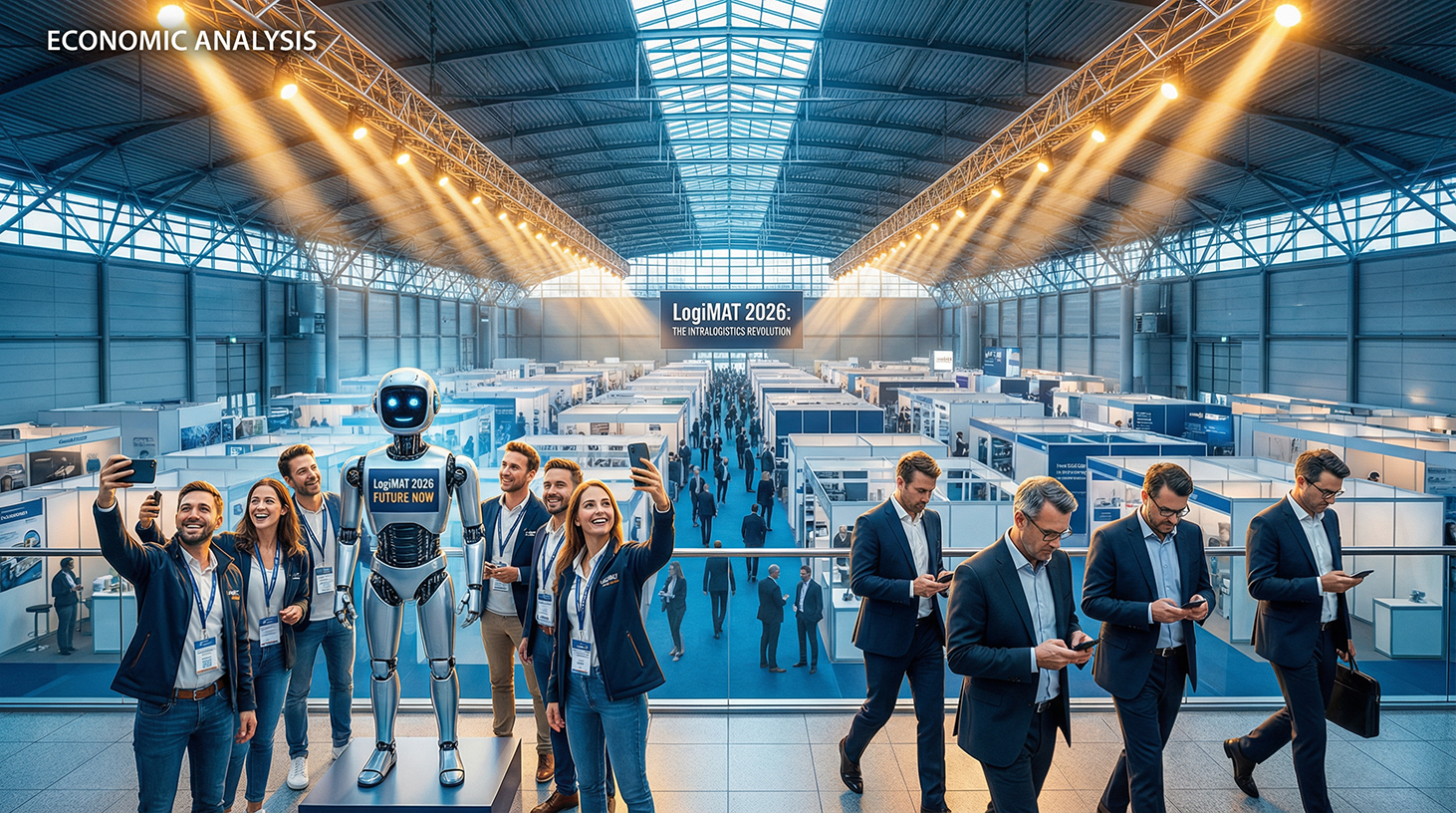
LogiMAT 2026: Record numbers, but where are the real innovations? Between self-promotion and substance – Image: Xpert.Digital
Humanoid robots as mere show: The real problem of the largest logistics trade fair
More spectacle than substance? Why LogiMAT needs to reinvent itself
Hidden Crisis: Why LogiMAT 2026 Disappoints Despite Record Times
LogiMAT 2026 in Stuttgart, with record numbers, fully booked halls, and over 1,600 exhibitors, presents itself as the undisputed pacesetter of global intralogistics. But behind the glittering facade of world premieres and humanoid robots, often serving more as selfie props than scalable business solutions, a structural gap yawns. Is the classic trade fair format undergoing a transformation? Our in-depth review of the event analyzes the critical balancing act between expensive self-promotion, undeniable networking value, and the pressing question of where, amidst all the spectacle, the actual technological substance lies that a $30 billion industry urgently needs.
Europe's largest intralogistics trade fair: record-breaking attendance, but where is the real innovation?
LogiMAT is officially considered the world's largest trade fair for intralogistics solutions and process management – and the raw figures seem to confirm this assessment: over 1,600 exhibitors from more than 40 countries, fully booked exhibition halls covering more than 125,000 square meters of gross exhibition space in Stuttgart, and more than 100 announced world and European premieres. However, a sober analysis of this spectacle reveals a structural gap: between what trade fairs promise and what they actually deliver.
Market size as a backdrop to a structural problem
The global intralogistics market is experiencing a pronounced growth cycle. Its value is estimated at approximately US$29.14 billion for 2025, with a projected increase to US$75.84 billion by 2033 – an average annual growth rate of 12.7 percent. In Germany alone, the production volume of the materials handling and intralogistics sector is estimated at around €27.3 billion for 2025, and according to market forecasts, the German intralogistics market is expected to grow from US$4.09 billion in 2023 to US$11.05 billion by 2033, with an annual growth rate of 10.45 percent. On this dynamic foundation, LogiMAT maintains its role as the industry's central showcase – but this is precisely where the tension between form and content begins.
The trade fair presents itself to the outside world as an innovation hub, a trendsetter, and a decision-making platform. Trade fair director Michael Ruchty explicitly described it as an "indispensable trade fair event for fast movers" and emphasized the "unique mix of important technology and innovative product developments, as well as networking and an informative supporting program at a congress level." However, what can actually be observed on the exhibition floor is often far less spectacular: products already familiar from the previous year, slightly modified software solutions, and demonstrators that are more marketing tools than genuine technological proofs.
Network value versus depth of innovation
An interesting and, in some ways, more honest concept is offered by the Mobility & Logistics Cluster, which will celebrate its tenth anniversary at LogiMAT in 2026. Since 2015, the network, based at TechBase Regensburg, has been present with a joint booth – this year with 13 co-exhibitors in a 120-square-meter space in Hall 4. The cluster authentically embodies what LogiMAT itself should be: a place for exchange, cooperation, and the joint development of solutions related to digitalization, automation, and artificial intelligence. Networking formats such as the well-known Bavarian breakfast programmatically represent the true strength of a physical trade fair – personal, unrepeatable human contact.
However, this networking value, important as it is, should not be confused with innovation performance. Networks are now created just as effectively – and significantly more cost-efficiently – in digital spaces, via LinkedIn communities, industry webinars, or specialized B2B platforms. The economic justification for a physical trade fair presence must therefore be measured against a higher standard: the concrete transfer of knowledge, the experience of genuine technological leaps, and the quality of initiating business relationships that actually lead to sales. At least: At LogiMAT 2025, 22 percent of trade visitors stated that they had placed an order at the fair or intended to do so immediately afterward – an indication that the trade fair as a working event is indeed effective.
The humanoid robot as a symptom
No example illustrates the contradiction between trade fair staging and economic added value more vividly than the use of humanoid robots. The technology is real: The global market for humanoid robots is projected to grow from US$3.28 billion in 2024 to US$66 billion by 2032 – an annual growth rate of 45.5 percent. A study by the Fraunhofer IPA, based on over 100 responses from industry, has demonstrated that humanoid robots could be particularly compelling due to their flexibility in performing various tasks – with potential applications in material handling, machine loading, and grasping complex objects. The Fraunhofer IPA explicitly classifies the combination of their ability to change location and their flexible gripping technology as potentially game-changing for the automation of existing systems.
But what can actually be observed at LogiMAT hardly reflects this potential. Trade fair appearances where humanoid robots are staged for visitor entertainment, positioned for selfies, or presented as visual eye-catchers without a concrete business application context lack the crucial next step: proof of measurable efficiency gains, real ROI scenarios, and integrable solution architectures. While trade fair director Ruchty promised that the next development steps would be visible here and there "as eye-catchers and as real applications of humanoid robotics"—the very wording reveals the problem: eye-catcher as the primary category, real application as an add-on.
Companies like Artisteril Robotics demonstrated, at least to some extent, what a more serious approach looks like: The cooperation between a humanoid robot and an autonomous mobile robot (AMR), in which both systems communicate directly with each other and dynamically adapt their processes to the environment, at least points in the direction of a seamless workflow. This is more than just show business – but it remains a demonstrator, not a commercially scalable production system.
🎯🎯🎯 Data-driven B2B industry hub as a quasi-in-house solution

The quasi-in-house solution: How Xpert.Digital closes operational gaps in B2B marketing and sales – Smart Content-Driven Business - Image: Xpert.Digital
Xpert.Digital is a data-driven B2B industry hub led by Konrad Wolfenstein . The company acts as an external, quasi-in-house solution for industrial partners, closing operational gaps in marketing, content, and sales – without requiring additional resources on the client side.
More information here:
From eye-catcher to evidence: How trade fair formats should rethink intralogistics
The economic logic of the trade fair format put to the test
LogiMAT 2024 recorded 67,420 trade visitors (up 8.1 percent compared to the previous year) and 1,610 exhibitors (up 6 percent), with a net exhibition area of over 67,000 square meters. LogiMAT 2025 followed with 65,719 visitors and 1,625 exhibitors – a near-record result despite strikes at airports and in public transport. This demonstrates that LogiMAT is one of the stable, well-functioning industry events in a trade fair market that is generally under pressure.
But capacity utilization and relevance are not synonymous. The economic logic behind trade fair participation has fundamentally shifted in recent years. Exhibition costs for a medium-sized booth – space, booth design, personnel, travel, and hotel expenses – quickly reach five to six figures in euros, often without a clearly measurable return on investment. In an era where high-resolution product presentations can be digitally disseminated worldwide, the question arises whether trade fairs in their current form still meet the demands of data-driven, efficiency-oriented procurement processes – or whether they primarily serve the institutional self-affirmation of an industry.
What really matters: Substance over spectacle
The intralogistics industry faces real and pressing challenges that extend far beyond the visual appeal of trade fairs. The increasing shortage of skilled workers, the growing pressure from e-commerce, the need for energy-efficient production, and the integration of AI into existing system landscapes are not abstract future topics, but rather operational problems with economic consequences. A study presented at LogiMAT 2026, while revealing a generally positive public image of the logistics industry, simultaneously uncovers significant information gaps and traditional prejudices. The industry has a communication problem – and a trade fair format that prioritizes spectacle over substance exacerbates this problem rather than solving it.
What distinguishes reputable innovation platforms from marketing events can be defined by concrete criteria. First: Are technologies showcased in the context of real-world operating environments, or are they sterile laboratory demonstrations lacking proof of scalability? Second: Is there reliable economic data available – payback periods, efficiency gains in percentage terms, and concrete comparative costs? Third: Are failures and limitations of technologies openly communicated, or is the focus solely on success? And fourth: Does genuine knowledge transfer take place, for example, through research partners, user reports, and critical expert panels – or does everything remain in the mode of a sales pitch?
Structural change in the trade fair industry
The broader development of the trade fair industry in Germany and Europe gives cause for objective reflection. Trade fairs have been under pressure for years: on the one hand, due to the experiences of the pandemic, which has shown that many information and networking functions can also be fulfilled digitally; on the other hand, due to changing decision-maker preferences in a time when trade visitors are increasingly selective and must strategically justify their trade fair visits. LogiMAT is responding to this pressure with growing exhibitor numbers and ever more extensive premiere offerings – which is ultimately a quantitative response to a qualitative problem.
The challenge for organizers and exhibitors alike lies in evolving the trade fair format from a product presentation platform into a genuine innovation testing ground. International examples – such as CES in Las Vegas or specific themed sections at the Hannover Messe – demonstrate that trade fairs are most effective when they are conceived not as a catalog of physical products, but as a testing ground for system solutions and a platform for debating industry-relevant future issues. For LogiMAT, this translates specifically to: less stand architecture competition, more application-oriented demo zones; less self-promotion by corporate brands, more co-creative formats with users, research institutions, and critical voices.
Between persistence and renewal
LogiMAT 2026 reflects the state of an industry undergoing a fundamental transformation, yet one that hasn't fully grasped the implications for its leading trade fair format. The market data is compelling – automation, AMR, AI integration, and sustainable warehouse solutions are not passing fads, but structural megatrends. Exhibitors from more than 40 countries, fully booked halls, and hundreds of premieres underscore the event's economic significance. And yet, for many visitors, the trade fair experience is too often a repetition of the previous year – familiar faces, familiar products, familiar promises.
The fundamental economic question is not whether LogiMAT is superfluous – it isn't, as visitor numbers, conversion rates, and network value impressively demonstrate. The question is whether it's realizing its full potential. An industry boasting a global market volume of nearly 30 billion US dollars and a growth trajectory of over twelve percent annually deserves a trade fair format that lives up to these demands: less staging, more substance; fewer eye-catchers, more evidence. Until then, LogiMAT remains what it is, despite all the criticism: an indispensable, yet improvable, rendezvous of an industry with itself.
Consulting - Planning - Implementation

Konrad Wolfenstein
I would be happy to serve as your personal advisor.
contact me at wolfenstein ∂ xpert.digital
Just call me on +49 7348 4088 965 (Munich) .
Our global industry and economic expertise in business development, sales and marketing

Our global industry and economic expertise in business development, sales and marketing - Image: Xpert.Digital
Industry focus areas: B2B, digitalization (from AI to XR), mechanical engineering, logistics, renewable energies and industry
More information here:
A thematic hub offering insights and expertise:
- Knowledge platform covering global and regional economies, innovation and industry-specific trends
- A collection of analyses, insights, and background information from our key areas of focus
- A place for expertise and information on current developments in business and technology
- A hub for companies seeking information on markets, digitalization, and industry innovations










