
Bombs on data centers: Why the next big tech boom is called "resilience"
Xpert Pre-Release

Language selection 📢
Published on: March 25, 2026 / Updated on: March 25, 2026 – Author: Konrad Wolfenstein
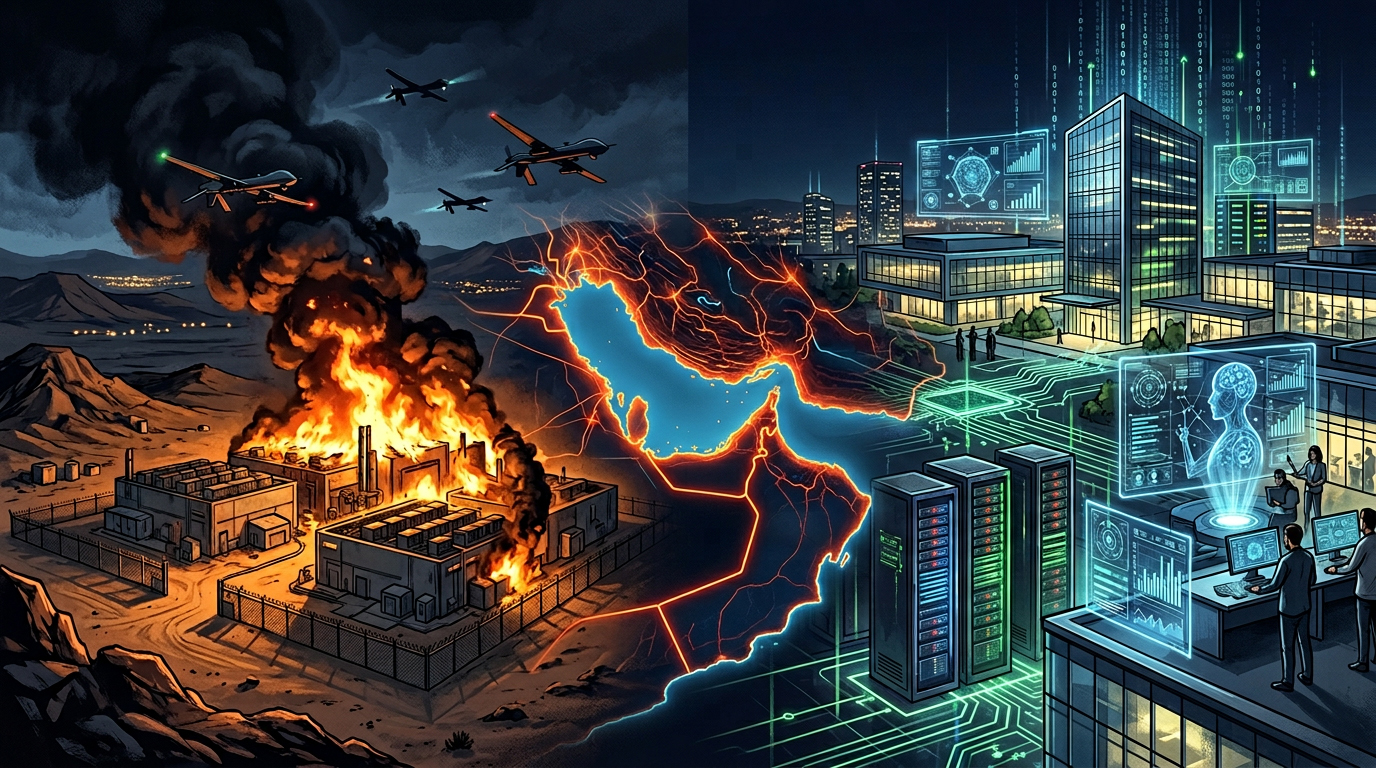
Bombs on data centers: Why the next big tech boom is called "resilience" – Image: Xpert.Digital
The Gulf as a geopolitical stress test: How the Middle East conflict is shaping the next wave of the technology economy
Billion-dollar AI dream in jeopardy: How the Gulf conflict is halting global tech investments
The war has reached a new, invisible, but highly sensitive front: global digital infrastructure. It's no longer just about territorial gains or traditional military objectives, but about destroying the very nervous systems that keep our modern economy running. Recent targeted drone attacks on AWS data centers in the Persian Gulf and severed undersea cables dramatically demonstrate that the internet has long since become an active war zone. This escalation has far-reaching consequences: While gigantic, geopolitically motivated investments in AI and technology by the Gulf states, amounting to billions, are suddenly being called into question, a new, highly profitable arms elite is forming in the US. Start-ups like Anduril, Palantir, and Shield AI, backed by massive Pentagon budgets, are becoming the new digital systems integrators of modern warfare. This development marks the end of the politically neutral cloud era and the rise of a multi-billion-dollar “resilience economy” in which physical data security, autonomous weapon systems and technological sovereignty are the new currencies of the global economy.
Digital infrastructure as a military target: A new era of warfare
That war destroys infrastructure is nothing new. But that war specifically targets data centers housing tens of thousands of enterprise applications, banking systems, and government services is a paradigm shift of historic proportions. This is precisely what happened in the Gulf region when Iranian drones attacked three AWS facilities in the United Arab Emirates and Bahrain, causing structural damage, power outages, and firefighting efforts that resulted in further water damage. Amazon Web Services subsequently advised its customers to relocate their workloads to other regions and explicitly warned that restoring the infrastructure could be a "protracted event"—a euphemism for what, in practice, meant the total shutdown of critical digital services.
These attacks alone caused the downtime of approximately 60 AWS services. The impact wasn't limited to abstract data packets, but affected everyday life: the ride-hailing platform Careem, payment providers like Hubpay and Alaan, the data management company Snowflake, and several of the UAE's largest banks, including Emirates NBD, First Abu Dhabi Bank, and Abu Dhabi Commercial Bank. This revealed a strategic weakness that distributed systems architects had ignored for years: the availability zones of the AWS ME-CENTRAL-1 region are insufficient when a physical attack disables two out of three zones simultaneously. Redundancy on paper offers no protection against drones in reality.
This attack is not an isolated incident, but rather the escalation of a development that has been brewing for some time. As early as 2024, Houthi attacks in the Red Sea disrupted three key submarine cables – AAE-1, Seacom, and EIG – with months of disruption impacting internet latency and capacity between Europe, Africa, and Asia. By March 2026, approximately 30 to 37 percent of global internet traffic will be routed through 17 submarine cables running through the Persian Gulf. Iran has explicitly identified these connections as potential targets. Therefore, anyone operating data centers in the region is operating them in an active war zone – with all the systemic consequences for the global data economy.
The security paradox of Gulf partnerships: Export control instead of war protection
The Gulf region has become a focal point for AI infrastructure investments in recent years, driven by geopolitical ambitions. The most prominent project is Stargate UAE: an AI data center campus projected to cost more than $30 billion, cover 19.2 square kilometers in Abu Dhabi, and provide 5 gigawatts of computing capacity. Developed in partnership with G42, OpenAI, Oracle, Nvidia, Cisco, and SoftBank, its first phase was slated for completion in the third quarter of 2026. Amazon's concurrently planned Saudi Arabian cloud region, with an announced investment of over $5.3 billion, was expected to open later that same year.
What emerges upon closer inspection as a strategic weakness is that the regulatory frameworks securing these collaborations were primarily designed to control the export of high-performance chips—not to protect physical infrastructure in the event of war. The security architecture of these partnerships is a compliance architecture, not a war architecture. If drones strike the cooling systems of a data center, export licenses are of no use. This design flaw is not a technical failure, but a political one—it reflects how the technology industry viewed the Gulf primarily as a source of capital and a growth market, not as an operational war zone.
The immediate economic consequences are significant. Sovereign wealth funds in the Gulf states, which together manage approximately $5 trillion in assets, are currently reviewing their investment commitments. Three of the four largest economies in the Gulf Cooperation Council – Saudi Arabia, the UAE, Qatar, and Kuwait – have already begun reassessing their sovereign wealth fund strategies, according to an unnamed government official. This includes potentially withdrawing existing commitments and realigning global sponsorship agreements. The foundations of these funds remain structurally intact: Mubadala alone invested around $12.9 billion in AI and digitalization in 2025, the Kuwait Investment Authority $6 billion, and the Qatar Investment Authority $4 billion. The ambitions remain undiminished; only the time horizon has shifted.
The Pentagon discovers the startup complex: 13.4 billion for the AI army
While Gulf investments are paused, Washington is accelerating its course in the opposite direction. For the first time in the history of the U.S. Department of Defense, the 2026 defense budget includes a dedicated budget line for AI and autonomous systems: $13.4 billion. The total budget amounts to $1.01 trillion, a 13 percent increase over the previous fiscal year. A breakdown of this AI spending reveals the operational priorities: $9.4 billion for aerial drones and unmanned aerial systems, $1.7 billion for maritime autonomous platforms, $734 million for underwater systems, $210 million for autonomous ground vehicles, and $1.2 billion for software and cross-domain integration. This is complemented by $153 billion in new defense spending, including $29 billion for shipbuilding and $24 billion for munitions.
These figures are not merely budgetary benchmarks; they represent the economic gravitational pull that attracts and funds a new class of technology companies. Since 2021, more than $200 billion has flowed into defense tech startups. 2025 alone saw the sector's best funding year to date: The total value of venture capital transactions in the defense tech industry surged to $49.1 billion, nearly double the previous year's $27.2 billion. Ten new unicorns emerged in this sector, and the combined valuation of all active defense tech unicorns reached $495 billion.
This dynamic is not solely attributable to geopolitical urgency, but also to a fundamental realignment of venture capital. Defense tech investments outperformed overall equity financing in 2025, which grew by "only" 47 percent, while defense tech equity financing surged by 145 percent. Investors recognize that this sector has structural, rather than cyclical, growth drivers: government demand with long-term contracts, high barriers to entry, and minimal cyclical dependence on general consumer sentiment.
The new defense elite: From startup to Pentagon systems integrator
No development illustrates the structural transformation of the American defense industry better than the rise of Anduril Industries. Founded in 2017, the company has challenged the traditional procurement model of the US military with its Lattice OS, an AI-powered, real-time situational awareness platform. In March 2026, Anduril signed a framework contract with the US Army for up to $20 billion to establish Lattice as a comprehensive AI architecture for battlefield integration—from sensors and drones to weapon systems, all connected in a common data sphere. The contract runs until March 2036, giving Anduril long-term institutional support within the US defense establishment. The company is valued at $30.5 billion.
In parallel, the Pentagon decided to recognize Palantir's Maven Smart System as an official defense program—a classification that guarantees long-term, secure funding. Maven is the central AI infrastructure for the US military: It processes satellite imagery, drone video, signals intelligence, and intelligence reports into a unified interface, enabling commanders and analysts to perform faster situational awareness assessments and target acquisition. The system is not only actively deployed by five US combat commands but was also adopted by NATO as a standalone capability in 2025. According to Pentagon sources, Maven was involved in several precision strikes against Iranian targets during the recent Gulf War.
The logic behind this consolidation is economically rational: The Pentagon is no longer seeking isolated innovations, but rather systemic platforms that can be scaled over decades. Both companies – Anduril and Palantir – have understood this requirement and deliver precisely that: not weapons in the traditional sense, but digital operating systems for modern warfare. The economic advantage lies not in the individual product, but in the network architecture: Whoever controls the platform to which all other systems connect possesses structural market power comparable to that of an operating system provider in the consumer market.
Hub for Security and Defense - Advice and Information

Hub for Security and Defense - Image: Xpert.Digital
The Security and Defence Hub offers expert advice and up-to-date information to effectively support companies and organizations in strengthening their role in European security and defence policy. Working closely with the SME Connect Defence Working Group, it particularly promotes small and medium-sized enterprises (SMEs) that wish to further develop their innovative capacity and competitiveness in the defence sector. As a central point of contact, the Hub thus creates a crucial bridge between SMEs and European defence strategy.
Related to this:
Default risk
Autonomous systems: When AI takes over the cockpit
Military demand for autonomous systems has propelled several startups to the valuation threshold of billion-dollar companies, a level unthinkable in civilian markets. Shield AI is perhaps the most striking example: With its AI piloting software Hivemind, the company controlled an autonomous F-16 fighter jet through real dogfights with manned enemy aircraft. Shield AI then unveiled the X-BAT, a self-developed, fully autonomous fighter jet capable of operating without runways, launching from container ships, and navigating autonomously without GPS or stable communication links. Its valuation stands at $5.3 billion – for a company that, until a few years ago, was considered an unconventional experiment on the fringes of the Pentagon's radar.
The autonomous naval vessel sector is experiencing a similar development. Saronic Technologies, a company specializing in unmanned surface vessels, projected revenues of $200 million in 2025 – a 1,500 percent increase over the previous year. This growth is partly due to a situation that seems tailor-made for Saronic's core thesis: the de facto closure of the Strait of Hormuz by the Gulf conflict has confirmed that securing critical sea lanes without manned military personnel on the front line is both possible and necessary. The US Navy has already awarded Saronic a framework contract worth $392 million for the delivery of its Corsair-class autonomous surface vessels, and the company is considered a key component of the US Navy's 2026 "Golden Fleet" initiative. Its valuation was recently around $9 billion.
Epirus, in turn, addresses one of the most pressing tactical challenges of the Gulf conflict: protection against drone swarms. The company has integrated its high-performance microwave system, Leonidas, which electronically neutralizes drones through targeted energy pulses, into Anduril's Lattice OS. The result is a system that detects, tracks, and destroys drones within a single control interface—without ammunition consumption, without human intervention, and within a millisecond. Epirus is valued at $1.5 billion. Finally, Hermeus pursues a complementary niche with hypersonic aircraft for ISR (Intelligence, Surveillance, and Reconnaissance) and rapid strike applications, a niche that has regained considerable strategic relevance in the context of the Gulf crisis.
The resilience economy: A new $100 billion category is emerging
The attack on AWS data centers has brought to the forefront a profound structural question that the entire hyperscaler industry must now urgently address: How resilient is digital infrastructure when located in geopolitically unstable regions? The market's response is already measurable: Global spending on sovereign cloud infrastructure is projected to increase by 35.6 percent to $80 billion in 2026. Gartner forecasts that approximately 20 percent of all workloads will migrate from global public cloud providers to local, government-controlled infrastructure. By 2032, the global market for sovereign cloud services is expected to reach $572 billion.
This shift has broad economic leverage. Governments are the primary buyers, but regulated industries—energy, telecommunications, financial services—are close behind. In Europe, the European Commission has already awarded a $209 million procurement contract for sovereign cloud services. The Gulf crisis is now massively accelerating this trend because it demonstrates that geographic risk is not an abstract planning variable, but a real possibility.
A diverse group of startups and established providers are benefiting from this. CoreWeave, which only went public in 2026, is positioning itself as the first truly AI-native cloud platform and has introduced flexible capacity models to absorb workloads that need to be migrated from affected regions. Satellite communications companies, acting as a backup connectivity layer, are gaining importance as traditional submarine cable infrastructure is considered vulnerable. Demand for underground or modular data center designs, which are physically more difficult to attack, has surged. Cybersecurity companies specializing in state-sponsored threat actors are in a seller's market.
The economic logic behind this resilience wave is robust: Every hour of downtime for a business-critical system typically costs corporations several million US dollars; for banks and payment providers, the costs are significantly higher. Those who provide infrastructure that mitigates these risks can command premium prices – both from governments that have defined data sovereignty as a strategic priority, and from private companies that have learned from the Gulf War that geographic diversification is not an option, but a necessity.
The golf capital is paused – but it is not disappearing
The Gulf region's structural ambitions have not been destroyed by the conflict, but merely put on hold. This distinction is crucial for long-term investors. The region's sovereign wealth funds—with a combined $5 trillion in assets under management—have been built up over decades as intergenerational buffers, precisely for economic shocks of this kind. A prolonged conflict could force these funds to liquidate portions of their overseas holdings to finance domestic deficits. But the fundamental motivation behind these capital allocations—the transformation away from oil dependency toward a knowledge-based economy—remains unchanged.
The Stargate UAE project, the over $30 billion AI campus in Abu Dhabi, is already under construction; the first phase of 200 megawatts was built according to an accelerated schedule. The UAE has publicly reaffirmed its commitment to its investment strategies. Amazon's Saudi cloud region, planned with a $5.3 billion investment for 2026, is not yet formally suspended, but is under considerable pressure to reassess given the security situation. Analysts expect that, in the medium term, Gulf governments will intensify their diversification strategies in the wake of the conflict—with a greater emphasis on sovereign infrastructure and their own digital defense capabilities. This does not make them less attractive partners; it makes them different partners, with altered requirements for physical security, data sovereignty, and technological independence.
Geopolitics as a business model: What holds it all together
The Gulf crisis is not an accident of the globalized technology economy. It is the structural consequence of a development that has long been ignored: Digital infrastructure is physical infrastructure. It burns when drones hit it. It fails when submarine cables are severed. And it is part of the military calculations of all parties to a conflict—just like bridges, ports, and power plants. This realization changes not only the risk models of the technology industry but the entire geography of capital allocation.
This creates concrete structural opportunities for investors and entrepreneurs with a multi-year horizon. Defense tech startups benefit from a state-funded demand corridor driven by geopolitical necessity and exhibiting minimal cyclicality. Resilience infrastructure providers—from sovereign cloud and satellite connectivity to modular data center designs—are in the process of forming an independent technology sector for which the political urgency already exists. The Gulf States themselves, partially deprived of their primary technological partner to date—reliable cloud infrastructure—will renegotiate their technology partnerships after the conflict, placing greater emphasis on physical security, domestic manufacturing capacity, and strategic independence.
What became apparent on a small scale during the weeks of the Gulf conflict is, in reality, the first act of a much more profound reorganization: the transition from a world in which technological infrastructure was treated as a civilian, politically neutral resource to a world in which it is considered critical state infrastructure—with all the implications that entails for location decisions, security requirements, regulation, and financing logic. Those who understand this transition early on are not merely observers of change, but active shapers of the next chapter of the digital economy.
Consulting - Planning - Implementation

Markus Becker
I would be happy to serve as your personal advisor.
Head of Business Development
Chairman SME Connect Defense Working Group
Consulting - Planning - Implementation
Konrad Wolfenstein
I would be happy to serve as your personal advisor.
contact me at wolfenstein ∂ xpert.digital
Just call me on +49 7348 4088 965 (Munich) .





