
Heavy-duty high-bay warehouses: When the rack can do more than its reputation — why intralogistics knows no bounds
Xpert Pre-Release

Available in 27 languages 📢
Prefer Xpert.Digital on GoogleⓘPublished on: March 24, 2026 / Updated on: March 24, 2026 – Author: Konrad Wolfenstein
Heavy-duty high-bay warehouses: When the racking can do more than its reputation suggests — why intralogistics knows no bounds – Creative image: Xpert.Digital
From pallet racking to all-rounder: How LTW Intralogistics is reinventing the high-bay warehouse
Forget Euro pallets: What all is now parked fully automatically in high-bay racking
When people think of high-bay warehouses, they usually picture endless rows of standard Euro pallets, gray industrial halls, and monotonous processes. But what happens when suddenly multi-ton luxury yachts in Florida, highly sensitive military containers in the Alps, or 31-meter-long special goods are stacked fully automatically? The Austrian company LTW Intralogistics, which emerged from the cable car giant Doppelmayr, impressively demonstrates that the boundaries of automated storage can be radically shifted. In an era where land consumption, skills shortages, and the growing pressure of e-commerce are pushing global logistics to its limits, simply managing standard dimensions is no longer sufficient. Tailor-made solutions, seamless system integration, and engineering expertise that doesn't shy away from saltwater, extreme altitudes, or enormous loads define the intralogistics of the future. The following text explores how a pragmatic idea from a cable car manufacturer became a global technology leader – and why the racking of tomorrow is capable of far more than its reputation suggests.
Too big, too heavy, too extreme? Why the most spectacular warehouses no longer use Euro pallets
Shelf skyscrapers instead of concrete deserts: This ingenious invention solves the biggest problem in logistics
The high-bay warehouse is generally seen as a symbol of streamlined, interchangeable industrial logistics: tall steel racks, uniform Euro pallets, silent storage and retrieval machines gliding up and down between the aisles in strictly timed sequences. Anyone who associates the term with boats, military containers, or railway carriages at Europe's highest station is on unfamiliar ground—yet this perfectly describes the reality of an Austrian company that has methodically and with considerable technical ingenuity explored the limits of automated storage. LTW Intralogistics, based in Wolfurt, Vorarlberg, is not a niche provider, but a global systems integrator that emerged from the Doppelmayr Group and has demonstrated to the field of intralogistics that the principle of the fully automated high-bay warehouse extends far beyond traditional palletized goods.
A company from the cable car sector — and its unexpected strength
The history of LTW Intralogistics doesn't begin with a typical logistics startup, but rather with a pragmatic industrial consideration. On August 14, 1981, the company, then known as "Lagertechnik Gesellschaft mbH," was registered in the Austrian commercial register. The initiative came from Peter Malin, who founded the new company together with Doppelmayr, the world market leader in cable car construction. The underlying strategic idea was decidedly pragmatic: to better utilize the high-precision production capacities that Doppelmayr had established for the construction of cable car systems. Cable cars and stacker cranes share more similarities than might initially appear—both require extreme precision in mechanics, heavy-duty drive technology, and sophisticated control electronics.
From this industrial heritage, a global intralogistics provider has emerged over four decades, now implementing projects in more than 35 countries and generating around 70 percent of its revenue in German-speaking regions. The evolution from a pure storage and retrieval machine manufacturer to a system integrator was a gradual process: in 1984, LTW achieved its first major product success with a patented switch technology that shaped the company for years to come. The decisive strategic milestone was reached in 2017 when LTW acquired a software company in Vienna, thereby creating the conditions to offer mechanics, electronics, and software from a single source—a so-called turnkey solution that propelled the company to the technological forefront of the market. With over 2,300 warehouse automation systems implemented worldwide, LTW is now among the most experienced providers in its segment.
The integration into the Doppelmayr Group is more than just a historical legacy. It provides LTW with a structural competitive advantage that can hardly be overestimated: all mechanical components—drives, support structures, precision elements—are manufactured in-house. The parent company achieved consolidated sales of €1,057 million in the 2023/24 fiscal year, giving LTW a stable institutional backing that independent suppliers lack. This "backup," as Managing Director Konrad Eberle describes it, is a crucial selling point in an industry that relies on long-term plant performance and guaranteed availability.
The global context: Why automated high-bay warehouses tell a growth story
To understand the economic significance of LTW's innovations, it's worth looking at the overall market dynamics of intralogistics. The global market for intralogistics systems was valued at US$59.81 billion in 2024 and is projected to grow to US$97.19 billion by 2032, representing an annual growth rate of 6.25 percent. The more specific market for automated storage and retrieval systems (AS/RS) even shows a growth rate of around 7.0 percent per year, increasing from US$9.58 billion in 2025 to US$17.4 billion by 2034. The figures for the German market paint an even more dynamic picture: The German intralogistics segment grew from US$4.09 billion in 2023 at an annual rate of 10.45 percent and is expected to exceed the US$11 billion mark by 2033.
Behind this growth are structural drivers that reinforce each other. First, the expansion of e-commerce has dramatically increased the pressure on warehousing systems: faster throughput times, greater product variety, and lower tolerance for picking errors are driving up automation rates. Second, the growing shortage of skilled workers in many industrialized countries is making manual warehousing processes increasingly expensive and prone to errors. Third, digitalization, under the banner of Industry 4.0, has improved the technological prerequisites: real-time warehouse management software, sensor-based control systems, and AI-based optimization algorithms now enable levels of automation that were not economically feasible a decade ago.
Particularly relevant to LTW's strategic position is a third megatrend: the increasing demand for customized automation solutions beyond standard products. The warehouse automation market is growing at a rate of almost 20 percent annually, with a growing share of this growth coming from industries that were not previously typical users of high-bay warehouses. It is precisely in this area that LTW has carved out a niche that, over time, has developed into a unique selling proposition.
The principle of vertical densification — and its limits in convention
From an economic perspective, high-bay warehouses are primarily a solution to a resource problem. Space is scarce and expensive at many industrial sites, while vertical space often remains unused. Technically defined, a high-bay warehouse begins at a height of approximately 12 meters and can now be built up to 50 meters high. In this so-called silo construction, the racking system itself assumes the load-bearing function for the roof and walls, thus simultaneously acting as the building structure. Automated AS/RS systems can save up to 85 percent of the floor space compared to conventional storage, clearly illustrating the basic economic case: The initial investment is high, but the ongoing costs—for space, personnel, and error correction—are significantly lower.
The classic application of this technology involves the storage of Euro pallets or standardized containers. The system relies on standardization: uniform load carriers, reproducible dimensions, and stable weights allow for the design of storage and retrieval machines with tight tolerances and the complete automation of storage processes. Where these standardization prerequisites are lacking—for irregularly shaped goods, extreme weights, or corrosive environments—standard solutions reach their limits. This is where LTW Intralogistics truly excels.
The company's technological expertise lies not in optimizing the standard case, but in systematically expanding the boundaries of what is technically feasible. Over time, LTW has developed a portfolio of exceptional reference projects demonstrating that the principle of automated high-bay warehouses is applicable to virtually any type of stored goods, provided the design is consistently tailored to the specific requirements. Storage and retrieval machines for goods up to 31 meters long or for containers with payloads of up to 18 tons are not exceptions, but rather documented serial references.
When yachts park on shelves — the world's first fully automated boat storage facility
Few projects illustrate LTW's conceptual boldness better than the boat storage facility at Gulf Star Marina in Fort Myers Beach, Florida. Developed in collaboration with GCM Contracting Solutions, a general contractor specializing in design-build projects and operating in Southwest Florida since 1988, the project is the world's first fully automated boat storage facility. The high-bay, silo-style warehouse measures 54 meters in length, 46 meters in width, and 19 meters in height, offering approximately 300 boat storage spaces with multi-deep storage. The automated storage and retrieval system is designed for a payload of 7,000 kilograms, enabling the handling of large motorboats and sailboats.
The economic logic behind the project is compelling. Conventional boat storage facilities utilize either outdoor areas or ground-level warehouses, which are inefficient in terms of space. The fully automated high-bay racking system allows for 40 to 50 percent greater boat and container capacity on the same footprint compared to traditional rack systems. Furthermore, there are operational advantages: The system eliminates the need for human forklift operators, minimizes noise emissions, and protects the stored vehicles from severe weather and storms—a significant factor in a region regularly hit by hurricanes. The building is structurally designed to withstand wind speeds of up to 200 kilometers per hour.
The technical challenges of the project went far beyond simply upscaling a pallet solution. Boats are shape-variable, asymmetrical objects without standardized interfaces; they must be picked up, transported, and set down using specialized equipment. The maritime environment further complicated matters: saltwater is one of the most aggressive corrosion accelerators for steel and electronics, necessitating special considerations in both material selection and sealing design. Completed in 2020, the project received the Tilt-Up Achievement Award from the Tilt-Up Concrete Association that same year—an award that recognizes innovation, versatility, and architectural quality in concrete construction, placing the project within a broader context of technical excellence.
The economic success of the pilot project is setting a precedent: In the 2023/24 financial year, the Doppelmayr Group already reported two further boat storage projects as being under development. The marina industry is facing a structural transformation, where urban space constraints, growing interest in recreational boating, and increasing demands for weather protection converge—a scenario that is pushing customized high-bay racking solutions out of their niche and into a growth segment.
Armaments logistics on 18 tons — the container high-bay warehouse for the Swiss Army
A second, structurally quite different reference project demonstrates how the high-bay racking concept can be transferred to a highly specialized military-logistical context. Armasuisse, the Swiss procurement organization for defense equipment, faces a logistical challenge that is difficult to solve using conventional methods: the reliable, secure, and space-saving storage of military containers, swap bodies, and roll-off containers housing technically complex systems.
LTW, together with its partner manufacturer Jungheinrich AG, implemented a high-bay warehouse with 206 storage locations. The stacker crane built for this purpose, with its 20-meter-high structure and a payload capacity of 18,000 kilograms, is the heaviest LTW had ever built – a heavy-duty giant capable of handling not only ISO containers but also non-stackable swap bodies and roll-off containers. A key design feature is that the stored containers cannot simply be left unattended and forgotten: a special gate system allows minor maintenance work to be carried out directly in and on the containers at their storage location, without having to remove them.
Since defense logistics cannot tolerate downtime, the drive system of the storage and retrieval machine was designed with redundancy: a dual drive system guarantees that operation can be maintained even in the event of a malfunction. This technical redundancy solution reflects a principle that is fundamental in military logistics and which LTW has translated into civilian engineering terminology. The high-bay warehouse is leased and used by the Swiss military, demonstrating that government institutions are increasingly relying on operator-financed automation solutions instead of investing in expensive infrastructure themselves.
LTW Intralogistics Solutions

LTW Intralogistics – Engineers of Flow - Image: LTW Intralogistics GmbH
LTW offers its customers not individual components, but integrated complete solutions. Consulting, planning, mechanical and electrotechnical components, control and automation technology, as well as software and service – everything is networked and precisely coordinated.
In-house production of key components is particularly advantageous. This allows for optimal control of quality, supply chains, and interfaces.
LTW stands for reliability, transparency, and collaborative partnership. Loyalty and honesty are firmly anchored in the company's philosophy – a handshake still means something here.
Related to this:
Urban logistics reimagined — six times the capacity in the smallest space
Intermodality thought through vertically — container high-bay warehouse for combined terminals
One of the most conceptually ambitious developments in LTW's portfolio concerns intermodal freight transport. In Europe, goods are transported in a single loading unit—container, semi-trailer, or swap body—by combining different modes of transport: rail, road, waterway, or air combine their respective strengths. However, the European Supervisory Authority for Accounting determined in 2023 that, due to structural infrastructure barriers, intermodal freight transport still cannot compete on an equal footing with pure road freight transport.
One of these obstacles is the availability of space at intermodal terminals. Conventional container storage areas are space-intensive and create logistical bottlenecks in urban or space-constrained environments. LTW and the Hamburg-based system integrator Gomultimodal have interpreted this bottleneck as a business opportunity and jointly designed a high-bay warehouse solution specifically for intermodal transport units. The system allows for the storage of loaded and empty semi-trailers, containers, and swap bodies in high-bay warehouses with up to ten levels.
The space efficiency is spectacular: On a footprint of approximately 9,000 square meters, up to 500 loaded semi-trailers can be accommodated—that's six times the capacity of a conventional storage facility of the same size and the volume of twelve 700-meter-long trains. Within a width of just 12 meters, up to 100 swap bodies, each 13.60 meters long, can be stored per 100 meters of length. The loading track is integrated directly into the high-bay warehouse, allowing horizontal and vertical handling operations to take place simultaneously—both trains and trucks are loaded and unloaded fully automatically.
The urban planning relevance of this solution is considerable: Because all transshipment processes take place indoors and no noise or light emissions escape to the outside, the facility can be used in the immediate vicinity of residential or office buildings—an urban city hub for combined transport that was previously difficult to realize. In addition, roof and wall surfaces can be used for photovoltaic systems, which covers at least part of the facility's energy needs from renewable sources. The technology has already been tested: High-bay warehouses for combined transport (CT) loading units are in operation in material depots of the Swiss Army and on the Jungfraujoch.
Heavy load beyond all convention — 31 meters long and 80 tons total weight
Anyone wishing to grasp the full spectrum of LTW's custom developments will inevitably encounter a project whose engineering audacity surpasses anything seen before. An Austrian materials manufacturer approached LTW with a requirement that initially seemed beyond the realm of technical feasibility: They needed a fully automated high-bay warehouse for goods measuring 31 meters in length and weighing 13.5 tons. Furthermore, the goods had to undergo a maturation period under strictly controlled climatic conditions, which further increased the space requirements and rendered a conventional solution economically impossible.
The LTW team began with an unusual approach: Instead of constructing the system directly, they worked with the customer to build an 80-meter-long and 5-meter-wide test structure. This allowed the concept to be tested and evaluated under realistic conditions across approximately 400 square meters. The result, after 18 months of intensive planning, engineering, and testing, was a globally unique storage and retrieval machine: two interconnected frames supporting a three-section lifting carriage with a total width of approximately 31 meters. The total weight of the machine, including payload, is 80 tons. The 31-meter-long goods are stored lengthwise in a single-deep configuration in approximately 600 storage locations. The high-bay warehouse commenced operations in early 2020.
The heavy-lift system for armasuisse, with a payload capacity of 18 tons, serves as a benchmark for a separate product line, while payloads exceeding 18 tons are possible for even more specialized requirements. This heavy-lift capability opens up application areas previously reserved exclusively for gantry or bridge cranes—thus eliminating the need for investments in separate crane infrastructures, which are expensive to procure and costly to maintain.
At an altitude of 3,454 meters — automated logistics on the Jungfraujoch
Perhaps the most poetic of LTW's reference projects combines extreme alpine conditions with precise intralogistics. At the Jungfraujoch, Europe's highest railway station at 3,454 meters above sea level, LTW has implemented the first fully automated loading and unloading station for railway wagons. The system works as follows: The swap body, which the Jungfrau Railway pushes ahead of it on its way from the Eiger Glacier to the Jungfraujoch, is automatically removed from the freight wagon upon entering the station and temporarily stored on a rack underground. A further handling device then places a pre-loaded swap body onto the freight wagon, which is then ready for departure.
What makes this project special is not just its height, but also its frequency and safety requirements: the train must be unloaded and ready to depart again within three minutes. Since the entire unloading process takes place simultaneously with ongoing passenger traffic, the project required a sophisticated safety concept that separates the two operations without compromising efficiency. The extreme weather conditions—temperatures well below freezing, snow loads, and gusts of wind—place demands on the mechanics, electronics, and software control systems that can only be met with the highest quality standards. The project demonstrates that intralogistics solutions can function even under conditions that could not be further removed from the normal operation of a distribution center in flat Central Europe.
The economic logic behind diversification — why special solutions are no coincidence
The strategic question that arises in light of this range of projects is: Why would a medium-sized company from Vorarlberg invest the considerable engineering effort associated with each of these specialized applications? The answer can be summarized in three dimensions.
First: Differentiation as protection against commoditization (standardization). The standard pallet market for high-bay warehouses is fiercely competitive globally, with established heavyweights such as Jungheinrich, Dematic, Swisslog, SSI Schäfer, and Kardex vying for market share. Margins in the standard business are shrinking, and price pressure is increasing. However, those who demonstrate technical expertise in custom solutions can achieve higher contribution margins and create a competitive position that cannot be easily undermined by price competition.
Secondly: learning effects and technology transfer. Every special project expands the internal repertoire of expertise. Experience gained with saltwater corrosion at the boat storage facility informs future offshore or port projects. Heavy-lift development for 31-meter cargo sharpens the understanding of statics, guidance accuracy, and drive dynamics under extreme load conditions. This cumulative learning curve is difficult to replicate and protects the company in the long term from the competitive pressure of new market entrants.
Third: Market development through innovation. The marina industry would likely not have ordered fully automated high-bay boat storage systems if LTW hadn't taken the conceptual initiative and communicated the potential of this solution. Disruptive intralogistics innovations rarely arise from customer requirements alone—they emerge from an active technological reinterpretation of existing problems. LTW systematically practices this approach, which explains why the company is considered a benchmark in such unusual sectors as recreational boating, defense logistics, and mountain railway operations.
Sustainability, land use and the political economy of logistics
Beyond the purely economic arguments, the debate surrounding high-bay warehouses takes on a regulatory dimension that is significant for long-term market development. Logistics areas are among the most controversial elements of spatial planning: they seal off land, generate traffic, and compete with residential, agricultural, and nature conservation interests. Germany is losing land to new uses every day, with logistics and industrial facilities claiming an increasing share.
Automated high-bay warehouses offer a technological solution here. The AS/RS concept can save up to 85 percent of the floor space compared to conventional flat-area storage. LTW's container solution for combined terminals illustrates this efficiency particularly clearly: Six times the storage capacity on the same footprint means that only one-sixth of the area needs to be sealed for the same logistical performance. High-bay warehouses can also be built on sites unsuitable for flat-area development—for example, over railway cuttings or on sloping terrain.
In addition, there is the energy aspect: Enclosing fully automated high-bay warehouses allows for precise climate control of only the temperature zones actually required, resulting in energy efficiency gains compared to fully air-conditioned large warehouses. The option of using roof and facade surfaces for photovoltaics transforms the warehouse building from a pure energy consumer into a partial energy producer. In an era of rising CO₂ pricing and regulatory requirements regarding the ecological footprint of supply chains, these aspects are gaining increasing importance in investment decisions.
System integration as a promise of competence — software, hardware and the whole package
What distinguishes LTW from a purely mechanical engineering company is its commitment to complete system integration. The LTW LIOS warehouse management system coordinates all processes within a high-bay warehouse complex: it controls stacker cranes, conveyor technology, and order management, and visualizes the entire flow of goods in real time. This software layer is not merely an addition to the hardware, but rather its prerequisite for functioning, error-minimizing automation. The integration of a Vienna-based software company, completed in 2017, substantially strengthened this area of expertise and transformed the company from a component supplier to a system provider.
The turnkey model—the delivery of a fully functional system including mechanics, electronics, and software—offers significant advantages from the customer's perspective. Interfaces between subsystems from different vendors are often the weak points of intralogistics projects: data and control interfaces fail due to incompatible protocols, warranty issues in the event of malfunctions can remain unresolved, and optimization potential remains untapped because no single vendor has an overview of the entire system. A single system integrator, responsible for everything, structurally eliminates these inefficiencies.
For special applications where the system parameters are unknown from the outset, this integrated expertise is even more crucial. The boat storage facility could only be realized because LTW developed not only the storage and retrieval machine, but also the boat handling device, the boat detection control system, and the control software for fully automated provision at the water's access point – all from a single source. In a project with multiple specialized suppliers, the coordination effort would have been prohibitive.
The future of special logistics — between standardization and creative transfer
LTW Intralogistics exemplifies a development trend in automation technology that will gain importance in the coming years: the creative transfer of proven principles to new fields of application. The high-bay warehouse principle is technically mature, well understood, and established in its standard industrial application. The next step in growth lies not in perfecting the familiar, but in systematically expanding its range of applications.
Airports could use fully automated high-bay warehouses for baggage—instead of today's space-intensive and error-prone carousel systems. Data centers could integrate server racks into automated storage systems that coordinate maintenance access with robotic assistance. Hospitals for pharmaceutical and sterile goods logistics, ports for container handling, winter sports resorts for ski rental management—wherever physical objects need to be stored, moved, and made available, the basic principle of the automated high-bay warehouse can be applied, provided the design adaptation is consistent.
The economic signal is clear: The global market for automated storage systems is growing and diversifying simultaneously. Companies capable of serving both the breadth of the standard market and mastering the depth of specialized solutions will benefit disproportionately from this development. LTW Intralogistics has proven over forty years that it possesses this dual expertise—and that the high-bay warehouse, however mundane it may seem in its basic form, is an astonishingly versatile tool in the hands of experienced engineers.
What remains is a sober economic observation: In a logistics world characterized by pressure to standardize, scarce space, and the imperative of automation, the ability to develop customized innovations is among the most lasting competitive advantages. The product is not the shelving unit itself—but rather the specific promise that any type of goods, whether boat, container, or swap body, can be moved automatically, precisely, safely, and in a space-saving manner.
Consulting - Planning - Implementation

Konrad Wolfenstein
I would be happy to serve as your personal advisor.
contact me at wolfenstein ∂ xpert.digital
Just call me on +49 7348 4088 965 (Munich) .
Your container high-bay warehouse and container terminal experts

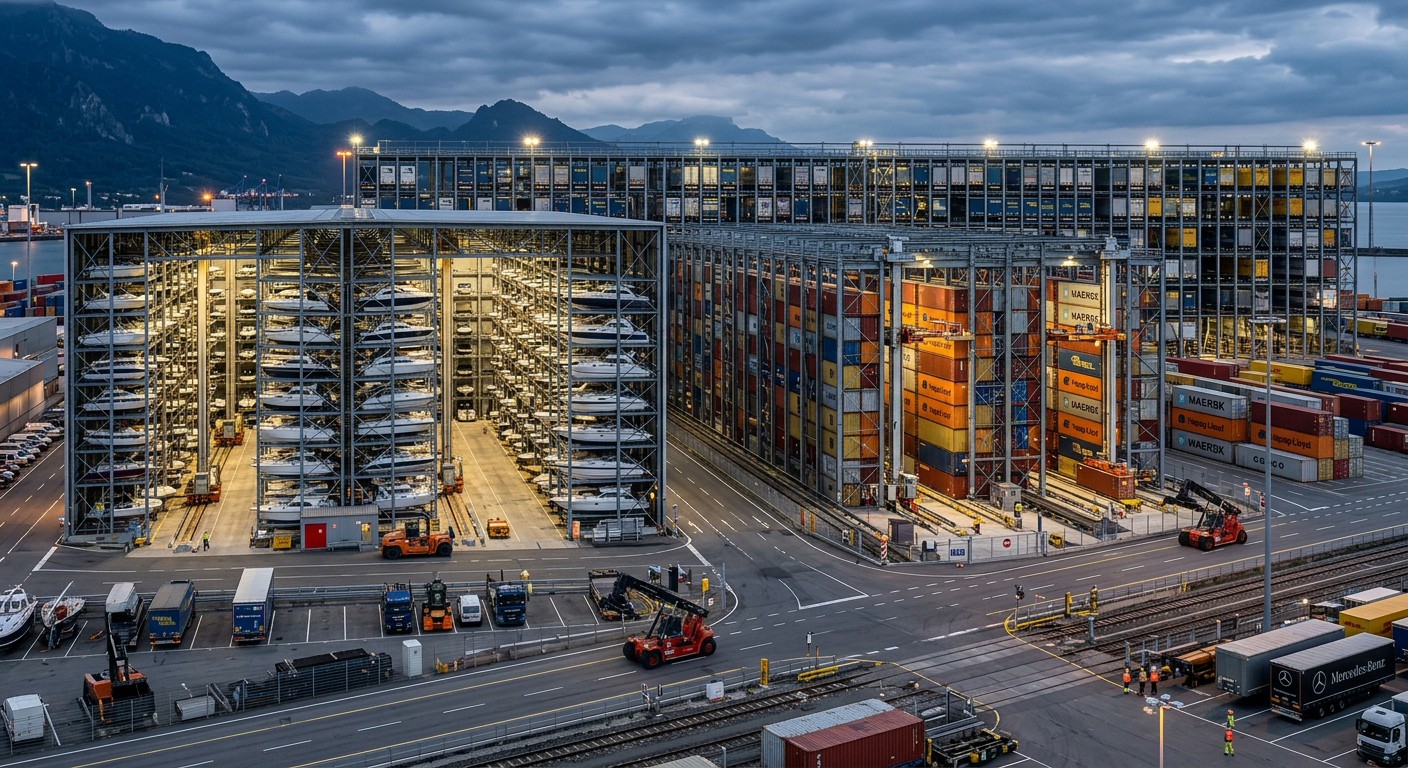
Container high-bay warehouses and container terminals: The logistical interplay – expert advice and solutions - Creative image: Xpert.Digital
This innovative technology promises to fundamentally change container logistics. Instead of stacking containers horizontally as before, they will be stored vertically in multi-story steel racking structures. This not only allows for a drastic increase in storage capacity within the same area, but also revolutionizes all processes at the container terminal.
More information here:










