
Waiting as a weapon: The real reason why Trump's Iran deal is taking so long – stalled negotiations or calculated waiting?
Xpert Pre-Release

Available in 27 languages 📢
Prefer Xpert.Digital on GoogleⓘPublished on: June 2, 2026 / Updated on: June 2, 2026 – Author: Konrad Wolfenstein
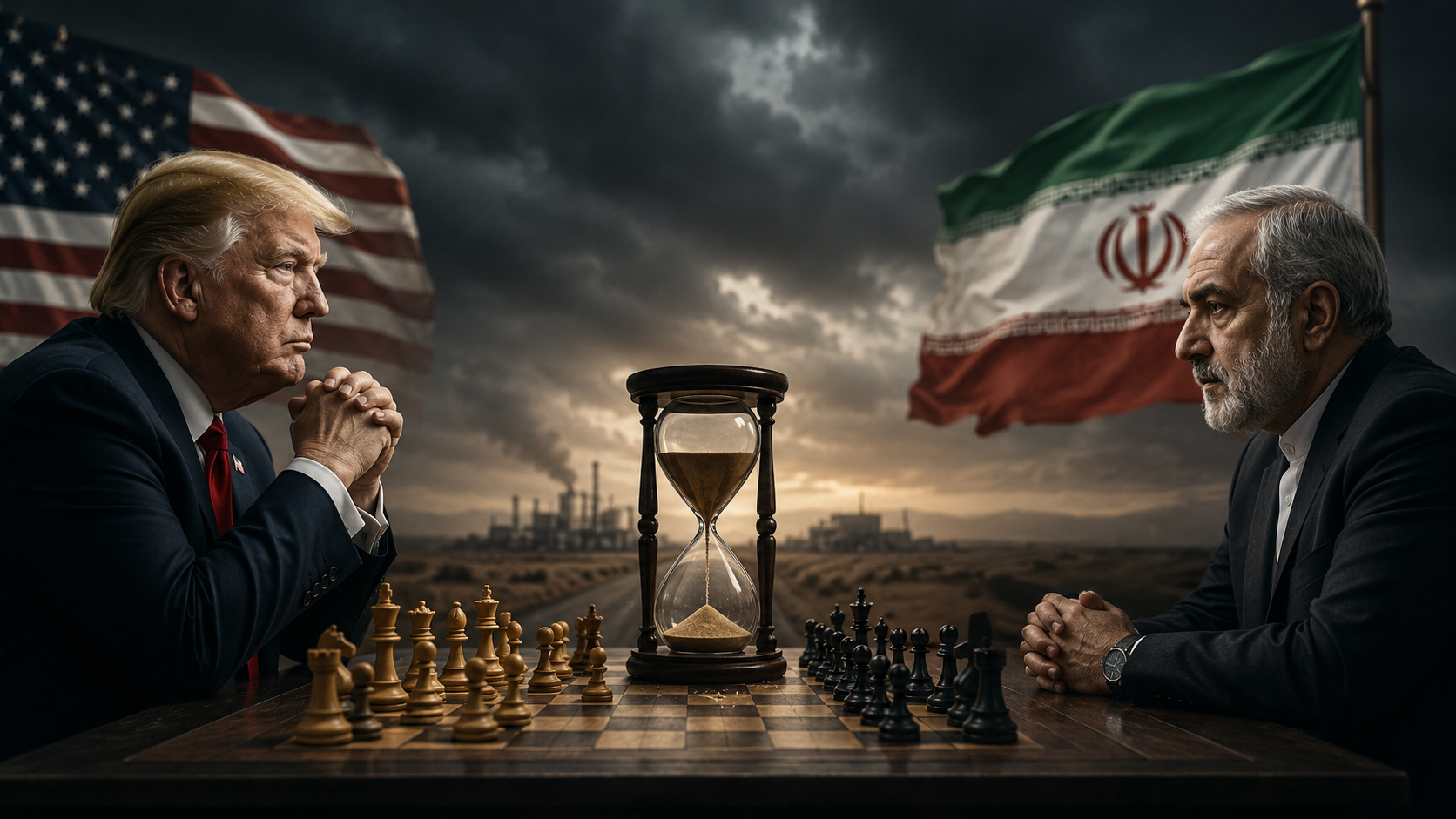
Waiting as a weapon: The real reason why Trump's Iran deal is taking so long – Stalled negotiations or calculated waiting? – Image: Xpert.Digital
More than just ego: What's really behind Trump's risky delaying tactics in Iran
Oil, power, and calculation: The unvarnished truth about Trump's strategy in the Persian Gulf
For weeks, a fragile ceasefire has held the world in suspense, while the hoped-for new Iran deal remains elusive. The common explanations offered by the international media—Donald Trump's unpredictable ego and the internal political chaos in Tehran—fall far short of the mark. Behind the scenes, a completely different picture emerges: American hesitation is not a diplomatic failure, but rather cold-blooded geopolitical calculation. For Washington, the unresolved conflict serves as strategic leverage. It not only legitimizes a continued US military presence in the Persian Gulf, but, through the ongoing blockade of the Strait of Hormuz, also puts immense pressure on China's critical energy supply. A thorough analysis of Trump's psychological negotiating style, the crumbling power structures in Iran, and the mechanisms of the global economy reveals that those who understand this state of limbo as a means of exerting pressure are in no hurry to reach a swift agreement. Read here why deliberately maintaining the crisis is Washington's strongest weapon in the fight for global dominance.
Related to this:

Those who do not want peace cannot let it fail – Washington's strategic hesitation as a geopolitical instrument
Deadlocked negotiations or calculated waiting?
After 39 days of air war and more than 54 days of a fragile ceasefire, the world is asking a seemingly simple question: Why is there no Iran deal? The prevailing media answer—Trump's ego, the military complexities of the Strait of Hormuz, and the internal political chaos in Iran—isn't wrong, but it remains superficial. It doesn't answer the truly crucial question: Does Trump even want a quick deal—or is deliberate delay itself the strategy?
A dispassionate analysis of Trump's second foreign policy reveals a pattern that extends far beyond impulsive tweets. The US is engaged in a geopolitical competition with China for influence in the Persian Gulf – a region through which some 20 million barrels of crude oil flow daily, accounting for almost 20 percent of global consumption and a fifth of global liquefied natural gas trade. In this context, the ongoing crisis in the Gulf is not a failure of American diplomacy; it is its tool.
The ego argument: Why Trump's Obama complex is more than vanity
In 2015, Obama negotiated a multilateral agreement, the JCPOA, which imposed massive restrictions on Tehran's nuclear program and rigorous IAEA inspections. Trump tore up the agreement during his first term and has mocked Obama at every opportunity ever since. US political scientist Jonathan Cristol puts it succinctly: What Trump understands by Obama's Iran deal is the caricature he himself created of it – and not the actual agreement.
This self-created caricature now sets the standard for Trump's own success. His agreement must not only be good—it must be demonstrably better than anything his predecessor ever achieved. Trump's central demand—that Iran must agree never to possess a nuclear weapon—goes significantly beyond what the Obama deal required. US security expert Jonathan Schroden takes a pragmatic view: Trump needs a convincing deal to counter the negative political sentiment surrounding the war. But he cannot afford a deal that is too early—one that cannot be staged as an unequivocal triumph—due to domestic political pressure.
The art of not rushing things: Delay as an instrument of power
At the end of May 2026, Trump announced that a framework agreement was "largely negotiated" and details would be released "shortly"—only to instruct his negotiators shortly thereafter that they should "not rush into anything on the deal" because "time is on our side." Secretary of State Marco Rubio added that nuclear talks were "highly technical" and that one couldn't finalize a nuclear issue in 72 hours on the back of a napkin.
This seemingly contradictory communication is Trump's signature strategic tool. In his 1987 book, "The Art of the Deal," he describes the psychological anchoring principle: those who show no haste retain negotiating power. Trump begins every major negotiation with drastically exaggerated demands—a tactic known in negotiation theory as anchoring. Negotiation expert Thorsten Hofmann analyzes that Trump's staging fails to create an image of trustworthiness on the Iranian side—and as long as Iran sees no trustworthy basis for talks, it will rely on its own leverage: control of the Strait of Hormuz.
The real goal: Geopolitics in the Persian Gulf beyond the nuclear deal
This is where the blind spot in the public debate lies. The ongoing conflict offers the US something that no quick peace agreement could provide: a permanent, legitimate military presence in the world's most strategically important energy corridor. Around 80 percent of the oil transported through the Strait of Hormuz is destined for Asian markets – with China by far the largest customer.
China has described the US blockade of Iranian ports as "dangerous and irresponsible" and clearly articulated its opposition. Beijing's Foreign Minister Wang Yi stated that the blockade of the Strait of Hormuz does not serve the common interests of the international community. MERICS describes China in 2026 as economically self-confident – but also heavily dependent on a stable energy flow from the Persian Gulf. A swift Iran deal that reopens the strait to free trade would immediately restore China's energy security – and thus eliminate American leverage.
Related to this:

The Strait of Hormuz as a geopolitical lever against China
The Strait of Hormuz is the narrowest geographical bottleneck in the global energy supply. Only Saudi Arabia and the UAE have alternative export pipelines with a combined capacity of approximately 2.6 million barrels per day – a fraction of the daily flow through the 50-kilometer-wide passage. A prolonged closure would hit China hard, while the US, as a net oil exporter, would only be indirectly affected through rising global prices.
At the same time, according to an analysis by the think tank Table.Briefings, the Iran war weakens the US military presence in the Indo-Pacific because troops, ships, and missile defense systems have been withdrawn from Asia. This is a real strategic price. But it is being paid for by maintaining a presence precisely where China's dependencies are greatest—in the Persian Gulf. US analyst Zhang Lun sees Washington in a dilemma: It wants to persuade Beijing to exert pressure on Tehran in order to save face—and would be willing to wager its significant concessions on the Taiwan issue should China grant Trump this victory.
Related to this:
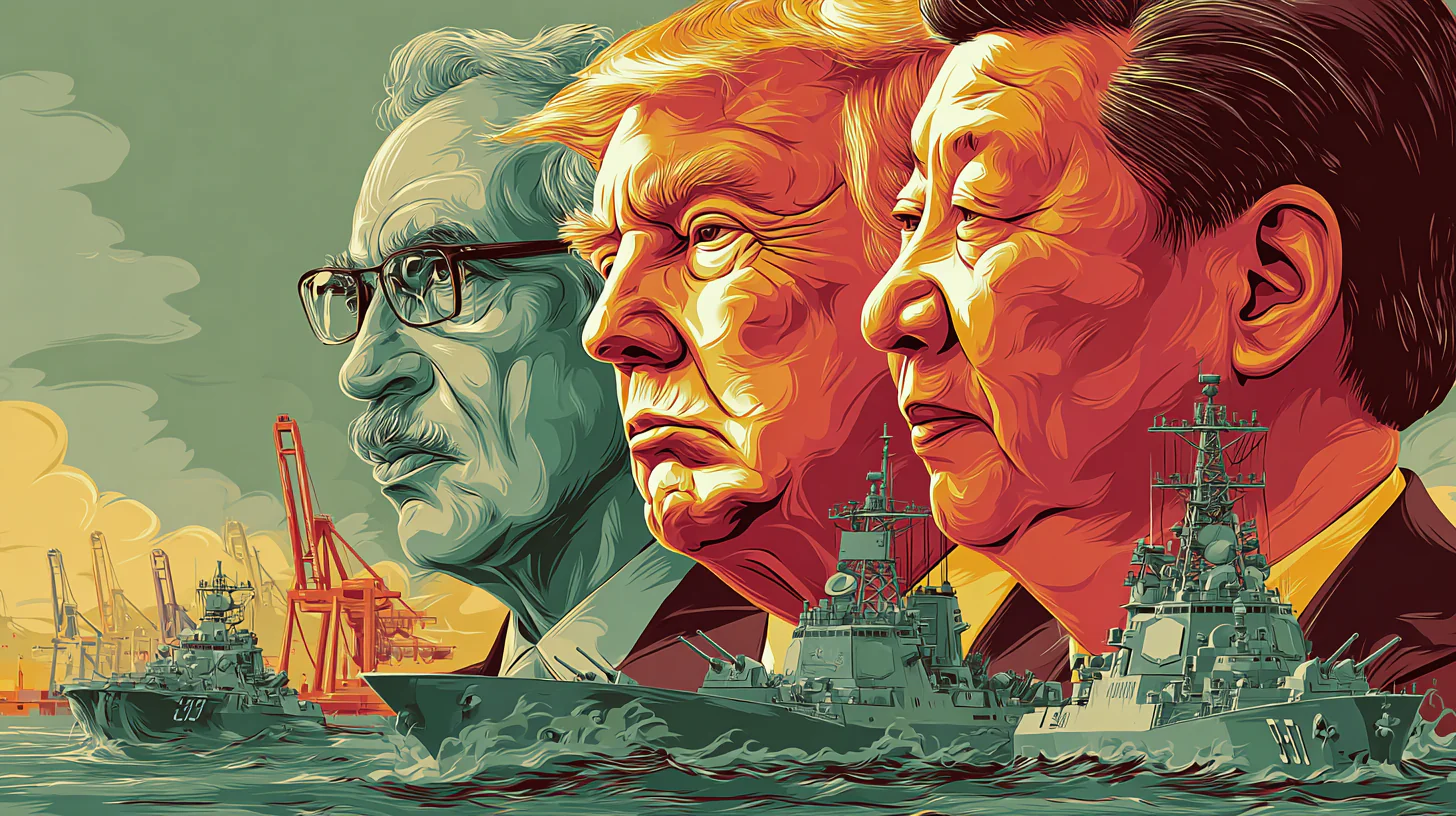
The Mullah Chaos: Structural Inability to Negotiate as a Trump Card
The internal political disintegration in Iran further complicates the negotiations – but at the same time offers Trump a convenient justification. Iran expert Ralph Ghadban identifies three rival power centers in Tehran: the advisors surrounding the seriously injured new Supreme Leader Mojtaba Khamenei, who has so far made few public appearances; the pragmatists around Parliament Speaker Ghalibaf and Foreign Minister Araghchi; and the Islamic Revolutionary Guard Corps (IRGC), which, according to Ghadban, is currently the most influential.
The New York Times Iran expert Farnaz Fassihi succinctly describes the situation: If you ask in Iran who is currently making the decisions, the answer is "Sepah"—the Revolutionary Guard. This dramatic shift in power has immediate consequences for the ability to negotiate: Communication is conducted exclusively through messengers, responses take days, and the actual authority of individual actors remains contested. Even if Washington were to put the perfect compromise proposal on the table, it would be unclear who could accept it. The Revolutionary Guard now also dominates control of the Strait of Hormuz—which, according to Ghadban, will ultimately lead to war as long as civilian forces have no influence over the military.
Our global industry and economic expertise in business development, sales and marketing

Our global industry and economic expertise in business development, sales and marketing - Image: Xpert.Digital
Industry focus areas: B2B, digitalization (from AI to XR), mechanical engineering, logistics, renewable energies and industry
More information here:
A thematic hub offering insights and expertise:
- Knowledge platform covering global and regional economies, innovation and industry-specific trends
- A collection of analyses, insights, and background information from our key areas of focus
- A place for expertise and information on current developments in business and technology
- A hub for companies seeking information on markets, digitalization, and industry innovations
Trump as a dealmaker: Why unpredictability is part of the American golf strategy
The Gulf States caught between two powers: partners or hostages of US strategy?
Between motor oil and power politics: How the Gulf States balance between the USA and China
The Arab Gulf states find themselves in a structural dilemma. Historically deeply embedded in the American security architecture, they have simultaneously developed intensive economic ties with China. The Konrad Adenauer Foundation describes the Gulf states' relationship with Trump as one that has led from initial hope to sobering realization: While Trump pursued a policy of confrontation with Iran, the Gulf states pursued a policy of de-escalation towards Tehran.
The Gulf states have a vital interest in secure transit rights through the Strait of Hormuz. Qatar, Kuwait, Iraq, and Iran itself are entirely dependent on transport via the Gulf ports. When Trump allegedly planned a military strike against Iranian facilities, the leaders of Qatar, Saudi Arabia, and the UAE successfully appealed to him to dissuade him—fearing that Iran would retaliate by attacking their oil and energy facilities. Political scientist Nesreen Ket of the Emirates Policy Center succinctly summarizes the dilemma: what is emerging is not a historic solution, but rather the perpetuation of an ongoing conflict. For Washington, this could be precisely the preferred starting point.
Trump's Personality Architecture: The DISC Profile of a Dealmaker
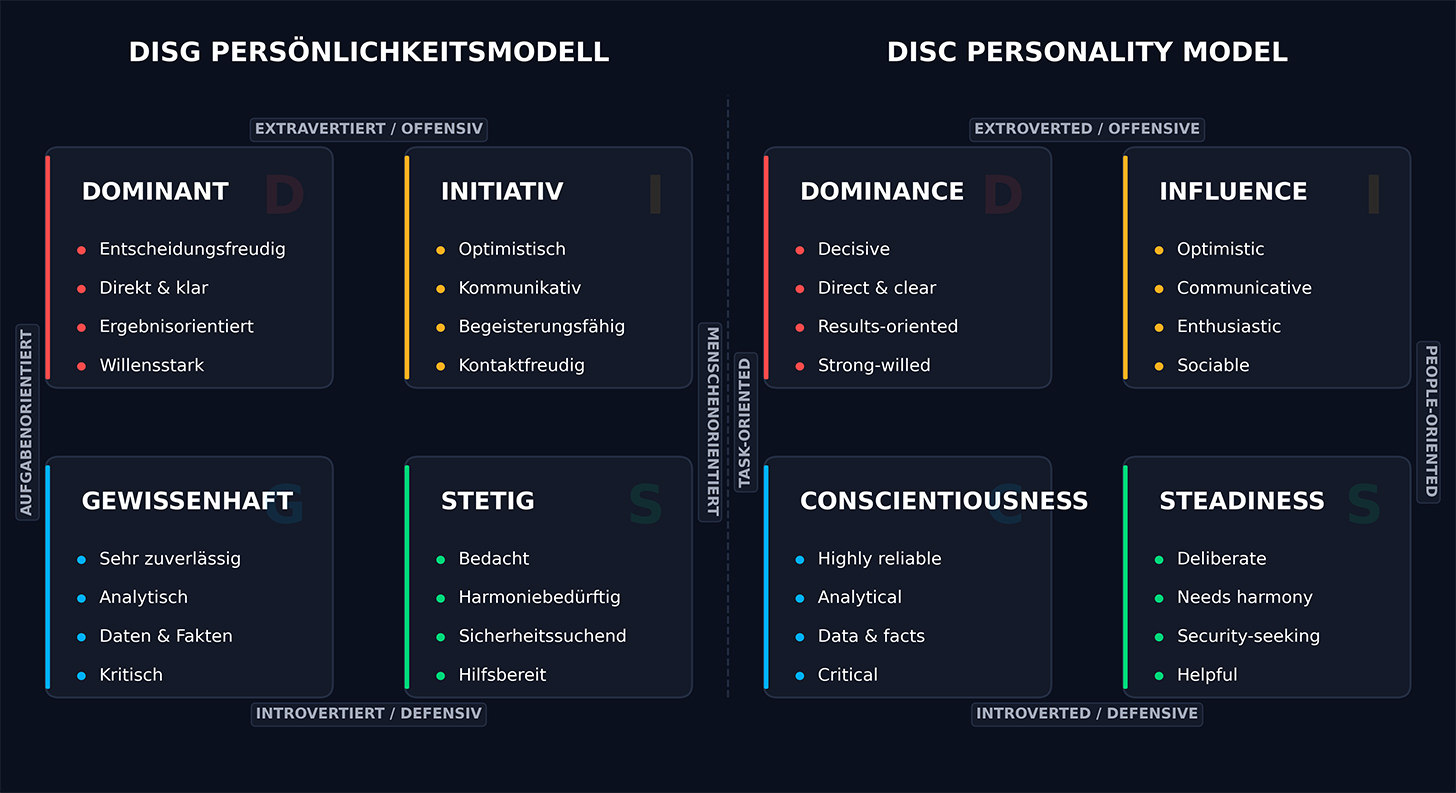
The DISC model as an analysis tool in detail – Image: Xpert.Digital
To fully understand Trump's behavior in the Iran crisis, it is worth taking a look at his personality structure from the perspective of the DISC model, which is based on the work of William M. Marston and distinguishes four behavioral styles: Dominant, Influential, Steady and Conscientious.
| Analysis criterion | Donald Trump (D/I) |
|---|---|
| DISG profile | Primary Dominant (D), Secondary Initiative (I); pronounced results orientation, high risk tolerance, strong need for recognition |
| Core strength | Maximum pressure as a negotiating tool; media staging skills; agenda-setting through surprise |
| Leadership style | Control through intimidation and reward; hierarchical sender model; short-term decision horizon |
| Dealing with pressure | Counter-pressure through escalation; public show of force; shift towards de-escalation when political costs rise |
| communication | Loud, repetitive, slogan-based; contradictions as a strategic tool; the agenda is redefined daily |
| Historical Heritage | A tension between transactionalism and nationalism; shaping of geopolitical discourse without sustainable institutional development |
| Greatest weakness | Lack of strategic patience; destructive impact on multilateral trust architectures; inability to engage in discreet diplomacy |
| What we learn | Psychological dominance can shift the scope of negotiations – but only if a trustworthy agreement seems possible in the end |
| Ideal complement | G-Type (Conscientious): Detail-oriented, institutionally rooted diplomats who technically develop framework agreements and build trust through continuity |
Trump's dominant personality structure explains his behavior in the Iran conflict in several ways. The D-type thrives on challenges and quick results – but he defines "results" according to his own standards. What appears to be chaos from the outside – the daily interplay between threats and offers of dialogue – is, from this perspective, a consistent strategy for dominance. It aims to disorient the other side, maximize his own room for maneuver, and use his own unpredictability as a deterrent, which aligns with the research literature on "constructive ambiguity" (Henry Kissinger).
The secondary initiative aspect explains the media self-promotion: Trump needs the audience, the stage, the reaction. A discreet diplomatic success behind closed doors would be worthless to him because it cannot be translated to the cameras. This is also why negotiation expert Hofmann recommends that Trump simply remain silent – advice that is psychologically sound, but fundamentally contradicts the nature of a pronounced D/I type.
The economic calculation: oil prices, energy markets and geopolitical rents
The ongoing crisis has immediate economic consequences, which in turn can be strategically exploited. The price of oil is highly sensitive to any escalation or de-escalation in the Gulf: the mere suggestion of a preliminary agreement caused Brent crude to fall by more than five percent to below $100 per barrel at the end of May 2026. Conversely, any pause in negotiations drives prices up. For American energy companies, which profit from high global market prices, this fluctuation represents a significant source of revenue – and a structural incentive not to resolve the crisis too quickly.
The FERI Institute's analysis concludes that a prolonged oil crisis in the Persian Gulf remains unlikely because China's interests there are too strong. This is true – but it also means that Beijing will repeatedly have to act as a supplicant in this crisis, dependent on American goodwill. The structural power asymmetry that Washington is systematically expanding in this crisis lies precisely in this: not only military and diplomacy are being used as leverage, but also the energy dependence of a systemic rival.
The paradox of the fragile ceasefire: stability without peace as a goal definition
What ultimately remains is a deeply uncomfortable conclusion. The current situation—a fragile ceasefire, unresolved negotiations, the ongoing blockade of the Strait of Hormuz, and a continued American military presence in the Gulf—might not be the worst outcome from Washington's strategic perspective. It is unstable enough to legitimize the American presence. It is stable enough to prevent uncontrolled escalation. And it is open enough to allow Trump to announce the deal at any time should the domestic costs of the conflict threaten to outweigh the geopolitical gains.
A framework for a preliminary agreement was reportedly on the table in late May 2026: a 60-day extension of the ceasefire, conditional opening of the Strait of Hormuz, and an Iranian commitment to non-enrichment of uranium. Trump still needs to approve it. His failure to do so is not a sign of weakness. It is a deliberate decision to maintain the moment of maximum negotiating pressure for as long as possible – true to the principle from "The Art of the Deal": whoever controls the time, controls the deal. The question on everyone's mind – "Why is this all taking so long?" – is thus answered: not because Trump can't reach a deal, but simply because he doesn't want to conclude one as long as the conditions aren't optimal.
🎯🎯🎯 Data-driven B2B industry hub as a quasi-in-house solution

The quasi-in-house solution: How Xpert.Digital closes operational gaps in B2B marketing and sales – Smart Content-Driven Business - Image: Xpert.Digital
Xpert.Digital is a data-driven B2B industry hub led by Konrad Wolfenstein . The company acts as an external, quasi-in-house solution for industrial partners, closing operational gaps in marketing, content, and sales – without requiring additional resources on the client side.
More information here:
Your global marketing and business development partner
☑️ Our business language is English or German
☑️ NEW: Correspondence in your native language!

Konrad Wolfenstein
I and my team are happy to be available to you as your personal advisor.
You can contact me by filling out the contact form here simply call me at +49 7348 4088 965. My email address is [email protected]:or
I'm looking forward to our joint project.










