
Trump's ingenious move: The silent starvation – The US-Iran naval blockade and the economic collapse of the mullah regime
Xpert Pre-Release

Available in 27 languages 📢
Prefer Xpert.Digital on GoogleⓘPublished on: April 30, 2026 / Updated on: April 30, 2026 – Author: Konrad Wolfenstein
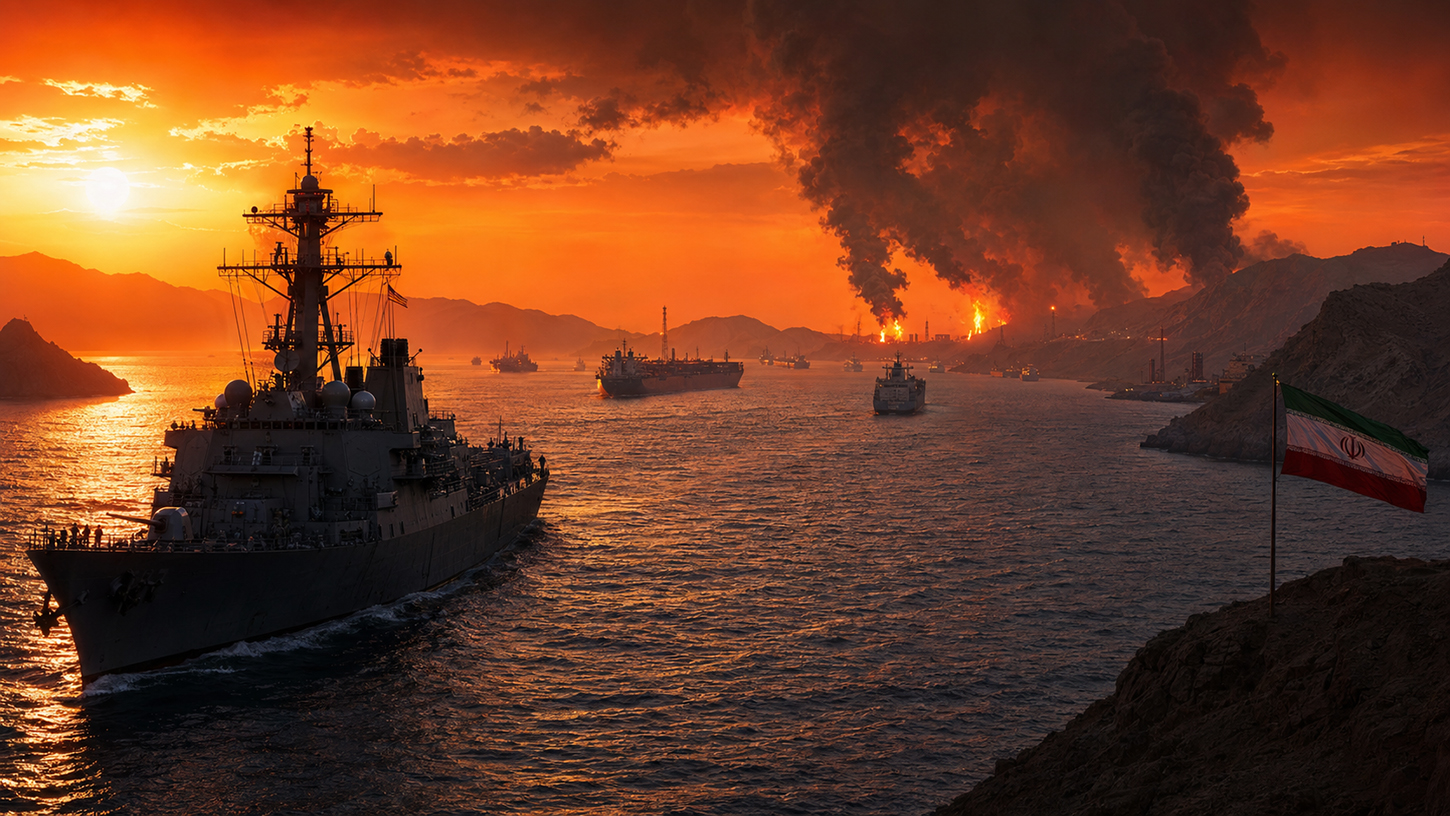
Trump's ingenious move: The silent starvation – The US-Iran naval blockade and the economic collapse of the mullah regime – Image: Xpert.Digital
Days until collapse: Iran's mullah regime faces economic ruin
Cracks in the Mullah regime: Trump's naval blockade triggers panic among the Revolutionary Guards
After an unprecedented US-Israeli surprise attack on Iran, the mullah regime initially appeared to have emerged as the survivor. But the real battle is raging not in the air, but on the high seas: With a complete blockade of the Persian Gulf, the Trump administration has turned the tables and turned Iran's most important weapon – oil – against itself. While Tehran loses hundreds of millions of dollars daily and its oil reserves overflow, the Islamic Republic faces economic collapse. The first cracks in the Revolutionary Guard's power structure are already becoming visible. But this risky geopolitical chess game, which also secretly aims to weaken China, comes at a price: Exploding oil prices and a new wave of inflation could drag the entire global economy into the abyss. Who will hold their breath the longest in this global war of nerves?
Trump's true goal: How the Iran blockade is actually intended to bring China to its knees
Around two months ago, the geopolitical landscape of the Middle East changed dramatically, a move reminiscent of the most audacious passages in military strategy literature. The US and Israel launched a coordinated surprise attack on Iran, which on its first day not only crippled the country's military infrastructure but also eliminated Supreme Leader Ali Khamenei and dozens of his closest advisors from the center of power. It was an attack the likes of which the world had not seen in decades—surgical, focused on the top brass of the regime, with the explicit aim of bringing Tehran to its knees before a full-scale escalation could occur.
But history loves the treachery of the unfinished. The Iranian regime survived the war, struck back with asymmetric warfare, and on April 8, 2026, agreed to a two-week ceasefire with Washington. What initially appeared to be an American triumph was quickly interpreted by Western experts as a strategic defeat for Trump. The regime was still standing—weakened, but upright. Western analysts spoke of Iran as the true victor of the conflict, having demonstrated, simply by surviving, that even a massive US military strike could not bring down the Islamic Republic. The narrative seemed to have been dominated by Tehran.
This interpretation was understandable, but premature. It overlooked the fact that the real strategic battle was not to be decided on the battlefields of the Middle East, but on the invisible routes along which millions of barrels of crude oil supply the world daily with the fuel of modernity. The decisive instrument was not the fighter jet, but the warship. Not the bomb, but the blockade.
A U-turn in the Persian Gulf: The naval blockade as a strategic calculation
Once the ceasefire took effect, Iran immediately used it as leverage in negotiations to close the Strait of Hormuz – the 54-kilometer-wide bottleneck between the Iranian coast and the Sultanate of Oman, through which approximately 20 million barrels of crude oil are transported daily, representing about one-fifth of global oil consumption. Only Iranian ships or tankers approved by the regime, which often paid protection money to the Revolutionary Guard, were allowed to pass. Tehran believed it held the decisive trump card: a stranglehold on the world's energy supply.
On April 13, 2026, Washington reacted with a move that fundamentally altered the negotiating landscape. The US Navy began not only securing the strait against neutral tankers but also actively preventing Iranian ships from leaving their home ports. US Central Command (CENTCOM) specified that the blockade applied to all ships entering or leaving Iranian ports on the Persian Gulf and the Gulf of Oman. Eight oil tankers linked to Iran had already been intercepted. Ships that had paid an "illegal toll" to the regime would forfeit any right to safe passage, Trump announced via the platform TruthSocial.
The strategic brilliance of this move lies in its paradox: The US turned Tehran's own weapon against Tehran. Iran had believed that closing the Strait of Hormuz would force the West to its knees. Now the regime was trapped in its own self-made predicament. For the Strait of Hormuz is not only the most important export route for Saudi Arabia, Kuwait, and the United Arab Emirates—it is, above all, and almost exclusively, the only artery through which Iran brings its oil to the world market. A situation that one experienced market observer succinctly summarized: This decision has created a situation in which the clock is now ticking not only for the West, but also for Iran itself.
The markets reacted with the nervousness typical of energy crises. Brent crude oil rose by as much as 9.1 percent in early trading on April 13, 2026, exceeding the symbolic threshold of $103 per barrel. European gas futures even climbed by almost 18 percent at one point. Bloomberg Economics issued unequivocal warnings of higher oil prices, a further slowdown in growth, and a new surge in inflation. In the extreme escalation scenario of a months-long blockade, analysts calculated oil prices of up to $170 per barrel, a global growth slowdown to 2.2 percent, and inflation of 5.4 percent by the end of the year. This wasn't panic – it was cold, calculated risk assessment.
Iran's Achilles Heel: Anatomy of an Oil-Dependent Economy on the Verge of Collapse
To understand the extent of the economic pressure exerted on the Iranian regime by the US blockade, one must take a sober look at the structure of the Iranian economy. Despite its ambitions as a regional power and its rhetorical pronouncements of economic independence, Iran is a country whose state function depends to an almost existential degree on a single commodity: oil.
The country possesses the world's third-largest oil reserves and ranks among the top ten producers. In 2024, despite tightened US sanctions, Iran exported between 1.3 and 1.5 million barrels daily, and in the months immediately preceding the blockade, exports averaged 1.69 million barrels per day, according to estimates by the oil market firm Kpler. These figures may sound technical, but they have immediate political consequences: Without these revenues, the regime can neither finance its Revolutionary Guard nor appease the increasingly disaffected population with subsidies, nor sustain its proxy organizations like Hezbollah or the Houthis in Yemen.
Since April 13, 2026, these revenues have almost completely dried up. Reports indicate that Iran is losing approximately $430 to $435 million daily due to the blocked oil tankers alone. By comparison, in March 2026, Iran was still earning around $153 million daily from oil exports – even this figure was significantly reduced compared to normal times due to sanctions and the war. The complete blockade has reduced this number to almost zero. According to multiple reports, Iran has now suspended all petrochemical exports indefinitely – an unmistakable sign that the blockade is taking effect.
Added to this is a technical problem whose consequences are more dramatic than the mere loss of revenue: exhausted storage capacity. If oil cannot be exported, it must be stored. But Iran has limited reserve tanks. According to calculations by the data analytics provider Kayrros, the country's crude oil storage tanks were already more than 60 percent full at the start of the blockade. The consulting firm FGE NextantECA estimates the remaining storage capacity at only around 90 million barrels total – with a surplus production of 1.5 to 2 million barrels per day, which is normally exported, these storage facilities would be exhausted after just a few weeks.
The analysis firm Energy Aspects, based on satellite data, offers an even gloomier forecast: According to their findings, available free storage capacity amounts to only around 30 million barrels, which, at a normal production rate, would lead to the depletion of storage space after approximately 16 days. Should the blockade continue beyond May, production would have to be substantially reduced. Such a step is by no means trivial: throttling and later restarting oil fields causes significant technical damage to the production infrastructure, which, in the worst-case scenario, could result in years of lost capacity. The Wall Street Journal reported that Iran is "feverishly" searching for solutions for oil storage and is doing everything possible to avoid a crippling production shutdown, which could inflict massive long-term damage on the oil industry as its most important source of revenue. At the same time, attempts are being made to utilize available tankers in ports as floating interim storage facilities to postpone the inevitable production halt for as long as possible.
The current economic situation in Iran is simply catastrophic for a country that has boasted for years about overcoming Western sanctions. The International Monetary Fund (IMF) had already projected an inflation rate of 42.4 percent for 2025, which is unlikely to remain below 40 percent in 2026. The World Bank has fundamentally revised its growth forecasts downwards and now anticipates a decline of 1.7 percent in 2025 and a 2.8 percent drop in gross domestic product in 2026. The Iranian rial has depreciated dramatically against the euro and the dollar. This economic collapse was already underway before the blockade – the complete blockade has accelerated it into freefall.
The race against time: How long can Tehran withstand the stranglehold?
The crucial economic question occupying analysts and strategists is not whether the US blockade is effective, but how long Iran can withstand this pressure before its economy heads towards collapse. The answers vary considerably depending on the methodology and data used – and this divergence is itself politically charged.
Analysts who rely on the more optimistic assessment, citing FGE NextantECA, argue that Iran could theoretically survive the blockade for up to three months with a moderate production cut of around 500,000 barrels per day before a complete shutdown becomes unavoidable. This would correspond to sustaining production until mid-July 2026 at the latest. Analysts who place more trust in satellite imagery from Energy Aspects see the critical point for a forced production cut considerably earlier: after 16 to a maximum of 30 days. In this scenario, Iran would face a seriously precarious economic situation in the weeks following April 13, 2026. Experienced observers consider both extremes unlikely and suspect the real breaking point lies somewhere in between – within a window of four to eight weeks, during which the cumulative damage could no longer be politically concealed.
This time dimension is crucial for understanding the dynamics of the negotiations. Trump himself stated that the blockade "might be more effective than bombing." Indeed, the economic attrition strategy combines two effects that a purely military campaign can hardly achieve: It deprives the regime of the financial basis for its survival without generating the psychological solidarity effect that bombings of civilian infrastructure regularly trigger. A starving state cannot pay revolutionary guards, grant subsidies, or keep its propaganda machines running—all without a single image of destroyed hospitals that would garner international sympathy for the regime.
The alternative route via land is hardly viable. Iran lacks sufficient pipeline infrastructure for significant oil exports via neighboring countries like Turkey or Iraq. Even in the unlikely scenario that such pipelines could expand their capacity in the short term, they would be easy targets for military pressure or diplomatic intervention. And the Caspian Corridor, discussed in some European strategy papers as an alternative for energy imports, is not a scalable alternative route for Iranian oil exports in the foreseeable future.
Our US expertise in business development, sales and marketing

Our US expertise in business development, sales and marketing - Image: Xpert.Digital
Industry focus areas: B2B, digitalization (from AI to XR), mechanical engineering, logistics, renewable energies and industry
More information here:
A thematic hub offering insights and expertise:
- Knowledge platform covering global and regional economies, innovation and industry-specific trends
- A collection of analyses, insights, and background information from our key areas of focus
- A place for expertise and information on current developments in business and technology
- A hub for companies seeking information on markets, digitalization, and industry innovations
Oil, power, pressure: Why the naval blockade threatens the global balance
Cracks in the foundations of the theocratic state: The regime's internal crisis
Even more revealing than the economic data on the pressure are the political rifts that this pressure is provoking within the Iranian regime. A regime cannot be defeated simply by depriving it of resources – it must also be destabilized by the loss of its internal cohesion. The latest reports from Tehran paint a picture of this that is hard to miss.
The London-based Financial Times, citing well-informed sources, reported that since the ceasefire began on April 8, 2026, “long-standing tensions between rival factions within Iran’s political elite have once again erupted openly.” The most radical Islamists and hardliners within the Revolutionary Guard want to immediately halt any negotiations with the US—a position based on an almost pathological aversion to any compromise with America, which they label the “Great Satan.” So far, they have not been able to prevail, but their influence is growing in proportion to the failures of the more pragmatic forces.
The pattern of division becomes apparent in a specific, symbolically significant moment: On Friday, following the ceasefire, Foreign Minister Abbas Araghchi announced the reopening of the Strait of Hormuz – much to Washington's obvious delight. However, the leadership of the Revolutionary Guard publicly contradicted this the following day: The strait would remain closed, and several cargo ships were fired upon. This rare instance of public dissent between the foreign minister and the Revolutionary Guard is not a political slip-up, but rather a symptom of the fundamental tension between those seeking a survival deal and those who would rather perish than surrender. The US-based Institute for the Study of War (ISW) explicitly speaks of "deep divisions within the Iranian regime" in its assessment.
The New York Times, through its Iran correspondent Farnaz Fassihi, reported that Iranian generals have a genuine interest in reaching an agreement with the US because they view it as a matter of survival. This is an extraordinary statement: It is precisely the military—that part of the regime which benefits most from the continuation of the conflict—who are calculating most soberly and recognizing the untenability of the current situation. The generals of the Revolutionary Guard, who owe their influence and privileges to the regime, know that an economically collapsing Iran can no longer finance a functioning armed force.
Trump seized this opportunity in his characteristic way: He publicly speculated on the platform Truth Social about the alleged division of the regime, claiming there were internal conflicts between hardliners and moderates, thus deliberately playing on the fault line in the Iranian power structure. The Iranian regime responded with an unusually coordinated propaganda campaign: Parliament Speaker Ghalibaf and President Massoud Peseshkyan simultaneously shared identical posts on the platform X, proclaiming that there were no hardliners or moderates in Iran—all were committed to the revolution and the Supreme Leader “in complete loyalty.” This staging of unity in response to reports of disunity is itself a telltale sign.
What further complicates the internal regional dynamics is the Iranian system's decades-long inability to distinguish between short-term survival and long-term adaptability. The factional infighting surrounding the nuclear deal is nothing new: as early as the summer of 2025, following the first American attacks on Iranian nuclear facilities, a so-called "Reformist Front" publicly advocated for direct negotiations and a halt to uranium enrichment—only to be denounced by state-affiliated media as executors of American interests. The hardliners consistently cite Gaddafi's fate as a cautionary tale: whoever abandons weapons and negotiates with America will end up like Libya. This logic of self-immunization against any compromise is the regime's fundamental structural problem—it simultaneously makes it resistant to military pressure and incapable of adapting to economic realities.
The great chess game: Trump's multi-front strategy and China's silent vulnerability
The conflict over the Strait of Hormuz would be fundamentally misunderstood if it were viewed merely as a bilateral US-Iran dispute. It is the provisional centerpiece of a broader geopolitical strategy pursued by the Trump administration toward China – a strategy being implemented by its architects with a consistency that compels even critics to take its strategic calculations seriously.
The key to understanding this lies in China's energy vulnerability. The People's Republic is the world's largest oil importer: In 2025, China imported an average of around 11.6 million barrels of crude oil per day. Of this, roughly half is estimated to flow through the Strait of Hormuz. China receives the lion's share – between 80 and 94 percent according to various estimates – of Iranian oil exports, for which Tehran's oil is available at significantly discounted prices due to sanctions. The US blockade alone prevents around 2 million barrels of Iranian crude oil from reaching its most important customer, China, every day.
Washington's strategy, as outlined by Under Secretary of Defense Elbridge Colby in early 2026, aims to gradually deprive China of access to markets and resources—ideally through a combination of trade agreements and indirect resource control. US influence over Venezuela's, Iran's, and potentially other energy exports, as well as over trade relations with China, is to be used as leverage—in parallel with pressure on Gulf allies to make China's raw material supply more controllable. In this logic, Iran is not the actual target, but rather the instrument.
China, however, possesses considerable buffers: strategic oil reserves of approximately 1.5 billion barrels – enough to cover roughly 200 days of oil imports. Furthermore, Beijing can switch to Russian oil, which, due to the decline in Indian demand, can be increasingly diverted to China. Analysts at Société Générale therefore describe potential disruptions in Iranian supplies to China as "manageable" – which is true from a Chinese perspective, at least in the short term. In the medium term, however, economic pressure is mounting: without cheap Iranian oil, China will have to purchase it at a higher price, which increases production costs, weakens the renminbi, and intensifies trade pressure from Washington.
At the same time, the US strategy contains a serious design flaw, which the Carnegie Endowment for International Peace explicitly identified in March 2026: While the interventions in Iran and Venezuela align with the strategy of containing China, they simultaneously strengthen Russia's position. Moscow can now redirect oil exports that previously went to India to China, which weakens American pressure on New Delhi and solidifies the Russian-Chinese partnership—precisely the power constellation that poses the greatest long-term danger for the US. Trump's geopolitical maneuver is brilliantly calculated in the short term, but strategically risky over a five- to ten-year timescale.
Global market in a state of emergency: The global economic consequences
The economic collateral damage of the Hormuz conflict is no longer limited to the immediate adversaries, Iran and the USA. It has developed into a systemic risk for the global economy, which, depending on the scenario, will leave profound and long-lasting scars.
Germany provides a particularly vivid example of Europe's changing energy dependency. Between January and November 2025, 94.7 percent of the liquefied natural gas (LNG) imported into Germany came from the USA. Across the EU, the US share of LNG imports is around 57 percent – roughly four times higher than in 2021. While Europe has reduced its dependence on Russian gas, it has replaced it with a new dependence on American LNG. In a situation where Washington uses energy markets as a geopolitical tool, this dependence is not a neutral factor, but rather a structural vulnerability.
The reaction of international financial markets and the G7 illustrates the extent of global concern. According to reports in the Financial Times, leading Western industrialized nations were discussing a joint release of 300 to 400 million barrels of strategic reserves – which would represent roughly 25 to 30 percent of the G7's estimated reserves of 1.2 billion barrels. The mere news that such a release was being discussed was enough to push the price of oil back down from nearly $120 to around $105 – proof of just how nervous and volatile energy markets are at this time.
Morgan Stanley has outlined three scenarios for the development: In the de-escalation scenario – resumption of normal shipping within a month – the Brent price would trade in a range of $80 to $90 in 2026. In the intermediate scenario of continued tension without full escalation, prices would rise to $90 to $110. In the maximum stress scenario with a blockage lasting several months, prices could reach up to $170 per barrel, as already mentioned. The economic consequences for export-dependent economies like Germany would be severe in this third scenario: rising production costs, loss of purchasing power due to higher energy and transport prices, a renewed surge in inflation, and consequently, another monetary policy dilemma for the European Central Bank.
Particularly exposed economies like Qatar and Kuwait, which export a significant portion of their economic output via sea, could, according to Goldman Sachs, face a temporary decline in economic output of up to 14 percent in an extreme scenario. In such a scenario, the positive price effect of higher oil prices for energy exporters would quickly be outweighed by the costs of the export shortfall. Even the wealthy Gulf states are therefore by no means the sure winners of this crisis, even if they might initially appear to benefit from higher prices.
The decision dilemma: scenarios, escalation risks, and possible outcomes
What outcomes can realistically be expected? Anyone who has even occasionally studied the history of sanctions regimes and economic blockades knows that the answer is neither simple nor can it be formulated within short timeframes. The effect of economic pressure on political systems can only be reliably predicted in one respect: it unfolds more slowly than optimists hope, and faster than autocrats believe.
Scenario one: diplomatic agreement. Negotiations between Washington and Tehran—initially mediated by Oman in Geneva, later under Pakistani mediation in Islamabad—have gone through several rounds since February 2026. In February 2026, Oman called Iran's willingness not to stockpile weapons-grade nuclear material an "extremely important breakthrough." Iran submitted an initial draft agreement but withdrew from subsequent rounds of negotiations several times, citing the naval blockade as an obstacle to serious talks. The US insists on a complete halt to all uranium enrichment—a position Iran considers politically untenable domestically.
Scenario two: slow economic collapse with regime adjustment. Here, the Iranian regime would gradually make concessions under increasing economic pressure without sacrificing its fundamental power structures. This scenario corresponds in some ways to the course of the initial nuclear diplomacy under Obama between 2013 and 2015, where Iran accepted restrictions negotiated under the pressure of the JCPOA process. The question is whether Trump's maximalist approach—no uranium enrichment, no state terrorism, no missile programs—leaves room for such a middle ground.
Scenario three: Escalation by hardliners. The Revolutionary Guard has already demonstrated its willingness and ability to publicly thwart the foreign minister and fire on cargo ships, even if this weakens the regime's negotiating position. Should the hardliners gain the upper hand, Iran risks not only complete economic collapse but also a resumption of direct military strikes. Trump has hinted that he is considering new attacks to restart negotiations. The logic of escalation is difficult to break in this scenario.
The overarching strategic picture is one of an unequal but protracted battle of nerves. Experienced regional analysts predict that Iran will indeed "reach this breaking point," but "probably not as quickly as many optimists believe." Three to four more months of blockade seem realistic before the regime maneuvers itself into an economically unsustainable position. For the US, the parallel question then arises: Can Washington maintain domestic support for the blockade over such a long period, especially given rising energy prices and the pressure on its own economy?
This twofold question – who will break first? – is the real core issue of the war of nerves between Washington and Tehran. With his counter-blockade, Trump has created a situation in which both sides are under time pressure. He has shifted the negotiating asymmetry in favor of the US without outright destroying the regime. This is indeed a rarely acknowledged strategic achievement – even if the question of whether Trump consciously planned the entire scenario in advance or acted in his characteristically intuitive and aggressive manner remains a legitimate debate.
A conflict with an uncertain outcome – and a global price
The conflict over the Strait of Hormuz, in its current form, is no longer a war in the classical sense – it is an economic duel with military safeguards and high diplomatic tension. For the Iranian regime, every day of the blockade represents a further step towards economic erosion: $430 million in lost oil revenues daily, shrinking storage capacity, rising inflation in a population already struggling with a projected inflation rate of over 40 percent by 2026, and an economy that the World Bank forecasts will experience negative growth of 2.8 percent by 2026.
For the world, the conflict means uncertainty in energy markets, higher commodity prices, and growing nervousness in capital markets. For Europe, it means the uncomfortable realization that dependence on American LNG is not a neutral supply relationship, but a geopolitical positioning with risks that have so far been barely calculated. For China, it means increasing pressure on its energy security and a gradual loss of freedom of action, even if its strategic reserves offer a short-term buffer.
The crucial variable remains the factor of time. Economists and geopoliticians agree that the regime will reach its breaking point – the disagreement lies in precisely when. Historical parallels to other sanctions regimes – from South Africa under apartheid to Iraq under Saddam Hussein to North Korea under Kim Jong-un – caution against overly short-term predictions of collapse. Authoritarian regimes develop a remarkable resilience to economic pressure as long as the security apparatus remains loyal and the population does not openly rebel. Both are currently the case – but neither can be guaranteed indefinitely if the supply situation deteriorates further.
What can be said with certainty is that the naval blockade has fundamentally altered the negotiating architecture of the US-Iran conflict. It has transformed Tehran's attempt at asymmetric blackmail—the closure of the Strait of Hormuz as leverage against the West—into a mutual war of attrition, in which the clock is truly ticking on both sides. Trump's intuitive escalation, despite all the justified criticism of his foreign policy, was tactically effective at this specific juncture. Whether it will also prove strategically sustainable will be revealed by the next historical stage of this conflict.
Hub for Security and Defense - Advice and Information

Hub for Security and Defense - Image: Xpert.Digital
The Security and Defence Hub offers expert advice and up-to-date information to effectively support companies and organizations in strengthening their role in European security and defence policy. Working closely with the SME Connect Defence Working Group, it particularly promotes small and medium-sized enterprises (SMEs) that wish to further develop their innovative capacity and competitiveness in the defence sector. As a central point of contact, the Hub thus creates a crucial bridge between SMEs and European defence strategy.
Related to this:










