
The vertical port: Why ports worldwide must learn to grow upwards instead of outwards
Xpert Pre-Release

Available in 27 languages 📢
Prefer Xpert.Digital on GoogleⓘPublished on: August 7, 2026 / Updated on: August 7, 2026 – Author: Konrad Wolfenstein
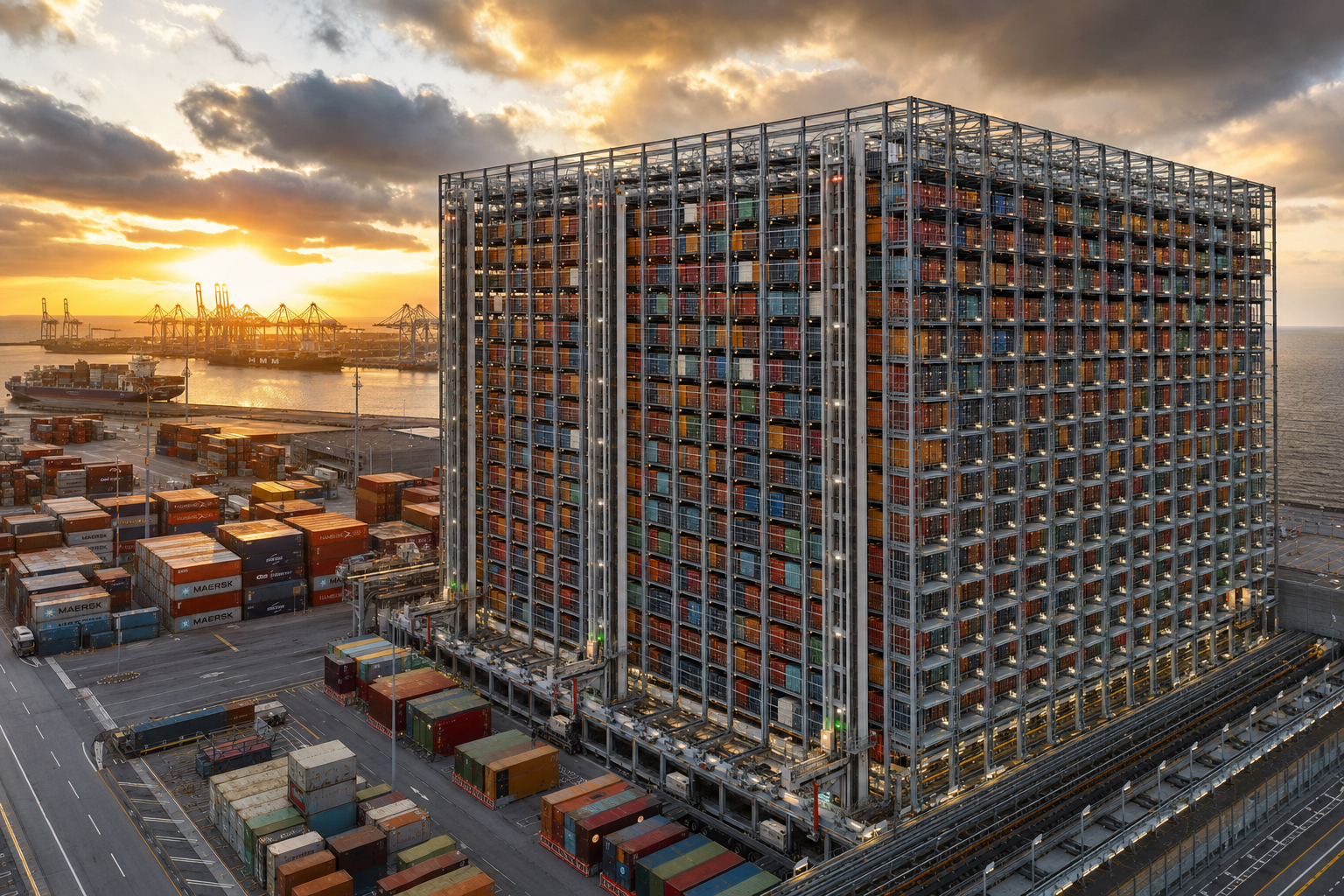
The vertical port: Why ports worldwide must learn to grow upwards instead of outwards – Creative image on the topic, with AI: Xpert.Digital
No more restacking: Why this German system is turning port logistics worldwide upside down
From the steelworks to the port: The ingenious idea behind the new container towers
16 floors full of containers: The gigantic port project that is making logistics history
Global port logistics is reaching its limits: Growing freight volumes, increasingly scarce space in urban areas, and the constant pressure for greater efficiency are forcing terminal operators to rethink their strategies. Surprisingly, the solution to the chronic lack of space at the quayside is coming from heavy industry. So-called automated high-bay container warehouses are currently revolutionizing cargo handling by no longer stacking gigantic steel boxes flat and laboriously on top of each other, but instead allowing them to grow vertically – fully automatically, space-savingly, and with immediate access to each individual container. From the first pilot projects in Dubai and mega-facilities in London to unexpected military applications in Switzerland and the still hesitant approach in Germany: A novel technology is poised to fundamentally and, above all, vertically transform the landscape of seaports worldwide.
Skyscrapers for containers: How a new technology is saving our seaports
Global container logistics faces a structural space problem that can hardly be solved by horizontal expansions anymore. Growing trade volumes are colliding with finite quay lengths, rising land prices in urban port areas, and increasing pressure to decarbonize. In this context, a technology that was considered a niche solution for heavy industry for decades is establishing itself and is now experiencing a second career in port logistics: the automated high-bay container warehouse. Instead of stacking containers flat and multiple high on open yard areas, as was previously the case, they are stored individually and directly accessible in steel high-bay racking structures, similar to pallets in an automated distribution center. Surprisingly, the origins of this technology lie not in shipping, but in the steel and aluminum industries, where coils weighing up to fifty tons have been moved for years in high-bay racking systems up to fifty meters high.
From steelworks to quayside: The basic technical concept
The basic principle of high-bay container storage differs fundamentally from traditional yard logistics. In conventional terminals, containers are stacked in blocks of up to eight layers, with each access to a lower container requiring the repositioning of several containers above. These so-called unproductive movements waste time, energy, and personnel and are one of the main causes of delays in port operations. A high-bay system, on the other hand, places each container in its own compartment within a multi-story steel structure, where automated storage and retrieval machines (AS/RS) can access each individual container directly without restacking. This results in a 100% access rate while drastically reducing the required floor space, as storage capacity is scaled vertically rather than horizontally. This technology was developed by the German plant engineering company SMS group from its subsidiary AMOVA, which was originally responsible for storing steel coils, and is now marketed through the joint venture BOXBAY in partnership with the port operator DP World.
The pioneering location: How Dubai proved it in practice
The first real-world test run for a high-bay container warehouse took place at Terminal 4 of the Jebel Ali port in Dubai. After eighteen months of construction, a pilot facility with 792 container storage positions went into operation in January 2021, capable of stacking containers up to eleven levels high. A two-year test phase with nearly 500,000 TEU movements demonstrated that the system not only functioned technically but also achieved the promised performance parameters. After just 10,000 successfully completed container moves, the terminal operator, DP World, publicly declared that the concept had proven its fundamental viability. Also noteworthy about this pilot facility is its energy concept: it is fully electrified and was intended to be the first container warehouse in the world to cover its entire energy needs using solar panels on its own roof. A full-scale expansion behind the two quays under construction at Terminal 4 was estimated at the time to handle more than three million containers per year.
The leap to commercial scale: Busan as a turning point
Following the completion of the test phase in Dubai, the decisive step from trial to commercial application was taken. In March 2023, Busan Newport Corporation, a subsidiary of DP World in South Korea, and Boxbay FZCO signed a contract for the construction of the first commercially used high-bay container warehouse. The South Korean project was deliberately integrated as a retrofit into an existing empty container area and was designed to operate alongside ongoing operations with conventional gantry cranes and truck handling. According to the operators, the facility eliminates up to 350,000 unproductive movements annually and improves truck turnaround times by 20 percent. This proved that the concept could prove its worth not only in isolated test operations but also in the ongoing operational environment of a busy major port.
The flagship project in London: Dimensions of a new order of magnitude
The project at the British deep-sea port of London Gateway marks the biggest step to date towards industrial maturity. On October 23, 2025, Boxbay signed a contract with DP World for the construction of a high-bay warehouse with an investment volume of approximately €91.7 million, designed exclusively for storing empty containers. The structure will reach sixteen levels, five more than the pilot facility in Dubai, and thus have a capacity of 27,000 TEU, equivalent to about 13,500 forty-foot containers. The facility has ten racking aisles with fifteen stacker cranes and can handle more than 200 container movements per hour on the waterside. A total of forty transfer points are distributed across twenty landside points for trucks and twenty waterside points for shuttle vehicles. Unlike previous facilities, the London system is fully enclosed and thus, for the first time, designed to be weatherproof, facilitating operation in a temperate but rainy climate. The project is part of the ongoing €1.15 billion expansion offensive, which aims to transform London Gateway into the UK's largest container port within the next five years, and is scheduled for completion by 2027.
Swiss precision on land: Military logistics as an unexpected pioneer
While major ports are still in the early stages of implementation, the Swiss Army has already commissioned two fully functional high-bay container warehouses. Together with the Vorarlberg-based specialist LTW Intralogistics and the full-service provider Jungheinrich, they initially built a warehouse with approximately 206 storage locations. Its 20-meter-high stacker crane, with a payload capacity of 18,000 kilograms, can handle both ISO containers and non-stackable swap bodies and roll-off containers. A second, significantly larger warehouse at the Emmen site was officially opened in spring 2025 and offers space for 600 containers. The fully automated structure measures 105 meters in length, 40 meters in width, and 25 meters in height and was built in 21 months at a cost of around 30 million Swiss francs. A special feature of this military application is that containers can be stored with their doors open, allowing personnel to carry out maintenance work directly on the racks, protected from the elements. The dual drive system of the storage and retrieval machines also guarantees particularly high availability – a safety concept that originates from military logistics, but should also be of interest for civilian port applications.
China's alternative: Height without direct access
Parallel to European developments, the Chinese crane manufacturer ZPMC is pursuing its own, technically distinct approach. As part of the third expansion phase of the Ningbo-Zhoushan port, a fully automated empty container storage facility has been under construction since the end of 2024. With a building height of over 84 meters, it is designed to accommodate more than 25,000 standard containers on an area of approximately 49,000 square meters. Unlike the BOXBAY concept, however, the Chinese system is based on a so-called 9+9 double-stack system, in which containers are still stacked directly on top of each other, but in two separate levels of nine layers each. This difference is conceptually significant because it means that not every container is individually accessible without restacking – a key criterion that defines a true high-bay warehouse. While the Chinese solution achieves impressive vertical density and fully automated operation, it remains technically closer to classic stacking logic than to the direct access principle of BOXBAY technology. In addition, ZPMC has implemented a more compact version at the terminal of Yangshan Port near Shanghai, whose space requirement is estimated at around 17,000 square meters.
LTW Intralogistics Solutions

LTW Intralogistics – Engineers of Flow - Image: LTW Intralogistics GmbH
LTW offers its customers not individual components, but integrated complete solutions. Consulting, planning, mechanical and electrotechnical components, control and automation technology, as well as software and service – everything is networked and precisely coordinated.
In-house production of key components is particularly advantageous. This allows for optimal control of quality, supply chains, and interfaces.
LTW stands for reliability, transparency, and collaborative partnership. Loyalty and honesty are firmly anchored in the company's philosophy – a handshake still means something here.
Related to this:
What do container high-bay warehouses really cost? An economic analysis
Australia's vision: Vertical planning for the next forty years
In June 2025, the Port of Brisbane presented one of the most ambitious long-term visions for vertical port logistics with its PortBris 2060 strategy. The document explicitly identifies the need for high-density vertical storage solutions as a response to the foreseeable space shortage on the port island and places this approach within a broader context of fully automated operations, zero-emission ship arrivals, and a Level 5 autonomous transport corridor between the terminal and adjacent warehouses. The vision envisions that by the target date of 2060, cargo will be moved safely and efficiently into solar-powered vertical warehouses, while autonomous trucks and trains will transport the freight via dedicated corridors. This positions Brisbane as one of the first major port projects worldwide to understand vertical container storage not as an isolated measure, but as an integral component of a holistic, decades-long infrastructure plan. Even though concrete construction projects are still a long way off, the official inclusion in a government-affiliated planning document signals that the concept is now being taken seriously at a strategic level as well.
Germany's reluctance: Between interest and hesitation
Despite the fact that the underlying technology was originally developed by a German plant engineering company, there are currently no publicly confirmed projects in German ports. According to the SMS group, the company is in talks with around twenty interested parties worldwide, six of whom are already engaged in very intensive negotiations – including reportedly a North German seaport whose identity has not yet been disclosed. According to these figures, the first German plant could be operational no earlier than 2028. At the same time, independent observers emphasize that they are unaware of any concrete planned projects in Germany, which suggests a certain degree of caution among German port operators regarding the new technology. This reluctance likely stems from several factors: Firstly, German ports such as Hamburg and Bremerhaven have established, albeit land-intensive, terminal structures compared to their international counterparts. Secondly, the investment required for a large-scale plant, potentially amounting to several hundred million euros, represents a considerable financial risk, especially as long as there are no reference projects in the European port environment. Dockworkers and union representatives also express skepticism about the impact of automation on jobs – a resistance that has repeatedly surfaced in many highly automated port logistics projects.
Investment logic: What a high-bay warehouse really costs
The cost structure of high-bay container warehouses varies considerably depending on size and features. A large facility with 25 racking aisles and a length of 650 meters is estimated to cost around €500 million, while medium-sized facilities can cost between €5 and €20 million. The London BOXBAY project, with its capacity of 27,000 TEU, falls into the middle to upper segment of this range at around €100 million, while the Swiss military project in Emmen, at around CHF 25 million for the racking system alone, is significantly cheaper, although it also has a considerably lower capacity and no commercial handling function. The economic benefits of a high-bay warehouse stem primarily from three factors: the drastic reduction in space requirements by up to 70 percent compared to conventional yards, the elimination of unproductive restacking operations, which account for a significant portion of operating costs in traditional terminals, and the potential for significant energy cost and emission savings through fully electric drives and potential solar integration. Especially in ports with extremely high land prices or physically limited land availability, the high initial investment can be amortized over an extended period of use, particularly if alternative land expansions are simply not politically or geographically possible.
Limits and open questions of the new technology
Despite impressive technological advances, several questions remain regarding widespread market penetration. First, the technology is currently primarily designed for storing empty containers, while loaded containers with varying weights, hazardous materials classifications, and temperature requirements place significantly more complex logistical demands on an automated racking system. Second, retrofitting existing terminals requires substantial structural modifications that are difficult to implement during ongoing operations, leading many operators to adopt a wait-and-see approach until more reference systems in continuous commercial operation provide empirical data. Third, a comparison between the BOXBAY concept and the Chinese ZPMC solution reveals that the market has not yet established a uniform technical standard, complicating interoperability, maintenance structures, and spare parts supply. Fourth, legitimate concerns exist regarding system redundancy, as a total failure of a central storage and retrieval machine could theoretically block access to significantly more containers in a high-density system than a comparable failure in a traditional, more redundant yard layout. The systems implemented so far address this risk with multiple redundant drive systems and several parallel rack aisles, but practical proof over decades is still pending.
A turning point for the global port landscape
The developments of the past six years demonstrate a clear acceleration in technological maturity, from the first concept plant in Dubai to the commercial breakthrough in South Korea and the large-scale industrial facility in London. According to the companies involved, the global market potential lies in several hundred port terminals, which, given the limited number of projects realized to date, indicates enormous, largely untapped growth potential. At the same time, a comparison of the different national approaches makes it clear that no uniform global blueprint has yet emerged, but rather that different regions are pursuing different priorities – be it the radical direct access logic of the Emirates and Great Britain, China's densely packed double-stack alternative, Switzerland's precision-driven niche application, or Australia's decades-long vision. For ports with acute space shortages, high cost pressures on land prices and ambitious climate targets, vertical container storage is likely to evolve from an experimental niche solution to an integral part of modern terminal planning in the coming years, with the speed of this transformation largely depending on how convincingly the first large-scale commercial facilities in London and potentially subsequent locations prove themselves in operation.
Consulting - Planning - Implementation

Konrad Wolfenstein
I would be happy to serve as your personal advisor.
You can contact me at wolfenstein∂xpert.digital or
Just call me on +49 7348 4088 965 .
Your container high-bay warehouse and container terminal experts

Container high-bay warehouses and container terminals: The logistical interplay – expert advice and solutions - Creative image: Xpert.Digital
This innovative technology promises to fundamentally change container logistics. Instead of stacking containers horizontally as before, they will be stored vertically in multi-story steel racking structures. This not only allows for a drastic increase in storage capacity within the same area, but also revolutionizes all processes at the container terminal.
More information here:










