
Vertical container storage applications: Why the biggest logistics revolution of our time isn't just happening in the port
Xpert Pre-Release

Available in 27 languages 📢
Prefer Xpert.Digital on GoogleⓘPublished on: May 4, 2026 / Updated on: May 5, 2026 – Author: Konrad Wolfenstein
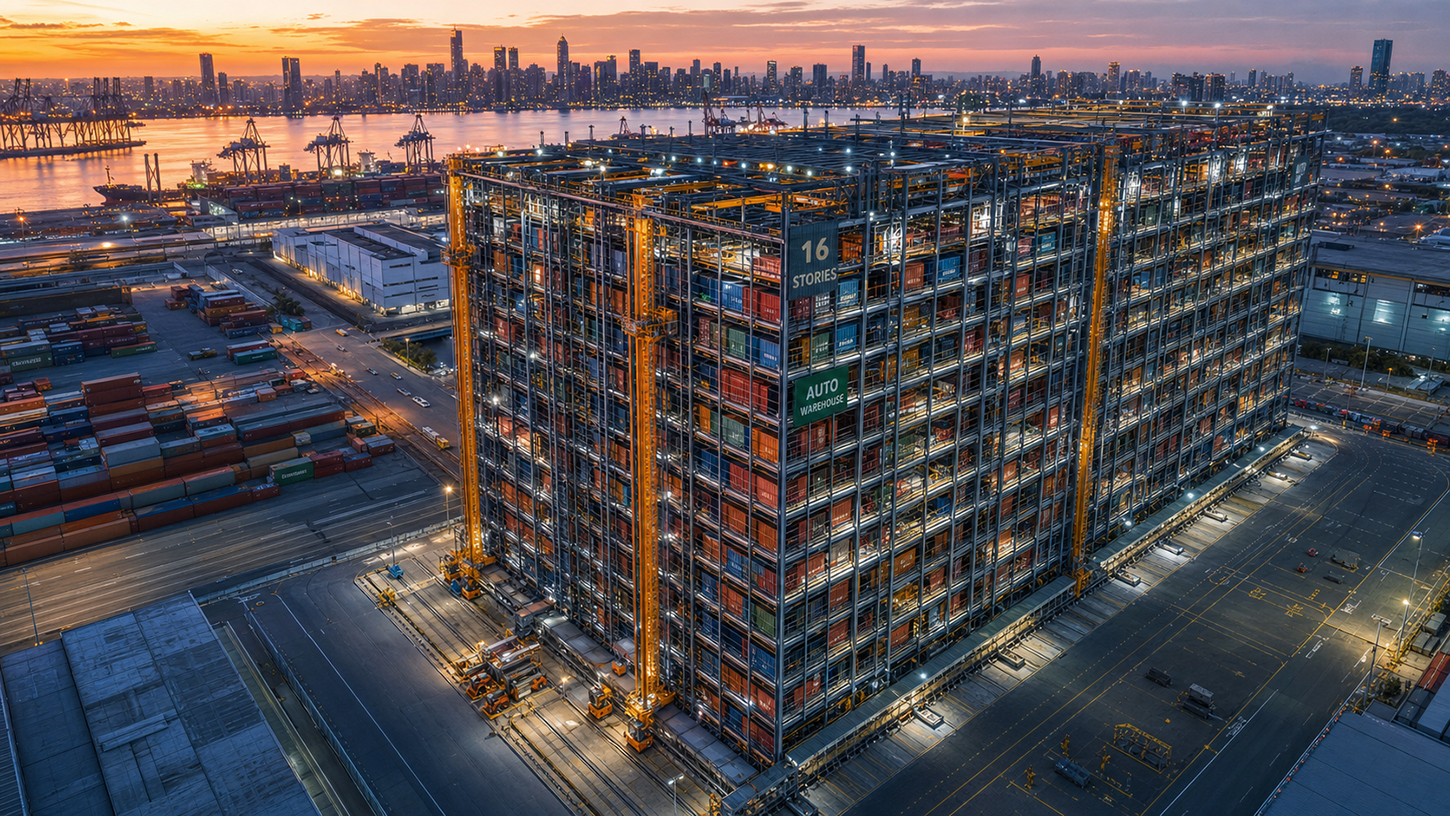
Why the biggest logistics revolution of our time isn't taking place in the port – Creative image: Xpert.Digital
Space shortage solved? How gigantic container towers are changing our cities
From port to city: These mega-shelves are revolutionizing global trade
Not just for cargo: Why container shelves will soon serve as giant batteries
Containers have been transported around the globe for decades, yet on land we still stack them on top of each other in a space-consuming and inflexible manner. Fully automated high-bay container warehouses – enormous "bookshelf" systems up to sixty meters high for steel boxes weighing tons – now promise a technological revolution. Anyone thinking about this innovation inevitably pictures gigantic seaports like Dubai or London. But the true, disruptive potential of these vertical logistics marvels lies elsewhere entirely: in our cities, at railway hubs, and at the heart of the energy transition.
Whether as vertically compacted large-scale storage facilities for solar and wind energy, as highly efficient city hubs for urban goods distribution, in demanding pharmaceutical logistics, or as a lightning-fast base for disaster relief – the ability to access every single container fully automatically within minutes, without time-consuming restacking, not only solves acute space problems. It is reinventing entire sectors of the economy. A journey to the underestimated applications of what is perhaps the most important strategic infrastructure of our time.
Why one of the most important logistics technologies of our time is still hardly used where it would make the biggest difference
From the waterfront to the global imagination — the underestimated reach of a silent revolution
The idea is brilliantly simple: Instead of laboriously stacking containers on top of each other and rearranging dozens of tons of steel every time they are accessed, each individual container has its fixed place in an automated racking system—accessible at any time, without a single restacking operation. A bookshelf for containers, made of steel and reaching up to sixty meters in height. Sounds obvious. And yet it took decades for this technology to make the leap from concept to commercial reality.
The world's first fully automated high-bay container warehouse wasn't built in the ports of Hamburg or Rotterdam, but in the Jebel Ali port in Dubai—developed by the German engineering firm SMS Group in collaboration with the logistics company DP World. SMS Group brought decades of experience in high-bay storage of metal coils weighing up to fifty tons from the steel industry to the project—a technology that had been tested in more than eighty reference facilities worldwide before being adapted for containers. What had long been routine in steel mills seemed unthinkable to the container shipping industry.
The technical logic is undeniable: A standard shipping container weighs between two and four tons empty and can be loaded with up to thirty tons. The high-bay warehouse concept treats it like any other standardized object—as a manageable, automatable unit. Up to eleven layers stacked on top of each other, each position directly accessible without any productive or unproductive rearrangement. That sounds technical. But it is above all economically and strategically crucial—because this feature, direct access without any loss of time, is the key to a multitude of applications that hardly anyone has seriously considered until now.
Related to this:

The scarce resource of space — Why space is the new oil
Before exploring the unknown applications, it's worthwhile to understand the fundamental economic argument behind the technology. Currently, high-bay container warehouses require only a third of the floor space needed for a conventional warehouse of the same capacity. More than three times as many containers can be stored on the same area—and the Boxbay system at London Gateway, which is currently slated to become the world's largest, achieves figures with sixteen levels and a capacity of 27,000 TEU that dwarf any conventional port planning.
But this argument of space savings extends far beyond ports. Land is scarce and expensive everywhere in modern economies. In metropolitan areas, the price of commercial space is at an all-time high. In remote industrial regions, at railway hubs, or on the coast, usable land is either structurally limited or subject to regulations. Wherever containers are handled as transport units—that is, virtually everywhere in the globalized economy—there is a need for a space-saving, easily accessible, and automatable storage solution. High-bay warehouses for containers fulfill this requirement. The only question is who is asking for it and where.
The economic core here is not just space saving. It's the combination of efficiency, predictability, and reduced operating costs. While conventional container yards spend between thirty and sixty percent of their time simply moving containers around—work that adds no value but only costs money—high-bay warehouses eliminate this effort entirely. A system that has no unproductive movements, whose performance remains constant regardless of fill level, and that can be utilized at almost one hundred percent capacity without any loss of service quality—this is not just an improvement. This is a structural transformation in logistics economics.
Related to this:

Urban logistics of the future — high-bay warehouses as the hidden engine of last-mile logistics
The biggest and fastest-growing challenge of urban mobility is not passenger transport, but freight transport. Online retail, just-in-time delivery, rising customer expectations, and the simultaneous political demand for less noise, fewer emissions, and fewer trucks in city centers—these areas of tension are leading to a fundamental reorganization of urban logistics. This is precisely where container high-bay warehouses can make a contribution that has received little attention so far.
The concept of the city hub, a transshipment point on the city's outskirts from which the last mile is handled by low-emission vehicles, is rapidly gaining importance in European metropolises. When these city hubs are equipped with a compact container high-bay warehouse, an infrastructure of enormous efficiency is created in a minimal space. The available floor space in an expensive suburban area can be tripled by verticalizing the warehouse—without expanding the footprint, without building permits for new warehouses, and without additional land sealing.
Of particular interest in this context is the connection with rail freight transport. Research on containerized urban logistics shows that standardized containers, transported to the city center by tram or freight train and unloaded at central transshipment points, can enable cost savings of up to 25 percent, while simultaneously drastically reducing CO₂ emissions. The high-bay container warehouse would not be the endpoint, but rather the hub—the buffer warehouse between long-distance transport and local distribution.
We need to go even further: Under motorway interchanges, on brownfield sites, on covered railway platforms, or next to large freight centers, there are hundreds of areas in German cities that are too impractical and too expensive for conventional uses—but would be ideal for a compact, automated high-bay warehouse. These areas are currently wasted. They could be the logistics hubs of the future.
Rail as a lifeline — Intermodal terminals and the potential for modal shift
Germany has made a political commitment to shifting freight transport to rail. However, reality is not keeping pace with this promise. One of the main reasons is that the transshipment terminals where containers are transferred between rail and road are technically outdated, space-intensive, and inefficient. A fully automated high-bay container warehouse, integrated into a railway site with a loading track, fundamentally changes this calculation.
The Austrian company LTW Intralogistics has developed precisely this concept: a high-bay warehouse with the loading track directly integrated into it. Within a width of just twelve meters, up to one hundred swap bodies can be stored per one hundred meters of length – with fully automated loading and unloading. This means that a train station that currently struggles with several hectares of storage space could achieve three to four times its capacity with a fraction of the area. The train arrives, the storage and retrieval machines take over, and the trucks are loaded and unloaded on the outside – all fully automated, around the clock, without shunting locomotives, without forklifts, and without waiting times.
This solution is particularly relevant for medium-sized freight centers, inland transshipment terminals, and industrial sites with their own rail sidings. Especially in regions where truck driver shortages and rising transport costs are increasing the pressure to switch to more efficient modes of transport, the combination of rail and automated high-bay warehouses offers an economically compelling answer. It is no coincidence that combined road/rail transport is the fastest-growing segment in rail freight – high-bay warehouse technology could accelerate its growth even further.
Related to this:


Energy in shelf form — container high-bay warehouses and the energy transition
One of the most fascinating, and least expected, use cases lies at the intersection of logistics and energy infrastructure. The energy transition is creating a massive demand for stationary battery storage to buffer fluctuating wind and solar energy and stabilize the grid. Used lithium-ion batteries from electric vehicles are being reused in so-called second-life storage systems—and these systems are preferably housed in containers because this is the most cost-effective and scalable design.
Containerized energy storage units in 20-foot formats can achieve capacities of up to two megawatt-hours, and in 40-foot versions, up to almost five megawatt-hours. When these energy containers are housed in a high-bay warehouse system, a scalable, vertically compacted energy storage infrastructure is created: a high-bay warehouse not for general cargo, but for energy. Each container in each shelf is not a receptacle for goods, but a battery—connected to the grid and controllable by a central energy management system.
The economic advantage is obvious: The land requirements for such storage parks are enormous today. Grid operators, industrial companies, and energy suppliers are desperately searching for locations for large-scale storage facilities near load centers and renewable energy feed-in points—often precisely where industrial land is scarce and expensive. A vertically compacted energy storage tower on the footprint of a parking lot could partially solve the scaling problem of the energy transition without sealing off new land. This is not speculation, but the logical continuation of existing technological pathways.
Cool heads and sensitive goods — pharmaceuticals, food and delicate value chains
The pharmaceutical industry grapples with a structural contradiction: its products are high-value, temperature-sensitive, and often time-critical—yet its warehouse logistics in many places still fall far short of modern standards. Vaccines, blood plasma, cancer drugs, and biotechnological agents require strictly controlled storage conditions, complete documentation, and very short access times. Refrigerated containers—operating in temperature ranges from plus twenty degrees Celsius to minus seventy-five degrees Celsius—are already an established means of transport for these products.
What's still missing is the consistent extension of this concept to stationary storage: a fully automated high-bay warehouse for reefer containers, i.e., refrigerated containers, equipped with an unbroken cold chain, comprehensive sensors, and direct access to each individual container. Such a system would be equally attractive for pharmaceutical logistics providers, large hospitals with their own inventories, vaccine manufacturers with seasonal peaks in demand, and the food processing industry. The container high-bay warehouse with integrated reefer capacity is already technically feasible—JFE Engineering's Tokyo system was designed for reefer containers on all levels as early as 2011.
In the field of food logistics, another, largely untapped area of application is emerging: vertical urban agriculture in containers. Container farms, in which vegetables, herbs, and microgreens are grown hydroponically under fully controlled conditions, are already commercially available and achieve yields equivalent to two to three hectares of traditional agriculture within the space of a single 40-foot container. When such production containers are stacked in a high-bay warehouse, an urban food factory of considerable capacity is created—powered by rooftop solar panels, integrated into the neighborhood infrastructure, and with directly connected cold storage.
LTW Intralogistics Solutions

LTW Intralogistics – Engineers of Flow - Image: LTW Intralogistics GmbH
LTW offers its customers not individual components, but integrated complete solutions. Consulting, planning, mechanical and electrotechnical components, control and automation technology, as well as software and service – everything is networked and precisely coordinated.
In-house production of key components is particularly advantageous. This allows for optimal control of quality, supply chains, and interfaces.
LTW stands for reliability, transparency, and collaborative partnership. Loyalty and honesty are firmly anchored in the company's philosophy – a handshake still means something here.
Related to this:
More profitable than expected: When container high-bay racking becomes worthwhile for ports, pharmaceuticals and energy
Crisis preparedness and defense — logistics as a strategic asset
The debate surrounding resilience and security of supply has been intensified by the experiences of the pandemic, the war in Ukraine, and numerous extreme weather events. Those who can access material reserves quickly and reliably in times of crisis maintain their ability to act. In fact, container high-bay warehouses are one of the most efficient technologies for modern, responsive crisis preparedness.
The basic idea: Instead of storing emergency supplies in sprawling depots in traditional warehouses, they are recorded in containers and stored in a fully automated high-bay warehouse. Each container is immediately accessible without restacking. The system manages the inventory digitally, knowing the contents, condition, and expiration date of every stored item. In an emergency, the appropriate container can be retrieved within minutes, loaded onto a truck, and dispatched to the deployment area—without waiting times, without searching, and without requiring additional personnel.
For the Federal Agency for Technical Relief (THW), the Federal Office of Civil Protection and Disaster Relief (BBK), the German Armed Forces (Bundeswehr), or large welfare organizations, such an infrastructure would represent a quantum leap compared to the status quo. Containers are already used in crisis and disaster relief scenarios as mobile units for decontamination, medical care, and accommodation. Managing them in a high-bay warehouse would, for the first time, make these resources truly controllable and quickly accessible.
From a military perspective, the idea has even greater implications. Modern armed forces are highly mobile and rely on flexible, rapidly deployable supply chains. A modular, transportable containerized high-bay warehouse that can be assembled within a few days and combines an entire logistical supply base in a vertically compact form would have enormous tactical and strategic value. NATO compatibility is not a technical obstacle—the ISO container has been the standard for global military transport for decades.
Related to this:

Offshore and remote – providing services where conventions fail
Offshore wind farms, oil platforms, remote islands, Arctic research stations, mining settlements in inhospitable terrain—all these locations share a fundamental logistical problem: resupply is expensive and unreliable, yet storage in confined spaces must guarantee constant access to critical goods. Container high-bay warehouses offer a compelling solution for these extreme situations.
Logistics needs are growing rapidly in the offshore wind energy sector. The planned expansion of Germany's offshore wind capacity to 30 gigawatts by 2030 requires numerous new supply bases along the coast, which must stock spare parts, tools, operating fluids, and specialized equipment for the maintenance-intensive installations. Space in coastal ports and on offshore base platforms is limited. Quadrupling the available area through vertical densification increases supply security without requiring new land.
Similar considerations apply in the mining sector. Large mines in Australia, Canada, or Africa operate their own logistics infrastructures, often located hundreds of kilometers from the nearest port or town. Just-in-time access to expensive spare parts, explosives, lubricants, and food supplies can mean the difference between productive operation and costly shutdowns. In this context, a modular containerized high-bay warehouse, delivered in segments and assembled on-site, is a viable alternative to sprawling, disorganized storage areas.
Related to this:

Circular economy and recycling — containers as raw material managers
The circular economy is no longer an abstract ecological ideal, but an economic necessity—driven by rising raw material prices, supply chain bottlenecks, and legal pressure from Brussels. Recycling electric vehicle batteries, processing electronic waste, sorting and pretreating waste materials—all of this generates large quantities of containerized goods that must be stored, sorted, and passed on to the next processing stage.
A fully automated container high-bay warehouse for recycled materials is not a logistical luxury project, but a necessity for efficiency. The system knows which container holds which material, in what quality and quantity. It can organize the inventory so that batches for processing lines are automatically assembled, without manual searching, without losses, and without defective batches. For the battery recycling industry, which is expected to grow exponentially in the coming years, this infrastructure could significantly improve throughput and thus profitability.
This application is particularly relevant in the field of so-called urban mining: the recovery of raw materials from the urban waste stream. Container collection stations in the city, which are automatically transported to a high-bay warehouse on the city's outskirts, sorted there and forwarded – this sounds like the distant future, but is the logical continuation of a trend that is already being planned today.
Floating logistics — container high-bay warehouse on the water
One of the boldest, yet technically feasible ideas: a container high-bay warehouse on a floating platform. In port cities where the land side is completely built up and where acquiring new land is no longer politically or economically viable, a high-bay warehouse floating on the water could be the solution. The principle has been proven in the offshore industry: floating production and storage platforms. Transferring it to container logistics is technically complex, but not impossible.
Ports like Hong Kong, Singapore, Rotterdam, and Hamburg are operating at the limits of their land capacity. For these megaports, the third dimension—the vertical—is the only remaining expansion path, unless they can expand onto the water. A floating high-bay container warehouse directly connected to ship berths would shorten terminal cycles, reduce truck traffic, and simultaneously relieve pressure on urban infrastructure. The idea isn't new—but given the increasing scarcity of land, it deserves renewed and serious attention.
Data, digitization and the intelligent warehouse — The underestimated cross-cutting technology
The container high-bay warehouse is not simply a physical structure. It is a data infrastructure that knows and manages every container, its contents, its location, its temperature, and its condition in real time. This knowledge is invaluable in itself—as a basis for supply chain transparency, predictive maintenance, dynamic pricing, and integration into higher-level logistics systems.
In an era where supply chain visibility is becoming a crucial competitive advantage, and where regulatory requirements for transparency and traceability are increasing—consider the EU Supply Chain Directive or the growing demands of the pharmaceutical industry—the fully automated container high-bay warehouse is not just a warehouse, but a database. Every movement, every storage, every retrieval is precisely logged. The warehouse always knows what it has, where it is, and its condition. This knowledge comes at a price—and it often exceeds the cost of the facility itself.
Economic calculation and the question of the right timing
For all the fascination with the technical possibilities, the crucial economic question is when and where the use of a container high-bay warehouse becomes profitable. The answer depends on several parameters: the land price at the respective location, the handling volume, labor costs, the investment capital, and the degree of existing automation. For a medium-sized inland port with a daily throughput of 1,000 TEU, the calculation may not yet be favorable. However, for a major port with 5 million TEU, for a pharmaceutical logistics center handling high-value cargo, or for an energy supplier facing permitting pressure for new storage capacity, the calculation can already be clearly positive.
The BOXBAY system at London Gateway, for which a contract worth almost one hundred million euros was awarded, is expected by the operator to be 65 percent more efficient than conventional solutions. The 16-tier facility with a capacity of 27,000 TEU demonstrates that the technology has left the pilot stage and is moving into large-scale application. The global market for these systems is projected to grow to over twenty billion US dollars by 2034.
What this figure underestimates rather than exaggerates is that it primarily considers traditional port terminals. Application areas such as urban logistics, rail intermodal transport, pharmaceutical refrigeration, energy storage, crisis preparedness, offshore supply, and the circular economy are barely addressed in these market forecasts. The actual market size is therefore many times larger than these port-focused estimates suggest.
Why change is happening more slowly than it could
It would be dishonest to ignore the obstacles to the widespread adoption of container high-bay warehouses. First, there are the capital costs: A fully automated system requires investments in the hundreds of millions—sums that many medium-sized logistics companies simply cannot raise. Financing is a real obstacle, especially in highly fragmented industries.
Added to this is what economists know as the productivity paradox: A technology that is demonstrably more efficient nevertheless only gains traction slowly because existing structures, the self-interest of established players, and the inertia of bureaucratic approval processes slow down change. This phenomenon is particularly pronounced in container logistics. Dockworkers' unions have historically mounted massive resistance to automation. Infrastructure planning with a thirty-year investment horizon shies away from disruption.
But these obstacles are not inevitable. The combination of climate pressure, scarcity of land and resources, increased labor costs, and the pressure of digital transformation shifts the cost-benefit analysis every year, to the detriment of conventional methods. Container high-bay warehouses will prevail—the question is not if, but where first and with what societal consequences.
A paradigm shift is beginning in many places — even without realizing it
The strength of the container high-bay warehouse lies not only in its performance for ports. It lies in its capacity as a universal solution to a universal problem: the growing tension between increasing freight volume, scarce space, rising costs, and societal demands for efficiency and sustainability. This tension doesn't exist only in Rotterdam and Singapore. It exists at every freight hub, in every industrial region, in every pharmaceutical warehouse, on every offshore platform, in every recycling plant, and in every emergency preparedness depot.
What's missing isn't the technology. What's missing is the willingness of decision-makers to broaden the horizon of its applicability beyond the familiar context of the seaport. The container high-bay warehouse isn't a port structure. It's a platform—a universal infrastructure for managing the globalized flow of goods in a world where space, time, and energy are all equally precious.
Companies and institutions that recognize this connection early and invest in the necessary infrastructure will possess logistical resources in ten to fifteen years that their competitors and neighboring countries cannot replicate. Logistics has never been as strategic as it is today. And the high-bay container warehouse is one of its most powerful and underutilized tools.
Consulting - Planning - Implementation

Konrad Wolfenstein
I would be happy to serve as your personal advisor.
me at wolfenstein∂xpert.digital contact
Just call me on +49 7348 4088 965 .
Your container high-bay warehouse and container terminal experts

Container high-bay warehouses and container terminals: The logistical interplay – expert advice and solutions - Creative image: Xpert.Digital
This innovative technology promises to fundamentally change container logistics. Instead of stacking containers horizontally as before, they will be stored vertically in multi-story steel racking structures. This not only allows for a drastic increase in storage capacity within the same area, but also revolutionizes all processes at the container terminal.
More information here:










