
Container Logistics Trend 2026: Why Megaships Become a Trap and Regional Ports Suddenly Triumph
Xpert Pre-Release

Available in 27 languages 📢
Prefer Xpert.Digital on GoogleⓘPublished on: February 2, 2026 / Updated on: February 2, 2026 – Author: Konrad Wolfenstein
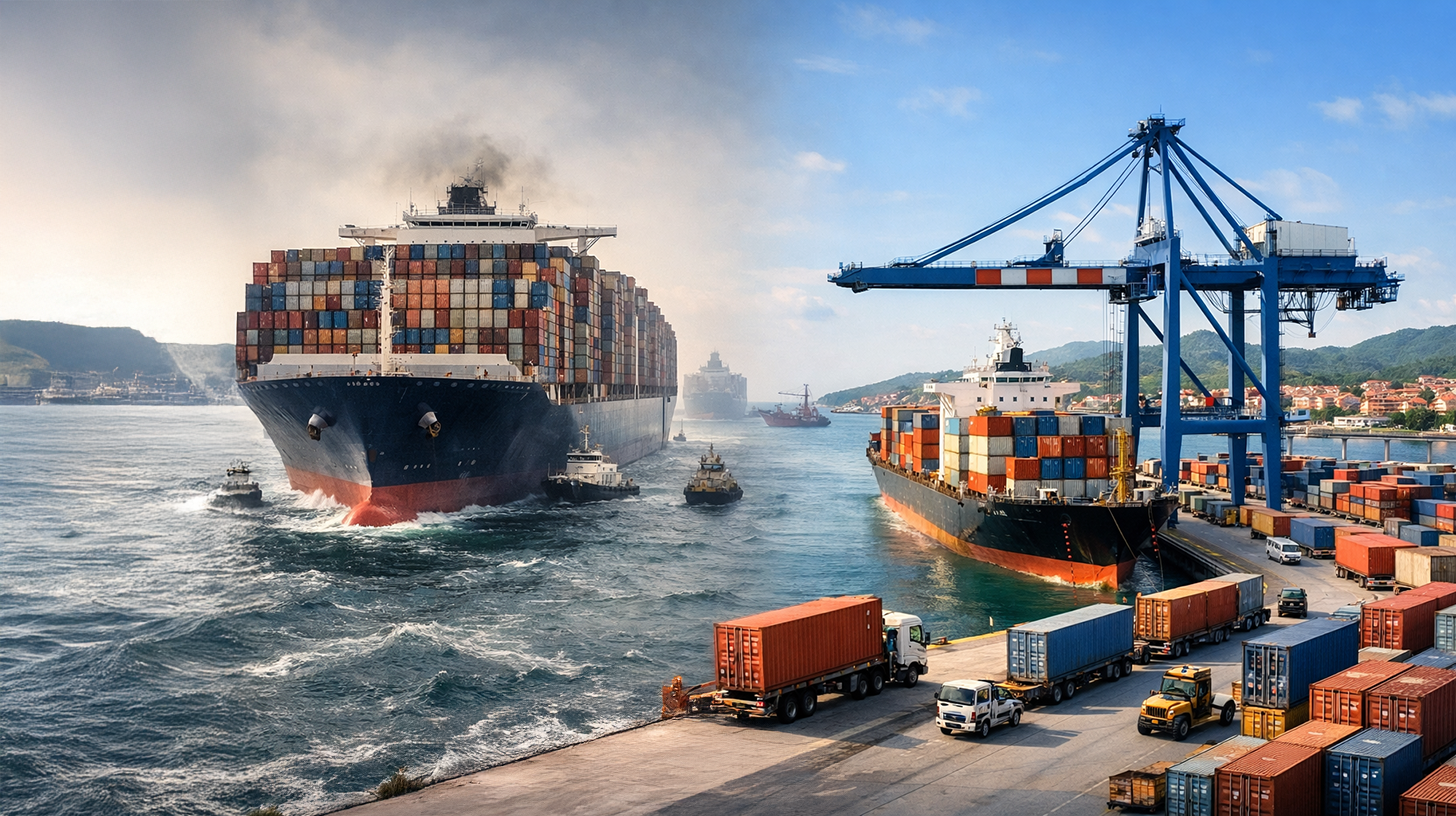
Container Logistics Trend 2026: Why mega-ships become a trap and regional ports suddenly triumph – Image: Xpert.Digital
Gigantism in times of uncertainty: The global battle for the ports of the future
Why billions are flowing into ports worldwide, even though trade is shaky
As the global economy in 2026 struggles to balance geopolitical tensions and fragile supply chains, a silent but massive revolution is taking place on the world's ocean shores. It's a paradox that's difficult to explain at first glance: although the old order of free global trade is showing cracks and protectionism is on the rise, states and corporations are investing billions in expanding maritime infrastructure. But it's no longer just about handling containers. Ports have transformed from mere logistics hubs into geopolitical instruments of power, energy centers, and strongholds of digital surveillance.
From the Elbe to the Adriatic, from the Baltic to the South Atlantic, concrete and steel structures are currently being built to define the trade flows of the coming decades. In Hamburg, a city steeped in tradition is grappling with the loss of its independence in order to remain relevant among the major players. Just a few hundred kilometers to the east, Poland is challenging German dominance with the Swinemünde megaproject, while in southern Europe, Rijeka is reshaping the logistics landscape with cutting-edge 5G technology. Simultaneously, in Santos in the Southern Hemisphere, a strategic shift away from the West and towards Asian markets is underway.
This analysis looks behind the facades of the new megaprojects. It sheds light on why shipping companies are suddenly buying terminals, why hydrogen is the new gold for port operators, and why the trend toward ever-larger ships could lead to an economic dead end. Anyone who wants to understand how the world of tomorrow will be interconnected must look at its ports today.
Between overcapacity and strategic sovereignty
The global maritime economy stands at a crossroads in 2026, characterized by an unprecedented divergence between infrastructural gigantism and geopolitical fragmentation. While global trade volumes exceeded pessimistic expectations in 2025, growing by 4.4 percent to approximately 126.75 million TEU between January and August, these figures mask structural instability. The industry is responding to this uncertainty not with restraint, but with a massive expansion of port infrastructure. Projects in Hamburg, Świnoujście, Rijeka, and Santos illustrate that ports no longer function merely as logistical transshipment points. They have become instruments of national sovereignty, energy transformation, and technological dominance. This economic analysis examines the driving forces behind this construction boom and questions the strategic logic in an era where shipping is increasingly being instrumentalized as an economic weapon.
Hamburg's defense and the redefinition of the Hanseatic hub model
Hamburg, traditionally the gateway to the world for the German economy, is facing a gradual decline in importance, exacerbated by structural disadvantages and a changing alliance landscape. The port's market share of container throughput in the North Range fell from almost 30 percent in 2007 to around 20 percent in 2023. The city and the port operators' response is a combination of physical expansion and a radical strategic realignment through the Mediterranean Shipping Company's (MSC) investment in Hamburger Hafen und Logistik AG (HHLA).
The planned western expansion of the port is the infrastructural backbone needed to keep Hamburg attractive to the latest generation of ultra-large container ships (ULCVs). Vessels like Hapag-Lloyd's Hamburg Express class, operating with a capacity of 23,664 TEU, a length of 399 meters, and a beam of 61 meters, place extreme demands on nautical accessibility. The project includes widening the turning circle for large vessels, extending the usable time window for their navigation from the current 2.5 hours to approximately 4 hours. This is crucial because modern mega-ships require precise handling to adhere to the complex schedules of new alliances such as the Gemini Cooperation.
A key economic factor is the political decision to grant MSC a 49.9 percent stake in HHLA, while the City of Hamburg retains 50.1 percent. This move marks the end of the neutral universal port model and ushers in an era of vertical integration. MSC has committed to significantly increasing its cargo volume in Hamburg, which is seen as a safeguard against the potential loss of volume to competitors Hapag-Lloyd and Maersk. Nevertheless, the transaction remains highly controversial. Critics fear that HHLA will become a pawn in the hands of a global shipping giant, which could jeopardize the independence of its operational decisions.
Key figures and forecasts for the Port of Hamburg
| Value / Specification | Data |
|---|---|
| Container throughput 2024 (actual) | 7.8 million TEU |
| Container throughput, first half of 2025 | 4.2 million TEU (+9.3 percent) |
| Theoretical total capacity of the terminals | 13.0 million TEU per year |
| Projected turnover in 2035 (adjusted) | 13.1 million TEU |
| Investment in MSC (shareholding structure) | 50.1 percent city / 49.9 percent MSC |
| Sustainability goal: Climate neutrality | Achievement by the year 2040 |
Technological leverage and digital resilience
In addition to physical expansion, Hamburg is focusing on comprehensive digitalization to maximize the efficiency of existing space. The TwinSim project, a collaboration between the Eurogate Container Terminal and the University of Hamburg, is developing a digital twin of the terminal. By integrating real-time data on vehicle positions, speeds, and container status using 5G technology, AI-based simulations can be performed to predict operational bottlenecks before they occur. This is economically crucial, as space productivity in Hamburg, due to the city-state's limited space, can only be increased through technological innovation.
Another aspect of the digital strategy is predictive maintenance. Sensors on container cranes monitor thermal patterns and vibrations to predict mechanical failures up to 72 hours in advance. In one instance, the detection of anomalous heat patterns on a conveyor motor prevented an estimated $500,000 in damage. Such efficiency gains are necessary to offset rising operating costs resulting from decarbonization and stricter environmental regulations, such as the EU Emissions Trading System (EU ETS), which mandates 100% coverage of verified emissions from 2026 onward.
The port as an energy transformation hub
Hamburg's economic future is inextricably linked to the development of a hydrogen economy. The Hamburg Green Hydrogen Hub (HGHH), located on the site of the former Moorburg coal-fired power plant, is a key project for decarbonizing the port from a fossil fuel base. A 100 MW electrolysis plant is planned, which is expected to produce around 10,000 tons of green hydrogen annually starting in 2027. This energy is intended not only for industry in southern Hamburg but also to transform maritime logistics. Partnerships with Kawasaki Heavy Industries and Daimler Truck aim to establish an international supply chain for liquid hydrogen, with Hamburg serving as the central import and distribution hub for Europe.
Hydrogen strategy Hamburg Green Hydrogen Hub
| Details | Data |
|---|---|
| Electrolysis capacity (phase 1) | 100 megawatts (MW) |
| Annual production volume (H2) | approximately 10,000 tons |
| Planned start of operations | Year 2027 |
| Primary energy source | Wind and solar energy |
| Partner consortium | Luxcara, Hamburger Energiewerke, Siemens Energy |
The Cape Pomerania project and Poland's quest for maritime autonomy
While Hamburg is operating on the defensive, Poland is pursuing an aggressive expansion strategy on the Baltic Sea. The construction of the deep-water container terminal in Świnoujście, under the project name Cape Pomerania, marks one of the most significant shifts in the European port landscape. With a planned capacity of 2 million TEU per year, the project aims to establish Poland as an independent player in global container trade and to end its traditional role as a hinterland for German ports.
The economic radicalism of this project is evident in its financing structure. After a foreign consortium failed to meet its financial obligations, the Polish government decided to implement the project entirely through state-owned entities. Total investments are estimated at around 10 billion PLN, a significant portion of which is being invested in maritime infrastructure. This includes a new 65-kilometer-long shipping channel with a depth of 17 meters, enabling the world's largest container ships, up to 400 meters in length, to call at Świnoujście.
Technical specifications Swinemünde (Cape Pomerania)
| Value | Data |
|---|---|
| Planned handling capacity | 2.0 million TEU per year |
| Water depth of the fairway | 17.0 meters |
| Length of the quays | 1.3 kilometers (container terminal) |
| Land reclamation (landmass) | 186 hectares |
| Number of berths for megaships | 3 ships simultaneously (2x 400m, 1x 250m) |
| Planned completion (Phase 1) | Year 2029 |
The geopolitical dimension and military integration
Cape Pomerania is far more than an economic infrastructure project; it is a security policy statement. The port is explicitly designed for dual civilian and military use. In times of growing tensions in the Baltic Sea region, a deep harbor basin in close proximity to the German border serves as a strategic logistics hub for NATO operations. The Polish government considers the port an integral part of its national security architecture, which also includes the adjacent LNG terminal and the connection to the Baltic Pipe.
This strategic focus is causing considerable diplomatic friction with Germany. The German states of Mecklenburg-Western Pomerania and Brandenburg, as well as environmental organizations like NABU, criticize the lack of consideration given to cross-border environmental impacts. The municipality of Heringsdorf on the island of Usedom, in particular, sees its tourism model threatened by the massive expansion and increasing shipping traffic. Nevertheless, the Polish judiciary has dismissed legal challenges against the environmental permit, clearing the way for construction of a technical access road to begin in 2026.
Logistical synergies and hinterland connections
The economic viability of Świnoujście depends crucially on its integration into the European transport network. Plans include a comprehensive rail infrastructure with ten 800-meter-long tracks directly at the terminal, as well as connections to the S3 expressway and the Oder waterway. This positions Świnoujście as a competitor not only to Hamburg, but also to the ports of the Northern Range for traffic to the Czech Republic, Slovakia, Austria, and Hungary. The expectation is that by 2030 the port will contribute to increasing total Polish container throughput to up to 10 million TEU.
Infrastructure components Swinemünde
| Details | Data |
|---|---|
| Rail connection | 10 tracks, each 800 meters long |
| Road access | 2 km of new access road to relieve the city |
| Logistics zone | 47 hectares of land for storage and distribution |
| Dredging volume (seabed) | 19 million tons of material |
| Sand quantity for land reclamation | Over 20 million tons |
LTW Solutions

LTW Intralogistics – Engineers of Flow - Image: LTW Intralogistics GmbH
LTW offers its customers not individual components, but integrated complete solutions. Consulting, planning, mechanical and electrotechnical components, control and automation technology, as well as software and service – everything is networked and precisely coordinated.
In-house production of key components is particularly advantageous. This allows for optimal control of quality, supply chains, and interfaces.
LTW stands for reliability, transparency, and collaborative partnership. Loyalty and honesty are firmly anchored in the company's philosophy – a handshake still means something here.
Related to this:
Race of the super-ports: Who will win the global battle for the most important trade flows?
The Adriatic Revolt: Rijeka Gateway as a new southern corridor
A similar dynamic of strategic repositioning is taking place on the Adriatic coast. The Rijeka Gateway project, a joint venture between APM Terminals and the Croatian company ENNA Logic, represents the largest private investment in the history of Croatian logistics. With a total investment volume of €600 million, of which €380 million is directly for the terminal, the project aims to develop Rijeka into the leading gateway for Central and Southeastern Europe.
Rijeka's economic appeal lies in the nautical advantage of the Adriatic route. Ships from Asia can navigate the Suez Canal directly into the northern Adriatic, reducing transit time by approximately seven to nine days compared to the North Range ports. In its initial phase, the terminal will offer a capacity of 650,000 TEU, which is planned to be expanded to over one million TEU in a second phase to accommodate 24,000 TEU vessels. This puts Rijeka in direct competition with the established ports of Koper in Slovenia and Trieste in Italy.
Rijeka Gateway project phases
| Key figure | Phase 1 (2025/26) | Phase 2 (Future) |
|---|---|---|
| Quay length | 400 meters | 680 meters |
| Capacity (TEU/year) | 650.000 | 1.055.000 |
| Container cranes (STS) | 3 | 4 |
| Storage crane systems (RTG) | 15 | Additional extension |
| Number of employees | 280-300 | Increase as needed |
Overcoming the rail barrier
The success of Rijeka Gateway hinges on the quality of its hinterland connections. Historically, the port suffered from an outdated, single-track railway line to Zagreb, which limited the share of rail transport to a mere 25 percent – one of the lowest figures in the European Union. To change this, the Croatian government, with substantial EU support, is pushing ahead with the construction of a new lowland double-track line designed for speeds of up to 160 km/h. The goal is to move 60 percent of cargo by rail to efficiently serve markets in Hungary, Austria, Slovakia, and southern Germany.
The strategic importance of this rail infrastructure is intensified by the competitive landscape. Slovenia is expected to complete construction of a second track on the strategically important Divača-Koper line in March 2026, which could increase the capacity of the Port of Koper to up to 1.8 million TEU by 2027. Trieste, in turn, is consolidating its position as a market leader in liquid bulk cargo handling and is massively expanding its container capacity through investments by the MSC Group. Rijeka must therefore not only create physical capacity but also score points through speed and reliability in the logistics chain.
Technological excellence through 5G integration
Rijeka Gateway positions itself as the most technologically advanced terminal on the Adriatic. It is the first terminal in Croatia to be controlled via a private industrial 5G network. This network enables complete automation of operations and remote control of electric cranes from a central control center. Economically, this leads to increased operational efficiency and a reduction in accident risks. Studies show that such a combination of automation and high-performance connectivity can increase the return on investment by up to 178 percent. Furthermore, 5G enables the use of drones for real-time inventory monitoring and perimeter security.
Advantages of the private 5G network in the port
| Characteristic | Impact on operations |
|---|---|
| Ultra-low latency | Real-time control of autonomous vehicles (AGVs) |
| High data security | Protecting sensitive logistics data from external access |
| Massive connectivity | Integration of thousands of IoT sensors for asset monitoring |
| Energy efficiency | Optimizing routes reduces electricity consumption |
| Scalability | Easy system expansion when capacity is increased |
Santos and the realignment of South American trade
In the Southern Hemisphere, the port of Santos in Brazil is undergoing a transformation characterized by an aggressive privatization policy and a focus on Asian markets. Santos is the most important gateway for Brazilian foreign trade, handling approximately 29 percent of the country's total trade volume. As part of a privatization drive, the Brazilian government is planning over 50 projects to attract more than US$3 billion in investment to the sector.
A key element is the auction of the STS10 terminal, which, after several delays, is now scheduled for April 2026. This project is intended to increase Santos' container capacity by 2 million TEU and requires an investment of approximately US$580 million. Interestingly, there is intense regulatory debate surrounding the participation of major shipping companies in the auction. To prevent market concentration, the Federal Court of Auditors (TCU) recommended excluding established operators such as Maersk, MSC, and CMA CGM from the first phase of the auction. This underscores the commitment to promoting competition and preventing monopolistic control over critical infrastructure.
Expansion plans for the Port of Santos
| Project / Investor | Status / Target |
|---|---|
| STS10 Terminal | Tender April 2026, +2.0 million TEU capacity |
| DP World Santos | R$1.6 billion investment, increase to 2.1 million TEU by 2028 |
| Santos Brazil | Acquisition by CMA CGM, modernization with R$3.0 billion by 2031 |
| Harbor canal concession | Privatization of the shipping channel, deepening for larger ships |
The change in strategy under CMA CGM
The acquisition of Santos Brasil by the French giant CMA CGM has already altered market dynamics. Since the takeover, the focus of trade routes has shifted significantly. While exports to the US fell from 19 percent to 4.5 percent, the share of shipments to Asia, particularly China, rose from 28 percent to 45 percent. CMA CGM is also integrating Santos Brasil into a new global joint venture called United Ports LLC, in which the US financial investor Stonepeak has a stake. The goal of this $10 billion company is to increase efficiency through massive investments in supply chain capacity and, at the same time, partially offset Chinese dominance in the shipbuilding and port logistics sectors.
Hub-and-spoke strategy and transatlantic decarbonization
A highly relevant economic trend in Santos is the introduction of a hub-and-spoke system. By improving the infrastructure for ultra-large container ships (366 meters in length), Brazil could almost triple its transshipment volume from 2.4 million TEU in 2023 to over 4.6 million TEU. This would drastically reduce the turnaround time of containers between Far East services and cabotage vessels from the current five to seven days.
At the same time, Santos is committed to developing green maritime corridors. An agreement with the Spanish port of Valencia aims to decarbonize transatlantic trade through the use of low-carbon fuels such as green ammonia, methanol, and hydrogen. Electrification of terminals, which DP World is already implementing with a reduction of over 1,000 tons of CO2 by mid-2025, is a key component of this strategy. These green initiatives are not only environmentally motivated but also ensure Brazil's economic competitiveness in European markets, which are increasingly demanding stricter emissions standards.
Sustainability projects in the port of Santos
| Measures | Effects |
|---|---|
| Electrification of RTG cranes | Retrofitting of 22 cranes by DP World (-1,000 t CO2 emissions by mid-2025) |
| Santos-Valencia Green Corridor | Use of green ammonia/methanol, climate neutrality on transatlantic routes |
| Shore power supply (OPS) | Power supply for ships in port, reduction of noise and local emissions |
| Energy Master Plan | Strategic energy planning for the port, transformation into a green hub in Latin America |
The structural paradox: Megaships versus regional flexibility
The comprehensive analysis of these four port locations reveals a profound structural imbalance in global shipping, which can be described as an overcapacity paradox. On the major east-west shipping lanes, there is a chronic oversupply of mega-vessels (over 10,000 TEU), the number of which increased massively between 2020 and 2025. However, these vessels are too large for many ports and unsuitable for the multi-port rotations of regional trade routes. At the same time, the fleet of small and medium-sized vessels (under 5,000 TEU) is shrinking rapidly, as over 60 percent of these units are older than 25 years and there are hardly any new orders.
This leads to a two-tier market:
Firstly, there are the global hubs like Hamburg, Santos, or, in the future, Swinemünde, which are investing billions to avoid falling behind in the competition for mega-ships. The pressure for vertical integration through shipping company ownership is strongest here, as carriers only want to handle their expensive vessels at terminals they control or in which they have a stake.
Secondly, there are the regional corridors where freight rates could rise as the availability of suitable vessels decreases. Nearshoring trends, where companies shift their production closer to sales markets in North America (Mexico) or Europe (North Africa, Turkey), are increasing the need for smaller, more flexible units.
The economic pressure of decarbonization
Another critical factor for the port economy in 2026 is the escalating compliance costs for environmental regulations. From 2026, the EU Emissions Trading System (ETS) requires 100% emissions coverage for journeys within the EU and 50% for journeys to or from EU ports. In addition, the FuelEU Maritime Regulation incentivizes low-emission fuels. These costs will be passed on to shippers via emissions surcharges, increasing the cost of logistics chains.
Ports that lack infrastructure for alternative fuels or shore power risk being avoided by new, more environmentally friendly fleets. Investments like the Hamburg Green Hydrogen Hub or the green corridors in Santos are therefore not mere prestige projects, but essential location factors in a market where the carbon footprint of a supply chain increasingly determines its economic competitiveness.
Environmental regulations and cost factors 2026
| regulation | Economic impact |
|---|---|
| EU ETS (Phase 2026) | 100% emissions coverage, increasing emissions surcharges for sea freight |
| FuelEU Maritime | Quotas for renewable fuels, higher fuel costs due to biofuels and e-fuels |
| CBAM | Border adjustment for CO2-intensive goods, increased administrative burden for imports |
| IMO 2023 Strategy | The goal of net-zero emissions by 2050 creates investment pressure for new ship propulsion systems |
Summary and strategic implications for global logistics
The economic analysis of current port expansions shows that we are in an era of strategic gigantism. Investments in Hamburg, Świnoujście, Rijeka, and Santos follow a clear logic of resilience and sovereignty. In a fragmented world where trade routes can be disrupted at any time by geopolitical conflicts such as in the Red Sea or by trade restrictions between the US and China, owning and controlling efficient, deep, and technologically advanced ports is becoming a crucial national advantage.
This results in three key areas of action for the stakeholders involved:
First, physical capacity alone is no longer sufficient. The integration of 5G, AI, and digital twins is essential to manage the operational complexity of these mega-ships while keeping costs under control. Ports must evolve into data hubs that provide seamless supply chain visibility.
Secondly, decarbonization must be seen as an economic opportunity. The development of hydrogen hubs and green corridors not only ensures compliance with regulatory requirements but also attracts industries that rely on sustainable logistics solutions.
Thirdly, the risk of overcapacity must be managed through diversification. While a focus on mega-ships is necessary to remain relevant in East-West trade, the needs of the growing regional and nearshoring markets must not be neglected. A flexible infrastructure that can efficiently handle both 24,000 TEU giants and medium-sized feeder vessels will demonstrate the highest resilience in the long term.
The coming years will show whether the massive investments in port infrastructure will generate the hoped-for returns, or whether we will witness a global subsidy race to compensate for excess capacity in a changing world of trade. What is certain, however, is that the ports of the future will no longer be merely places for handling goods, but rather the critical hubs of a new, green, and digitally networked global economy.
Consulting - Planning - Implementation

Konrad Wolfenstein
I would be happy to serve as your personal advisor.
contact me at wolfenstein ∂ xpert.digital
Just call me on +49 7348 4088 965 (Munich) .
Your container high-bay warehouse and container terminal experts

Container high-bay warehouses and container terminals: The logistical interplay – expert advice and solutions - Creative image: Xpert.Digital
This innovative technology promises to fundamentally change container logistics. Instead of stacking containers horizontally as before, they will be stored vertically in multi-story steel racking structures. This not only allows for a drastic increase in storage capacity within the same area, but also revolutionizes all processes at the container terminal.
More information here:










