
Betrayal of Iran: How the West abandoned the civilian population during the bombing raids
Xpert Pre-Release

Available in 27 languages 📢
Prefer Xpert.Digital on GoogleⓘPublished on: April 10, 2026 / Updated on: April 10, 2026 – Author: Konrad Wolfenstein
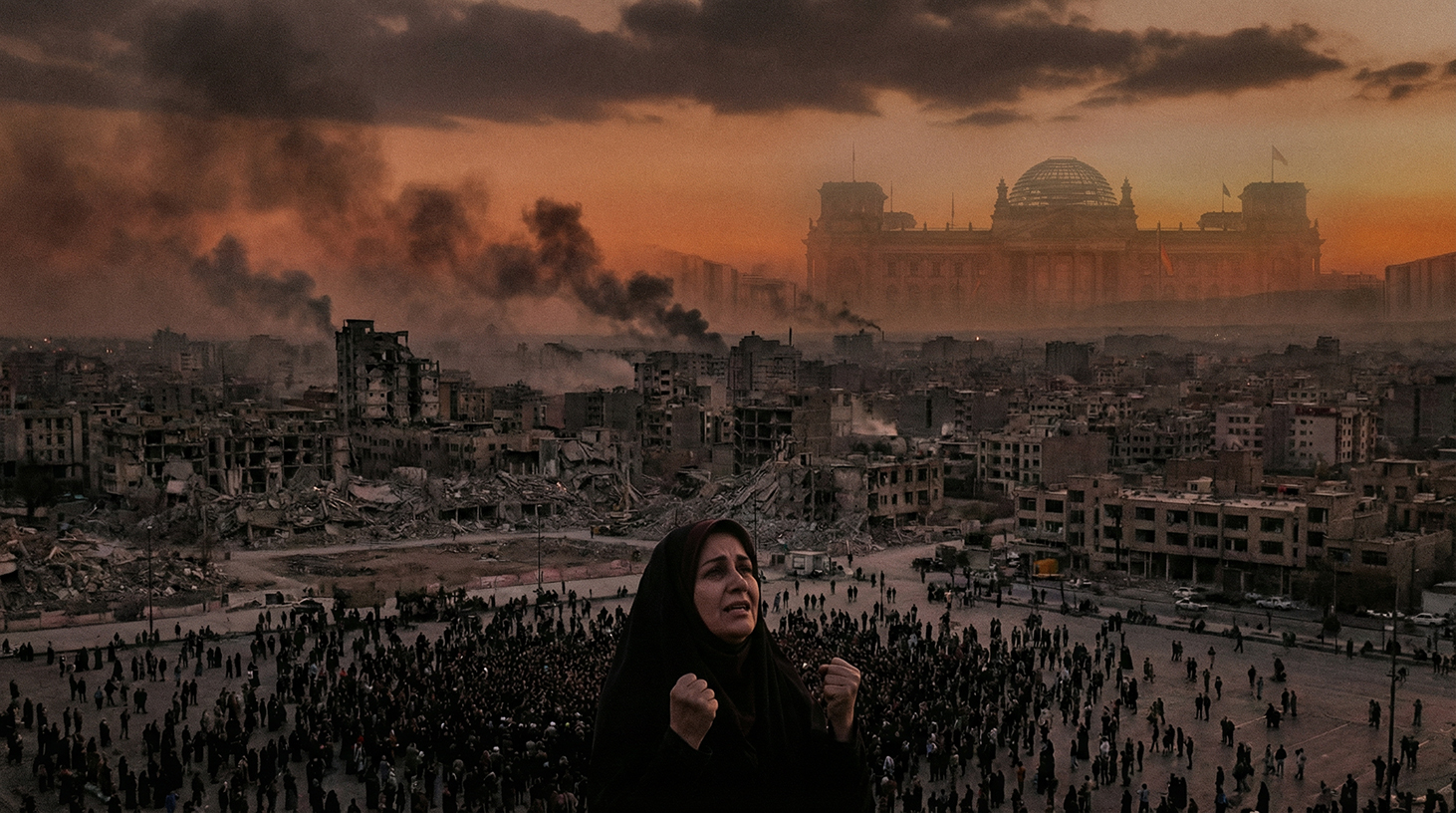
Betrayal of Iran: How the West abandoned the civilian population during the bombing campaign – Creative image: Xpert.Digital
“Dirty work” and false solidarity: Germany’s fatal mistake in the Iran war 2026
When Western morality without a concept meets geopolitics without scruples
The Iran-Iraq War of 2026 marks a historic low point in Western foreign policy—not only because of the bombs that fell, but because of the decades that preceded them. For years, Western democracies, above all Germany, had invoked the Iranian people in Sunday speeches, expressed solidarity with the protesters, and imposed sanctions on the mullah regime. The diagnosis was always the same: the regime must go. The cure was never specified. What began on February 28, 2026, with coordinated US and Israeli airstrikes on Iranian territory was, in a sense, the military consequence of precisely that sentiment which Western politicians had fueled for years and to which they had simultaneously offered no alternative. And when this consequence was drawn—not by Europe, but by Trump and Netanyahu, with different goals and different interests—the West fell silent. A great silence. Because of great helplessness.
Moral bankruptcy without a plan: How the West talked into nothing for years
For decades, Western politicians cultivated a role that would cost them dearly: that of the moralist against the Iranian regime. It was a role that incurred no costs. They could label the mullah regime a terrorist system, impose sanctions, bang their fists on the table—and sleep soundly at night, knowing that the next elections would be dominated by other issues anyway. What these politicians never provided was an honest answer to the simplest of all questions: If the regime has to go—how exactly? What comes next? Who will bear the costs of the transition? Who will protect the population during the period of instability that follows any regime change?
These questions weren't asked because the answers would have been uncomfortable. The historical record of regime change through external influence is devastating: Iraq, Libya, Afghanistan—in all cases, the forced collapse of an oppressive apparatus was followed not by a democratic awakening, but by state failure, civil war, and humanitarian catastrophe. Deutsche Welle already noted this in June 2025: “Regime change from the outside is a highly controversial concept—under international law, it is a clear violation of sovereignty; politically, it has almost always failed.” Nevertheless, the demand has been maintained time and again. Not as a political program, but as a moral gesture. A gesture that costs nothing—for those making it.
The fatal flaw of this policy was its cumulative effect. When Western governments declare for decades that the Iranian regime is illegitimate, must be eliminated, and poses a global threat, they create an expectation—and an atmosphere of entitlement. When Trump and Netanyahu drew the military conclusion from this atmosphere, European moralists could no longer credibly complain without admitting that their own rhetoric had contributed to it. Their silence was therefore no accident. It was the inevitable consequence of a policy that, in the style of a center-left, had repeatedly and loudly made demands without ever having the courage to fully consider the consequences: "Have your cake and eat it too.".
What the Iranian people really want: The ignored polls and their own voice
In no German talk show, in hardly any editorial, and in no Bundestag debate was a truly crucial question asked: What do the Iranian people themselves want? What kind of state do they desire? How much of their cultural and religious identity should a successor state retain? Is the population's discontent primarily economic—that is, an expression of the poor economic situation—or is it a fundamental desire for a modern, democratic form of government? These questions would have been the basic prerequisite for any serious policy toward Iran. They were not asked because the West already had its own answer: democracy modeled on the West, secularism, and accession to the international community. A projection, not an analysis.
However, remarkably robust survey data paints a much more nuanced picture. The Dutch institute GAMAAN (Group for Analyzing and Measuring Attitudes in Iran) conducted a representative survey in June 2024, the results of which were published in the summer of 2025. The finding: Around 70 percent of Iranians surveyed reject the continued existence of the Islamic Republic. This opposition had even risen to 81 percent during the "Women, Lives, Liberty" movement. Only eleven percent of Iranians now support the principles of the Islamic Revolution and the Supreme Leader—compared to 18 percent in 2022. Eighty-nine percent favor democracy as a form of government.
But caution is advised when interpreting this data: Rejection of the existing regime is not synonymous with agreement with a Western concept of regime change. The GAMAAN data shows that 40 percent see regime change as a prerequisite for change, 24 percent prefer an "orderly transition," and only 26 percent aspire to a secular republic. Twenty-one percent even advocate for a monarchy. This is not a homogenous movement waiting for Western exports of democracy. It is a diverse society with its own historical memory—a memory that includes the Western-backed coup against Mossadegh in 1953 as well as the support for Saddam in the war against Iran in the 1980s. A distinct Iranian culture and identity, a Persian history that predates the Western Enlightenment project by a thousand years—all of this has played no role in the Western debate on Iran.
Even more revealing is a leaked internal survey from the Iranian Student Opinion Center (ISPA) from November 2025: 92 percent of Iranians rate the situation in the country negatively, and 89 percent reject the economic policies. This suggests that the core of the discontent is profoundly economic in nature. Inflation exceeding 40 percent, a rial in freefall, more than a third of the population living on less than $8 a day—these are the driving forces behind the resistance, not necessarily an ideological yearning for Western-style parliamentary democracy. Anyone who fails to grasp this also fails to understand why a military strike from abroad is not liberation, but rather a further humiliation—this time with bombs instead of sanctions.
Chronology of an escalation: From diplomacy to the bomb
The path to war with Iran in 2026 was not inevitable. It was the result of a long chain of deliberate political decisions—and equally deliberate omissions. As early as 2015, the international nuclear agreement (JCPOA) seemed to offer a diplomatic way out: Iran agreed to drastically curtail its nuclear program, and in return, sanctions were gradually eased. German President Steinmeier summed it up perfectly in March 2026: Iran had then “never been so far from nuclear weapons.”.
But this assessment is too simplistic. The history of the Iranian nuclear program is a chronicle of tactically gaining time through feigned willingness to negotiate: No sooner had international pressure eased than Tehran systematically violated its own commitments—enriching uranium to 60 percent, massively expanding its production capacity, and restricting access for IAEA inspectors. By mid-2025, Iran had amassed enough enriched uranium to reduce the breakout time for its first bomb to just a few days. Experts from various political camps agreed: Tehran did not use nuclear talks as a genuine commitment to relinquish nuclear weapons, but rather as a shield against military pressure—tactical concessions to buy time and keep the nuclear path open. Anyone who ignores this bears partial responsibility for what followed.
It was Donald Trump who unilaterally terminated this agreement in 2018 during his first term in office, thereby setting in motion a spiral that culminated in bombs and death.
The escalation in 2025 unfolded in two phases: First, between June and October 2025, Israel carried out targeted precision attacks against Iranian nuclear facilities. In the summer of 2025, German Chancellor Friedrich Merz praised the Israeli actions with a phrase that made headlines and set the tone for German policy toward Iran for months: “This is the dirty work Israel does—for all of us.” This statement was not a slip of the tongue; it was political policy. It signaled that Germany considered the military strikes legitimate—without mentioning the people of Iran even once. And it illustrates the core problem of the Western discourse: The regime was fought, the people were forgotten.
On February 28, 2026, the conflict escalated dramatically: The United States, together with Israel, launched Operation Epic Fury, a direct military strike against Iranian territory. The strikes targeted not only nuclear facilities in Fordow, Natanz, and Isfahan, but also military and government installations in at least 190 cities across 27 Iranian provinces. Supreme Leader Ali Khamenei was killed in the attack. Iran responded with missile attacks on Israel and US military bases in the region, and declared the Strait of Hormuz closed—a move that would destabilize global energy supplies.
The Mullah Regime and the Iranian People: A Much-Needed Distinction
The Iranian regime is an apparatus of oppression. Since the outbreak of the "Women, Lives, Freedom" protests in September 2022, it has executed more than 900 people. It has responded to the courageous street protests with torture, rape, and executions. It has supplied drones to the war in Ukraine and cooperated closely with Hezbollah and Hamas. None of this can be excused. And none of it justifies the collective punishment of the population through bombs and missiles.
In German media discourse, the distinction between regime and population was practically nonexistent. German talk shows almost exclusively referred to the "Mullah regime," as if the Iranian population didn't exist. The editor-in-chief of the Jewish Allgemeine declared on ZDF that there were "no civilian casualties in Iran"—a claim that starkly contradicted the documented facts. Those close to the Springer publishing house interpreted the war as a "civilizational war," thereby symbolically equating the Islamist terror regime with those fighting it—the Iranian democracy movements. It was a rhetorical disempowerment of civil society, which had been risking its lives for years to fight for freedom.
This conceptual reduction had practical political consequences. Anyone who understands the Iranian people and the Iranian regime as a single entity inevitably concludes that bombing the regime is synonymous with bombing a hostile entity—not with bombing people suffering under that entity. The obscuring of the civilian population was therefore not a journalistic oversight. It was the prerequisite for a political narrative capable of justifying military action.
The humanitarian scale: figures that Germany has ignored
The humanitarian consequences of the war are devastating. According to the International Committee of the Red Cross, more than 1,900 civilians have been killed and over 20,000 injured since the war began. The human rights organization Hengaw, in its report of March 28, 2026, documented at least 720 confirmed civilian deaths—including 150 children and 190 women—in the first month of the war alone. A total of 6,900 people were killed by the end of March, approximately 10.5 percent of them civilians. These figures are conservative: Hengaw explicitly pointed out that Iranian state media systematically publish lower figures than can be confirmed by field documentation.
By mid-March, the UNHCR had already reported over 3.2 million internally displaced persons in Iran. Most fled Tehran and other urban centers to rural areas—without bunkers, without sirens, without government protection. More than 81,000 civilian facilities were damaged, including 61,000 homes, 275 medical centers, and nearly 500 schools. Jan Egeland, Secretary General of the Norwegian Refugee Council, summed it up: “After a month of relentless bombardment, the civilian population is exhausted and traumatized.” These words barely registered in Germany. In talk shows and government statements, the Iranian civilian population remained largely invisible—because their visibility would have disrupted the convenient narrative.
Germany's stance: applause, silence, and the subsequent bewilderment
The German political response to the war with Iran unfolded in three discernible phases. In the first phase—the initial Israeli attack in the summer of 2025—the German government demonstratively applauded. Merz's "dirty work" remark was no slip of the tongue. Jens Spahn, head of the CDU/CSU parliamentary group, wrote on Twitter that destroying the Iranian nuclear program offered "the chance to bring lasting stability and peace to the region and its people"—without a plan, without conditions, without mentioning the population. When the US then openly entered the war in March 2026, the applause gave way to the second phase: strategic silence. Chancellor Merz offered no criticism, convened the security cabinet, and called on Iran to begin negotiations.
The third phase began with the Federal Presidential Office. On March 24, 2026, Steinmeier broke with the government line: "This war is illegal under international law—there is little doubt about that." He described it as a "politically disastrous mistake" and an "avoidable, unnecessary war." He thus aligned himself with the Bundestag's expert opinion of March 19, 2026, which classified the attacks as a violation of the UN Charter. SPD parliamentary group leader Miersch and Vice Chancellor Klingbeil had reached similar conclusions. The Federal Government itself, however, remained divided and paralyzed by communication.
This paralysis is the real failure. It is an admission that decades of anti-regime rhetoric were never linked to a plan. Now that someone is trying to cut this Gordian knot—in their own way, with their own means, for their own interests—Europe can neither go along with it nor sincerely oppose it. Because both would reveal its own lack of a coherent strategy. Anyone who has railed against the mullah regime for decades, imposed sanctions that achieved nothing, and yet never truly wanted or was prepared to take responsibility for regime change, has no moral capital left when someone else attempts it—and still manages to do it wrong.
Our global industry and economic expertise in business development, sales and marketing

Our global industry and economic expertise in business development, sales and marketing - Image: Xpert.Digital
Industry focus areas: B2B, digitalization (from AI to XR), mechanical engineering, logistics, renewable energies and industry
More information here:
A thematic hub offering insights and expertise:
- Knowledge platform covering global and regional economies, innovation and industry-specific trends
- A collection of analyses, insights, and background information from our key areas of focus
- A place for expertise and information on current developments in business and technology
- A hub for companies seeking information on markets, digitalization, and industry innovations
"Woman, Life, Freedom" and the bitter cynicism of the West
International law and its strategic dismantling
The war with Iran has sparked a debate that extends far beyond the region: whether international law still possesses normative binding force or has become a political bargaining chip. The expert report commissioned by the German Bundestag found that neither the US nor Israel had obtained a UN mandate and that their justifications were not coherent. The US argument, in particular, appeared contradictory: Trump declared in 2025 that Iran's nuclear facilities had been "completely destroyed"—only to then invoke the nuclear threat again in 2026.
In March 2026, international law experts published a statement sharply criticizing the German government's reaction: The statements "failed to demonstrate a clear condemnation of the actions contrary to international law" and contributed to the "further erosion of the rules-based order." Article 26 of the Basic Law explicitly prohibits participation in a war of aggression—this principle makes Germany an active guardian of the international legal order, not a silent bystander. The IPG Journal summarized the creeping normalization: Media commentaries called for "more dirty work, less international law," as if the norm itself were the problem, not its violation.
And yet: The uncomfortable truth is that the real failure lies deeper. The true betrayal is not merely the violation of international law—it lies in the fact that the West is now neither unequivocally condemning the war, which violates international law, nor consistently advocating for the genuine regime change it has demanded for decades. To refuse both simultaneously is not pragmatism; it is moral bankruptcy.
The economic shock: Germany pays — America collects
The Iran war hit the German economy at a particularly inopportune time. A joint forecast by leading German economic research institutes halved their GDP growth projection for 2026 to just 0.6 percent. For 2027, the institutes now expect growth of only 0.9 percent, down from the previous 1.4 percent. Inflation is projected to rise to an average of 2.8 percent in 2026. The German Economic Institute (IW) calculated the total damage to the German economy by the end of 2027 at 40 billion euros.
The Strait of Hormuz was and remains the central bottleneck. Around 20 percent of the world's oil and LNG shipments pass through this strait daily. Iran blocked passage, fired on tankers, and drove insurance premiums to historic highs. Goldman Sachs described the oil supply disruption as the largest in the history of global energy markets. European gas prices temporarily doubled to over €50 per megawatt-hour. The price of Brent crude oil rose by more than 20 percent in the first days of the war, reaching a peak of $87.66 per barrel.
This reveals an economic asymmetry that has received little attention in the German debate: The US and Israel are bearing the economic burden of the war at a fraction of what Europe has to shoulder. For the US oil and gas industry, high energy prices are not a loss, but a gain. According to calculations by Energy Flux, the nominal profits of US oil and gas companies have doubled since the start of the war. The Trump administration had already taken control of Venezuelan oil trade after the arrest of Venezuelan President Maduro, making Venezuelan crude oil available to the US and not to China. Trump also openly stated that he wanted to "take the oil from Iran," "just like in Venezuela." War as energy policy by other means: Europe foots the bill, America reaps the profits.
The insider suspicion: When war becomes a private money-making machine
A stock market thriller that has international financial regulators investigating the situation fits the image of a war that serves no other purpose. On March 23, 2026, an unknown group of traders placed bets on falling oil prices totaling up to $650 million within a single minute. Minutes later, Trump announced on Truth Social that talks with Iran were "very good and productive"—whereupon the price of oil plummeted by up to 15 percent. In the five preceding trading days alone, the corresponding trading volume in the same timeframe had been only around 700,000 barrels. According to calculations by the Financial Times, traders bet more than half a billion US dollars on falling oil prices—precisely before Trump's about-face.
Capital.de and Bloomberg confirmed the pattern: Within just two minutes, futures contracts for at least six million barrels of oil were sold shortly before Trump publicly spoke of easing tensions. The IMF's chief economist and several financial market experts stated that the pattern was "statistically difficult to explain by chance." The head of the German Economic Institute (IW), Hüther, left open the question of whether it was insider trading or whether experienced traders had recognized a pattern of behavior in the US president—first a threat, then a retreat when the markets punished him. Both are equally worrying: either corrupt misuse of government information, or a world in which global war and peace decisions are made according to the pattern of an erratic dealmaker whose next tweet shifts billions.
This is not the first time that Trump's political pronouncements have coincided with market movements with striking precision. Whether meme coins, tax bets, or now oil derivatives—the suspicion is growing that the US president's inner circle is profiting from signals of war and peace. This dimension of the Iran war—war as a private financial instrument for insiders—is, from a moral standpoint, perhaps the dirtiest aspect of an already sordid chapter.
The Iranian economy before the war: Poverty as a context for betrayal
To understand the extent of the betrayal, one must know the Iranian population's situation before the war. They were not living in prosperity that was destroyed by bombs—they were already living in economic hardship, exacerbated by Western sanctions. The IMF documented an inflation rate of 32.5 percent in Iran for 2024 and projected 42.4 percent for 2025. The Iranian rial had reached a historic low on the black market: one euro was equivalent to approximately 1.7 million rials. More than one in three Iranians lived on around 8 US dollars a day. Even before the war began, the World Bank had predicted negative growth of 1.7 percent for 2025 and 2.8 percent for 2026.
This economic erosion was not solely the result of internal mismanagement. It was also the product of years of Western sanctions policy, designed to put pressure on the regime without harming the population. As is often the case with sanctions, the regime remained, and the people suffered. And then came the bombs. The "Theory of Change" based on maximum Western pressure—the more isolated the regime, the more likely a popular uprising—was never empirically proven and never borne out. It deepened distrust, fueled revanchism, and economically exhausted the population.
“Woman, Life, Freedom” and the bitter cynicism of the moment
The "Woman, Life, Freedom" movement was a global promise. When Jina Mahsa Amini died in police custody in September 2022 and the Iranian people took to the streets, Western democracies expressed their solidarity. German politicians wore the movement's colors, and Foreign Minister Baerbock declared her commitment to a feminist foreign policy. The message was clear: Europe stands with the Iranian people.
This message wasn't wrong—it just wasn't meant seriously. When the movement was brutally suppressed, the protection rate for Iranian asylum seekers in Germany was halved. On the movement's third anniversary in September 2025, PRO ASYL documented that while the German government had promised support for vulnerable Iranians in its coalition agreement, the actual implementation fell far short. Deportations to Iran were not stopped, and protection rates declined even as repression and executions increased.
And then, when Israel and the US launched a military attack on the regime—the very regime that oppresses the Iranian people—the Western advocates remained silent. The promise of a life without mullah rule was now being fulfilled by others—with bombs, on rubble, for other interests. The German-Iranian journalist Natalie Amiri summed it up perfectly: Trump wasn't at all concerned with liberating the population or protecting human rights, but rather with economic interests—raw materials, oil, and gas—and with appearing victorious. That's the bitter cynicism of the moment: The right people had the right goal in mind. The wrong people implemented it militarily. And the people of Iran are bearing the cost.
The global energy structure and Europe's geopolitical losers
The war with Iran is shifting the geopolitical balance of power to Europe's disadvantage. Among the unexpected beneficiaries is Russia: rising oil prices mean significant additional revenue for sanctioned Moscow, which can flow directly into the war against Ukraine. A perverse logic that has hardly been openly addressed in Berlin.
For Germany, the structural damage is far more complex than economic forecasts suggest. Since the 2022 energy crisis, Germany has made considerable efforts to replace its dependence on Russian gas with LNG alternatives. Qatar was a key partner in this endeavor. The production shutdown of QatarEnergy and the de facto closure of the Strait of Hormuz are hitting precisely the supply chain that Germany had only recently established as a strategic alternative. Berenberg Bank lowered its growth forecast to 1.1 percent and raised its inflation forecast to 2.1 percent—assuming a short conflict. The ZEW (Centre for European Economic Research) emphasized that the consequences of the crisis depend significantly on the duration of the conflict and predicted a "sharp decline in growth" in the event of a prolonged war.
On April 7th/8th, 2026, a two-week ceasefire was finally agreed upon, brokered by Pakistan. Iran agreed to reopen the Strait of Hormuz to shipping under certain technical conditions. The relief in the markets was palpable. But the humanitarian crisis and the shattered trust of the Iranian people cannot be mended by a press release from Islamabad.
Structural guilt: Between shared responsibility and complicity
The question of whether Germany bears partial responsibility for what happened to the Iranian people in the spring of 2026 cannot be answered with a simple yes or no. It requires a nuanced analysis of the chain of events—and a willingness to make even uncomfortable assessments.
Germany did not bomb. It was not operationally involved. But its complicity runs deeper. It lies in the symbolic legitimization provided by Merz's "dirty work" comment. It lies in the failure to issue a clear condemnation under international law, which would have enabled other states to exert political pressure. It lies in the decades-long policy of sanctions that did not remove the regime but economically exhausted the population. It lies in the systematic erasure of the civilian population from German media discourse. And it lies in the gap between the rhetorical solidarity with "Women, Life, Freedom" and a protectionist policy that never lived up to this rhetoric.
The real failure, however, lies even deeper: For decades, the West railed against the mullah regime, imposed sanctions that achieved nothing, and simultaneously never mustered the courage or the will to bear the consequences of genuine regime change. Now someone is attempting to cut the Gordian knot—with questionable goals, without regard for civilians, with bombs instead of strategies. And now the West can neither say that this is wrong, nor participate without betraying its own principles. That is the real dilemma. And the Iranian people are caught in this dilemma—as victims whose opinions have never truly been sought.
What's missing now: a concept instead of morality, honesty instead of PR based on principles
The two-week ceasefire in April 2026 offers a narrow window of opportunity. It would be naive to assume a simple return to the status quo ante. The damage is too great: human, infrastructural, diplomatic, and economic. But the window exists.
Germany should clearly and unequivocally condemn the war against Iran as a violation of international law—not just through the Federal President, but through the entire Federal Government. At the same time, Germany must stop pretending that demands for regime change can be made without consequence. Anyone calling for regime change must specify what that change should look like, who will bear the costs of it, and who will finance the transition.
When morality is cheap and bombs become expensive
The Iran war of 2026 is a mirror. It reveals what Western democracies mean when they speak of solidarity, human rights, and a rules-based order—and what they are actually willing to risk for it. Germany's answer is uncomfortable: solidarity is acceptable as long as it comes at no cost. When bombs fall, the reflex of geopolitical calculation takes over.
This is understandable from a human perspective and politically disastrous. Understandable because the Iranian regime did indeed pose a real threat—to its population, to Israel, to regional stability. Disastrous because the people of Iran now bear not only the burden of their own regime, but also the burden of Western moralizing without a plan and the subsequent silence. Those who point the finger at the mullah regime for decades, then applaud when bombs fall, and then fall silent when the bodies are counted—have lost all moral capital to claim solidarity.
President Steinmeier is right: German foreign policy needs to be recalibrated. Not because Germany should become weaker, but because strength without a strategy is not leadership. International law, as the IPG Journal put it, is “not an option, but a constitutional obligation.” And the duty of solidarity with oppressed peoples does not end at the border of geopolitics and energy prices—but neither does it begin with an empty promise that is never kept.
The people of Iran have a right to both: to an end to the regime that oppresses them — and to a West that does not praise, remain silent and collect money.










