
For Russia, China and Iran, the US move in Venezuela is far more than the loss of a key outpost
Xpert pre-release

Language selection 📢
Published on: January 6, 2026 / Updated on: January 6, 2026 – Author: Konrad Wolfenstein
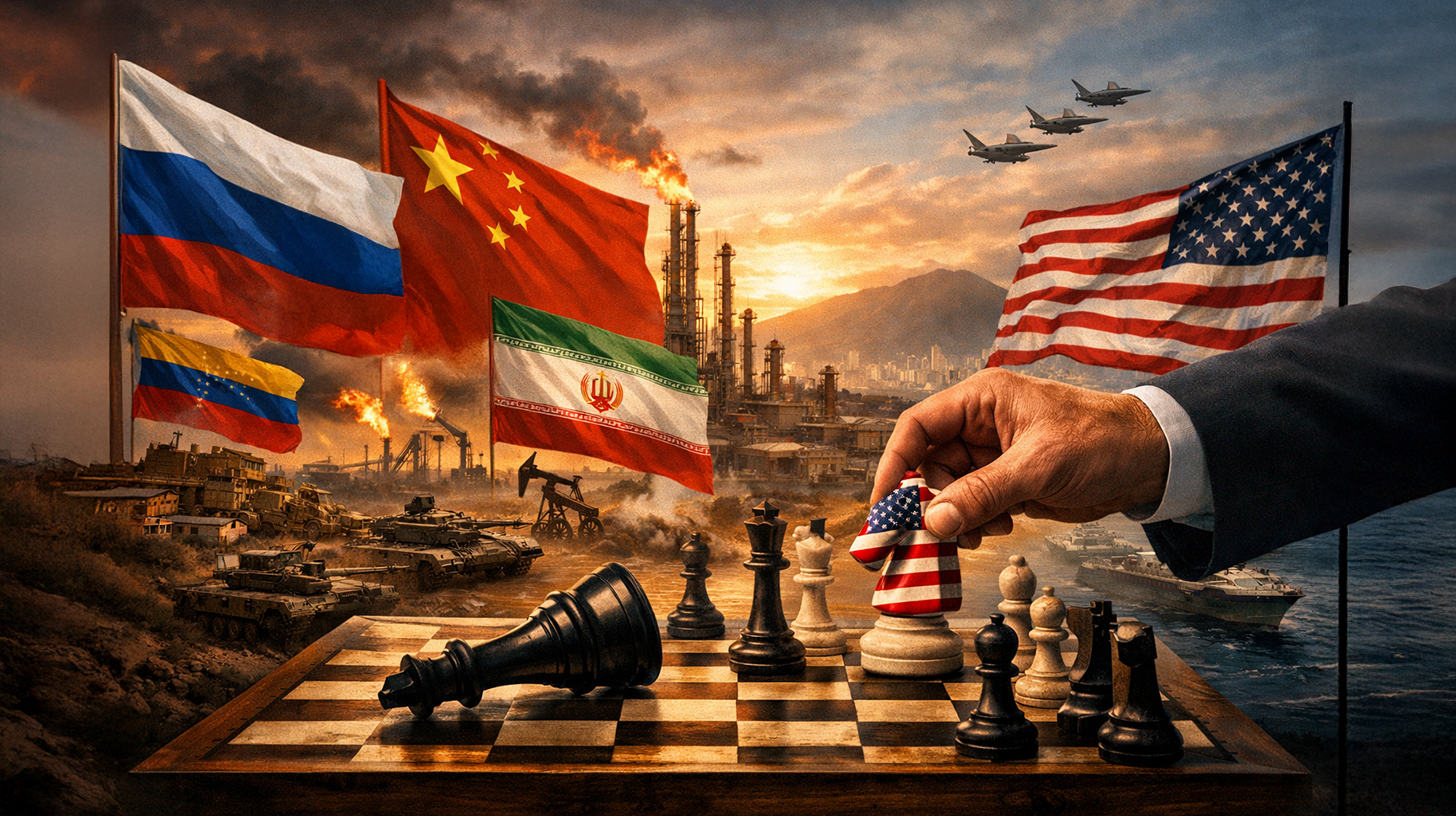
For Russia, China, and Iran, the US move in Venezuela is far more than the loss of a key outpost – Image: Xpert.Digital
Putin's nightmare in Latin America and China's 100 billion dollar risk: The US access to Venezuela and the end of the Silk Road in South America
A geopolitical earthquake is shaking the world order: The violent overthrow of the Maduro regime marks the beginning of a new era of US dominance
In the early morning hours of January 3, 2026, facts were established in Caracas that would have repercussions far beyond the borders of South America. With surgical military precision, US special forces, as part of "Operation Southern Spear," ended the more than two-decade-long rule of Chavismo and extracted President Nicolás Maduro from his stronghold. But it is far more than the supposedly necessary blow against drug crime and tyranny; it is, in truth, also a tectonic shift in the global power architecture: the re-establishment of the Monroe Doctrine.
This move catches the US's strategic rivals—Russia, China, and Iran—off guard and with full force. For the Kremlin, a crucial bridgehead crumbles, while Beijing's billions in investments are under threat overnight and Tehran's logistical networks for circumventing sanctions are dismantled. The events in Venezuela are more than a regime change; they are a demonstration of operational superiority and an unmistakable signal to the world that the US is prepared to once again enforce its interests with an iron fist. As international markets react to the redrawing of the world's largest oil reserves and international law is put to the test, this report analyzes the profound consequences of the day Eurasian expansion in the Western Hemisphere came to an abrupt halt.
Suitable for:

Operation "Southern Spear": How US special forces extracted Maduro from Caracas in 150 minutes
The dramatic events of early January 2026 shook the global power structure in a way that extends far beyond the borders of South America. The arrest of Nicolás Maduro by US special forces in a coordinated military operation not only marks the end of over two decades of Chavismo but also signals the United States' violent re-establishment of the Monroe Doctrine. For Washington's strategic adversaries—namely Russia, China, and Iran—this action represents an unprecedented setback, neutralizing their respective ambitions in the Western Hemisphere and ruthlessly exposing their internal weaknesses and the limits of their global influence. While the US government portrays the operation as legitimate law enforcement action against a criminal regime in the context of drug terrorism, an analysis of the economic and geopolitical consequences reveals a profound shift in the balance of power that will make 2026 a watershed year in history.
Suitable for:

The operational superiority of the United States and the end of strategic ambiguity
Operation Southern Spear, which began on the night of January 3, 2026, is already destined to become a classic example of military precision in strategy textbooks. Unlike previous, often chaotic interventions, US forces managed to execute a comprehensive air and ground operation that extracted the incumbent Venezuelan president and his wife, Cilia Flores, from a heavily guarded stronghold in Caracas in just two and a half hours. The coordination of over 150 aircraft, including bombers, fighters, and reconnaissance platforms, launched from 20 different land and sea bases, demonstrated a technological and logistical dominance that Venezuelan air defenses—despite their Russian equipment—were powerless to counter.
This military success has immediate implications for the global perception of US power. Experts point out that the ability to invade a sovereign state, arrest its leadership, and withdraw without losses serves as a warning to all those who had been banking on Washington's weakness. The operation represents a significant improvement over previous failures, such as Operation Claw-Eagle in 1980, and underscores the US's willingness and ability to enforce its national security interests with robust force when diplomatic and economic pressure tactics fail.
Key figures for Operation Southern Spear
| Total duration of the deployment | approximately 150 minutes |
| Time spent on the ground in Caracas | approximately 30 minutes |
| Participating aircraft | 150 (Bombers, Fighters, ISRs, Rotary Wings) |
| Logistics base | 20 land and sea bases |
| Own losses (USA) | No fatalities, no aircraft losses |
| Target persons | Nicolás Maduro and Cilia Flores |
Economically speaking, this military strength forms the basis for the announced takeover of government by the US until a stable transition is achieved. President Trump emphasized immediately after the operation that the United States would now exercise control over the country in order to rebuild the devastated system and the oil industry. This poses a direct challenge to the investments that China and Russia have made in Venezuela over decades, investments that could now fall under the direct administration of Washington.
The collapse of the Russian sphere of influence and the internal turmoil of the Kremlin
For the Russian Federation, the fall of Caracas is a geopolitical catastrophe of existential proportions. Moscow had viewed Venezuela not only as a market for arms and a target for massive energy investments, but above all as a strategic bridgehead against US influence in Eastern Europe. Maduro's arrest exposes the limits of Russia's power projection, as the Kremlin, despite official alliances and strategic partnerships, was unable to protect its closest ally in the region. In nationalist circles in Russia, this inability is seen as proof of a fundamental failure of foreign policy under Vladimir Putin.
The public reaction in Russia is characterized by unusual aggression. Military bloggers, in particular, who support the war in Ukraine, have expressed themselves in ways that call into question the stability of the regime. The rhetoric on nationalist platforms has reached a boiling point, with accusations of madness and treason against the leadership in Moscow. Critics claim that the US has cemented its dominance for centuries through this operation, while Russia's future is jeopardized by the rapid commitment of all resources to the war in Ukraine. This internal pressure is exacerbated by economic realities, as the state-owned energy company Rosneft faces the loss of billions of dollars.
The writer Maxim Kalashnikov aptly captured the prevailing sentiment by comparing Russia's long-standing involvement in Venezuela to a loud but ultimately useless fireworks display that made no real contribution to Russia's industrialization. This assessment gets to the heart of the economic predicament: While Moscow poured billions into politically motivated projects overseas, the domestic industrial base is eroding under the pressure of sanctions and falling oil prices. The following table illustrates Rosneft's financial difficulties in 2025, which are further exacerbated by the looming total loss of its Venezuelan holdings.
Rosneft financial data (Jan-Sept 2025)
| Value | Change from the previous year |
| Net profit 277 billion rubles (3.6 billion USD) | – 70 % |
| Revenue: 6.28 trillion rubles | – 18 % |
| EBITDA 1.64 trillion rubles | – 29 % |
| Operating cash flow (H1 2025) 916 billion rubles | Almost entirely spent on investments/debt |
| Estimated value of Venezuelan assets: USD 5 billion | Acute threat from US control |
Moscow's inability to intervene militarily or diplomatically is directly attributed to the strain of the war in Ukraine, which is tying up all available political and military resources. While Maduro signed a new strategic partnership in Moscow just eight months earlier, the current situation demonstrates that such agreements are worthless in the reality of hard-nosed power politics unless backed by credible deterrence.
China's strategic withdrawal and the protection of billions in investments
The People's Republic of China faces a complex dilemma. As Venezuela's largest creditor, with estimated loans exceeding $100 billion over the past decades, Beijing has a strong interest in the repayment of these debts. The official reaction from Beijing was accordingly sharp, condemning Maduro's arrest as a blatant violation of international law and the UN Charter. China positions itself as a defender of sovereignty and criticizes the US as a self-appointed world judge that threatens global stability.
Behind the scenes, however, a strategic realignment is evident. Analysts observe that China is increasingly relying on private companies to protect its interests in Venezuela, while state-owned actors like CNPC are acting more cautiously. A prominent example is China Concord Resources Corp (CCRC), which in 2025 began implementing a multi-billion-dollar project in Lake Maracaibo to significantly boost oil production. The arrival of the offshore platform Alula in September 2025 signaled Beijing's long-term confidence in the sector, which has now been severely shaken by the US intervention.
China now faces a difficult decision: whether to cooperate with the US-backed interim government to protect its investments, or to take a confrontational approach and risk losing all of its claims. There is great concern that a Washington-loyal administration will restrict access for Chinese companies while simultaneously opening the doors wide to US corporations. This would not only damage Beijing's economic interests but also weaken its strategic position in Latin America, a region China has successfully courted as a partner in recent years through its Belt and Road Initiative.
Project parameters China Concord Resources (CCRC)
| Planned investment volume | $1 billion |
| The goal of oil production | 60,000 barrels per day until the end of 2026 |
| Current basic production | 12,000 barrels per day |
| Infrastructure | Alula Jack-up Rig (Lake Maracaibo) |
| Contract type | CPP (Productive Participation Contract) |
Beijing is also using the event to promote its Global Security Initiative (GSI) and portray itself as a more stable alternative to the US. Nevertheless, the Chinese leadership is keenly aware that diplomatic protests and multilateralism in the UN Security Council are largely ineffective when the US unilaterally creates military facts on the ground. The realization that even the closest strategic partners, such as Venezuela, can fall within hours will have a lasting impact on China's assessment of other regional conflicts, such as the one over Taiwan.
The destruction of the Iranian logistics bridge and the end of the shadow fleet
With Nicolás Maduro's arrest, Iran loses its most important ally in the Western Hemisphere and a key hub for its global sanctions-evading networks. For nearly two decades, Tehran and Caracas had cultivated a deep cooperation that extended far beyond mere oil trade. Venezuela served as a logistical base for Hezbollah and a platform for Iranian intelligence operations in South America. With Maduro's arrest and the US takeover, this network is now under immediate threat.
Economically, Iran faces a significant loss. Venezuela's officially registered debt to Tehran amounts to approximately $2 billion, resulting from joint industrial projects, housing construction, and energy deliveries. Given that Venezuela's total debt exceeds $150 billion and is now under US influence, repayment to Iran, which is also subject to sanctions, is highly unlikely. Iranian insiders are already warning of a scenario similar to that in Syria, where investments were lost following a change of power.
A critical issue is the so-called shadow fleet, consisting of hundreds of tankers that transported Venezuelan and Iranian oil while circumventing US blockades. Operation Southern Spear involved a massive tightening of this blockade, forcing numerous ships to abandon their voyages or divert cargo to floating warehouses. The seizure of the tanker The Skipper by US forces was a clear signal that the era of sanction-free trade on the high seas was over.
Iranian-Venezuelan areas of cooperation
| Financial claims | Approximately USD 2 billion (official) – acute risk of loss |
| Logistics base | Loss of the operational hub for regional activities |
| Shadow Fleet | Disruption of export routes to Asia |
| Oil barter deals | End of mutual fuel/crude oil supply |
| Military advisors | Withdrawal or arrest by US forces likely |
The leadership in Tehran is watching with concern as the US demonstrates its ability to bring about regime change without a protracted ground war. This increases the pressure on the Iranian regime, which is already struggling with internal protests and economic instability. The American show of force in Venezuela is perceived in Tehran as a direct threat that could jeopardize its own survival should Washington employ similar tactics in the Middle East.
Our Latin America expertise in business development, sales and marketing

Our Latin America expertise in business development, sales and marketing - Image: Xpert.Digital
Industry focus: B2B, digitalization (from AI to XR), mechanical engineering, logistics, renewable energies and industry
More about it here:
A topic hub with insights and expertise:
- Knowledge platform on the global and regional economy, innovation and industry-specific trends
- Collection of analyses, impulses and background information from our focus areas
- A place for expertise and information on current developments in business and technology
- Topic hub for companies that want to learn about markets, digitalization and industry innovations
Venezuela's oil comeback: Why Putin's biggest nightmare is now coming true
The reconfiguration of the global energy market and the vision of an oil power center
In the economic analysis of these events, the future of the Venezuelan oil industry plays a central role. Venezuela possesses the world's largest proven crude oil reserves, with approximately 303 billion barrels, representing about 17 percent of global reserves. Nevertheless, due to mismanagement, corruption, and sanctions, the country produced only about 1.1 million barrels per day in 2025 – a fraction of the 3.5 million barrels produced in 1997.
Suitable for:

President Trump has made it unequivocally clear that the US intends to revitalize this industry and transform Venezuela into an energy powerhouse. This is to be achieved through massive investments by American oil companies such as Chevron, ExxonMobil, and Halliburton, whose stock prices surged immediately after the news of Maduro's arrest. However, analysts estimate that it will take a decade and investments of approximately $100 billion to bring production back up to 4 million barrels per day.
In the short term, the return of Venezuelan oil to the world market will put downward pressure on prices, which aligns with Washington's strategic goals of reducing the revenues of Russia and Iran. Experts expect Brent crude to average $57 per barrel in 2026, with a stable transition in Venezuela offering further downside potential. In particular, refineries on the US Gulf Coast that specialize in processing Venezuelan heavy crude would benefit from stable access to these resources.
Projections of Venezuela's oil production
| Expected quantity (millions b/d) | Analyst / Source |
| Current status at the end of 2025: approx. 1.1 | OPEC / Trading Economics |
| Forecast for 2026 (assuming stability): 1.2 – 1.4 | JPMorgan / Trading Economics |
| Forecast for 2027: up to 1.5 | Goldman Sachs |
| Long-term potential (10 years): 2.5 – 4.0 | Rystad Energy / Experts |
| Historical high (1997): 3.45 | EIA / OPEC |
A resurgence of Venezuela as a leading exporter would also reduce global dependence on OPEC+ and significantly weaken Russia's geopolitical leverage in the energy sector. While Moscow has thus far benefited from a competitor being eliminated through sanctions and economic collapse, a US-led recovery of Venezuelan oil fields will increase the supply of heavy fuel oil, thereby putting additional pressure on prices for Russian Urals blends.
International law at a crossroads and the fragmentation of the international order
The global political reactions to Maduro's arrest reveal a deep division within the international community that extends far beyond the traditional blocs. While the US frames the action as the enforcement of law and order against a criminal despot, numerous states warn of a dangerous precedent that threatens the sovereignty of all nations. The United Nations faces a critical test, as the Security Council debates the legality of the operation in special sessions, while the US has already established a fait accompli on the ground.
Within the BRICS nations, a more nuanced picture emerges. Brazil and South Africa strongly condemned the US intervention as an act of state terrorism and aggression that undermines the foundations of international law. President Lula da Silva emphasized that this attack crossed an unacceptable line, pushing the world toward instability and belligerence. In contrast, India acted far more cautiously, merely calling for dialogue, a move that was criticized domestically as a departure from its traditional non-aligned policy and a capitulation to Washington.
The European Union is divided. While Britain and the EU leadership underscored Maduro's lack of legitimacy and indirectly welcomed the action as a liberation from an authoritarian regime, France and Spain expressed more critical views. Spain emphasized that while it did not recognize the Maduro regime, it also did not accept an intervention that violates international law and plunges the region into uncertainty. This fragmentation demonstrates that the unified Western value system is increasingly being replaced by national interests and the fear of an unpredictable US foreign policy under President Trump.
International reactions to the US intervention
| Positioning / Statement |
| USA: Lawful law enforcement measure against drug terrorism |
| China: Blatant violation of international law, demand for release |
| Russia: An act of armed aggression, an exposure of US hegemony |
| Brazil: Crossing an unacceptable line, violating international law |
| South Africa: Violation of sovereignty, disregard for the UN Charter |
| Great Britain: No tears for the end of an illegitimate regime |
| UN Secretary-General: Warning of a dangerous precedent |
The long-standing image of the United States as the guarantor of a rules-based world order has been permanently damaged by this unilateral military action. Experts at Chatham House point out that this moment could mark Washington's final break with the core values that have united the transatlantic alliance for over a century. The world is entering a phase in which naked power politics and the pursuit of national interests by military means are once again becoming the norm, while multilateral institutions like the UN are increasingly losing relevance.
Long-term economic consequences and the risks of a protracted occupation
Despite the rapid military success, the US faces immense challenges in implementing its plans for Venezuela. The assumption that a transition will be swift and seamless could prove deceptive. While Vice President Delcy Rodríguez has been temporarily appointed to lead the country, loyalties within the Venezuelan army and the armed militias, the so-called colectivos, remain unclear. Prolonged instability would delay necessary investments in the oil sector, as international corporations require legal certainty and physical protection for their facilities.
Another economic risk lies in the complex legal situation regarding compensation claims by former investors. Companies like ExxonMobil and ConocoPhillips, whose assets were expropriated under Hugo Chávez, are demanding billions in payments that would severely restrict the financial leeway of a new government. President Trump is also demanding repayment for stolen oil and destroyed infrastructure, which contradicts the goal of providing economic relief to the Venezuelan population and ending the humanitarian crisis.
Venezuela's financial burdens (estimates)
| Amount in billion USD |
| Total foreign debt: 150 – 170 |
| Recognized arbitration awards: tens of billions of euros |
| Estimated GDP (2025): 82.8 |
| Necessary investments in the oil sector: 100 |
| Debt to China: approximately 100 |
| Debt to Iran: approx. 2 |
The economic stabilization of the country therefore requires not only military control, but also a comprehensive international financial package and a resolution to the debt issue. Without such a solution, Venezuela will remain an unstable territory where criminal structures and remnants of the old regime can continue to operate, jeopardizing the long-term goals of the United States – securing energy supplies and eliminating rival powers.
Synthesis of the new geopolitics after Operation Southern Spear
The arrest of Nicolás Maduro in January 2026 marked the end of US multilateral restraint and the beginning of an era of robust enforcement of spheres of influence. For Russia, this event meant the painful loss of a strategic asset and a deep internal crisis that shattered the Kremlin's image of invincibility. The inability to protect an ally from Washington's grasp will weaken Moscow's position in other regions, including Eastern Europe, in the long term, as the credibility of Russian security guarantees has been severely damaged.
China is being forced to redefine its role in the world. Its previous strategy of purely economic expansion without military support is reaching its limits in regions that the US considers its core interests. Beijing is expected to act more pragmatically and try to secure its financial interests through cooperation with the new reality, while continuing to rhetorically invoke multilateralism.
Iran is losing a crucial outlet for its sanctioned economy and an operational base for its regional ambitions. The collapse of the Venezuelan axis demonstrates the vulnerability of asymmetric alliances to a determined superpower. This will fundamentally alter strategic calculations in Tehran and may lead to further radicalization or a desperate attempt at realignment.
With Operation Southern Spear, the US not only toppled a regime but also redefined the rules of global politics. The economic benefits of gaining access to Venezuela's oil reserves and dismantling rival networks are immense, but the price is a more unstable world order in which the law of the jungle is once again gaining ground. Venezuela will become a testing ground in the coming years for the US's ability to rebuild a devastated country while simultaneously addressing the challenges of a multipolar world, where, despite this setback, China and Russia will continue to seek ways to challenge American dominance.
Your global marketing and business development partner
☑️ Our business language is English or German
☑️ NEW: Correspondence in your national language!

Konrad Wolfenstein
I would be happy to serve you and my team as a personal advisor.
You can contact me by filling out the contact form or simply call me on +49 7348 4088 965 (Munich) . My email address is: wolfenstein ∂ xpert.digital
I'm looking forward to our joint project.
☑️ SME support in strategy, consulting, planning and implementation
☑️ Creation or realignment of the digital strategy and digitalization
☑️ Expansion and optimization of international sales processes
☑️ Global & Digital B2B trading platforms
☑️ Pioneer Business Development / Marketing / PR / Trade Fairs
🎯🎯🎯 Benefit from Xpert.Digital's extensive, five-fold expertise in a comprehensive service package | BD, R&D, XR, PR & Digital Visibility Optimization

Benefit from Xpert.Digital's extensive, fivefold expertise in a comprehensive service package | R&D, XR, PR & Digital Visibility Optimization - Image: Xpert.Digital
Xpert.Digital has in-depth knowledge of various industries. This allows us to develop tailor-made strategies that are tailored precisely to the requirements and challenges of your specific market segment. By continually analyzing market trends and following industry developments, we can act with foresight and offer innovative solutions. Through the combination of experience and knowledge, we generate added value and give our customers a decisive competitive advantage.
More about it here:










