
The new Silk Road without Russia: Europe's billion-dollar bet on the Trans-Caspian route via Bulgaria
Xpert Pre-Release

Available in 27 languages 📢
Prefer Xpert.Digital on GoogleⓘPublished on: June 9, 2026 / Updated on: June 9, 2026 – Author: Konrad Wolfenstein
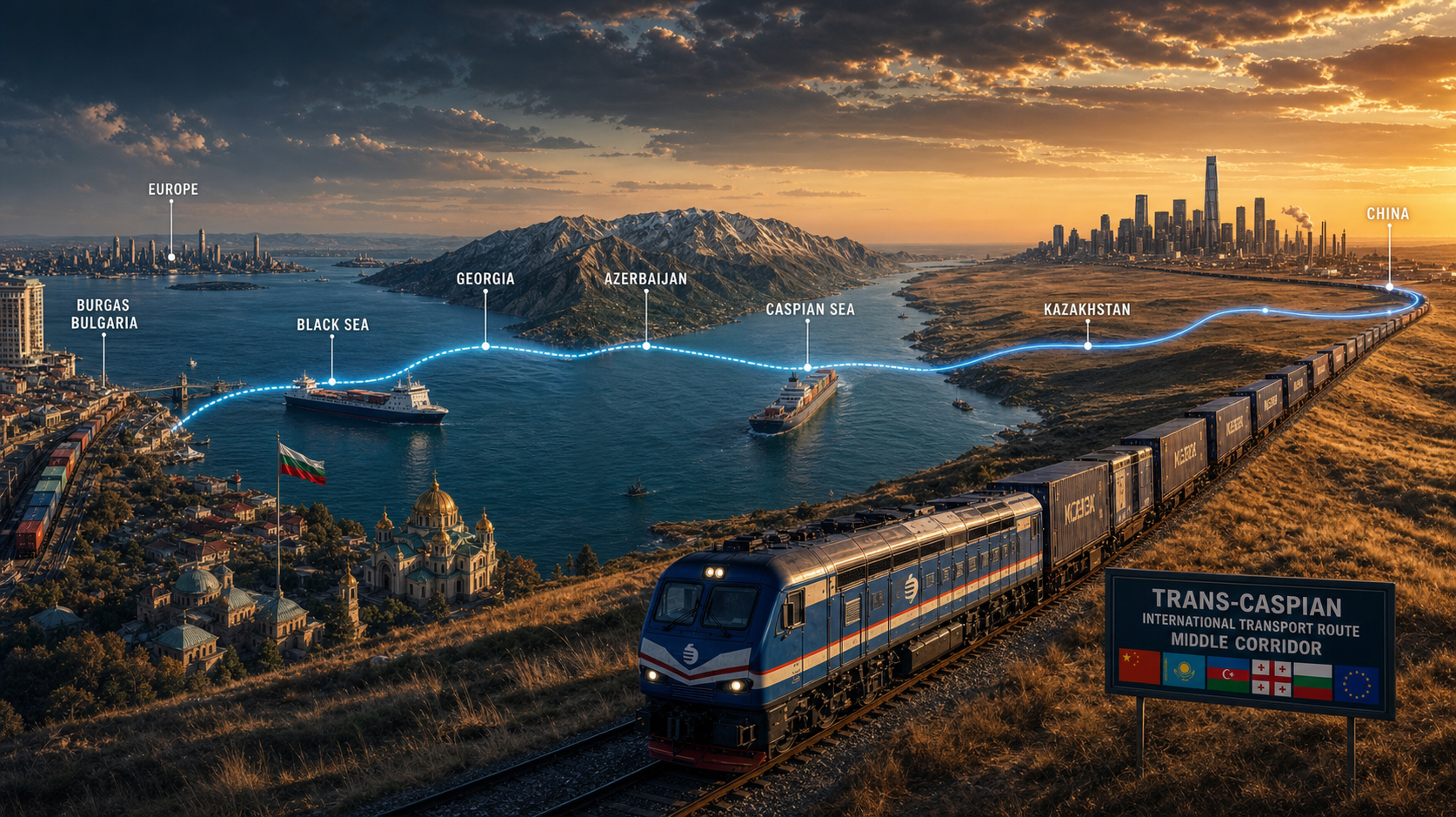
The new Silk Road without Russia: Europe's billion-dollar bet on the Trans-Caspian route via Bulgaria – Image: Xpert.Digital
15 days faster from China: Why this almost forgotten trade route is suddenly booming
Bypassing the Suez Canal and Russia: How the "Middle Corridor" is reshaping world trade
Houthi attacks and sanctions: This trade route is now vital for our supply chains
For years, freight transport between Asia and Europe was considered a reliable system with two undisputed main arteries: the maritime route through the Suez Canal in the south and the Northern Corridor via the Russian rail network. But geopolitical upheavals have profoundly shaken this certainty. Russia's war of aggression against Ukraine and the ongoing threat from Houthi rebels in the Red Sea have massively disrupted global supply chains and made the search for secure alternatives a matter of survival for the logistics industry. In this vacuum, a route that long languished in obscurity is coming into focus: the Middle Corridor, also known as the Trans-Caspian Route. Once ridiculed for its infrastructural bottlenecks and bureaucratic hurdles, the route is now experiencing astronomical growth rates. Geopolitically fueled by billions in Western investment and as part of China's Belt and Road Initiative, it offers the shortest land connection between western China and Europe. But can this multimodal route live up to the immense expectations? An in-depth analysis shows that the Central Corridor is (still) not a complete replacement for the large ocean liners, but it is rapidly developing into a crisis-resistant and indispensable lifeline of Eurasian trade – with far-reaching consequences for the economy and geopolitics.
From emergency exit to successor: The Trans-Caspian Route as a geopolitical reorganization of Eurasian trade
The hour of the silent alternative – why the middle corridor now counts
Anyone who, at the beginning of 2022, still believed that freight traffic between Europe and China would permanently rely on two axes – the maritime Suez Canal route in the south and the Northern Corridor through Russia in the center – was confronted with two major upheavals in quick succession. The Russian war of aggression against Ukraine in February 2022 rendered the Northern Corridor virtually unusable for European logistics companies. European freight forwarders were no longer allowed to enter Russia, Russian trucks lost their registration in the EU, and the transit volumes, which had grown steadily over years, plummeted. Just over two years later, at the end of 2023, the second front escalated: Houthi rebels from Yemen began systematically attacking merchant ships in the Red Sea, prompting major shipping companies such as Maersk, Hapag-Lloyd, and CMA CGM to reroute their fleets around the Cape of Good Hope – adding 10 to 15 days to transit time and massively increasing fuel consumption. Since then, the Middle Corridor, also known as the Trans-Caspian International Transport Route (TITR), has emerged from its marginal existence and is at the center of logistical, geopolitical and economic debates.
This route is not a product of the crisis. It has existed for decades, was institutionally established in 1996, and formalized in 2013 with the founding of the TITR association. Its geographical route leads from Southeast Asia and China via the Kazakh rail network, the Caspian Sea ports of Aktau and Kuryk, the ferry route to Baku in Azerbaijan, then through Georgia and either via Turkey or across the Black Sea to Europe. What distinguishes the route is its geographical brevity: with approximately 4,250 kilometers of rail and around 500 kilometers of sea route for the Caspian crossing, it represents the shortest land connection between western China and western Europe. Until recently, its infrastructural weaknesses, regulatory fragmentation, and high transshipment costs in multimodal operations held it back.
Growth in numbers – a still modest foundation with impressive dynamics
The growth rates of the Central Corridor are impressive, but a look at the absolute figures brings a sobering perspective. The total volume of freight transported via the route increased from around 586,000 tons in 2021 to approximately 1.87 million tons in 2025. Container traffic doubled within the same period, from around 25,000 TEU to almost 77,000 TEU. The year 2024 was particularly dynamic: Freight volume between the seaports of Kazakhstan and Azerbaijan reached 3.3 million tons, an increase of 20 percent compared to the previous year, and container transports rose by a remarkable 176 percent to 56,500 TEU. The number of container trains handled by China increased 33-fold in the same year compared to 2023.
In the first nine months of 2025, over two million tons were already transported, with projections reaching around five million tons for the entire year. For comparison, in the same year, approximately 674,000 TEU were transported in transit between Asia and Europe via the Northern Corridor through Russia, while the Central Corridor, at just 20,500 TEU, lagged far behind. This discrepancy has narrowed considerably since then, but the sea route through the Suez Canal, which handled over 16 million TEU per year at peak times, remains dominant by a wide margin. The Central Corridor is therefore experiencing impressive growth – but is still far from being a structural replacement for the major shipping routes.
EU Commissioner Marta Kos aptly stated at the Trans-Caspian Transport Corridor and Connectivity Investors Forum in Tashkent in November 2025: Freight volume on the Central Corridor had already quadrupled between 2022 and 2025. It could triple again by 2030 – but only if the right investments are made and capacity bottlenecks are addressed. The World Bank, in its 2023 report, sees the potential to transport around 11 million tons annually by 2030 and halve transit times – provided the identified key measures are implemented.
Geographical anatomy – one route, many dependencies
The Central Corridor is a multimodal system linking rail infrastructure, inland waterways, seaports, and road networks across six to eight transit countries. Its starting point is China – typically the Xinjiang province or industrial centers in the interior. From there, the route crosses the Chinese-Kazakh border region, where the Dostyk (Alashankou) level crossing has been the most significant bottleneck between the two rail systems for decades. Here, the first structural complication arises: the Chinese tracks follow standard gauge (1,435 mm), while Kazakhstan – as a legacy of the Soviet rail network – operates a broad gauge of 1,520 mm. Every container must either be transshipped or its bogies replaced, resulting in both time and expense.
In Kazakhstan, the route follows the central railway network from Alashankou towards Aktau, Kazakhstan's main port on the Caspian Sea. Alternatively, the newer port of Kuryk, whose development has been intensified in recent years, serves as a second Kazakh exit from the Caspian. Crossing the Caspian Sea is done by ferry – a journey of approximately 300 to 400 kilometers that can take between 12 hours and several days, depending on weather conditions, ship availability, and port capacity. In Baku, the route continues via the Azerbaijani railway network to Georgia, from where two onward connections are possible: via Turkey by train or road to the EU borders, or by ferry across the Black Sea to Romania or Bulgaria. The total length of the route is between 9,400 and 11,000 kilometers, depending on the chosen path.
This architecture makes it clear: Each section has its own capacity limits, its own regulatory regimes, and its own dependencies. The route is only as efficient as its weakest segment. And structurally, this lies at the Caspian Crossing.
The Caspian Sea as a bottleneck – a bottleneck in the heart of the route
Of all the segments of the Central Corridor, the Caspian Sea crossing is the most capacity-constrained. For a route with global ambitions, the available shipping capacity has been chronically inadequate. At the peak of growth in 2022, just three cargo ships with a combined capacity of around 600 TEU operated between Aktau and Baku. Even after the planned doubling to six ships, experts noted that this capacity was far from sufficient for the intended transit. The total freight volume of the China Railway Express on the main route in 2021 was around 27,500 TEU per week – many times more than what the Caspian fleet could handle even after expansion.
Added to this are the limited port capacities on both sides of the sea. The port of Aktau, Kazakhstan's central transshipment hub, is operating at its capacity limit and requires billions in investment. At the same time, the new port of Kuryk is being expanded to alleviate the pressure. On the Azerbaijani side, the port of Baku (Alat) is expanding, with its second development phase aiming to increase throughput capacity to 25 million tons of cargo and 500,000 TEU per year. These figures sound ambitious – but the gap to the targets remains considerable, and their realization depends on funding commitments, political continuity, and operational discipline in several countries. Kazakhstan has announced plans to invest a further 15 billion US dollars in rail, road, and port infrastructure by 2030.
Time advantage and cost disadvantages – the competitive profile of the route
A frequently cited argument in favor of the Central Corridor is transit time. Compared to sea voyage via the Suez Canal, which takes between 28 and 40 days, and especially compared to circumnavigating Africa, which can take up to 55 days, the Central Corridor offers a significant time advantage at 18 to 23 days. The long-term goal is 15 days or less. Compared to the Northern Corridor through Russia, which takes around 19 days on the Trans-Siberian Railway, the Central Corridor is currently slightly slower, but within the same range.
The cost structure is more differentiated. For transporting a FEU (40-foot standard unit) between China and Europe, the price on the Central Corridor varies between US$2,500 and US$3,250. The Northern Corridor costs approximately US$2,599 eastbound and US$3,121 westbound. While sea freight is the cheapest option at US$1,500 to US$2,000, it does not account for the indirect costs of longer capital commitment, the time value of goods, or the risks associated with route disruptions. During periods such as the Red Sea Crisis, when spot freight rates on sea freight increased by several hundred percent, the relative competitive position of the Central Corridor improved considerably.
A crucial factor influencing cost development is the tariff structure along the route. The Central Corridor suffers from the lack of a unified tariff framework and a single dominant operator. Each transit country sets its own tariffs and charges, which complicates calculations for shippers and reduces cost predictability. As long as this problem is not systematically resolved through multinational coordination, a structural competitive disadvantage will persist.
Geopolitics as a tailwind – and as a risk at the same time
The rise of the Middle Corridor cannot be fully understood without its geopolitical context. The route has directly benefited from the war in Ukraine and Western sanctions against Russia: Where previously over 85 percent of Chinese-European land trade flowed through Russia, shippers began seeking alternatives in 2022. The Middle Corridor presented itself as a route far removed from Russia, independent of both Russian territory and infrastructure. This is no coincidence, but rather the result of a years-long diplomatic strategy by the participating countries – Kazakhstan, Azerbaijan, Georgia, and Turkey – who sought to strengthen their transit position while simultaneously reducing their economic dependence on Russia.
At the same time, the geopolitical environment poses considerable risks. Azerbaijan and Armenia have been engaged in an armed conflict over Nagorno-Karabakh for years, the repercussions of which continue to strain stability in the South Caucasus. Turkey, a key node in the route, pursues an independent foreign policy that sometimes clashes with EU interests. Iran—not part of the TITR, but geographically an inevitable neighbor—could act as an alternative southern segment or as a disruptive factor. And Russia views the development of the Middle Corridor as a geopolitical threat to its own transit positions, driven by a mixture of obstructionist interests and economic pressure on the participating states.
China's ability to keep both hands on the field is also significant. Beijing supports the Middle Corridor as part of its Belt and Road Initiative and signed infrastructure development agreements with Kazakhstan, Georgia, and Azerbaijan in 2022. At the same time, China maintains intensive economic ties with Russia, which operates a directly competing route with its Northern Corridor. China is thus skillfully exploiting geopolitical fragmentation without committing to a specific strategy.
Our EU and German expertise in business development, sales and marketing

Our EU and German expertise in business development, sales and marketing - Image: Xpert.Digital
Industry focus areas: B2B, digitalization (from AI to XR), mechanical engineering, logistics, renewable energies and industry
More information here:
A thematic hub offering insights and expertise:
- Knowledge platform covering global and regional economies, innovation and industry-specific trends
- A collection of analyses, insights, and background information from our key areas of focus
- A place for expertise and information on current developments in business and technology
- A hub for companies seeking information on markets, digitalization, and industry innovations
Central Corridor 2030: How Europe is building a real alternative to sea freight
Investment and financing architecture – Europe relies on the Middle Corridor
The financial dimension of the corridor demonstrates how seriously the West views the route as a geopolitical project. A study commissioned by the European Commission and conducted by the European Bank for Reconstruction and Development (EBRD) identified 33 infrastructure projects, estimated to require an investment of approximately €18.5 billion. At an investor forum in Brussels in January 2024, European and international financial institutions pledged a total of €10 billion for sustainable transport networks in Central Asia. At the first EU-Central Asia Summit in Samarkand, Uzbekistan, in April 2025, European Commission President Ursula von der Leyen announced a further €12 billion Global Gateway investment package for the region.
At the same summit, the European Investment Bank (EIB) signed memoranda of understanding for €365 million for Tajikistan, Kyrgyzstan, and Uzbekistan in the areas of sustainable transport, water infrastructure, and climate resilience. This is in addition to by far the largest bilateral commitment: Kazakhstan itself has been investing tens of billions of US dollars in its rail, road, and port infrastructure for years – with a further $15 billion planned by 2030. Azerbaijan reported an 8 percent increase in transit volume for 2024, reaching 114.5 million tons across all modes of transport.
The TITR association has meanwhile expanded its institutional presence and opened a representative office in Xi'an, China, to intensify cooperation with Chinese partners. New members – including the Xi'an Free Trade Port and UZ Cargo Poland – signal the growing interest on both sides of the route.
Regulatory barriers and the deeper structural logic of the problem
A key finding of the Central Corridor is the EBRD study: the biggest obstacles are not a lack of infrastructure or funding, but rather complicated customs processes, differing regulatory frameworks in neighboring countries, and a lack of coordination mechanisms. Across six to eight transit countries, there are different legal systems, divergent customs procedures, incompatible digital systems, and no uniform tariff regulations. Each of these breaks means lost time, a lack of predictability, and additional costs for shippers.
In its analysis, the World Bank highlights five key areas: first, the creation of end-to-end logistics solutions along the entire corridor; second, the simplification of border clearance processes; third, coordinated digitalization with standardized tracking systems; fourth, the elimination of bottlenecks at Caspian and Black Sea crossings; and fifth, a joint investment prioritization system among transit countries. The implementation of each of these points requires political will and coordinated action in countries that historically lack a strong tradition of multilateral institution-building.
The lack of interoperability in rail transport is particularly critical. The track gauge issue between the Chinese standard-gauge network and the post-Soviet broad-gauge network still necessitates transshipment operations at border points, which can take hours or even days. Added to this are differing safety standards, different electrical systems, and the lack of mutual recognition of certifications. All of these problems are solvable – but none of them will solve themselves.
Key transit countries as economic winners
For the transit countries along the route, this growth trend not only means higher throughput volumes but also offers substantial potential for economic diversification. Kazakhstan is at the forefront of this development. The country possesses by far the largest landmass within the corridor, the densest rail network, and the most important Caspian port capacities. The state-owned railway company KTZ is investing heavily: the expansion of the Dostyk–Moyintsy line and the Almaty bypass are expected to increase capacity fivefold. The new Darbaza–Maktaaral railway line, scheduled for completion in 2026, will improve connections with Uzbekistan and enable closer integration of the southern corridor segment.
For Uzbekistan, which has no direct access to the sea, the corridor offers a rare opportunity to position itself as a regional logistics hub. If the connection to the main route via Kazakh territory is improved, not only will transit volumes increase, but also its own export capacity in all directions. Geographically, Azerbaijan is the critical link between the Kazakh shore of the Caspian Sea and Georgia: the country has recognized that the port of Alat in Baku can become not just a transit station, but a regional hub for goods, energy, and digital infrastructure. Finally, Georgia connects the Caucasus region with the Black Sea and Turkey and benefits from its role as an indispensable link – as long as domestic political stability is maintained, which has not always been the case in recent years.
Europe between strategic interest and structural inertia
A paradox emerges on the European side. The political rhetoric is ambitious: EU Commissioner Kos emphasized in Tashkent that reliable routes between Europe and Asia are a geopolitical and economic benefit for all involved, and warned against excessive dependencies that could create vulnerabilities to blackmail. The Global Gateway program aims to mobilize up to €300 billion in investments, and the Central Corridor is explicitly named as one of its flagship projects. At the Tashkent 2025 Investors Forum, a new cooperation mechanism for the Trans-Caspian Transport Corridor was agreed upon, intended to usher in its operational phase.
However, operational reality lags behind the announcements. The EU is struggling to keep pace with the dynamics. Private European logistics companies are still hesitant, as the route is initially seen as a supplement to, rather than a replacement for, their supply chains. Major players such as MSC, Maersk, CMA CGM, COSCO, DHL, and CEVA Logistics have established or tested initial services. But structural uncertainties—regulatory incoherence, capacity gaps, and price volatility—are hindering deeper commitment. Market logic will continue to favor established routes as long as these are reliably available again following the easing of tensions in the Red Sea.
Another strategic area of tension arises from the relationship with China. The Central Corridor is part of the Belt and Road Initiative, and Europe is simultaneously working with and against China on this project. For the EU, it is an instrument for reducing its dependence on Russia and strengthening its partnership with Central Asia. For China, it is an additional export channel and a tool for geopolitically integrating several Eurasian countries. This dual nature makes the route both valuable and sensitive.
Sustainability aspects – the green dimension of a brown corridor
A thorough economic analysis of the Central Corridor must not neglect the sustainability aspect, especially as it is becoming increasingly relevant for investment decisions and regulatory frameworks. Rail freight transport has significantly lower greenhouse gas emissions per ton-kilometer compared to road and air freight. While rail is less energy-efficient than sea freight, the CO2 balance improves noticeably when considering the considerably shorter distances of the Central Corridor compared to maritime routes. For goods with a high time value – electronics, pharmaceuticals, industrial components – the combination of shorter transit times and comparatively moderate emission intensity results in growing potential for attractiveness.
The EU's Global Gateway strategy explicitly prioritizes sustainability, digitalization, and transparency in investments in the Middle Corridor. This creates a competitive advantage over purely state-funded financing models such as China's BRI approach, which is often criticized from a Western perspective as opaque and debt-driven. At the same time, compliance with sustainability standards in countries like Kazakhstan, Uzbekistan, and Azerbaijan presents a significant governance challenge that cannot be solved solely through capital inflows.
Scenarios for 2030 – what is realistic?
The World Bank forecasts that, with optimal investments and policy measures, freight volumes on the Central Corridor could triple by 2030 – to around 11 million tons. The EBRD study envisions a scenario in which container volume could increase from 18,000 TEU in 2022 to as much as 865,000 TEU in 2040 if all recommended measures are implemented. The route's current capacity is 6 million tons, with plans to increase it to 10 million tons by 2027. The ambitious target level for 2030 appears achievable if the coordinated investments are actually implemented and regulatory barriers are removed.
A realistic scenario is a middle ground: The Central Corridor will not be a structural replacement for the Northern Corridor or the sea route by 2030, but it will be an established third pillar of Eurasian freight transport. Its share of China-Europe container traffic could grow from under one percent today to three to five percent. That sounds modest, but in absolute volumes, it represents significant economic relevance for all transit countries. And above all, it means resilience. A route that functions even if Russia escalates again or the Red Sea flares up again has a strategic value that extends beyond mere market share.
What conclusions does economics allow?
The Central Corridor is not just hype. It is a real infrastructural alternative with measurable growth rates, substantial geopolitical support, and a solid investment framework from multilateral institutions. At the same time, it would be a fatal mistake to underestimate the structural hurdles: the lack of tariff harmonization, the capacity gaps at the Caspian Sea, regulatory fragmentation, and the dependence on political stability in several simultaneous transit countries are genuine obstacles to growth.
For European industrial and logistics companies, the operational consequence is this: The Central Corridor is already suitable for time-critical and high-value goods, for which an 18- to 23-day transit time represents a significant advantage over sea freight. For bulk goods and price-sensitive items, sea freight will remain the most cost-effective option for the foreseeable future. The strategic recommendation is diversification rather than substitution: Companies should incorporate the Central Corridor into their procurement and distribution planning as a stable, non-Russian segment that can be quickly scaled up in times of crisis.
The geopolitical message is even clearer: Europe needs a credible alternative to Russian dependence on land transport. The Central Corridor is that alternative – not yet fully developed, not yet fully regulated, but already functional and rapidly growing. Those who invest now in its infrastructure, its digitalization, and its regulatory harmonization are not just buying transport capacity, but also geopolitical capability for the next crisis.
🎯🎯🎯 Data-driven B2B industry hub as a quasi-in-house solution

The quasi-in-house solution: How Xpert.Digital closes operational gaps in B2B marketing and sales – Smart Content-Driven Business - Image: Xpert.Digital
Xpert.Digital is a data-driven B2B industry hub led by Konrad Wolfenstein . The company acts as an external, quasi-in-house solution for industrial partners, closing operational gaps in marketing, content, and sales – without requiring additional resources on the client side.
More information here:
Your global marketing and business development partner
☑️ Our business language is English or German
☑️ NEW: Correspondence in your native language!

Konrad Wolfenstein
I and my team are happy to be available to you as your personal advisor.
You can contact me by filling out the contact form here [email protected]:or simply call me at +49 7348 4088 965. My email address is
I'm looking forward to our joint project.





