
From election manifesto to broken promise? The Election Compass trap and what the psychological DISC model reveals about our politicians
Xpert Pre-Release

Available in 27 languages 📢
Prefer Xpert.Digital on GoogleⓘPublished on: June 2, 2026 / Updated on: June 2, 2026 – Author: Konrad Wolfenstein
From election manifesto to broken promise? The Election Compass trap and what the psychological DISC model reveals about our politicians – Image: Xpert.Digital
Söder, Merz and Pistorius: What the psychological DISC model reveals about our politicians
The Election Compass Trap: Why political parties tell us something completely different before the election than after
Intentionally incomprehensible? The great secret of German election manifestos
Why do politicians seem to break their word so often? Is it due to malicious intent, a lack of competence – or is there a fundamental systemic flaw at play? At a time when trust in the federal government is plummeting to historic lows and party platforms are taking on the length of short novels, it's worth taking an unvarnished look at the inner workings of our democracy. The reality is sobering: the most important link between voters and government – the election manifesto – is increasingly degenerating into an incomprehensible string of platitudes and jargon. At the same time, the harsh realities of coalition building force almost every party to retract its central promises after the election. The result is a fatal credibility gap that plays into the hands of radical fringes. But how can we, as voters, better understand political action? This article not only sheds light on the linguistic pitfalls of German election promises, but also uses the proven psychological DISC model to show how we can see through the true motives and behavioral patterns of top politicians like Friedrich Merz, Boris Pistorius, or Markus Söder. It is a plea for greater transparency, genuine understanding, and a new democratic culture of communication.
Related to this:

Election promises, party programs and the structural credibility problem of German democracy
Only 19% trust the government: How incomprehensible politics endangers democracy
Political parties in Germany operate with a multi-tiered document system that is theoretically precise but often ineffective in practice. At the base is the party platform: a document outlining the party's ideological self-positioning, describing its values and long-term goals, and updated only infrequently. Above this lies the election manifesto, which, for each federal election, formulates the specific plans for a legislative period and is intended to serve as a basis for voters' decisions. Finally, the coalition agreement, negotiated between the partners after a successful government formation, reaches the highest level of detail and contains comprehensive measures, timelines, and responsibilities.
This architecture follows an internal logic: the closer a document is to actual government action, the more detailed and binding it is. The election manifesto occupies a structurally difficult middle ground. It is meant to mobilize, inform, and differentiate simultaneously – and regularly fails at all three tasks because it is written in language that reflects insider political discourse, not the democratic process of understanding with the public. Thus, the central document of democratic accountability before the election is often the least accessible.
The comprehensibility gap: When election manifestos become an intellectual exclusion zone
That election manifestos are incomprehensible is nothing new – but the University of Hohenheim has been systematically measuring the extent of this incomprehensibility since 1949. As part of a long-term project, communication scientists led by Professor Frank Brettschneider analyze all 90 election manifestos of the parties represented in the Bundestag or three state parliaments and calculate the so-called Hohenheim Comprehensibility Index (HIX). The index takes into account parameters such as average sentence length, the proportion of sentences with more than 20 words, clause length, and word length.
For the 2025 federal election, the parties' programs achieved an average of 7.3 out of a possible 20 points – and this was even considered an improvement, as the average in 2021 had been 5.6 points. For comparison: A doctoral dissertation in political science scores 1.2 points, while budget speeches in the Bundestag score 15 points. The parties are therefore producing documents that are significantly less comprehensible than spoken speeches in the Bundestag – even though they are explicitly intended for the general electorate.
The linguistic pathologies are manifold and documented in a truly curious way: Sahra Wagenknecht's alliance produced run-on sentences with up to 69 words, the FDP constructed monstrosities like "Telecommunications Network Expansion Acceleration Act," the CDU/CSU used technical terms like "Small Modular Reactors," the Greens resorted to the English legal instrument "Quick Freeze," and the SPD adopted the Anglicism "Catcalling" without explanation. The average election manifesto for the 2025 federal election comprised 25,544 words—compared to 5,496 words for the comparable manifesto in the 1949 federal election. In other words, the manifestos have become five times longer over the decades without any discernible increase in clarity.
The most understandable program was that of the CDU/CSU with 10.5 points, followed by the Left Party (8.3 points) and the SPD (7.1 points). The BSW, with its first federal election program, came in second to last with 6.6 points. The AfD brought up the rear with 5.1 points. The finding is sobering because it doesn't flatter any single political direction: The problem is structural, transcends party lines, and apparently resistant to learning effects over decades.
Communication scientist Brettschneider summarized the result as "disappointing": "All parties have championed transparency and citizen engagement. However, with their sometimes difficult-to-digest election manifestos, they are excluding a significant portion of the electorate." This discrepancy between democratic self-promotion and linguistic reality is more than an editorial shortcoming—it is a structural credibility problem.
The Election Compass as a bridge between citizens and bureaucracy
Given the inaccessibility of original election manifestos, the Wahl-O-Mat (Election-O-Mat) has established itself as the most popular orientation tool for voters. This interactive online service from the Federal Agency for Civic Education (bpb), which has been in use since 2002, allows users to compare their political positions with those of the parties – based on 38 concrete statements formulated in easily understandable German.
The success is remarkable: For the 2025 federal election, the Wahl-O-Mat (election compass) was used a total of 26 million times – an increase of more than 22 percent compared to the 21.3 million uses in the 2021 federal election. On the first day after its launch on February 6, 2025, alone, it recorded nine million hits – more than ever before in a single day. Since its introduction in 2002, it has been used around 160 million times in federal, European, and state elections.
These figures demonstrate a strong latent demand for accessible political guidance. Citizens want to be informed, but they are thwarted by the communicative barrier that election manifestos systematically erect. The Election Compass (Wahl-O-Mat) fills this gap, but necessarily does so in a simplified way: 38 statements cannot fully capture the complexity of political programs. Reducing the information to agreement or disagreement sharpens contrasts but obscures nuances and occasional exceptions. The Election Compass is an excellent tool for treating symptoms—but no substitute for comprehensible original documents.
Election promises and broken promises: The political credibility paradox of the Merz era
The relationship between campaign promises and government action has rarely been discussed as openly as in the wake of the 2025 federal election and the subsequent formation of the government under Friedrich Merz. The bon mot attributed to Bismarck, but actually originating with the liberal Reichstag deputy Louis Berger (Witten) – "There is never so much lying as before an election, during a war, and after a hunt" – gained renewed relevance. The quote was first documented anonymously in 1879 and only erroneously attributed to Bismarck in 1904. The fact that it is still persistently attributed to the Iron Chancellor perhaps says more about the psychological yearning for authoritative confirmation than about the quote itself.
Specifically, several key campaign promises that Friedrich Merz and the CDU/CSU had emphasized during the 2025 election campaign can be identified, and which have experienced significant deviations in government practice:
The debt brake was one of the CDU/CSU's defining promises. As recently as July 2024, Merz had declared on ARD that the debt brake, "as it is enshrined in the Basic Law, is correct." The CDU's election manifesto explicitly did not include a reform. Shortly after the election, however, a multi-billion-euro special fund was passed—utilizing the majorities in the still-existing Bundestag—which effectively circumvented the debt brake. FDP parliamentary group leader Christian Dürr spoke of "deceiving the voters.".
The return to nuclear power was presented as a possible option during the election campaign, but dropped after the formation of the government. The abolition of the heating law—a key campaign issue and a central tool for mobilizing against the coalition government—was also not implemented; instead, the coalition agreement merely announced an "amendment." The ban on combustion engines, which Merz had wanted to abolish before the election, remained essentially in place. The promised reduction in electricity tax for citizens was scrapped by the finance minister. The announced increase in mothers' pensions was postponed for two years.
This list of discrepancies is politically sensitive because it is interpreted differently by various parties. In his guest article for Focus, Tilman Mayer argues that it wasn't the Chancellor who broke his word, but rather that the electorate failed to grant him the necessary mandate for a fundamental shift in policy. Indeed, the CDU/CSU did not achieve a sufficient election result to implement their agenda without significant compromises, and their coalition partner, the SPD, held differing positions on many of these points. This argument is not factually incorrect – but it also highlights the fundamental problem with political promises in a coalition democracy: they are formulated as absolute commitments during election campaigns, but structurally, they can only be fulfilled under very specific majority conditions.
This mechanism is not a failure of individual politicians, but a systemic problem of parliamentary democracy with proportional representation. Election manifestos are created in the context of political competition, which rewards maximum differentiation and pointed messages – while coalition building inevitably requires compromises that are never specified in advance. The result is a structural credibility gap that re-emerges with every change of government.
Trust in democracy put to the test: What the numbers say about the state of society
Distrust in political promises has measurable societal consequences. A representative survey conducted by the Körber Foundation in July 2025 found that only 45 percent of respondents expressed great or very great trust in democracy, while 53 percent reported little or no trust. The federal government fared particularly poorly: only 19 percent of respondents trusted it, and 64 percent were dissatisfied with the new government's performance – in East Germany, this figure was even higher at 76 percent.
At the same time, 80 percent of those surveyed expressed concern about rising populism – an increase of eleven percentage points compared to the previous year. The Democracy Monitor 2025 from the University of Hohenheim complements this picture: 17 percent of Germans hold a right-wing populist worldview, just over a quarter believe that politics is controlled by "secret powers," and a fifth are convinced that mass media "systematically lie" to the population.
These figures are not a random finding. They are the result of a years-long process in which the gap between campaign promises and government practice has systematically eroded trust in political institutions. The Federal Agency for Civic Education has described the phenomenon of disillusionment with political parties as a development in which "occasional disillusionment with parties or politics increasingly turns into a fundamental resentment against the liberal democratic system." This is the real danger to democracy: not the disappointment of individual campaign promises, but the cumulative effect of repeated credibility gaps on the foundation of democratic trust.
The DISC model as an analytical tool for political communication
Against this backdrop, the question of how citizens can better understand why political actors act the way they do—and why the same actions are evaluated so differently by different people—becomes increasingly important. The DISC model offers a promising perspective. This personality analysis system is based on the work of the American psychologist William Moulton Marston, who first described the four behavioral dimensions in his 1928 book "Emotions of Normal People." The current DISC personality profile was further developed by Professor John G. Geier of the University of Minnesota and last validated in 2014.
DISC stands for Dominant (D), Influential (I), Steady (S), and Conscientious (C). People with a dominant profile are results-oriented, decisive, and love challenges. The influential type is optimistic, communicative, and team-oriented. Steady personalities are empathetic, cooperative, and stability-oriented. Conscientious profiles, on the other hand, prefer numbers, data, and facts, act systematically, and strive for accuracy. In reality, a pure expression of each profile is rare—the strength of the model lies precisely in its ability to depict mixed forms and situational dependencies.
Applying this model to political actors makes typical communication patterns and conflict dynamics more tangible. A dominant politician will formulate campaign promises loudly, sharply, and uncompromisingly—less out of intent to deceive than out of a genuine conviction that strength sends a signal and that negotiations only begin after the election. An initiative-oriented politician will communicate broadly, seek allies, and present compromises as a sign of political maturity, which automatically dilutes previous promises. The steady personality will quietly moderate while the public demands delivery. And the conscientious type will drown in details, while political communication requires simplification and a concise, to-the-point approach.
The value of the DISC model in political analysis lies not in imposing a blanket psychological profile on politicians. It lies in offering citizens an interpretive framework that explains behavior beyond simplistic "liar vs. honest" dichotomies. When voters understand that a politician's specific communication pattern is structurally linked to a particular personality trait, political disappointment management becomes more informed. The same coalition compromise then appears not as a betrayal, but as a systemic adaptation.
DISC profile analysis: Germany's most popular politicians (May 2026)
Data basis: ZDF Political Barometer May 1 2026 (Research Group Elections, May 5–7, 2026, n = 1,240) · INSA/Bild Ranking · ARD Germany Trend May 2026
| Analysis criterion | Boris Pistorius (D/S) | Cem Özdemir (I/S) | Johann Wadephul (G/D) | Lars Klingbeil (I/S) | Markus Söder (D/I) |
|---|---|---|---|---|---|
| DISG profile | Primarily dominant with a strong, consistent foundation: decisiveness combined with a reliability signal | Primarily proactive with a continuous component: enthusiasm, bridge-building, consensus-oriented | Primarily conscientious with a dominant secondary characteristic: Systems thinker with a drive to enforce decisions | Primarily an initiative with a steady base: networker, mediator, internal party stabilizer | Primarily dominant with an initiative overlay: Power-oriented, stage-loving, risk-taking |
| Core strength | A clear stance under pressure; credible projection of power; building institutional trust | Authentic multi-partisanship; building bridges between issues; social cohesion | Expertise in foreign/security policy; structured argumentation; reliability in matters of detail | Party organization and loyalty; empathetic communication; coalition management | Political staging; rapid adaptation to the situation; mobilization power at the grassroots level |
| Leadership style | Leading through clarity and presence – “I decide, I take responsibility” | Leading through inclusion – consensus as the goal, issues as the glue | Leading through superior competence – authority through expertise, not charisma | Leading through relationship management – networking as a power resource | Leading through dominance and entertainment – attention as currency |
| Dealing with pressure | Stabilized, calmer tone, increased visibility; uses crises as a source of trust | Seeks mediation spaces; de-escalates; can appear indecisive under extreme pressure | Structured, analytical, reacts only after thorough assessment of the situation; rarely spontaneous | It retreats internally to the party apparatus; communicates consensually; avoids public confrontation | Escalates tactically; presents himself as a crisis manager; risk appetite increases under pressure |
| communication | Clear, concise, direct; military precision; emotional resonance through sincerity | Warm, inclusive, evocative; appeals to multiple social groups simultaneously; rarely sharp | Objective, structured, and using technical language; argues in terms of systems; avoids sloganeering | Friendly and network-oriented; party-justified; sends a lot of messages to internal target groups | Loud, pointed, populistically exaggerated; media-driven; shifts register depending on the audience |
| Historical Heritage | The only politician with consistently positive poll numbers across party lines is experiencing a crisis of confidence (value: +1.8; source: ZDF) | Bridge builder of environmental policy; embodies successful integration and party pluralism; election victory in Baden-Württemberg 2026 (Source: Merkur) | A quietly rising star in the foreign policy establishment; Wadephul's profile represents continuity on NATO's flank | Professionalization of the SPD party organization after the Scholz slump; a stabilizer in a turbulent phase | Long-serving Minister-President of Bavaria; embodies the CSU's attempt at modernization with a populist slant |
| Greatest weakness | Risk-taking can appear as a lone-wolf mentality; little willingness to compromise within a coalition is apparent | Consensus-oriented approaches cost speed; they can be perceived as indecisiveness | Communicatively lifeless in public; too complex for the soundbite media world | Too focused on party interests; weak as an independent political brand | Credibility deficit due to frequent changes of position; highly polarizing; high rejection rate outside of Bavaria |
| What we learn | Authenticity trumps positional politics – those who are credible as individuals can survive programmatic contradictions | Cross-disciplinary connectivity is a strategic advantage in fragmented societies | Technical expertise alone is not enough – leadership needs communicative communication to create impact | Organizational strength is invisible power – networkers keep systems running, even without the spotlight | Stage presence generates attention, but not lasting trust – the D/I type needs substance anchors |
| Ideal complement | The I-type needs someone on the team who can emotionalize the message and win allies | G-type needs: a structured analyst who can underpin Özdemir's ideas with numbers and systems | I-Type needs: a communicative translator who can present complex content in a way that is effective for the audience | D-type needs: someone with a clear direction who can sharpen Klingbeil's tendency towards consensus with a distinct profile | The G/S combination needs: a disciplined fact-checker and a quiet loyalist who grounds Söder's impulses |
Methodological note: The DISC classifications are based on publicly observable behavior, communication patterns, and documented decision-making situations. They are not clinical diagnoses, but rather analytical hypotheses in line with the behavior-descriptive DISC theory by Marston and Geier. Primary characteristics are indicated by the first letter, secondary characteristics by the second. Real personalities always exhibit mixed profiles – the strength of the model lies precisely in its ability to depict situation-dependent shifts in behavior.
Our EU and German expertise in business development, sales and marketing

Our EU and German expertise in business development, sales and marketing - Image: Xpert.Digital
Industry focus areas: B2B, digitalization (from AI to XR), mechanical engineering, logistics, renewable energies and industry
More information here:
A thematic hub offering insights and expertise:
- Knowledge platform covering global and regional economies, innovation and industry-specific trends
- A collection of analyses, insights, and background information from our key areas of focus
- A place for expertise and information on current developments in business and technology
- A hub for companies seeking information on markets, digitalization, and industry innovations
Democratic Literacy: DISC as a new tool for quality media
Media as a multiplier: Why journalism needs the DISC model
The most obvious practical application of the DISC framework in the political sphere lies not with the state, but with journalism. A publicly accessible politician profile based on psychological models would generate massive political resistance – and rightly so, since state-sanctioned personality classifications of public officials raise significant legal and fundamental rights issues. A different approach involves the media themselves increasingly using such models to gain a deeper understanding of political decisions.
This approach is democratically sound and analytically fruitful. When an editorial analyzes Friedrich Merz's about-face on the debt brake not merely as a "breach of promise" but as an expression of a dominant leadership style undergoing a pragmatic reorientation under coalition pressure, deeper insights emerge than through moralizing condemnation alone. When an interview with an opposition politician not only reports their statements but also contextualizes the fact that their proactive and enthusiastic communication style tends to produce promises that they later have to clarify, political action becomes more comprehensible.
Journalistic personality analyses of political actors already exist to some extent: in biographies, character profiles, and some political columns. What's missing is the systematic use of an established framework like DISC, which isn't dependent on the author's personal sympathies but is based on a validated psychological model. Media research has shown that journalists in Germany tend to lean slightly to the left politically—a structured analytical tool like DISC could mitigate this bias and objectify the interpretation of political behavior.
Another advantage of the DISC framework used in the media lies in its accessibility. While election manifestos achieve a HIX score of 7.3 out of 20, the basic principle of the DISC model can be explained in just a few minutes and is intuitively understandable. If quality media routinely provided a brief DISC classification when reporting on important votes, government decisions, or campaign appearances, it would promote political literacy in a way that requires no prior knowledge.
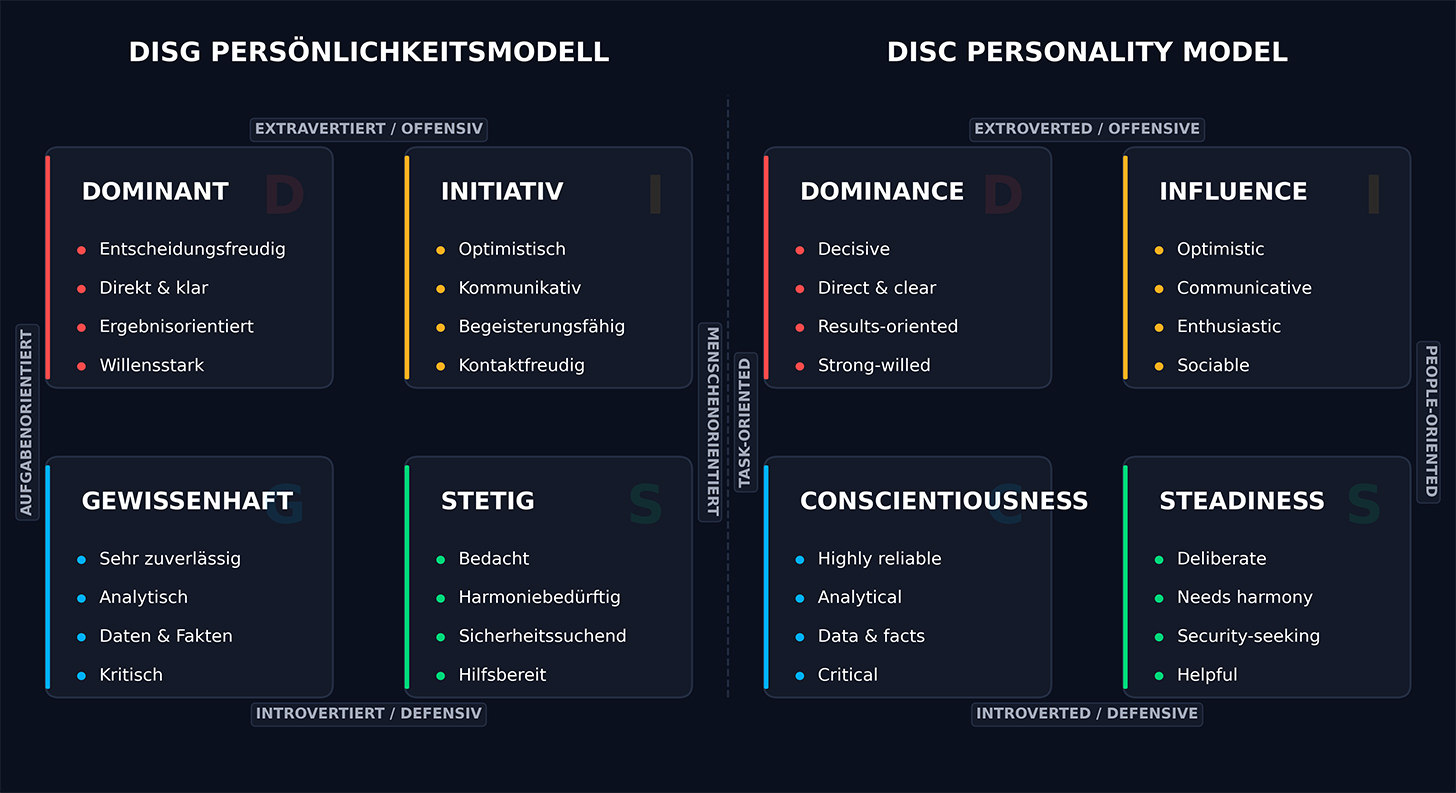
The DISC model as an analysis tool in detail – Image: Xpert.Digital
DISC Profile Analysis: Merz Cabinet – Five Leaders Compared
| Analysis criterion | Friedrich Merz (D/G) | Alexander Dobrindt (D/I) | Bärbel Bas (S/I) | Katherina Reiche (D/G) | Dorothee Bär (I/D) |
|---|---|---|---|---|---|
| DISG profile | Primarily dominant with a strong conscientious lower limit: control orientation, strictness of rules, focus on results – power as an end in itself | Primarily dominant with an initiative overlay: provocative mobilization combined with tactical coalition instinct | Primarily steady with an initiative-oriented secondary profile: consensus orientation, institutional reliability, social empathy | Primarily dominant with a conscientious foundation: an analytical, pragmatic politician with a strong will to reform | Primarily proactive with a dominant secondary profile: enthusiasm, visibility, passion for the topic – the stage as a force field |
| Core strength | Power structuring; clear assessment of the situation; disciplining of the party and government | Building coalition bridges; political agenda-setting; tactical flexibility under pressure | Institutional trust; employee-centric authenticity; consensus facilitation | Expertise in energy/economics; speed of decision-making; implementation of reforms in the face of resistance | Digital communication; enthusiasm for the topic; networking across party lines |
| Leadership style | Leading through demands and control – punctual, demanding, no tolerance for errors | Leading through tactical staging – provocation as a tool, coalition as bargaining chips | Leadership through inclusion and reliability – participation before decision-making, origin as legitimacy | Leading through facts and speed – clear statements, tight deadlines, little complacency in the ministry | Leading through enthusiasm and visibility – prioritizing vision, inspiring rather than commanding |
| Dealing with pressure | Hardens and escalates rhetorically; seeks offensive confrontation; pressure breeds stubbornness instead of adaptation | Moderates internally, escalates externally; adapts communication style to the situation; uses crisis as an opportunity for self-promotion | Stabilized; seeks institutional frameworks; retreats into procedures; rarely impulsive | Increases the pace; deliberately accepts conflicts; signals intransigence as a strength | Communicates assertively and emotionally; relies on publicity as a pressure release valve; social media savvy even in times of crisis |
| communication | Precise, coldly efficient, hardly any pathos; tone of a corporate leader; rhetoric of contrast (order vs. chaos) | Sharp, confrontational, and effective in populism; switched to de-escalation in the ministerial office – a break in style is evident | Down-to-earth, authentic, employee-oriented; speaks directly to different social groups; high credibility due to biography | Unadorned, direct, fact-based; hardly any slogan politics; targeted provocation as an agenda-setting tool | Warm, enthusiastic, visually rich; social media as the primary channel; low-threshold and accessible |
| Historical Heritage | First CDU chancellor after Merkel – historic; 84% dissatisfaction after just one year; CDU behind AfD in polls for the first time; ambivalent legacy | Saved the grand coalition negotiations as a bridge-builder; at the same time: Interior Minister's migration policy is a breaking point | First woman after Angela Merkel in the second-highest state office in terms of protocol (President of the Bundestag); rise from works council work as a social signal | First female Federal Minister of Economics in the history of the Federal Republic of Germany; the "shadow chancellor" label shapes the self-perception of conservatives | First dedicated Federal Government Commissioner for Digitalisation 2018–2021; now Minister of Research – continuity in tech issues |
| Greatest weakness | Empathy deficit; voters treated as subordinates; coalition pressure forces U-turns – credibility suffers structurally | Credibility gap: Change of style appears calculated; former populism clings to him; nervousness within the coalition is growing | Weakness in implementing structural reforms; consensus-seeking style slows down reform; can appear indecisive | Internal unrest due to demanding style; impatience destabilizes employees; statements violating the coalition agreement risk loss of trust | The depth of substance often remains hidden behind the visibility; visions lack an operational implementation structure; enthusiasm is no substitute for concrete results |
| What we learn | Authority without empathy creates resistance – a sense of power requires emotional connection to be effective in the long term | Tactical flexibility is only valuable when flanked by stable values – stylistic calculation without a credibility anchor erodes | Institutional background trumps abstract programming – those who know the lived reality of their target group communicate authentically | Speed is a leadership virtue – but only if the team keeps pace; a pace of reform without the ability to bring people along isolates | Enthusiasm opens doors, but not a ministry – I-types need strong operational structures that translate their visions into results |
| Ideal complement | What's needed is an I/S combination: communicators who can emotionalize Merz's messages and soften his coldness with social warmth | G-type needs: a structured fact-checker who can underpin Dobrindt's impulses with depth and consistency | D-type needs: a clear decision-maker who sharpens Bas's tendency towards consensus with a reform profile and pace | Needs S-type: a calm moderator who can moderate Reich's pace in the ministry and coalition and engage staff | The G/S combination needs: a conscientious structural engineer and a consistent operational specialist who implements Bär's visions and ensures commitment |
Methodological note: The DISC classifications are based exclusively on publicly documented behavior, communication patterns, biographical information, and observed decision-making situations. They are analytical hypotheses in line with the behavior-descriptive DISC theory according to Marston/Geier – not clinical diagnoses. Primary characteristics are listed first, secondary characteristics second. Cabinet data refers to the status of the Federal Government as of May 2025.
Democracy as a communication task: Structural reforms that no one is debating
The problems discussed here – incomprehensible election manifestos, systematic credibility gaps, declining trust in institutions, and a lack of psychological framework for political action – are not natural laws. They are the result of historically developed practices that could be changed with political will.
Several approaches are obvious: Parties could be required, or at least incentivized, to publish a citizen's version alongside their formal election manifesto. This version would be formulated at the level of an online voting advice application (e.g., a "Wahl-O-Mat") and make the actual content of the program accessible. The University of Hohenheim could collaborate with the Federal Agency for Civic Education (bpb) to establish a publicly visible comprehensibility score as a seal of approval – similar to the Nutri-Score on food products. Those who truly take the public seriously communicate clearly.
The problem of coalition arithmetic is more complicated. In a political system where absolute majorities are the exception, election manifestos must always be read with the caveat: "provided the coalition maths allow it." The fact that this caveat is never explicitly stated is a shortcoming of the democratic principle of honesty. One possibility would be to address so-called coalition traffic light systems more publicly—that is, transparent advance communication about which election promises are feasible under which government constellations and which are not. Other countries, particularly in the Anglo-Saxon world, have more developed cultures of the "costed manifesto"—that is, election manifesto commitments that are backed up by budgetary considerations.
The DISC model, as a media analysis tool, derives its appeal precisely from its accessibility. It requires neither legislation nor institutional reform – it simply demands journalistic curiosity and a willingness to engage in in-depth psychological analysis beyond the realm of event-driven journalism. The Wahl-O-Mat (election compass) has demonstrated how digital tools can transform the democratic information infrastructure: from 2002 to the present day, some 160 million uses show that the need exists. What is lacking is an equally consistently citizen-oriented approach in reporting on political actors themselves.
Trust is not a given, but a political achievement
The structural credibility problem of German democracy is multifaceted. It does not arise from the ill will of individual politicians, but from the interplay of several systemic factors: election manifestos that exclude citizens through their language; promises that are structurally impossible to fulfill under the conditions of coalition democracy, but are never explicitly labeled as such; institutional trust that is measurably eroding – according to the Körber Foundation, only 19 percent of Germans trust the federal government; and a public discourse that primarily frames political action as moral failure or success, instead of understanding it within its systemic and psychological contexts.
The answer to this syndrome lies not in cynicism, but in a mature democratic communication culture. This requires more understandable party communication, more honest signaling of coalition dependencies, and journalism that combines psychological depth with structural analysis. The DISC model is not a panacea, but a useful tool among others—one that can help systematically narrow the gap between political action and public understanding. Democracy is always also a communication task. Those who do not take this task seriously should not be surprised by declining trust.





